The Women’s Tour Down Under One Day Race enters a new chapter in 2026, continuing its evolution as a standalone feature of the South Australian WorldTour week. Known last season as the Schwalbe Women’s One Day Classic, the race now sits more clearly within the Tour Down Under identity, while retaining its role as a sharp, high-speed contest designed to reward the strongest sprinters in the peloton.
Although 2026 marks just its second appearance as a UCI ProSeries event, the race itself is not entirely new. Editions were held in 2023 and 2024 outside the UCI calendar (won by Nienke Veenhoven & Ally Wollaston), before stepping up in status in 2025. That promotion reflected growing confidence in women’s one-day racing in Australia and a desire to provide additional UCI points and opportunities alongside the established stage race.
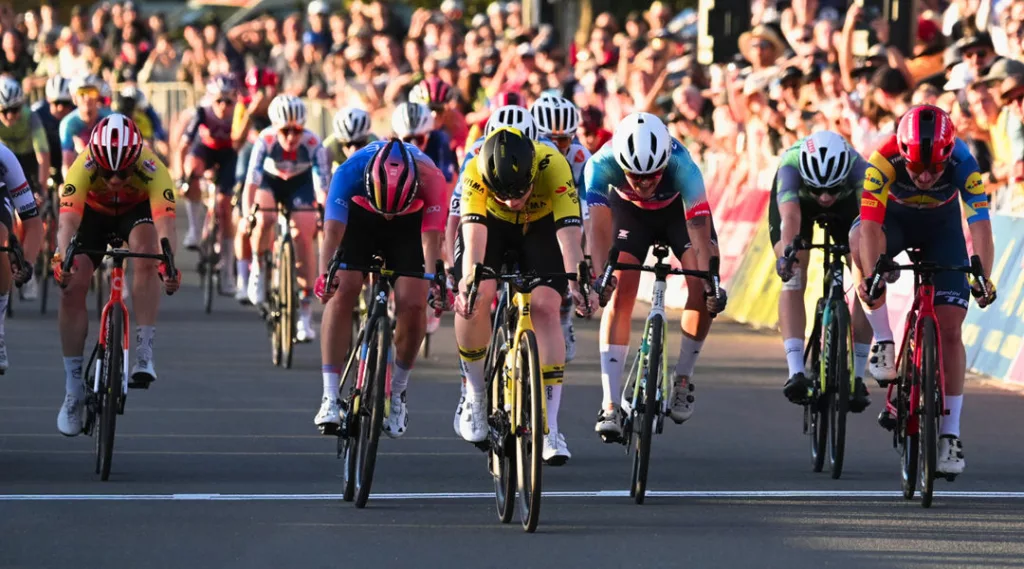
The inaugural UCI edition in 2025 delivered exactly the kind of finish the organisers envisaged, with a full sprint deciding the outcome in Tanunda. Clara Copponi emerged victorious after a controlled and tactical race, underlining the importance of lead-out organisation and positioning on a circuit where terrain offers little opportunity to break the peloton apart.
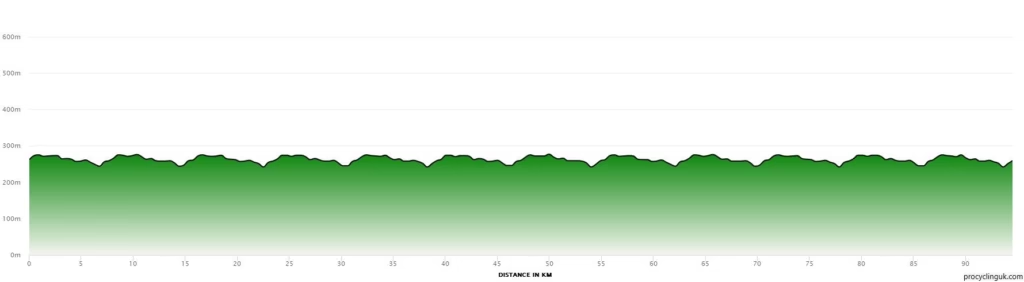
The 2026 edition once again heads to the Barossa Valley, with the race built around 12 laps of an 8.5-kilometre circuit starting and finishing on Murray Street in Tanunda. Riders head north-east out of town along Basedow Road before turning onto Thiele Road and Bethany Road, looping back via Barossa Valley Way. The repeated nature of the circuit places a premium on timing and patience, with teams spending most of the day preparing for a decisive final sprint on Tanunda’s main street.
Previous Winners
2025
Clara Copponi
2024
Nienke Veenhoven
2023
Ally Wollaston
2026 Women’s Tour Down Under One Day Race profile
2026 Women’s Tour Down Under One Day Race live TV coverage
Race Date: Wednesday 21st January 2026
United Kingdom
Live on Discovery+, Max and TNT Sports
- Race coverage: approx. 05:00–08:00 GMT
International broadcasters
In Europe, coverage is available via Discovery+ and Max, following the same early-morning GMT window. In the United States, the race is shown live on FloBikes. In Australia, live domestic coverage is available on Seven and 7plus throughout the afternoon local time.
2026 Women’s Tour Down Under One Day Race startlist

2026 Women’s Tour Down Under One Day Race Contenders
EF Education-Oatly do not arrive with an obvious pure sprinter on paper, but Noemi Rüegg has immediately made herself relevant to any sprint scenario here. She was 4th on stage 1 and then upgraded that to 2nd on stage 2, which is exactly the kind of repeatable top-end finish that signals both form and positioning confidence. The bigger intrigue remains Magdeleine Vallieres, because momentum often shows early in season openers, even when the finale is not built around a single dedicated lead-out. If the finish gets messy, with split groups and late accelerations disrupting the usual trains, Alice Towers is still the rider who could profit from a well-timed move rather than waiting for a straight drag race to the line.
A fast finish suits AG Insurance-Soudal Team in a cleaner way, because Alexandra Manly is already showing she can contest the sharp end of these finishes, taking 7th on stage 2. That result matters because it came in a sprint where the front was crowded and the positioning fight was real, which is often the difference between a good sprinter and a useful sprinter. The rest of the squad leans toward shaping the lead-in rather than being alternative winners, yet Nicole Steigenga has also been present when it matters, taking 14th on stage 1, and she remains a credible late attacker if the peloton hesitates and sprint teams refuse to fully commit until it is too late.
Even on a flat day, Canyon SRAM can matter because they have riders who can win in more than one way. Chloé Dygert is the obvious headline name, not as a conventional sprinter but as a rider who can make the final hour brutally hard and then still produce a finish, as her 12th place on stage 1 underlines in a pure bunch arrival. If the sprint is more traditional, Soraya Paladin remains the more natural finisher, particularly if she can survive the late positioning fight and still deliver a clean effort after a fast day. Tiffany Cromwell is the rider who can keep the race unpredictable, either by forcing breaks to stick or by backing a late move when sprint teams start looking at each other rather than committing fully.
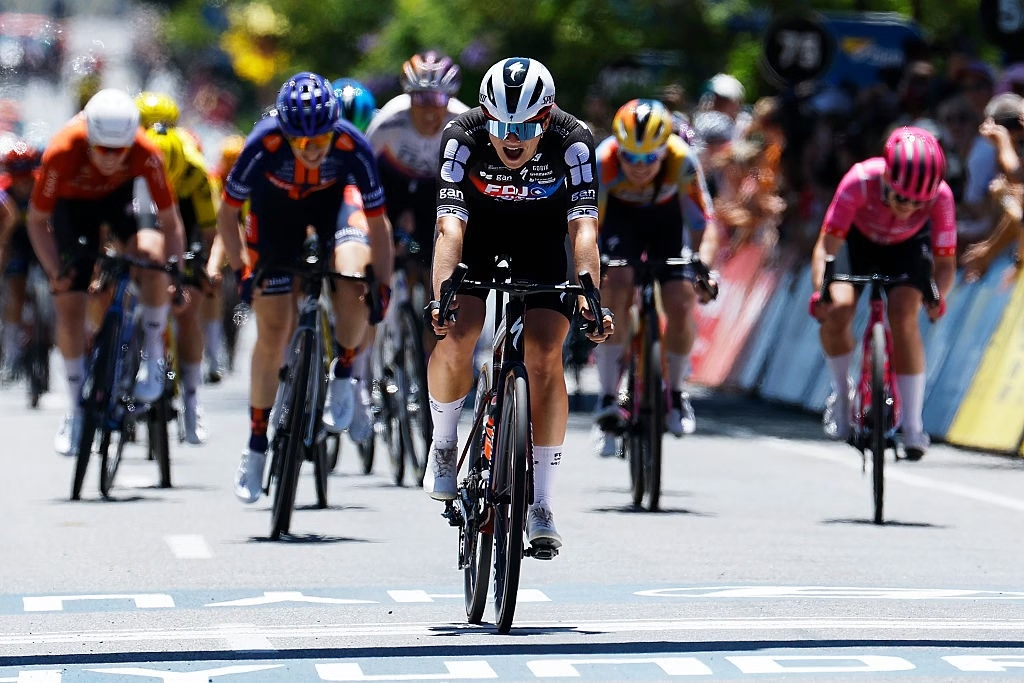
The most straightforward sprint team on the list is FDJ United-SUEZ, because Ally Wollaston has already delivered the clearest possible evidence of form. Winning stage 1 and then backing it up with another victory on stage 2 is not just speed, it is repeatability under pressure, and it confirms that she can handle slightly reduced, chaotic sprints where the lead-out is imperfect and the final kilometre becomes more about instinct than structure. Sofia Bertizzolo adds depth as a rider who can deliver in a fast finish if Wollaston is boxed in or forced to brake, while Marie Le Net is a useful hybrid, capable of racing aggressively late and still finishing strongly if the sprint comes from a smaller group. Amber Kraak remains the most obvious rider to test whether the sprinters’ teams are truly committed to bringing everything back if the bunch starts to stall in the final kilometres.
Fenix-Premier Tech have a clear play on a flat day because Fien Van Eynde has already shown she is repeatedly arriving in the right place at the right time, with 7th on stage 1 and 9th on stage 2. That consistency is often the clearest signal of early-season sprint form, because it is as much about sharpness and decision-making as it is about peak watts. Julie De Wilde is still the finisher who becomes more dangerous when the sprint is chaotic, and Lotte Claes is another rider who can feature if the sprint is messy or slightly reduced, giving the team options without needing to commit to a full lead-out from a long way out.
Human Powered Health look well suited to this kind of finish, and Nina Buijsman has quietly been one of the most consistent finishers in the race so far, taking 13th on stage 1 and then 8th on stage 2. Those are not headline results, but they are the kind of repeated top-10 proximity that often precedes a bigger finish when timing and wheels finally line up. The key extra layer is Maggie Coles-Lyster, because a flat sprint finish is exactly the environment where her speed and positioning can translate directly into a result if the lead-outs are not perfectly organised and the sprint becomes a long, drawn-out drag race. If the sprint is fully controlled, the team’s most realistic route is still the bunch finish, but they also have the capacity to complicate the day with late pressure if the sprint teams start to lose discipline.

A home sprint line-up makes Liv AlUla Jayco one of the most dangerous teams in a sprint finish, because Ruby Roseman-Gannon has already turned that potential into a tangible result with 6th on stage 2. That matters because it shows she is not just fast, she is already dialled into the timing and chaos of these early-season sprints. With multiple riders capable of contributing to the lead-in, Liv can race with options rather than a single point of failure, and that flexibility becomes even more valuable when the run-in is disorganised and the best wheel is not always the obvious one.
Lidl-Trek have the ability to shape a sprint day even when the primary finishing card is not the one taking the top results early. Amanda Spratt’s 11th on stage 2 is a reminder that she can still arrive in the group and contribute in the sharp end of the day, but her bigger value here is organisational, keeping the team positioned and calm as the finale compresses. If Lidl-Trek choose to commit to controlling the race, they have the depth to do it, and on a day where the sprint finish is inevitable, the teams that manage the final 10 kilometres best often decide who actually gets to sprint cleanly.
Movistar Team are more likely to approach this as a day for opportunism than for controlling a sprint, but Olivia Baril’s 12th on stage 2 suggests she can still convert presence into a result when the sprint is reduced or when the finish is more about holding a high speed to the line than producing one explosive jump. If the sprint trains start watching each other, Movistar are the kind of team that can exploit hesitation, but if the finish is a full-speed drag race, they are more likely to focus on placement and consolidation rather than domination.
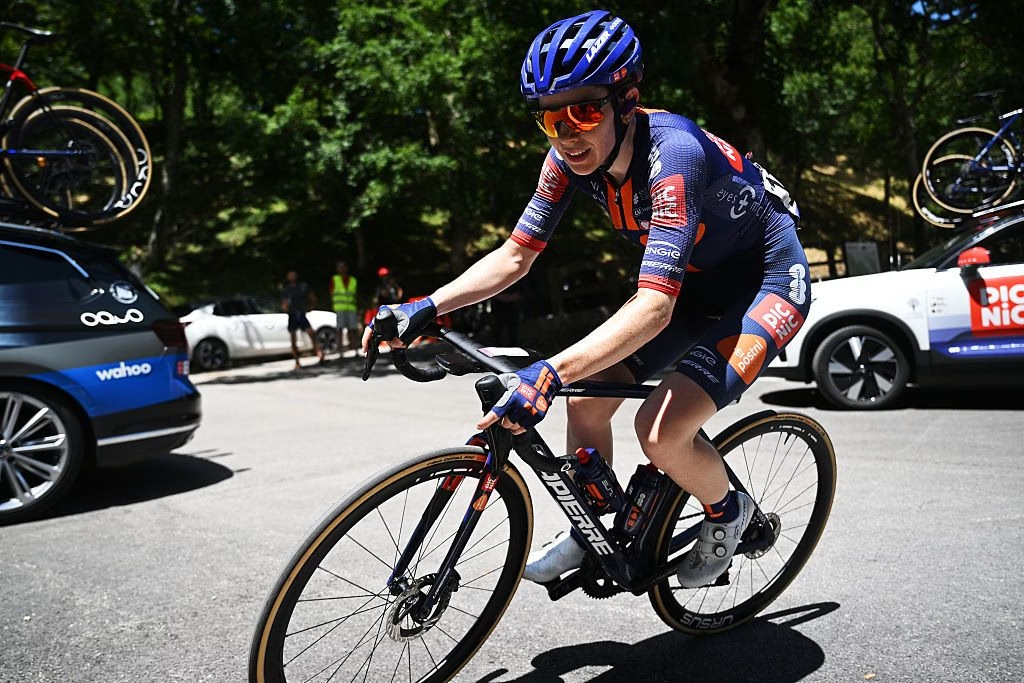 Photo Credit: Getty
If the race is decided by chaos and attrition rather than a perfectly controlled sprint, Team Picnic PostNL have already shown they can be a consistent factor at the front. Josie Nelson’s 2nd on stage 1 and 3rd on stage 2 is arguably the clearest signal in the race that she is reading these finishes well and has the speed to match it. That kind of back-to-back podium consistency is exactly what you want in a sprint-focused finale, because it suggests she is not relying on one perfect scenario, she is repeatedly delivering under different shapes of sprint. If the finish becomes messy again, that ability to find space and commit at the right moment keeps her firmly among the most credible winners.
A sprint day is exactly where Team SD Worx-Protime can look overwhelming, because they can bring both speed and organisation to control the finale. Femke Gerritse has already taken 3rd on stage 1, which immediately positions her as a serious finisher when the sprint is fast and contested, while Marta Lach has been present in both finals, placing 6th on stage 1 and 15th on stage 2. That combination gives them multiple cards to play depending on how the final kilometres unfold, and if the sprint becomes less clean and more instinctive, the team’s ability to hold position through the final corners can be as decisive as the final kick.

Team Visma | Lease a Bike look better placed to race aggressively than to run a full sprint train, but they still have riders who keep appearing in the right part of the sprint picture. Sarah Van Dam’s 5th on stage 1 is a genuine marker of speed and timing, and Margaux Vigié’s 11th the same day reinforces that the team have multiple riders capable of being in the mix when the sprint opens up. On a day where positioning decides who even gets to launch, those repeated top-15 finishes matter, because they show the team are already navigating the chaos well enough to give themselves chances.
UAE Team ADQ have the power to shape the finale, but in a full, clean bunch sprint the focus is far more on Paula Blasi than on their heavier engines. Blasi’s 4th on stage 2 is the clearest indicator that she has both the punch and the composure to contest the sharp end when the sprint opens up, and she also gives UAE the option to race aggressively in the final kilometres rather than simply waiting for a perfect lead-out that may never form. Dominika Wlodarczyk remains another credible finisher in this group after placing 10th on stage 1 and 5th on stage 2, which makes her a genuine challenger if the finale turns into a slightly reduced or disorganised sprint. Mavi Garcia is unlikely to be a winning threat if this is a full drag race to the line, but her 9th on stage 1 and 10th on stage 2 is still a surprisingly strong signal of early-season sharpness, and it matters because it suggests UAE have multiple riders arriving in the right positions even when the finish is moving at full speed.
Top 3 Prediction
⦿ Ally Wollaston
⦿ Femke Gerritse
⦿ Noemi Rüegg