
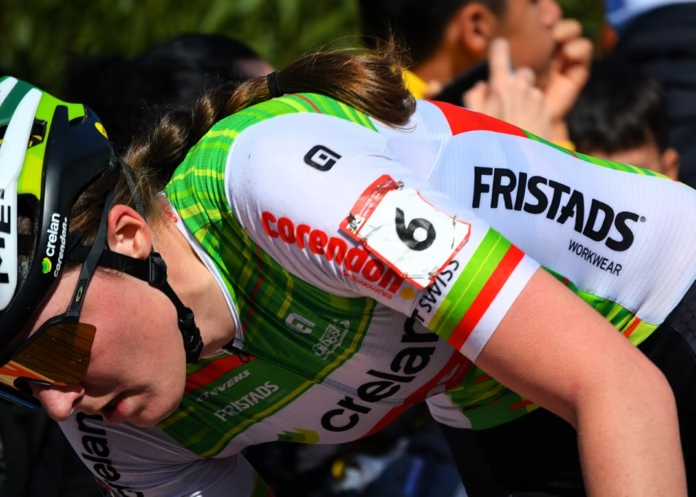
Manon Bakker has spent the last few weeks riding as if nothing is wrong, surfacing repeatedly near the front of World Cup races and turning up on podiums deep into the winter. Behind those results, though, the Crelan-Corendon rider says she has been working through a demanding medical process after doctors identified a problem with the arteries around her groin and pelvis.
On Instagram, Bakker described a long period of feeling restricted, coupled with an unmistakable loss of power in her left leg. What she initially dismissed as the kind of bad day every rider has began to look different once it kept returning, and once the racing context made it impossible to rationalise away.
“Clarity, disappointment, relief and fear,” Bakker wrote, describing the emotions that came with finally having an explanation. She said the issue became undeniable at the European Championships in early November, when she found herself in the group fighting for the podium before suddenly fading hard.
“I had been feeling a limitation and losing power in my left leg for a long time,” she wrote. “Where I first thought I just had a bad day, at the Euros it became clear, this is not normal.”

The moment it stopped feeling like ordinary ‘bad legs’
Bakker’s account is striking because it is familiar, in the way endurance athletes often normalise warning signs, and because it captures the precise moment that normalisation breaks.
She said she had often felt like she had ‘bad’ legs last season too, but that she had filed it away as part of racing. At the European Championships, the contrast between how she was positioned in the race and how quickly she deteriorated forced a rethink.
“After one and a half laps I was completely parked,” she wrote. “Just finishing became really difficult, let alone at a normal pace.”
It was after that race, she said, that the decision was made to investigate her iliac artery. Even then, she admitted she expected the tests to show nothing.
“And as stubborn as I am, I thought, of course, there’s nothing to be found here,” she wrote, adding that after the first consultation she still believed the same. “After the tests I was confronted with the facts. A problem with the groin and pelvic artery.”

A known issue in cyclo-cross, and a difficult set of choices
Bakker’s diagnosis resembles a problem that has affected other elite riders, particularly in disciplines where repeated accelerations under load can place extreme demands on the vascular system. Eli Iserbyt recently announced his retirement because of a similar issue. In her case, the issue was described as similar to what other cyclo-cross riders have faced, and it sits within a broader conversation in the sport about how riders manage symptoms that can be hard to describe, intermittent, and easy to misinterpret until they become severe.
An operation can be a solution in some cases, but Bakker’s post focused more on the uncertainty of the process than on any guarantee of a fix. She summed up the emotional swing bluntly.
“That feeling is super double,” she wrote. “From being happy that something really isn’t right, to the disappointment and fear for the next steps.”
Racing on, with an awareness of what the body might take away
For now, Bakker says she intends to finish the season, acknowledging that the condition will likely continue to shape individual race days. There is an acceptance in her words that the fluctuations are not a matter of form, but of a physical ceiling that can appear without warning.
“For now I will finish the season and try to do each race as well as possible,” she wrote. “There will be bad days too, but it also gives me confidence that they will be a lot less soon.”
That final line is telling. It is not a promise, but a hope grounded in the idea that identifying the issue is the first step towards reducing its impact.
Results that have masked the problem

What makes the revelation more jarring is that Bakker’s winter has looked, on paper, like one of her most consistent in the elite category. She has rarely been outside the top ten and has continued to convert form into visible results even while dealing with the underlying problem.
She was second in Mol behind Ceylin del Carmen Alvarado, and she has also been on the podium in Loenhout and Hofstade, performances that do not align neatly with the idea of an athlete losing power. That tension, racing well while feeling physically compromised, helps explain why it took time for the issue to be treated as more than a rough patch.

