

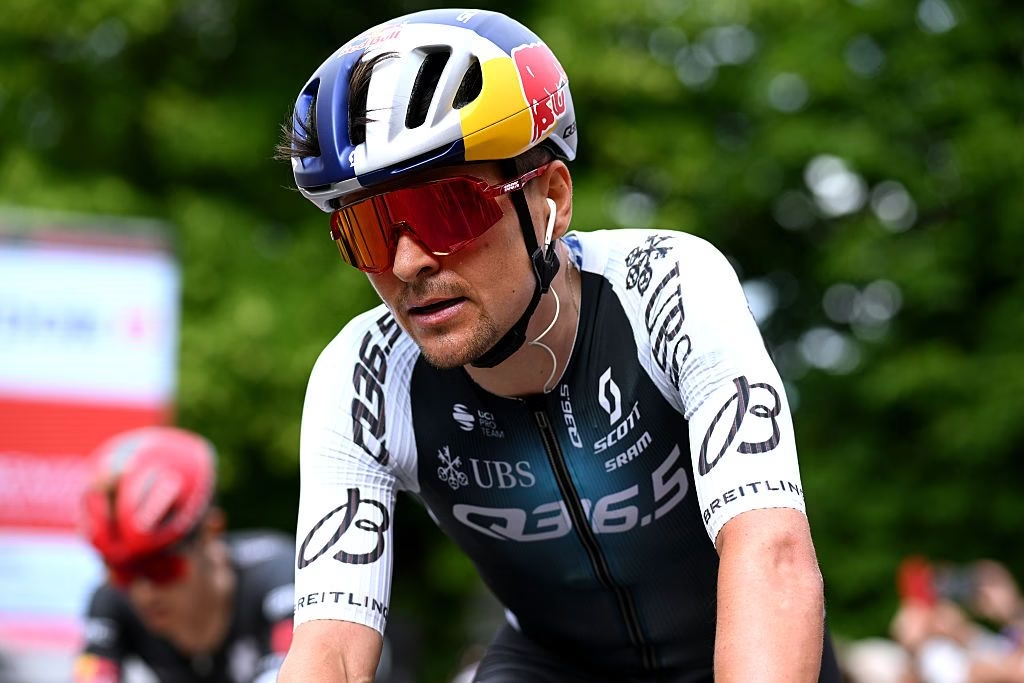
Tom Pidcock will begin his 2026 season in Spain next month, opening a 12-race spring programme that runs from early February stage racing through to the Ardennes, where Liège-Bastogne-Liège has been set as his primary target.
The 26-year-old, now entering his second season with Pinarello Q36.5, will race three times in Spain before heading north for Opening Weekend, using a familiar structure but with a few new elements designed to refresh the build-up and create space for training blocks between objectives.
“My schedule stays quite similar to previous years,” Pidcock said in a team press release. “But adding in some new races to keep things fresh. But also to give time to training blocks and periodisation to make sure I am ready for the races that matter most.”
A Spanish start, then Opening Weekend
Pidcock’s first race days of the year come at the Vuelta Ciclista a la Región de Murcia, which will run as a two-stage event for the first time since 2020. From there, he moves straight into the growing cluster of gravel-influenced Spanish one-day racing with Clásica Jaén, a race he has never ridden.
Jaén is still a young event, but it has already established a clear identity, part road race, part test of positioning and control on loose sectors. Pidcock has often spoken about keeping early-season racing varied, and this is a good example of that, a day where the sharpness needed for the classics arrives earlier than it does in a straightforward bunch sprint.
He then returns to the Vuelta a Andalucía Ruta Ciclista Del Sol, a race he rode last year, taking stage two and finishing third overall, before travelling to Belgium for Omloop Het Nieuwsblad on Opening Weekend. Omloop has not yet yielded a breakthrough result for him, his best is fifth from five appearances, but it remains a key marker of where he sits relative to the riders who build their season around the cobbled programme.
Italy in March, with Strade as the first major test
After Omloop, the focus shifts to Italy and a trio of races that shape the centre of his spring ambitions.
He returns to Strade Bianche on March 7th, a race that has consistently suited him. He won in 2023 and finished second last year, and it remains one of the clearest indicators of his ability to decide a race on terrain that rewards both punch and technical confidence.
From there, Pidcock adds Milano-Torino on March 18th, a new race for him, before lining up at Milan-San Remo on March 21st, his fifth start at the Monument. San Remo remains the outlier on his schedule, a race where he has been present but not yet decisive, his best result is 11th. Even so, it is a race he keeps returning to, partly because it demands patience and positioning, and partly because it offers a rare chance for a rider with his acceleration to flip the script if the race becomes selective on the Poggio.
Catalunya for stage race sharpness, then straight into the Ardennes
Pidcock then turns to stage racing again at the Volta a Catalunya from March 23rd to March 29th, a race he has not ridden before. It is a choice that fits a rider trying to hold form across different demands, a week of repeated climbing and tactical days that can sharpen both endurance and decision-making ahead of April’s one-day sequence.
Rather than staying in stage races beyond Catalunya, the programme pivots hard towards the hilly classics, where Pidcock’s record already suggests he can win and influence the biggest races.
He returns to Brabantse Pijl on April 17th, a race he won in 2021, then to the Amstel Gold Race on April 19th, where he won in 2024. From there it is the Ardennes triple, La Flèche Wallonne on April 22nd, and finally Liège-Bastogne-Liège on April 26th, the race identified as his main spring objective, and one where he has already shown he can finish on the podium.
A different backdrop for Q36.5
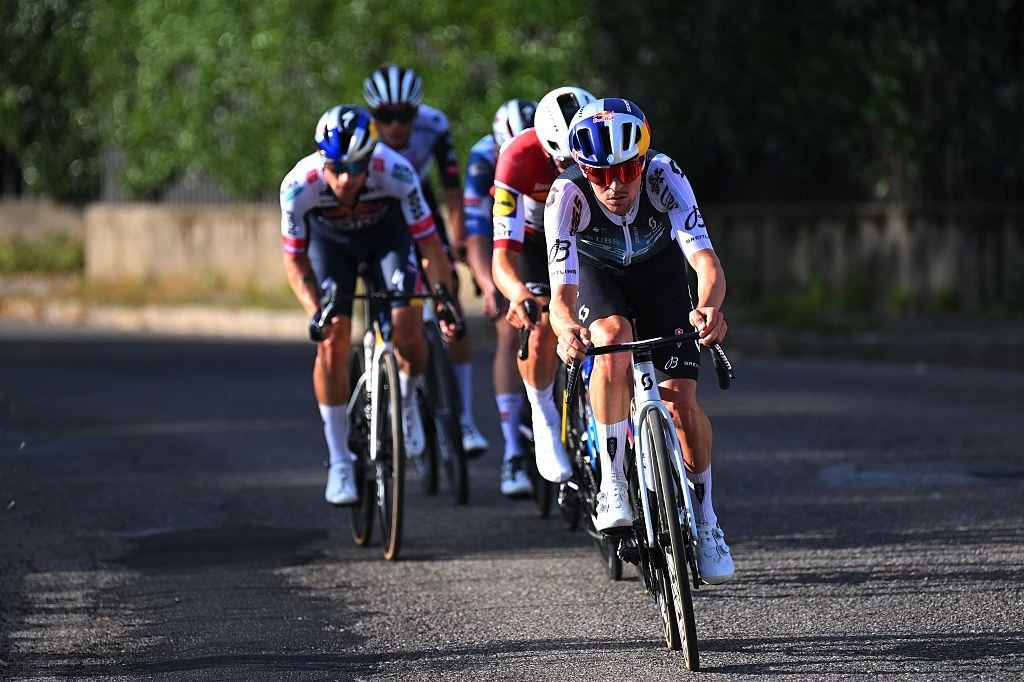
Pidcock’s schedule also sits within a changed context for Pinarello Q36.5. Thanks largely to points he delivered in 2025, the team’s position in the system has strengthened, reducing the uncertainty around access to the biggest races. The expectation is that this gives Pidcock and the team a cleaner platform, fewer logistical questions, more time to focus purely on performance planning.
A Tour de France start later in the year has been discussed, but the spring programme itself is structured as a self-contained block. It is built to let Pidcock race often enough to be sharp, but not so often that he arrives at the Ardennes without the freshness needed to make Liège more than a target on paper.
Tom Pidcock’s spring schedule
- February 13th-14th: Vuelta Ciclista a la Región de Murcia
- February 16th: Clásica Jaén
- February 18th-22nd: Vuelta a Andalucía Ruta Ciclista Del Sol
- February 28th: Omloop Het Nieuwsblad
- March 7th: Strade Bianche
- March 18th: Milano-Torino
- March 21st: Milan-San Remo
- March 23rd-29th: Volta a Catalunya
- April 17th: Brabantse Pijl
- April 19th: Amstel Gold Race
- April 22nd: La Flèche Wallonne
- April 26th: Liège-Bastogne-Liège

