
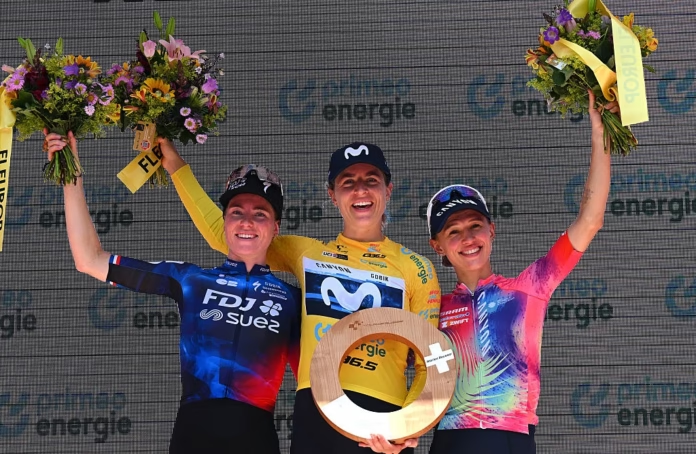
The Tour de Suisse Women 2026 takes place from Wednesday, 17th June to Sunday, 21st June, with a five-stage route that gives the race its most balanced and ambitious modern shape yet. For the first time, the women’s and men’s races use largely parallel route designs, creating a shared Swiss race week built around similar host towns, comparable terrain and a clear final-day climbing showdown.
This is not a route with an easy opening and a delayed GC battle. The race begins in Sondrio with a technical hilly stage, moves to Locarno for another punchy day, shifts to Bad Ragaz for a flatter but still tactical road stage, then gives the time triallists their moment in Aarburg before the queen stage in Villars-sur-Ollon. Across five days, the route asks for almost everything: positioning, climbing, descending, time trialling and recovery.
The final stage should decide the race if the gaps are still close. Villars-sur-Ollon brings the heaviest climbing of the week, with around 2,795 metres of elevation gain packed into just over 100km. That makes the 2026 Tour de Suisse Women a race for complete stage racers rather than riders who can win only one type of day.
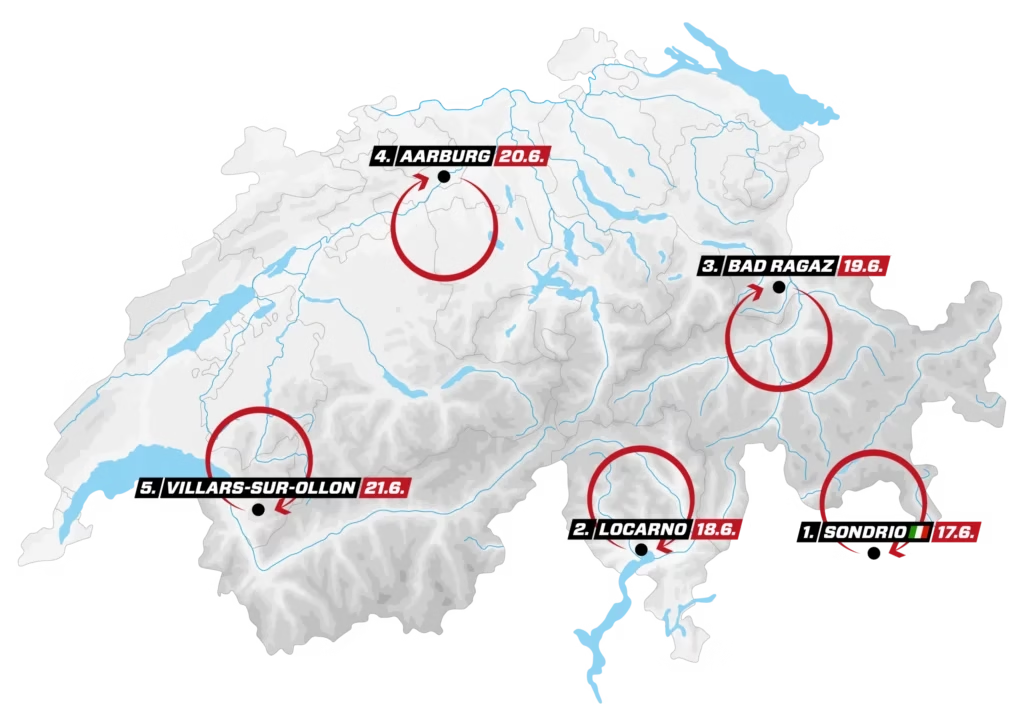
Tour de Suisse Women 2026 route overview
The race is made up of five stages:
- Stage 1, Wednesday, 17th June: Sondrio to Sondrio, 109.3km
- Stage 2, Thursday, 18th June: Locarno to Locarno, 105.3km
- Stage 3, Friday, 19th June: Bad Ragaz to Bad Ragaz, 120.3km
- Stage 4, Saturday, 20th June: Aarburg to Aarburg, 23.8km individual time trial
- Stage 5, Sunday, 21st June: Villars-sur-Ollon to Villars-sur-Ollon, 100.3km
The structure is clean but demanding. Stages 1 and 2 are hilly enough to prevent a slow start, stage 3 is the most sprint-friendly day, stage 4 is a meaningful time trial, and stage 5 is the mountain stage that should settle the general classification.
The race has no obvious dead day. Even the flatter stage around Bad Ragaz still carries enough terrain and positioning stress to matter, while the 23.8km time trial in Aarburg is long enough to create real gaps before the final mountain stage.

Stage 1: Sondrio to Sondrio, 109.3km
The race begins in Sondrio, on a hilly circuit that should immediately make the peloton alert. At 109.3km with 1,642 metres of climbing, this is not an opening stage designed simply to hand the first leader’s jersey to a pure sprinter.
The setting also gives the stage a very specific character. Sondrio sits in northern Italy, close to roads that naturally invite comparison with Lombardy-style racing: technical, rolling, constantly changing and difficult to control if attacks begin to come in waves. That matters because the first stage of a five-day race can shape the entire tactical mood.
The main GC riders will not want to lose time here, but the stage may be more tempting for puncheurs, attacking all-rounders and riders with a sharp finish from a reduced group. A full bunch sprint is possible only if the race is controlled carefully, but the amount of climbing makes a smaller front group more likely.
Teams with several strong climbers or Classics-style riders can use this day to test the race early. It may not produce huge GC gaps, but it can expose riders who are not ready for repeated changes of rhythm.

Stage 2: Locarno to Locarno, 105.3km
Stage 2 stays compact at 105.3km, but with 1,242 metres of elevation gain it is another day where the profile should favour aggressive racing over simple control. Based around Locarno and the Lago Maggiore region, the stage should bring punchy terrain, fast roads and enough climbing to keep the GC contenders attentive.
This is the sort of stage where the outcome may depend on how the teams interpret the race after stage 1. If the opening day has already created gaps, the leader’s team may try to manage the stage conservatively. If the race is still tight, stage 2 gives rivals a chance to apply pressure before the time trial and the final mountain stage.
The terrain should suit riders who can climb repeatedly but still sprint from a reduced group. It may also be one of the better chances for a breakaway if the strongest teams are reluctant to spend too much energy early in the race.
Locarno’s position gives the stage a different feel from Sondrio. The race moves from an Italian start into Swiss territory, and the roads around Lago Maggiore can make positioning important even when the gradients are not extreme. A rider who loses concentration here could pay for it quickly.

Stage 3: Bad Ragaz to Bad Ragaz, 120.3km
Stage 3 is listed as the flattest stage of the 2026 Tour de Suisse Women, but that should not be confused with an easy day. The 120.3km route around Bad Ragaz still includes 1,330 metres of elevation gain, which means the sprinters will need to earn their opportunity rather than simply wait for the final kilometre.
This is likely to be the best chance for the faster riders, especially if the opening two stages have been selective. A team with a strong sprinter who can survive rolling roads will see this as a key target. The challenge will be keeping enough control through the middle of the race and arriving in the final kilometres with a lead-out still organised.
For the GC riders, the priority should be safety. Stage 3 comes before the time trial and the queen stage, so no overall contender will want to waste energy unnecessarily. But flatter stages can be dangerous in a short stage race. Positioning, road furniture, wind and late tension can all create gaps if teams are careless.
If the sprinters are going to have their day, this is probably it. If they miss it, the route does not offer many obvious second chances.

Stage 4: Aarburg to Aarburg, 23.8km individual time trial
Stage 4 is the race’s major structural turning point. A 23.8km individual time trial around Aarburg is long enough to reshape the general classification, especially in a five-day race where the road stages may have created only small gaps.
The course has 270 metres of elevation gain and is described as fast and technical. That combination should reward riders who can hold power but still manage corners, pacing changes and road rhythm. It is not a pure mountain time trial, but it is also not just a flat drag-strip for specialists.
This stage will be crucial for the overall contenders. Strong climbers who are weaker against the clock may need to have gained time before Aarburg or be ready to attack hard on the final stage. More complete stage racers can use the time trial to move into control before Villars-sur-Ollon.
The distance is important. At just under 24km, the time trial is long enough for real damage. A poor ride could cost more than a minute. A strong ride could put a rider into yellow with one stage left. It also changes how the final mountain stage is raced, because riders who lose time here will have no choice but to attack on Sunday.
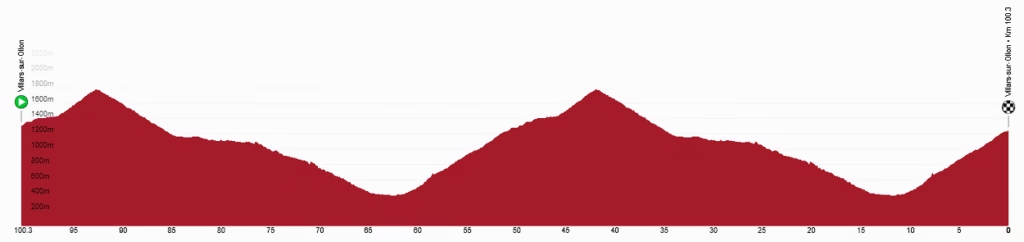
Stage 5: Villars-sur-Ollon to Villars-sur-Ollon, 100.3km
The final stage is the queen stage, and it is designed to settle the race. Villars-sur-Ollon to Villars-sur-Ollon is only 100.3km, but it includes 2,795 metres of climbing, making it by far the hardest day of the 2026 route.
This is where the Tour de Suisse Women should become a pure GC contest. The stage is short, climbing-heavy and unlikely to allow much time for recovery. The route is expected to be relentless, with little flat road and constant pressure either uphill or downhill.
That matters after the time trial. If the GC is close, the final stage gives climbers a chance to overturn the standings. If a stronger time triallist has taken the lead in Aarburg, Villars-sur-Ollon becomes a test of whether they can survive repeated climbing under pressure.
The stage should favour riders who climb well but also descend confidently. In Swiss mountain racing, downhill sections can be just as important as the climbs, especially when the route gives little room to settle. A rider dropped on one climb may not have a long valley to recover. A rider who attacks early may be able to keep pressure on because the terrain never fully eases.
This is also the stage most likely to expose team depth. A leader isolated too early could be vulnerable, particularly if rivals have teammates available to attack or pace on the climbs.
Where will the Tour de Suisse Women 2026 be won?
The race is most likely to be won across stages 4 and 5, but the first two road stages should not be dismissed. Sondrio and Locarno can create early differences, especially through bonus seconds, late splits or reduced-group finishes. In a five-day race, those small margins can still decide the final podium.
The key GC stages are:
- Stage 1, because Sondrio can create immediate pressure
- Stage 4, because the Aarburg time trial can create the largest controlled time gaps
- Stage 5, because Villars-sur-Ollon is the queen stage and final mountain test
The time trial may decide who starts the final day in control. The mountain stage will decide whether that control survives.
That balance makes the race particularly interesting. A pure climber may need to attack hard in Villars-sur-Ollon. A time trial specialist may need to defend uphill. A complete rider who can limit losses on every type of stage will have the clearest route to overall victory.
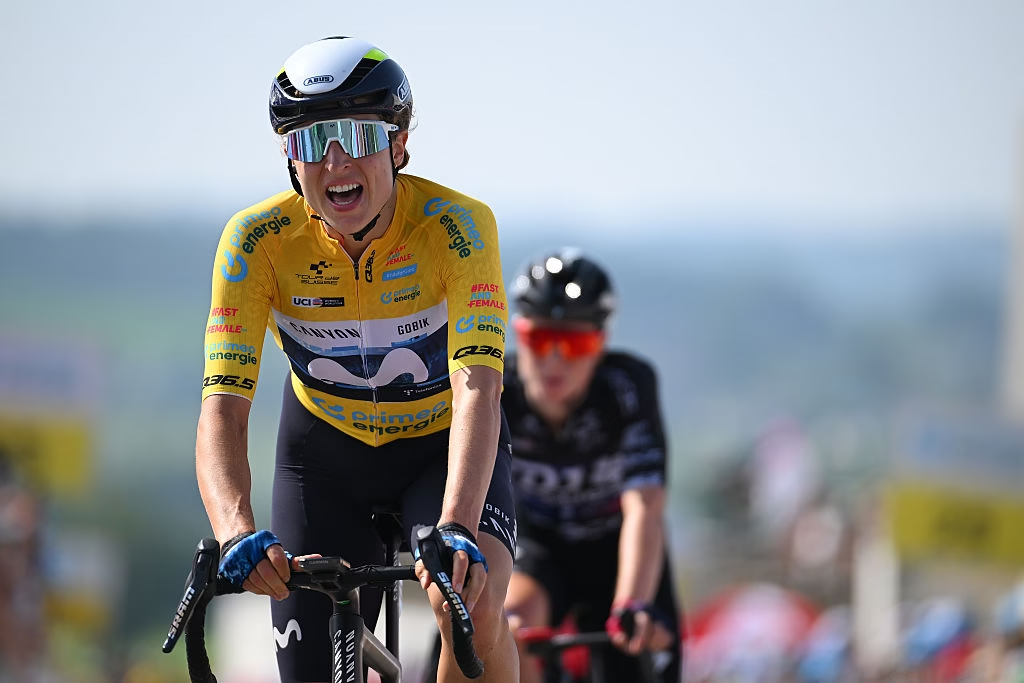
What kind of rider does the route favour?
The 2026 route favours a complete stage racer. Climbing matters, but it is not enough on its own. The winner will need to survive hilly opening stages, avoid mistakes on the flattest day, ride a strong time trial and then back it up on the hardest climbing stage of the race.
That makes the race especially difficult for one-dimensional riders. A pure sprinter may have only one clear opportunity. A pure climber may lose too much time in Aarburg. A time triallist who cannot climb will be exposed in Villars-sur-Ollon. The route rewards balance.
The ideal winner is a rider who can stay calm through the opening two days, produce a top-level time trial on stage 4 and then climb well enough to defend or attack on stage 5. That profile is closer to a Grand Tour contender than a one-day specialist.
Why the parallel route concept matters
The 2026 edition is significant because the Tour de Suisse is presenting the women’s and men’s races with largely parallel route designs. That is more than a symbolic change. It puts the women’s race into the same geographical and sporting framework as the men’s event, with shared host towns and comparable race narratives.
For the women’s race, that helps strengthen identity. It is not simply a shorter event attached to the side of a bigger race. It has its own five-day structure, its own time trial, its own queen stage and its own GC arc, while still being part of a wider Tour de Suisse week.
The route also shows ambition. The women’s race is not being built around one token mountain stage and a string of easier days. It has technical roads, hilly terrain, a meaningful individual time trial and a final mountain stage with nearly 2,800 metres of climbing.
That is exactly the kind of route design women’s stage racing needs more of: compact, demanding and varied, with enough difficulty to reward elite riders without relying only on one summit finish.
-
 Photo Credit: David Magalhães / Unsplash
Why the 2026 route works
The Tour de Suisse Women 2026 route works because it is short but complete. It gives sprinters a chance, but not too many. It gives climbers a decisive final day, but forces them through a time trial first. It gives all-rounders room to shape the race, but does not allow them to coast through any stage.
The opening in Sondrio should stop the race from drifting. Locarno keeps the pressure on. Bad Ragaz gives the faster riders their best opportunity. Aarburg then resets the GC through the time trial before Villars-sur-Ollon provides the final climbing verdict.
That is a strong five-day rhythm. It should produce a winner who has been tested properly across the week, rather than someone who simply dominated one stage and defended on the rest.
For the wider Women’s WorldTour, it also gives the Tour de Suisse Women a clear identity. This is no longer just a useful June race. In 2026, it looks like one of the most complete short stage races of the season, and a meaningful form test after the Giro d’Italia Women and before the Tour de France Femmes.

