
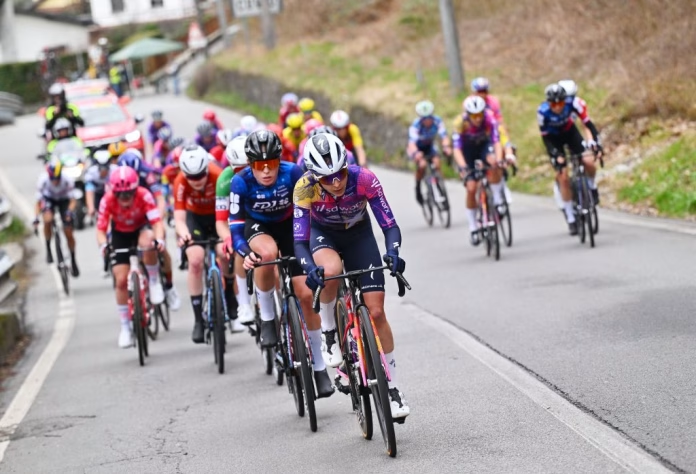
A new Women’s WorldTour cycle was always likely to bring a bedding-in period, but the first weeks of 2026 have exposed a familiar UCI problem: the regulations look clear on paper, while the application on the road appears far more flexible.
In one corner, the UCI has shown it is happy to enforce certain technical changes firmly, quickly, and with little room for interpretation. In another, a headline structural change to Women’s WorldTour eligibility is already being stretched by organiser requests, discretionary approvals, and what teams describe as a grey area that is still not properly explained in one place.
The latest flashpoint is the Trofeo Alfredo Binda on March 15th. Despite the widely understood shift towards a WorldTeam and ProTeam-only start list for Women’s WorldTour events, the Italian one day race has published a 2026 entry that includes five Italian women’s Continental teams.
That follows the 2026 UAE Tour Women, where three women’s Continental teams started, and one rider from that third tier of the sport even ended the week with a race classification.
The question is not whether Continental teams can be valuable in top-tier racing. They often animate the early breakaways, bring national interest, and give developing riders the chance to measure themselves. The question is what the rules now actually say, and what organisers are being told they can do when they want more teams on the line.

What the UCI entry rules say for Women Elite races
The key point is that the UCI does not apply one single entry rule across all women’s races. Eligibility depends on the classification of the event.
Women’s WorldTour events (1.WWT and 2.WWT)
For Women Elite WorldTour races, the entry table lists:
- UCI Women’s WorldTeams (with a stated minimum of 8)
- UCI Women’s ProTeams
- A national team from the organiser’s country, but only with UCI agreement (this is tied to a footnote provision)
The important omission, compared to past years, is that women’s Continental teams are not part of the standard entry categories for 1.WWT and 2.WWT events.
ProSeries and Class 1 races (1.Pro, 2.Pro, 1.1, 2.1)
For 1.Pro and 2.Pro women’s races, the entry table is broader. It includes:
- UCI Women’s WorldTeams (with a stated minimum of 4)
- UCI Women’s ProTeams
- Women’s Continental teams
- Cyclo-cross professional teams
- National teams
For 1.1 and 2.1 races, the rule set still allows women’s Continental teams and even regional and club teams. It also caps the number of Women’s WorldTeams that can enter these Class 1 events (minimum 1, maximum 7), which is a separate mechanism designed to protect lower-tier racing from being overwhelmed by the top flight.
In short, the UCI has tried to draw a hard line at WorldTour level, while keeping the lower tiers as a mixed ecosystem.
 Photo Credit: Getty
The crucial exception that is driving the 2026 debate
The most important piece of the rule set for this discussion is the footnote-style exception.
It states, in effect, that if 30 days before the event the number of confirmed teams is still below the minimum required, and the organiser can demonstrate that all Women’s WorldTeams and Women’s ProTeams have been properly invited, then the UCI may authorise the organiser to invite Continental teams.
The order matters:
- First, Continental teams registered in the organiser’s country
- Then, other Continental teams
This is designed as a backstop for races that risk falling below the minimum start requirement. It is not written as a blanket permission for organisers to invite Continental teams simply because they would like a fuller or more locally relevant field.
That distinction is at the heart of the current confusion.
What has happened so far in 2026
The first wave of Women’s WorldTour start lists has not followed one consistent pattern.
Australia: a cleaner break with the past
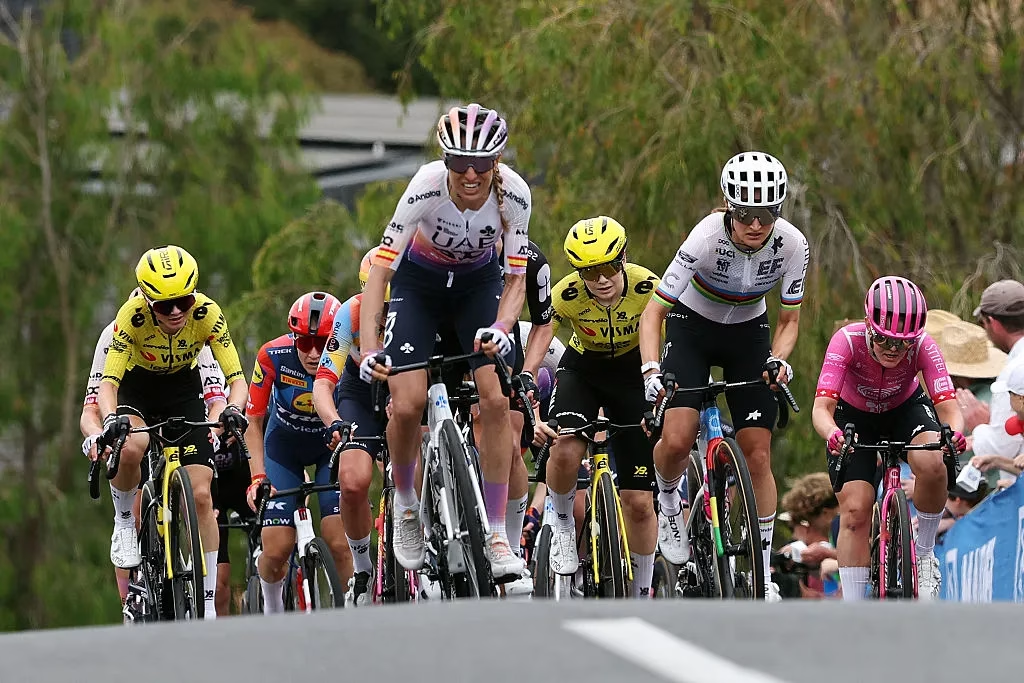
At the early-season WorldTour races in Australia, no women’s Continental teams were present. That is notable because Australian WorldTour rounds have historically been the place where local teams could access the top tier through wildcards, creating a visible pathway between domestic racing and the global level.
The absence of Continental teams suggests at least some organisers are treating 2026 as a strict reset.
 Photo Credit: Sprint Cycling Agency
UAE Tour Women: the first major contradiction
The UAE Tour Women included:
- all fourteen Women’s WorldTeams
- three Women’s ProTeams
- three women’s Continental teams
That is exactly the scenario where the “30 days before” exception looks least relevant, because the start list is already comfortably above any minimum threshold.
The practical effect was obvious. The race had a fuller field, more teams willing to animate the early kilometres, and a clearer development narrative. It also produced the exact headline the UCI was trying to avoid: a third-tier team on the start line of a race that is supposed to be restricted to the top two tiers. A rider from one of the Continental teams would win a jersey too – Sara Luccon of Top Girls Fassa Bortolo winning the intermediate sprints jersey.
Italy: Trofeo Alfredo Binda pushes further
Trofeo Alfredo Binda on March 15th is set to include:
- all fourteen Women’s WorldTeams
- five Women’s ProTeams
- five Italian women’s Continental teams
That takes the race to the maximum possible of 24 teams listed by the organiser.
If the UAE Tour Women looked like an organiser testing the edges, Binda looks like an organiser acting as though Continental invitations are still a normal part of the sport’s landscape, even at WorldTour level.
 Photo Credit: Getty
Comparison table: how the start lists split so far, and what is planned next
The table below only uses dates and team splits that are stated or directly confirmable from the material provided.
| Race | Date in 2026 | Women’s WorldTeams | Women’s ProTeams | Women’s Continental teams | Notes on what makes it relevant |
|---|---|---|---|---|---|
| Tour Down Under Women | January 17th-19th | 14 | 0 | 0 | Highlighted as a WorldTour race with no Continental teams present |
| Cadel Evans Great Ocean Road Race Women | January 31st | 14 | 0 | 0 | Same pattern as Australia’s other WorldTour race |
| UAE Tour Women | February 5th-8th | 14 | 3 | 3 | First 2026 WorldTour race cited as including Continental teams |
| Omloop het Nieuwsblad Women | February 28th | 14 | 6 | 0 | First 2026 WorldTour race for Flanders Classics organisers |
| Strade Bianche Donne | March 7th | Not announced | Not announced | Not announced | RCS race, relevant because UAE Tour Women also sits under RCS organisation |
| Trofeo Alfredo Binda | March 15th | 14 | 5 | 5 | Max-sized field and the clearest test of whether exceptions are becoming routine – independent organiser |
| Milano-Sanremo Donne | March 21st | Not announced | Not announced | Not announced | RCS race, relevant because UAE Tour Women also sits under RCS organisation |
| Ronde van Brugge, Tour of Bruges | March 26th | Not announced | Not announced | Not announced | Golazo race, start list still pending |
| In Flanders Fields – In Wevelgem | March 29th | 14 | 6 | 0 | Published as WorldTeams plus selected ProTeams by Flanders Classics |
| Dwars door Vlaanderen Women | April 1st | 14 | 5 | 0 | Newly promoted to Women’s WorldTour, published as WorldTeams plus selected ProTeams |
| Ronde van Vlaanderen | April 5th | 14 | 6 | 0 | Published as WorldTeams plus selected ProTeams by Flanders Classics |
| Paris-Roubaix Femmes | April 12th | Not announced | Not announced | Not announced | ASO race, start list still pending |
What this table tells us, in plain terms
The UCI’s intent for 2026 was a clean top tier: WorldTeams and ProTeams only at WorldTour level, with Continental teams competing at 1.Pro, 1.1 and below (or the 2. stage races at those levels).
What the early season shows instead is a split reality:
- some organisers are behaving as though the restriction is strict and immediate
- others are behaving as though an organiser request, and a UCI approval process behind the scenes, keeps the door open
This is why the peloton keeps calling it “confusion”. The same ruleset is producing different start list outcomes across different organisers.
Why this matters for British teams and British races later this season
In Britain, the consequences are not abstract. They are existential.
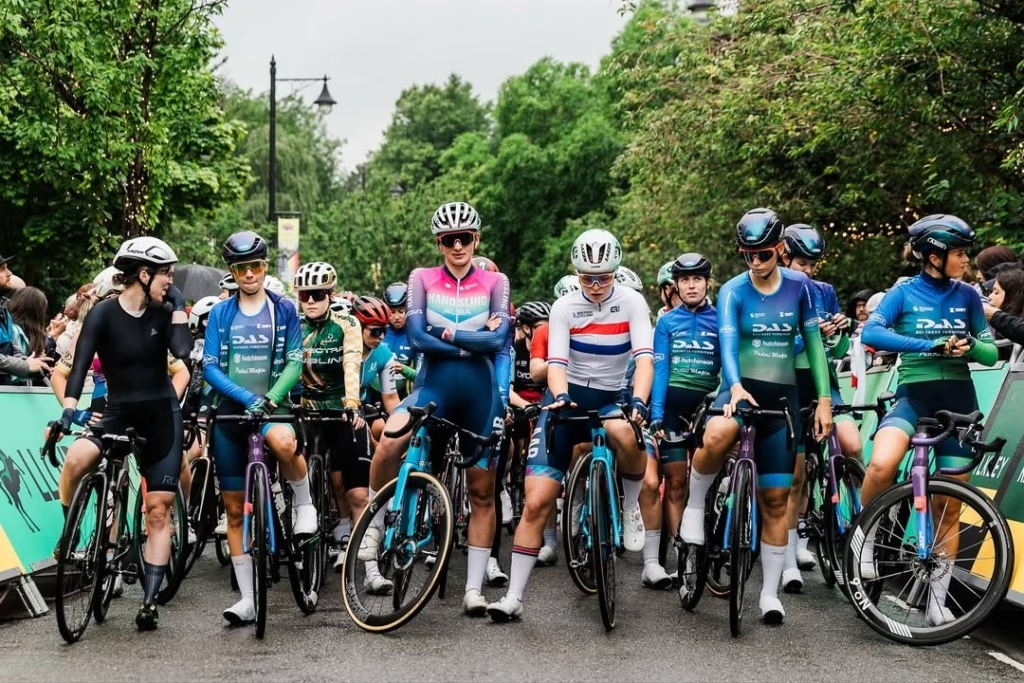
The UK’s women’s UCI teams all sit at the Continental level. If Women’s WorldTour races truly become WorldTeam and ProTeam only, those British teams lose access to the country’s biggest shop window, and with it a major part of the sponsorship argument that keeps their programmes alive.
That is why the apparent flexibility early in 2026 matters. If organisers are able to request Continental teams and receive approval even when the minimum start requirement is already met, then there is at least a small window that British teams might still be invited into the 2026 Tour of Britain Women later this year, despite expecting the door to be shut.
That window is narrow, and it comes with two big caveats:
First, timing. The written exception is tied to the 30-day-before checkpoint. If the UCI is allowing approvals outside that scenario, teams and organisers need that clarified in a way that can be planned around, not discovered after invitations land.
Second, prioritisation. The rule text implies host-country teams should be considered first when the exception is triggered. If that logic is extended more broadly, it strengthens the case for British teams to be included in a British WorldTour race, if any discretion is being applied at all.
The Alba Development project’s stated ambition to build towards ProTeam status and eventually the 2027 Tour de France Femmes hosted in the UK adds another layer here. A system that blocks domestic teams from domestic top-tier racing is a system that makes that ladder harder to climb, not easier.
The domestic teams will be hoping that British Cycling, organisers of the Women’s Tour of Britain, will ignore the ruling and be more like the Italian races rathern than the Belgian ones.
 Photo Credit: Getty
The immediate European picture: Belgium looks strict, Italy looks flexible
The early Belgian WorldTour races have published start lists that read like the UCI rule change was designed to be read:
- all Women’s WorldTeams
- a selection of Women’s ProTeams
- no women’s Continental teams
That is true for the Women’s Omloop het Nieuwsblad, Dwars door Vlaanderen, Gent-Wevelgem, and the Tour of Flanders, based on the ProTeam selections you provided.
Against that backdrop, the Binda start list feels less like a minor exception and more like a direct challenge to the idea that WorldTour participation has been fully professionalised.
 Photo Credit: LaPresse
What to watch next
Three things will decide whether this becomes a genuine policy shift, or just early-season turbulence.
1) Whether the UCI publishes a clearer operational note
Right now, the rules and the reality do not match neatly. Teams need to know if approvals are being granted as a true exception or as a quiet transitional policy.
2) How RCS handles Strade Bianche & Milano-Sanremo Donne
The UAE Tour Women sits under the same organisational umbrella. If Strade Bianche Donne & Milano-Sanremo Donne includes Continental teams, it becomes harder to argue this was a one-off judgment call. RCS will be gauging the fallout from their UAE Tour decision.

3) Whether organisers start citing the “minimum field” exception even when fields are full
If WorldTour races with 20 to 24 teams are still being approved to invite Continental squads, the exception has effectively become a discretionary wildcard system, just without being written that way.
If the UCI wants the Women’s WorldTour to mirror the men’s structure, it will need more than a red-lined entry table. It will need consistent enforcement, and it will need to do that without collapsing the development ladder in markets like Britain, where the domestic base still relies on those rare moments of WorldTour visibility to survive.

