
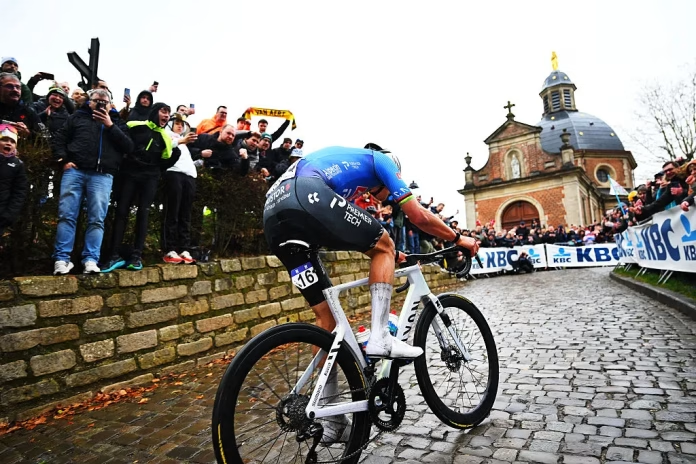
Omloop Nieuwsblad rarely rewards certainty, especially on a day when rain, gusting wind and relentless nervousness turn every cobbled approach into a fight for survival. But Mathieu van der Poel made the 2026 edition feel brutally simple. He survived the one moment that could have ended his race on the Molenberg, joined the move that mattered, then delivered the kind of acceleration on the Muur van Geraardsbergen that immediately removed everyone else from the equation.
“I’m really happy, and so is the team. This wasn’t on our list yet, so I’m really happy with today,” Van der Poel said at the finish, after opening his season with a statement win.
A grim opening, a controlled break, and crashes that kept resetting the race
The early kilometres followed the familiar Omloop pattern, a small breakaway of riders from smaller teams allowed a modest advantage while the favourites stayed attentive behind. It never felt like a day for generosity, though. The weather and the tension made the peloton brittle, and the first half of the race was punctuated by incident after incident, the kind that forces teams to spend energy simply staying upright and in position.
Crashes were threaded through the day and they shaped the race even when the favourites avoided the tarmac. Riders hit the deck, groups were delayed, and the elastic kept snapping and reforming. That constant stop-start stress mattered because it meant the peloton arrived at the decisive zone already depleted and already on edge.
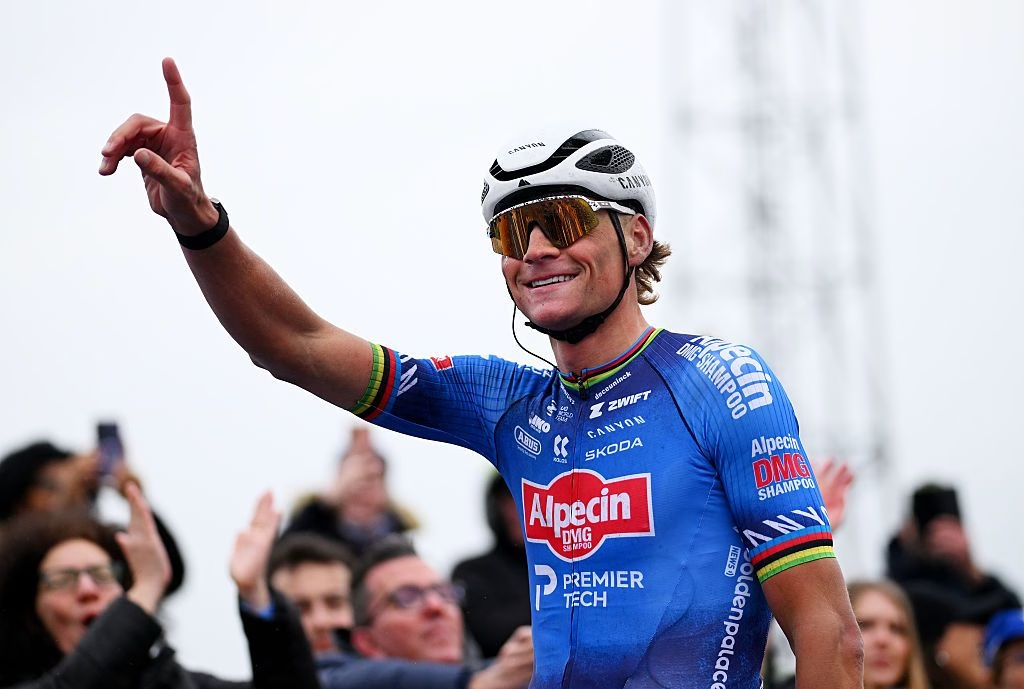 Photo Credit: Getty
The Molenberg moment that nearly ended Van der Poel’s day and created his winning move
The race properly ignited on the Molenberg with around 45 kilometres to go. Florian Vermeersch launched an acceleration that was serious enough to force the strongest riders to respond immediately. Van der Poel did exactly that, but the defining detail was not just the power, it was the split second of bike handling that kept him in the race.
A Tudor rider crashed directly in front of him on the slick cobbles. Van der Poel had no clean line around, yet somehow stayed upright, unclipped and half stepped over the fallen rider in one motion, then clipped back in and sprinted across the top to Vermeersch.
“How I stayed upright on the Molenberg? I don’t know myself. I couldn’t really avoid that Tudor rider, so I half ran over him with one foot out of my pedal. I hope I didn’t hurt him too much,” he said. “When I came up with Florian, we had a serious gap, so I think that was the moment of the race.”
Tim van Dijke bridged across on the descent, and suddenly Omloop had the move it needed: three riders with enough horsepower to build a lead, and enough class to keep it when the race behind started to stutter.
A three rider alliance becomes the front of the race as the chase fails to settle
Once clear, Van der Poel, Vermeersch and Van Dijke worked smoothly, turning a gap into a minute as they absorbed the remnants of the earlier break. The collaboration was not perfect, but it did not need to be. The bigger story was behind them, where no team could immediately impose a clean, unified chase.
Visma | Lease a Bike began to organise more seriously as the kilometres ticked down, but the conditions and the constant disruption made it hard to form a rhythm. Then came another blow for the chase. A heavy crash in the final 20 kilometres caught key riders, including Matthew Brennan, and split what had been a sizeable pursuit group into fragments that had to reform again while the leaders kept rolling.
Christophe Laporte was one of the riders who tried to salvage order from the mess. He would later attack clear from the chasing group for fourth, but by that point the win was already being shaped up front.
The Muur van Geraardsbergen, Van der Poel accelerates once and the race is effectively over
Omloop can be won on the Molenberg, but it is still the Muur that turns tension into decision. Vermeersch led into the Kapelmuur sequence with Van der Poel close and calm, then the Dutchman moved through on the steepest pitches and simply rode away.
It was not a long, dramatic sequence of attacks. It was one acceleration, one change of pace that the others could not match, on cobbles that were greasy enough to punish even a moment of hesitation. Van der Poel crested with daylight and immediately committed, extending his advantage into the run towards the Bosberg and then the flat roads to Ninove.
“I didn’t see what happened on the Muur. When I reached the top, I noticed I had a gap,” he said. “I was mainly focused on riding as smoothly as possible, because it was incredibly slippery on the cobbles. I heard what my father shouted after the Muur, that I had 15 seconds. That was important, because I didn’t know my lead.”
The detail about Adrie van der Poel shouting the gap matters because it underlines how Van der Poel raced the finale: not with panic, not with overconfidence, but with clarity. Get over the top, establish the margin, then ride the final kilometres like a time trial in the wind and rain.
Ninove settles the podium, Van Dijke wins the sprint for second, Laporte rescues fourth after Brennan’s crash
With Van der Poel gone, the race became a fight for what was left. Van Dijke and Vermeersch stayed together long enough to secure second and third, with Van Dijke timing the sprint better to take the runner-up spot.
Behind, the chasing group never truly found cohesion after the late crash that removed Brennan and shredded the chase into smaller pieces. Laporte attacked out of that group to take fourth, a hard-earned result that reflected how much energy had been lost simply navigating the chaos.
Van der Poel, though, was already beyond reach. The final run to the line, aided by a tailwind, became a controlled solo to the finish, the kind that makes the weather and the crashes feel like part of the same story: everyone else surviving the day, him mastering it.
2026 Omloop het Nieuwsblad men result
Results powered by FirstCycling.com
Main photo credit: Getty

