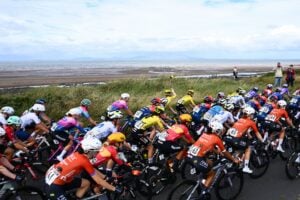
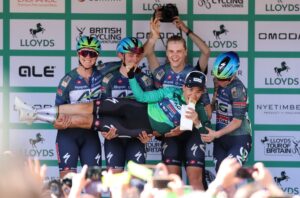
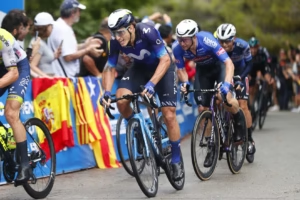
Tadej Pogačar did not just win the 2026 Tour of Flanders. He won it in the most season-defining way possible, attacking on the final Oude Kwaremont, dropping Mathieu van der Poel, and taking a third Ronde title that moved him level with the race’s record holders. Van der Poel finished 2nd, Remco Evenepoel was 3rd on his debut, with Wout van Aert and Mads Pedersen completing the top five.
That outcome matters because the Tour of Flanders is rarely just another Monument. It is the clearest test of who can shape the northern spring on the hardest terrain against the deepest field. When a rider wins here in such a direct fashion, especially against Van der Poel and with Evenepoel and Van Aert also in the picture, it changes the conversation around the rest of the campaign immediately.
For readers coming to this from the wider spring coverage, ProCyclingUK’s How to watch Tour of Flanders Men 2026 in the UK, Men’s Ronde van Vlaanderen 2026 team-by-team guide and A brief history of the Men’s Tour of Flanders all help place this result in the bigger picture.
 Photo Credit: Getty
Pogačar is setting the season’s standard
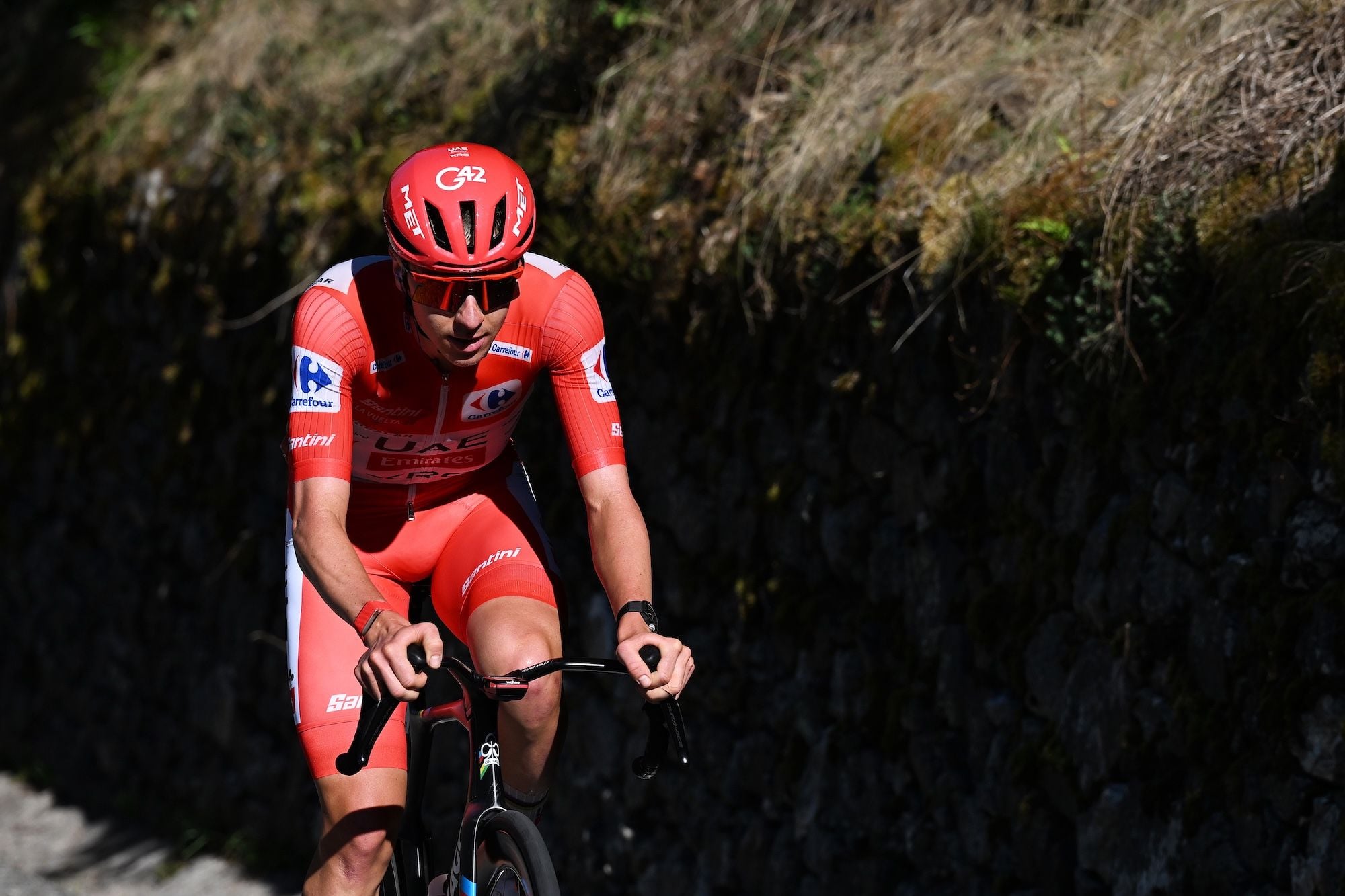
The simplest conclusion from Ronde van Vlaanderen 2026 is that Pogačar remains the benchmark for the men’s season. He had already won Milano-Sanremo before Flanders, and this latest Monument win strengthened the sense that the 2026 campaign is being shaped around his range rather than around one specialist niche.
What stands out is not only that he won, but how he won. This was not a reduced sprint stolen from a tactical stalemate. It was a solo move on the decisive climb of the race, the same terrain that usually exposes even the smallest weakness. That tells the rest of the peloton that matching Pogačar for one effort is not enough. They have to survive the whole race and still be able to answer his hardest acceleration.
For the season as a whole, that pushes every rival onto slightly reactive ground. Teams are no longer just asking how to win the next big race. They are asking how to stop the rider who can now dictate very different kinds of Monuments.
Van der Poel is still central, but not in control
Van der Poel’s 2nd place was still a major ride, but Flanders changed the tone around his spring. He arrived with the chance to take a record-breaking fourth Tour of Flanders win, yet once again found Pogačar too strong at the decisive moment.
That does not mean Van der Poel suddenly looks diminished. It means the balance at the very top has shifted from him being the rider others have to dislodge on cobbled Monument terrain, to him being one of the few riders capable of pushing Pogačar close. That is still elite territory, but it is a subtly different position in the season narrative.
For the rest of the spring and summer, Van der Poel still looks like a rider who can win the biggest races. But Flanders suggested that if Pogačar is present and at his best, Van der Poel may need either a more favourable race shape or a more disruptive team dynamic around him than he got here.
 Photo Credit: Getty
Evenepoel’s debut changed the picture too
Evenepoel finishing 3rd on his Tour of Flanders debut may prove one of the most important long-term takeaways from the race. A podium on debut broadens the way his season can be viewed.
For years, the biggest questions around Evenepoel in the spring have centred on which races really suit him at Monument level. Flanders 2026 offered a strong answer. He was not winning, but he was competitive deep into the decisive phase against the two riders who have most shaped recent cobbled Monument racing. That expands what feels realistic for him later in the year in major one-day races with hard, selective finales.
It also matters for Belgian cycling. Van Aert remains hugely important, but Evenepoel’s podium added another elite Belgian layer to the season, one that could become especially significant in races where long-range power and individual initiative matter even more.
Van Aert and Pedersen were strong, but not decisive
Wout van Aert in 4th and Mads Pedersen in 5th underlined something familiar about the current season. Both are strong enough to be present at the business end of the biggest races, but being present is not the same as controlling them.
For Van Aert, that keeps the pressure in place. He remains one of the defining riders of this era, but Flanders did not give him the sort of breakthrough result that would reset the spring story around him. Instead, it reinforced the sense that he is still searching for the race where all the pieces align against rivals who are setting an exceptionally high bar.
For Pedersen, the takeaway is slightly different. A top-five in this field again confirms his consistency and his status as one of the most dependable riders in hard one-day races. But Flanders also showed the current limit of that consistency when the race turns into a duel or trio between the very strongest on the climbs.
The season now has a clearer hierarchy
Every spring produces a pecking order, but Flanders usually sharpens it more than most races. Right now, the hierarchy looks clearer than it did before the race. Pogačar sits at the top. Van der Poel remains the most credible direct rival in the biggest one-day races. Evenepoel has strengthened his claim to be part of that conversation on this terrain, while Van Aert and Pedersen remain just behind that very front line.
That hierarchy will not hold perfectly all year. Different routes produce different races. But after the Tour of Flanders, teams and rivals have a more concrete idea of who is forcing the season’s biggest questions, and who is still trying to answer them.
-
 Photo Credit: Sprint Cycling Agency
The safety controversy will remain part of the race’s legacy
One element that should not be ignored is the level-crossing incident that disrupted the race early on. More than half the peloton were stopped, a smaller front group went through before the barrier fully shut, and the race was briefly neutralised before the sporting battle reset.
That issue does not change who won, but it does affect how this edition will be remembered. The result was clear. The wider fallout was less clean, and it raised awkward questions about coordination, rider responsibility and how incidents of that kind should be handled in real time.
For the wider season, it is a reminder that cycling’s biggest races are still shaped not only by legs and tactics, but by how well the sport manages risk in live conditions.
What it means for the rest of 2026
Above all, men’s Ronde van Vlaanderen 2026 made the season feel narrower at the top and richer just below it. Narrower, because Pogačar’s authority is becoming harder to dispute. Richer, because the mix behind him is still fascinating, with Van der Poel, Evenepoel, Van Aert and Pedersen all giving the season different possible storylines depending on the course and race dynamic.
The result also strengthened the sense that the sport is living through a period where the biggest races are repeatedly being contested by a small group of riders with very different strengths but similarly elite ceilings. That is good for the season because it gives each major race a clear tension. Can anyone stop Pogačar, and if so, who is best placed to do it on this terrain?
For more spring context, this piece sits naturally alongside ProCyclingUK’s What Dwars door Vlaanderen Women 2026 means for the season, Men’s cycling history, races, riders and teams hub and the broader Men’s route guide hub. Flanders did not close the season’s biggest question entirely, but it did make the answer look harder to find.