
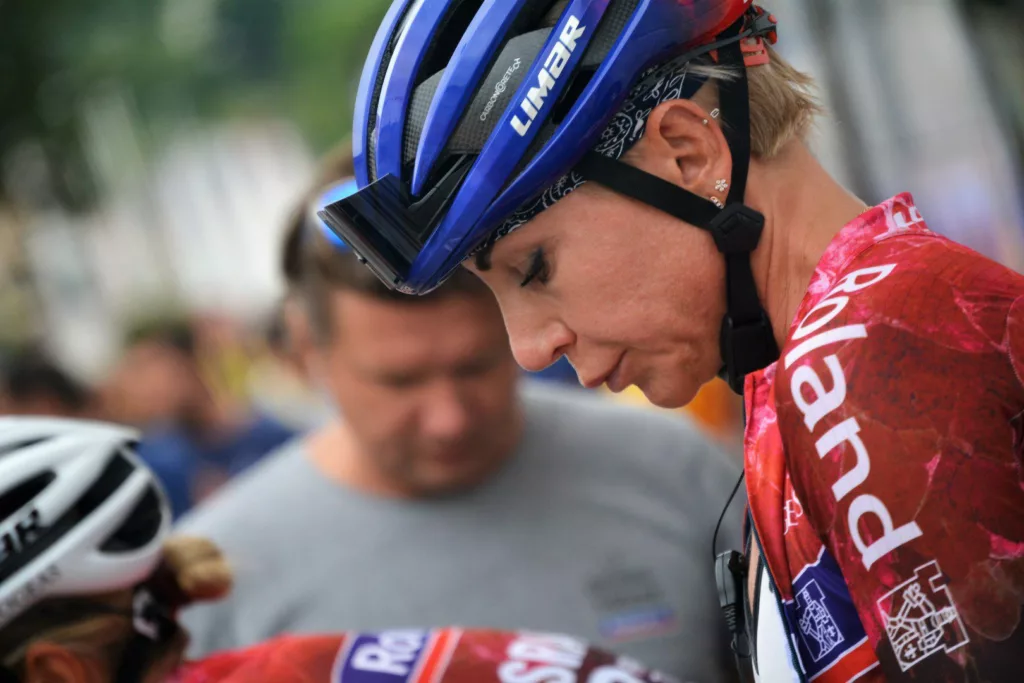
Olga Zabelinskaya’s career is one of those rare cycling stories that stretches cleanly across eras without ever feeling neatly contained by them. She has won Olympic medals, taken time trials apart with disciplined force, and remained relevant long after the sport around her changed shape. Different jerseys, different federations, different equipment, different pelotons – the same rider kept turning up, still awkward to mark, still hard to drop from a leading group when the road started to lean and the pace stopped forgiving mistakes.
For much of her career, Zabelinskaya was a rider who seemed to belong to multiple cycling worlds at once. She began on the Russian side of the sport, rode under the national structures that carried so many Eastern European riders into the 2000s, and later represented Uzbekistan, adding another layer to a career already marked by movement and reinvention. Her results did not arrive in a single burst. They accumulated. Olympic medals, time trial podiums, stage-race performances, hard-earned wins on narrow margins. The shape of her record tells the story of a rider who could absorb change and keep moving forward.
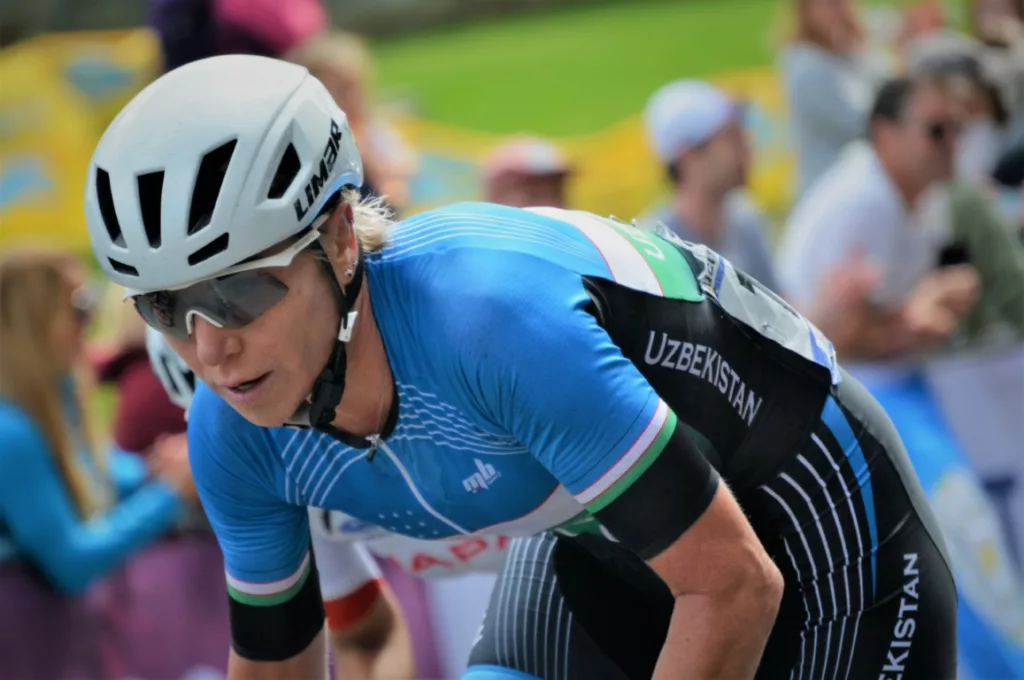
Olga Zabelinskaya and a career built across borders
Zabelinskaya was born in Leningrad in 1980, when cycling in the Soviet sporting system still carried its own heavy logic of discipline and progression. By the time she emerged internationally, the world around her had shifted. Teams were more global, women’s road racing was becoming more structured, and the calendar was starting to offer more serious opportunities beyond the traditional one-day races and occasional stage tests. She adapted quickly. That made her valuable, but also difficult to pin down. She could ride almost any terrain well enough to stay in contention, and her time trialling gave her a stable edge when the race needed order after chaos.
Her name is worth remembering because she sits in the background of two important developments in women’s cycling history. First, the growing legitimacy of elite women’s road racing at major championships and the Olympics. Second, the increasing internationalisation of the sport, where riders could cross federations and continue their careers well beyond the point where many had already stepped away. If you are tracing the sport’s evolution, Zabelinskaya belongs on the route. For broader context around the riders who shaped that story, see the women’s cycling history hub.
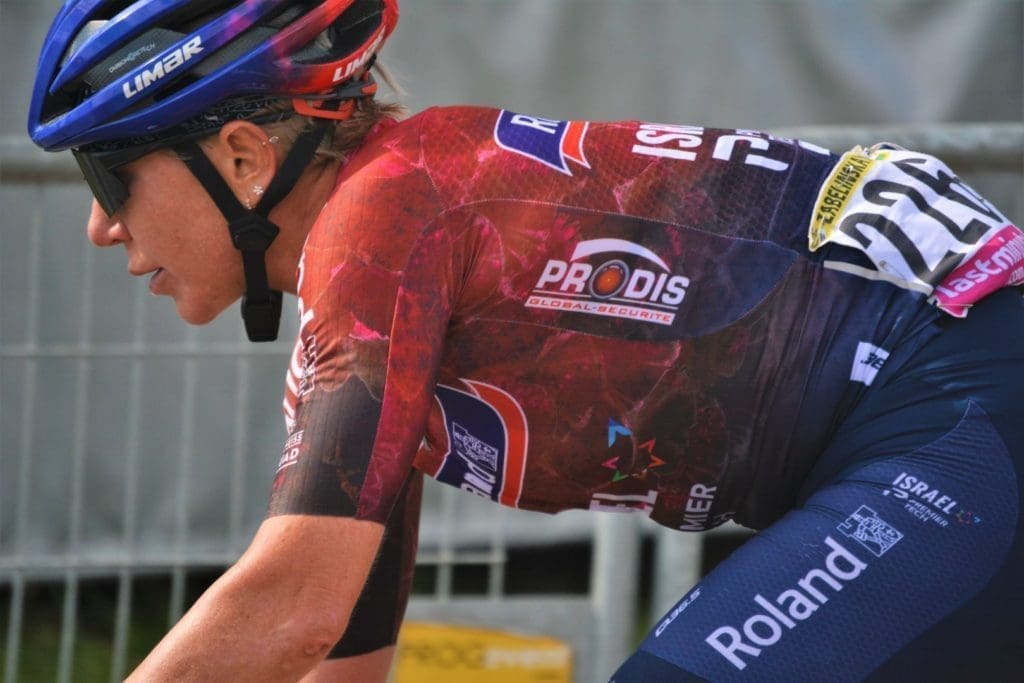
Olympic medals and her biggest results
London 2012: bronze on the road
Her first Olympic medal came in the road race at London 2012. It was a race shaped by heat, tension and the long drag of the Box Hill circuit, where the race kept folding back on itself until fatigue did the sorting. Zabelinskaya rode with patience, which is not the same as caution. She held position, saved effort where she could, and had enough left when the race opened up. The bronze medal placed her among the most significant riders of that Olympic cycle and confirmed that she could compete at a level where the margins were tiny and the consequences immediate.
Rio 2016: silver in the time trial
Four years later came one of the defining results of her career, the Olympic silver medal in the individual time trial in Rio de Janeiro. That course was rolling rather than flat, exposed in places and rhythmically uneven. It rewarded riders who could manage power cleanly through repeated changes in pace and gradient. Zabelinskaya was superbly suited to that kind of test. She did not win the gold, but the ride was a reminder of how much time trialling depends on head and spine as much as legs. You have to hold your line when the road keeps asking questions.
That medal mattered for another reason too. By then, she had already been in elite racing long enough for many riders to have slipped away. Instead, she was still producing one of the strongest performances in the world on one of the biggest days on the calendar. The result underlined her longevity better than any statistic could.
World Championships, stage races and one-day consistency
Zabelinskaya’s palmarès is not built on one lane only. She scored notable results across the road discipline, especially against the clock, and added podium-level performances in stage races and one-day events. She was repeatedly competitive at major championships, and her record includes strong placings in national and international time trials, plus victories and high finishes in races where positioning, patience and late-race nerve mattered more than outright spectacle.
She was also a familiar presence in races that required careful reading rather than brute force. On undulating circuits, in wind, on rougher roads, she knew how to settle into the shape of a day. That mattered in women’s racing, especially in years when the sport was still fighting for calendar depth and consistency.
The rider herself: precision, calm and hard edges
Zabelinskaya did not ride like someone chasing attention. Her style was deliberate. She often looked smooth rather than aggressive, but that smoothness concealed serious strain. In time trials she kept her upper body still, her effort distributed rather than dramatic. On the road, she could ride with the same economy, staying close without wasting much in the wind. There was a practical intelligence to it.
That kind of rider can be underestimated because the work is hidden. She was not a flamboyant attacker, and she rarely built her reputation on theatrical gestures. Instead, she accumulated results through repeatable qualities: discipline, resistance, the ability to keep her pace when other riders began to fragment. In a sport full of sudden accelerations and visible suffering, she often seemed to prefer the controlled burn.
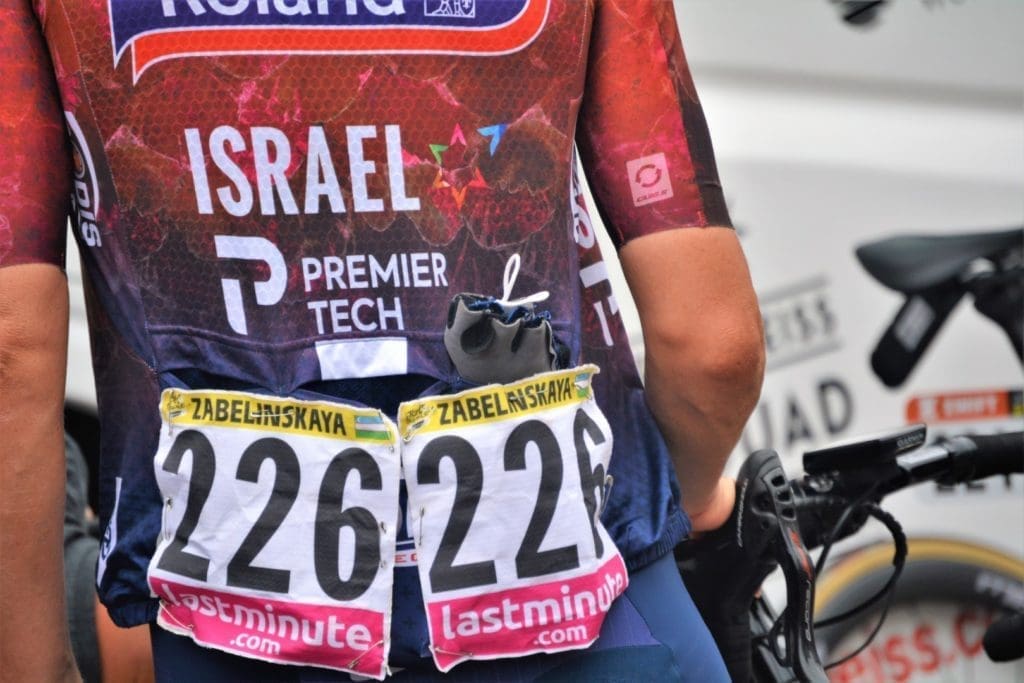
Teams, federation switches and the changing frame of her career
One of the more unusual aspects of Zabelinskaya’s career is the way it crossed federation lines. She represented Russia for much of her early elite career, then later switched to Uzbekistan. That shift reflected both personal circumstance and the practical realities of a long professional life in cycling, where national programmes, selection politics and opportunity can reshape a rider’s path as much as results alone.
She raced for a range of trade teams and national squads over the years, moving through a period in which women’s professional structures were still less stable than the men’s side. For riders like Zabelinskaya, that meant constant adaptation. Equipment changed, support levels changed, and race calendars changed. A rider with her engine and temperament could survive that instability because she did not depend on one type of race to express herself. She could target a stage race, a time trial, or a selective one-day event and still find a way to be relevant.
That resilience is part of what gives her career its historical interest. She was not simply a medal winner. She was a long-serving presence in a sport that was itself changing around her.
Why she stands out in women’s cycling history
Zabelinskaya’s importance lies in both what she won and how long she remained a factor. Olympic medals can define a rider, but longevity defines the shape of the career around them. She bridged an older era of national systems and a more modern, internationalised professional scene. She was among the riders who helped show that elite women’s road racing could sustain seasoned specialists, not just rising talents.
She is also notable because her best results came in the kinds of races that often reveal a rider most clearly. A time trial strips away the shelter. A demanding road race on a lumpy circuit asks for the same honesty in a different form. Zabelinskaya answered both. That makes her part of the sport’s deeper memory, not just a line in a medal table.
-
 Photo Credit: A.S.O./Billy Ceusters
After racing: where Olga Zabelinskaya is now
After her top-level racing years, Zabelinskaya remained connected to cycling rather than disappearing from it. Her later career saw her continue to compete in some capacity while moving further from the centre of the WorldTour-style spotlight. Like many riders with a long competitive life, she has had to fit cycling alongside changing personal and professional circumstances, and her post-peak years have been shaped by that same resilience that marked her racing.
She has also been associated with the wider Russian and international cycling scene beyond her biggest Olympic moments, remaining a recognisable figure to those who followed women’s road racing through the 2010s. For a rider whose career crossed borders, it feels fitting that her afterlife in the sport is less about a clean ending than a gradual withdrawal from the front of the race.
A career that lasted because it could keep changing
Olga Zabelinskaya is worth noting because she represents endurance in more than one sense. She endured hard courses, hard competition and the pressure of expectations that came with Olympic medals. She also endured the changing architecture of the sport itself. Her best results were substantial enough on their own. Her longer value is in the way those results were produced across years, countries and cycling cultures.
That is why her name still matters. She belongs to the group of riders who remind you that cycling history is not only written by the most attack-minded or the most visible. Sometimes it is written by the rider who keeps arriving, keeps riding into the wind, and keeps finding speed when the road becomes uncertain.

