Antwerp Port Epic Ladies is still one of the younger races on the women’s calendar, but it has quickly built a clear identity. First held in 2023, the race gives women’s cycling its own version of the rough, industrial, mixed-surface test around Antwerp, combining cobbles, gravel sectors, exposed roads and the constant stress of positioning near one of Europe’s major port cities.
That makes it different from many Belgian one-day races. It is not a pure cobbled Classic in the Tour of Flanders mould, and it is not simply a sprinter’s race dressed up with a difficult route. Antwerp Port Epic Ladies sits somewhere in between. The strongest riders need speed, but they also need the durability to survive repeated shocks, splits and mechanical risk before they ever reach the finish.
For that reason, the race has quickly become a useful marker for riders who thrive when the road surface changes and the bunch begins to fracture. It is a race for power, calm handling and resilience, which is why its early winners already say plenty about what the event is becoming.
For a wider look at how the race fits into the current calendar, our beginner’s guide to Antwerp Port Epic Ladies 2026 explains the route identity, race style and why it is one of the more distinctive one-day events in women’s cycling.
How Antwerp Port Epic Ladies began
The women’s Antwerp Port Epic was introduced in 2023, giving the existing Antwerp Port Epic format a women’s edition. The men’s race had already developed a reputation for being one of Belgium’s more unusual one-day events, with a route built around the docklands, gravel roads and cobbled sectors rather than the familiar Flemish hill pattern.
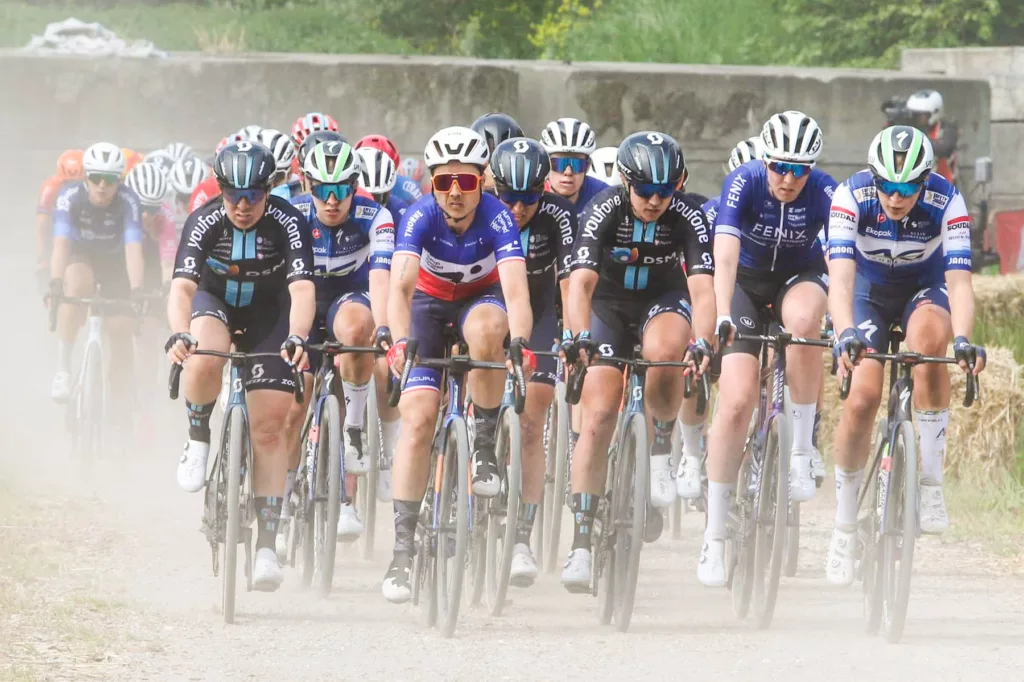
The women’s version immediately inherited that character. From the start, it was less about elevation and more about attrition. The race’s difficulty comes from repeated interruptions: rough surfaces, narrow lines, exposed roads, turns through industrial surroundings and the constant threat of punctures or crashes.
That made the first edition important beyond the result itself. It showed that the women’s peloton could produce the same kind of selective, unpredictable racing on this terrain, and it gave the race a distinctive place on the calendar almost immediately.
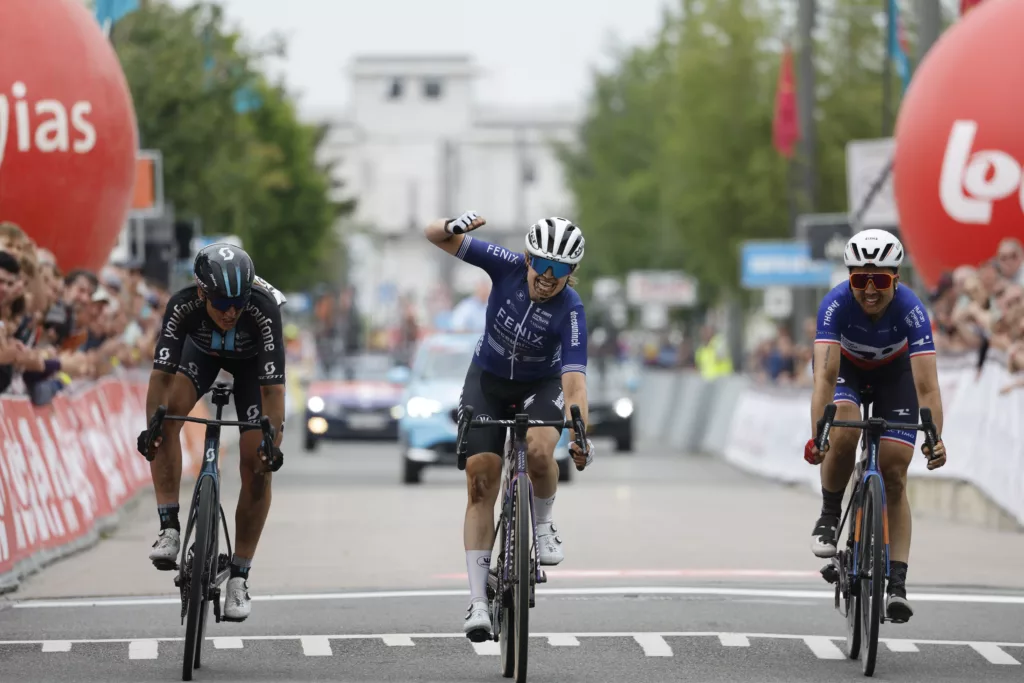
Marthe Truyen wins the first edition in 2023
Marthe Truyen became the first winner of Antwerp Port Epic Ladies in 2023, taking a four-rider sprint ahead of Franziska Koch and Audrey Cordon-Ragot. It was a fitting first result for the race because Truyen had already shown her quality on rough terrain, including a podium at Paris-Roubaix Femmes earlier that spring.
Her victory set the tone for the event. This was not a race likely to be won by a pure sprinter arriving fresh from a controlled peloton. Truyen’s win came after the race had been split and reduced, rewarding a rider with cyclo-cross handling, cobbled strength and enough speed to finish from a small group.
That first edition also gave Antwerp Port Epic Ladies immediate credibility. Koch and Cordon-Ragot were strong names to have on the podium, and the finish suggested that the race would lean towards riders who could combine endurance and technical confidence rather than those relying solely on a lead-out train.

Lara Gillespie adds an Irish win in 2024
The 2024 edition went to Lara Gillespie, who beat Zoe Bäckstedt and Sanne Cant in another reduced sprint. Again, the podium told a clear story. Gillespie brought track speed and road strength, Bäckstedt had the off-road and cobbled pedigree, while Cant’s cyclo-cross background made complete sense on a race defined by rough surfaces and repeated technical pressure.
Gillespie’s victory also broadened the race’s identity. Truyen had made the first edition feel like a natural home for Belgian rough-road specialists, but Gillespie showed that it could also reward fast, adaptable riders from outside that traditional cobbled Classics mould.
It was a significant result for Irish women’s cycling too. Gillespie’s win came in a race where positioning and tactical timing mattered as much as sprint speed, underlining why Antwerp Port Epic Ladies was already developing into more than a niche Belgian event.

The race moves up with Susanne Andersen in 2025
The 2025 edition marked an important step in the race’s development, with Antwerp Port Epic Ladies moving up to UCI Women’s ProSeries level. That upgrade mattered because it recognised the race’s growing status and gave it a stronger position within the women’s calendar.
Susanne Andersen won that 2025 edition for Uno-X Mobility, edging Clara Copponi in a photo finish, with Eilidh Shaw completing the podium. It was one of the most dramatic finishes in the race’s short history, but the result was only part of the story. The race itself had been shaped by difficult weather, cobbled and gravel sectors, crosswinds, crashes and punctures.
By the finish, the peloton had been heavily reduced, with only a smaller group still in contention. Late attacks were brought back before Andersen launched her sprint and held off Copponi by the smallest of margins. It was exactly the kind of finish that suits the race: not clean, not predictable, and not decided only by the fastest rider on paper.
That 2025 edition helped confirm Antwerp Port Epic Ladies as a serious race rather than simply a new addition to the calendar. The ProSeries status, the rough route and the depth of the podium all pointed in the same direction.
Why the race already has a clear identity
The defining feature of Antwerp Port Epic Ladies is that it creates selection without needing major climbs. Many women’s races are shaped by hills, wind or flat sprint control. Antwerp Port Epic Ladies uses rough surfaces and exposed roads instead.
That gives it a particular rhythm. Riders must stay near the front because each gravel or cobbled sector can stretch the bunch. Teams need depth because punctures and crashes can remove support riders quickly. Fast finishers need more than speed because they may have to sprint after a day of constant interruption.
The race also has a strong visual identity. Antwerp’s port roads, industrial backdrops, dockland sections and rougher surfaces make it feel different from the green lanes and bergs associated with many Flemish races. It is still recognisably Belgian, but it belongs to a different branch of Belgian racing culture.
That difference is valuable. Women’s cycling benefits from races with clear personalities, and Antwerp Port Epic Ladies already has one.
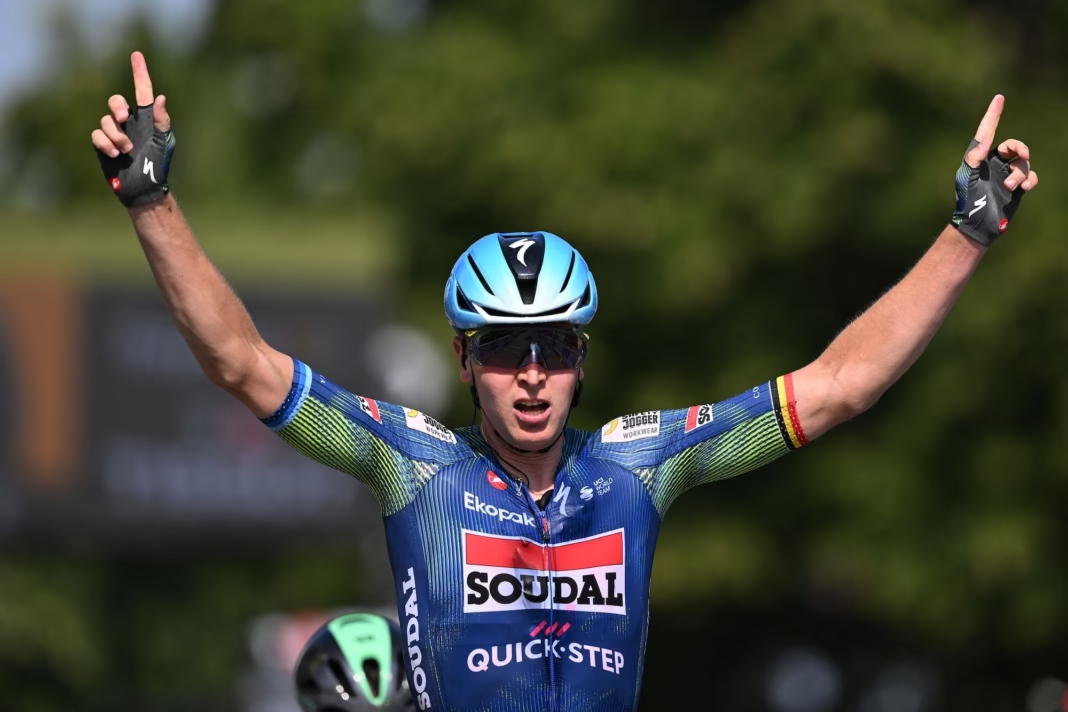
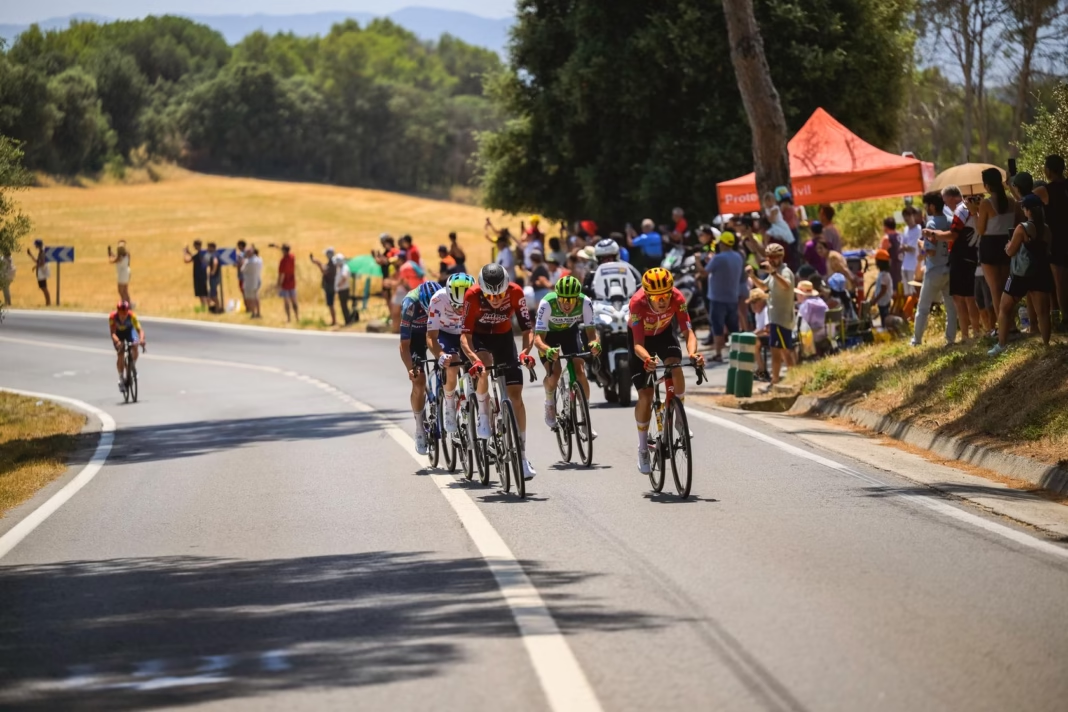
Antwerp Port Epic Ladies winners
- 2023: Marthe Truyen
- 2024: Lara Gillespie
- 2025: Susanne Andersen
What Antwerp Port Epic Ladies means now
Antwerp Port Epic Ladies has not been around long enough to have decades of tradition, but that is part of its appeal. Its history is still being written, and the early editions have already given it a strong foundation.
Truyen, Gillespie and Andersen are three very different winners, but they all fit the same broad race profile. Each had the speed to finish, but each also had the strength and composure to survive a difficult race before the sprint. That is the pattern to watch as the event grows.
As women’s cycling continues to expand, races like Antwerp Port Epic Ladies matter because they add variety. The calendar needs more than summit finishes, flat sprint days and established Classics. It needs events that ask different questions. Antwerp Port Epic Ladies asks whether a rider can handle chaos, rough roads and fatigue, then still make the right decision at the finish.
That is why, despite its short history, it already feels like a race with a future.