

The Tour Féminin International des Pyrénées 2026 is one of the most important climbing-focused women’s stage races outside the Women’s WorldTour. The race runs from Friday, 12th June to Sunday, 14th June, and has moved up to UCI Women’s ProSeries level for 2026, giving it a stronger place on the international calendar.
For newer fans, the easiest way to understand the race is this: it is a short, hard, three-day stage race in the French Pyrenees, built for climbers, developing GC riders and teams looking for a serious mountain test before the bigger summer races. It does not have the scale of the Tour de France Femmes or La Vuelta Femenina, but its terrain gives it a clear identity.
The Pyrenees give the race its character. The stages are usually short enough to encourage aggressive racing, but hard enough to expose riders who struggle on repeated climbs. That makes it a useful race for spotting emerging climbers, testing mountain domestiques and seeing which riders can handle stage-race pressure when the gradients start to bite.
For wider context on the women’s road season, our women’s cycling race guides follow the key events across the calendar, from the spring Classics to the stage races that shape the summer.

What is the Tour Féminin International des Pyrénées?
The Tour Féminin International des Pyrénées is a women’s professional stage race held in the French Pyrenees. It was first held in 2022 and has quickly become known for its climbing terrain, compact format and role as a development step for riders targeting harder stage races.
The race has had a short but eventful history. It arrived at a time when women’s cycling was expanding quickly and when the calendar needed more stage races with meaningful climbing. That made its concept valuable from the start. The women’s peloton needs races that are not simply flat sprint blocks or one-day Classics. It needs more opportunities for climbers and GC riders to race hard across several days.
By moving to Women’s ProSeries level in 2026, the race gains extra status. It is still below Women’s WorldTour level, but the upgrade matters because it should help attract stronger teams, better depth and more attention.
When is the Tour Féminin International des Pyrénées 2026?
The 2026 race takes place from Friday, 12th June to Sunday, 14th June.
That timing is useful. It comes after the early summer stage-race block and before the biggest July and August targets for many riders. For some teams, it will be a chance to sharpen climbing form. For others, it will be a major goal in its own right, especially for riders who may not always get leadership chances in WorldTour races.
The race lasts three days, so there is very little time to recover from a mistake. A bad opening stage can leave a rider chasing the race immediately. A poor day in the mountains can end GC ambitions altogether. That short format usually encourages more direct racing because there is no long first week for teams to ease into the event.
What level is the race?
The Tour Féminin International des Pyrénées is a UCI Women’s ProSeries stage race in 2026.
That puts it one level below the Women’s WorldTour, but above standard UCI 2.1 or 2.2 stage races. In practical terms, it should attract a strong mix of Women’s WorldTour teams, ProTeams, continental squads and development line-ups.
That mix is part of the appeal. The very biggest stage races can sometimes be dominated by a small group of elite teams. At ProSeries level, the field can be more varied, with smaller squads given more room to race aggressively and emerging riders getting a clearer chance to lead.
It is also an important category for the development of women’s cycling. Not every good climber immediately gets a leadership role at the Tour de France Femmes or La Vuelta Femenina. Races like the Tour Féminin International des Pyrénées give those riders a more realistic pathway to show what they can do.
What kind of route does the race usually have?
The race is built around the Pyrenees, so climbing is central to its identity. The exact stage designs can vary, but the basic race style is usually clear: rolling roads, mountain pressure, selective finishes and enough elevation to make the general classification meaningful.
The Pyrenees are different from the Alps in feel. The climbs are often irregular, the roads can be narrow, and the weather can change quickly. A stage does not always need one enormous summit finish to become selective. Repeated climbs, technical descents and hard roads between the major ascents can wear down the bunch just as effectively.
That makes the race useful for riders who can climb, recover and handle difficult positioning. It is not only about watts on one final climb. Riders need to deal with the rhythm of the terrain, respond to attacks and stay calm when the race becomes fragmented.
 Photo Credit: Cor Vos
Why is the Pyrenean terrain so important?
The Pyrenees give the race a proper mountain identity. For fans, that makes it easier to understand. If a rider wins this race, or rides strongly across all three stages, it usually says something meaningful about their climbing level.
The terrain also creates tactical variety. A team can make the race hard from distance, send riders into breakaways, use descents to apply pressure, or wait for the steepest sections to attack. Smaller teams can be dangerous because they do not always have to control the race. They can pick their moments and force larger squads to respond.
This is why the race suits riders who are prepared to race actively. A passive rider can survive some stage races by sitting in the bunch and waiting for one final effort. In the Pyrenees, that is harder. The roads naturally create pressure, and once the bunch starts to split, it can be difficult to put the race back together.
What type of rider can win?
The ideal winner is a climber with enough stage-race consistency to handle three consecutive days. Pure sprint speed is unlikely to matter much for the overall, although a fast finish from a reduced group can still decide a stage.
A strong GC rider needs three qualities here. First, they need climbing ability, because the race is unlikely to be won without being among the best uphill. Second, they need recovery, because three hard days in the Pyrenees can expose riders who are strong once but fade quickly. Third, they need race craft, because shorter stage races often reward good positioning and decisive reactions.
That is why the Tour Féminin International des Pyrénées is especially useful for emerging stage racers. It gives them a proper mountain test without the full weight of a Grand Tour. A rider who can win here has shown more than a single good climbing day.

Why does the 2026 edition matter?
The 2026 edition matters because the race has moved up to Women’s ProSeries level. That should make the field stronger and increase the value of the result.
It also arrives at a time when women’s cycling needs more serious stage-race depth. The top of the calendar has improved significantly, with the Tour de France Femmes, La Vuelta Femenina and Giro d’Italia Women giving the sport major focal points. But the wider ecosystem matters too. Riders need races between the biggest events where they can develop as GC leaders.
The Tour Féminin International des Pyrénées fits that space well. It is hard enough to matter, short enough to race aggressively, and placed well enough in the calendar to act as both a target and a stepping stone.
For more on how the biggest women’s stage races sit together, our Tour de France Femmes coverage and La Vuelta Femenina coverage follow the races that many climbers will use as their longer-term goals.
Which riders should beginners watch?
The final start list will decide the exact favourites, but the rider type is clear. Watch the climbers, the developing GC riders and the teams willing to attack before the final climb.
Usoa Ostolaza is an obvious reference point for this race. She has already shown how well she fits the Pyrenean terrain and remains one of the riders most closely associated with this event’s recent history. A rider with her climbing profile can turn this kind of race into a proper GC contest rather than a cautious waiting game.
Valentina Cavallar is another type of rider who makes sense in a race like this. She is still developing as a road climber, but the terrain suits riders who can handle steep gradients and repeated climbing pressure. For a rider trying to build stage-race credibility, the Tour Féminin International des Pyrénées is exactly the sort of race that can reveal progress.
Paula Blasi, Marion Bunel, Titia Ryo and other younger climbing names are also the kind of riders who could use this race well depending on team selection. It is not always the biggest names who define the event. Sometimes it is the next wave of riders, given more responsibility than they would receive in a Women’s WorldTour race.
Which teams should beginners watch?
At this level, team selection can vary, but the important squads are usually those with climbing depth and developing GC riders. Women’s WorldTour teams may bring riders looking for leadership chances, while ProTeams and continental squads often treat the race as a major opportunity.
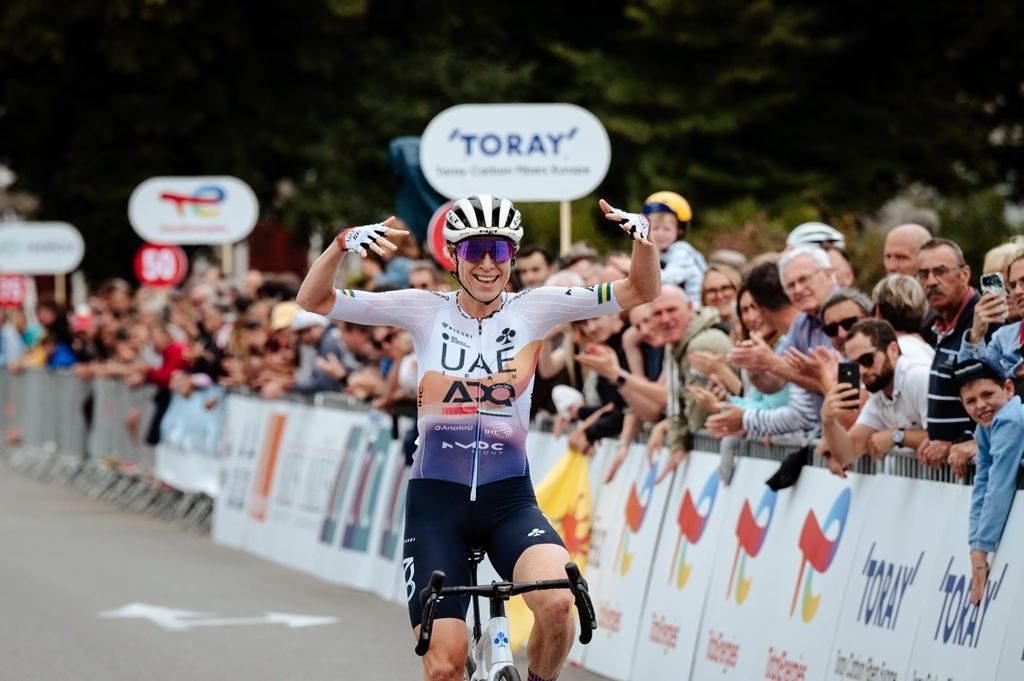
Laboral Kutxa-Fundación Euskadi are always worth watching in mountainous Spanish and French races because their roster often includes riders comfortable on hard climbing terrain. UAE Team ADQ, FDJ-Suez, Cofidis, Mayenne Monbana My Pie and other invited teams can shape the race depending on the final line-up.
Development teams are also important. Races like this give younger riders a chance to learn how to ride GC, not simply work for established leaders. That makes the race particularly interesting for fans who like spotting talent before it becomes obvious at the highest level.
How does it compare with the Tour de France Femmes?
The Tour Féminin International des Pyrénées is much smaller than the Tour de France Femmes, but it can still be very useful for understanding the climbing hierarchy below the absolute top tier.
The Tour de France Femmes carries more pressure, deeper fields, wider media attention and a broader range of stages. The Pyrenees race is shorter and more concentrated. That makes it less prestigious, but sometimes more direct. There is little time for caution, and riders who want to win often have to race positively from the start.
It can also act as a form marker. A strong performance here does not automatically translate into Tour de France Femmes success, but it can show that a rider is climbing well, ready for more responsibility, or capable of handling stage-race pressure.


How should new fans watch the race?
New fans should watch this race with three questions in mind.
First, who is climbing well from the opening stage? In a three-day race, there is no long settling-in period. Riders who look strong early are usually worth following closely.
Second, which teams have more than one option? A team with two climbing leaders can make the race far harder to control. One rider can attack while the other waits, forcing rivals to decide whether to chase or gamble.
Third, who recovers best? The winner of a short mountain stage race is not always the rider who makes the biggest single attack. Often, it is the rider who can climb well on consecutive days without fading.
That is what makes the race useful for learning stage racing. It compresses the key ideas of a bigger race into three days: climbing, recovery, tactics, team depth and timing.
Why the Tour Féminin International des Pyrénées matters
The Tour Féminin International des Pyrénées matters because women’s cycling needs more races like this. The sport has made major progress at the top level, but sustainable growth also depends on a deeper calendar. Climbers and developing GC riders need opportunities to lead, lose, learn and come back stronger.
The Pyrenees give the race a natural identity. It is not trying to be a flat sprint race or a mini-Classic. It is a mountain stage race, and that clarity makes it valuable. Fans know what sort of contest to expect, teams know what type of riders to bring, and the result usually tells us something meaningful about climbing form.
The move to ProSeries level in 2026 should only increase that importance. It gives the race more status, more competitive value and a stronger platform. For newer fans, the simplest summary is this: the Tour Féminin International des Pyrénées is a short, hard, climbing-focused stage race where future GC riders can show themselves before the biggest races of the summer.

