
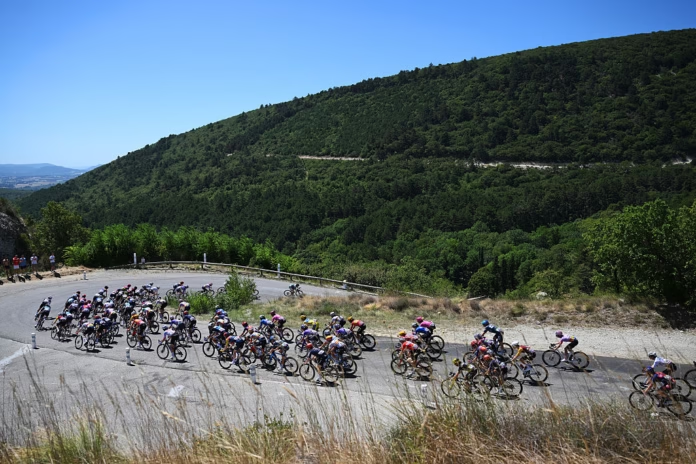
The Tour de France Femmes changes character completely on Stage 8, with the race leaving Sisteron for a 171.9-kilometre journey to Nice after the drama of Mont Ventoux.
Kasia Niewiadoma-Phinney starts the day in yellow after a superb solo victory on Ventoux, but her advantage over Demi Vollering is only 15 seconds. Marlen Reusser remains third at 39 seconds, meaning even a stage officially classified as flat cannot be treated as a complete day off by the GC teams.
For the sprinters, this is their best remaining opportunity. Lorena Wiebes has endured the hardest part of the race and reaches the Mediterranean with another 50 points available at the finish and a genuine chance of adding another stage victory.
It is not, however, a conventional flat stage. There are four categorised climbs, 1,420 metres of elevation and two short ascents inside the final 20 kilometres. If the race is made sufficiently hard there, Nice could produce a reduced sprint rather than a full bunch finish.
The stage sits between the two decisive mountain days on the 2026 Tour de France Femmes route, making recovery almost as important as the profile itself.
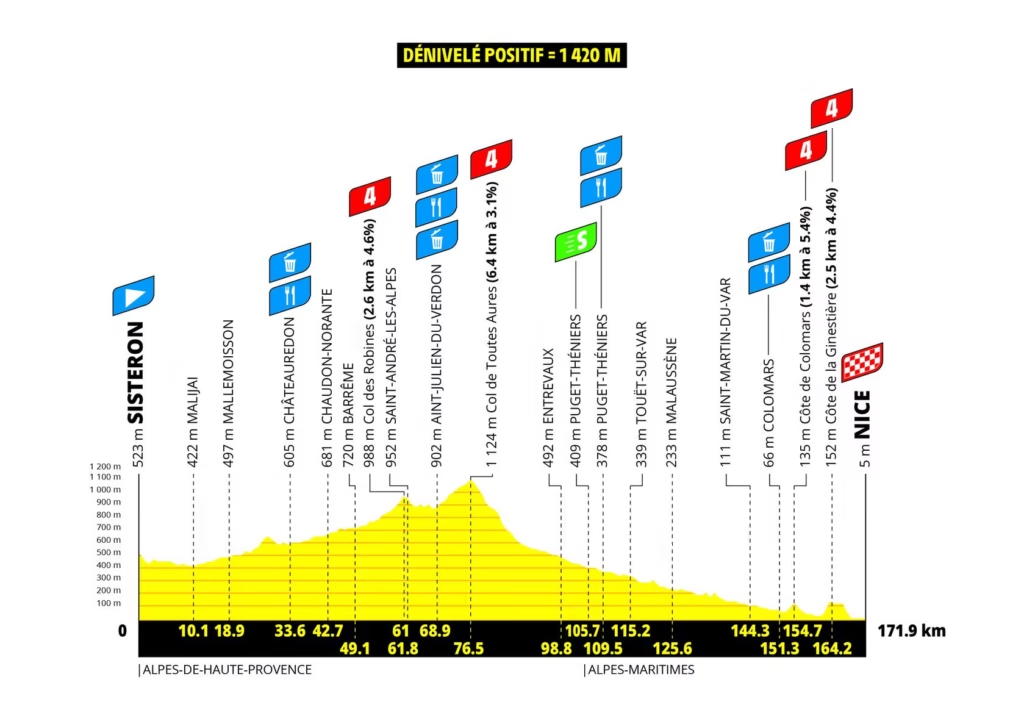
Tour de France Femmes Stage 8 route
| Stage detail | Information |
|---|---|
| Date | Saturday 8 August 2026 |
| Start | Sisteron |
| Finish | Nice |
| Distance | 171.9km |
| Stage type | Flat |
| Elevation gain | 1,420 metres |
| Neutralised start | 13:40 CEST / 12:40 BST |
| Expected finish | 17:43-18:05 CEST / 16:43-17:05 BST |
| Categorised climbs | Four |
| Final climb | Côte de la Ginestière |
| Final climb summit | 7.7km from finish |
The riders leave Sisteron and head south-east through the Alpes-de-Haute-Provence before following the Var towards Nice.
Most of the route gradually loses altitude as it approaches the Mediterranean, but the road is rarely completely flat.
The four categorised climbs are:
- Col des Robines: 2.6km at 4.6%, Category 4
- Col de Toutes Aures: 6.4km at 3.1%, Category 4
- Côte de Colomars: 1.4km at 5.4%, Category 4
- Côte de la Ginestière: 2.5km at 4.4%, Category 4
The first two should have little influence on the general classification. The final pair are much more interesting because they arrive after the race has entered its decisive final 20 kilometres.
The longest stage comes immediately after Ventoux
Stage 8 is officially categorised as flat, but its position in the race makes it much harder than a normal sprint stage.
The riders have just climbed Mont Ventoux.
Niewiadoma-Phinney attacked with 9.1 kilometres remaining and rode away while Reusser and Vollering initially watched one another. The move eventually delivered her first Tour de France Femmes stage victory and transformed a 1:17 deficit into the yellow jersey.
Vollering recovered late, attacking inside the final kilometre to limit the damage, but still begins Stage 8 15 seconds behind.
Reusser paid for the stalemate more heavily and dropped to third at 39 seconds.
That effort affected far more than the three riders at the top of the classification. The entire peloton had to survive Ventoux, manage the time limit and begin recovering almost immediately for the longest stage of the Tour.
Less than 24 hours later, they face 171.9 kilometres.
That should favour durable riders rather than fresh pure sprinters. Wiebes may remain comfortably the fastest woman in the race, but SD Worx-Protime still have to deliver her to the final eight kilometres with enough energy left to use that speed.
The scale of the previous day’s effort is explained in our Tour de France Femmes Mont Ventoux guide.
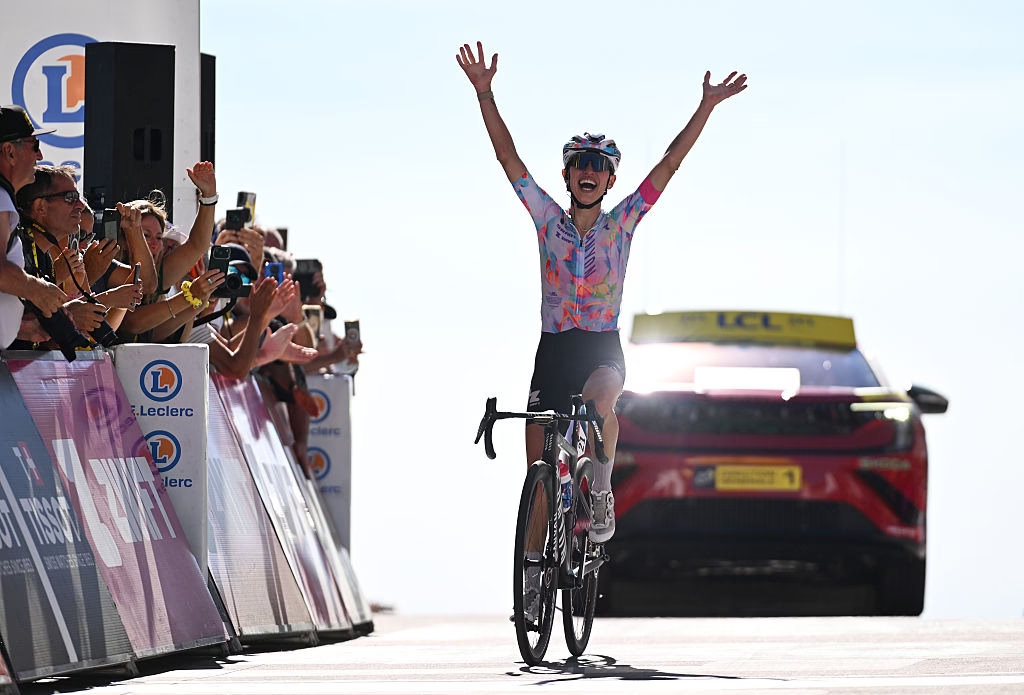
Niewiadoma-Phinney has yellow, but only by 15 seconds
Canyon SRAM now have responsibility for controlling the Tour.
Niewiadoma-Phinney’s Ventoux attack could hardly have worked better, but it did not give her the luxury of simply protecting a large advantage through the final weekend.
Fifteen seconds is almost nothing with Sunday’s 99.2-kilometre mountain stage around Nice still to come.
Stage 8 also awards the normal finish bonuses:
- 10 seconds for first
- 6 seconds for second
- 4 seconds for third
That creates an unusual tactical consideration.
Vollering is unlikely to beat the leading sprinters in a normal finish, but if the final climbs produce an exceptionally small group, every bonus second suddenly becomes relevant.
Canyon SRAM therefore cannot simply switch off because the stage has been labelled flat.
The importance of those deductions across such a closely fought Tour is covered in our Tour de France Femmes time bonuses guide.
Canyon SRAM would prefer the sprinters to control everything
Niewiadoma-Phinney’s ideal Stage 8 is probably a boring one.
Let a harmless breakaway go.
Allow SD Worx-Protime and the other sprint teams to manage the gap.
Keep Niewiadoma-Phinney near the front through the final climbs.
Finish in the same group as Vollering and Reusser.
Then turn attention towards Sunday’s repeated Col d’Èze ascents.
Canyon SRAM have little reason to spend Antonia Niedermaier and their other remaining support riders chasing a stage victory.
The yellow jersey changes their priorities.
What was previously an opportunity to attack becomes a day where unnecessary work should be avoided.
The complication is that Vollering and FDJ United-Suez know exactly that.
Why Vollering may still test Canyon SRAM
The obvious FDJ United-Suez strategy is to save everything for Stage 9.
There is good logic behind that.
Vollering demonstrated on Ventoux that she still had the climbing strength to attack late and gain time. Her problem was allowing Niewiadoma-Phinney too much freedom before reacting.
With only 15 seconds to recover, Sunday’s final mountain stage gives her an obvious route to yellow.
But that does not mean FDJ have to leave Niewiadoma-Phinney completely alone on Saturday.
The final 20 kilometres contain two short climbs where Vollering can force Canyon SRAM to react without committing to a major GC attack.
Even a brief acceleration serves a purpose.
It tests how Niewiadoma-Phinney has recovered from her Ventoux effort.
It forces Niedermaier or another Canyon SRAM rider to work.
And it reminds the yellow jersey that she cannot simply hide inside the sprint teams’ race.
Stage 8 could therefore become part of a two-day strategy rather than an isolated attempt to gain time.
Colomars begins the difficult part
The Côte de Colomars tops out with 17.2 kilometres remaining.
It measures only 1.4km at 5.4%.
That is not enough to trouble the Tour’s best climbers under normal circumstances, but the location makes it useful.
A powerful rider can attack almost completely above threshold knowing there is very little racing left.
For the sprint teams, the danger is not necessarily Wiebes being dropped.
It is losing the teammates required to control everything afterwards.
An attacker cresting Colomars with ten seconds could force SD Worx-Protime, Visma | Lease a Bike and the other teams interested in the finish to start chasing earlier than they would like.
The road then provides only a brief opportunity to reorganise before the final climb arrives.
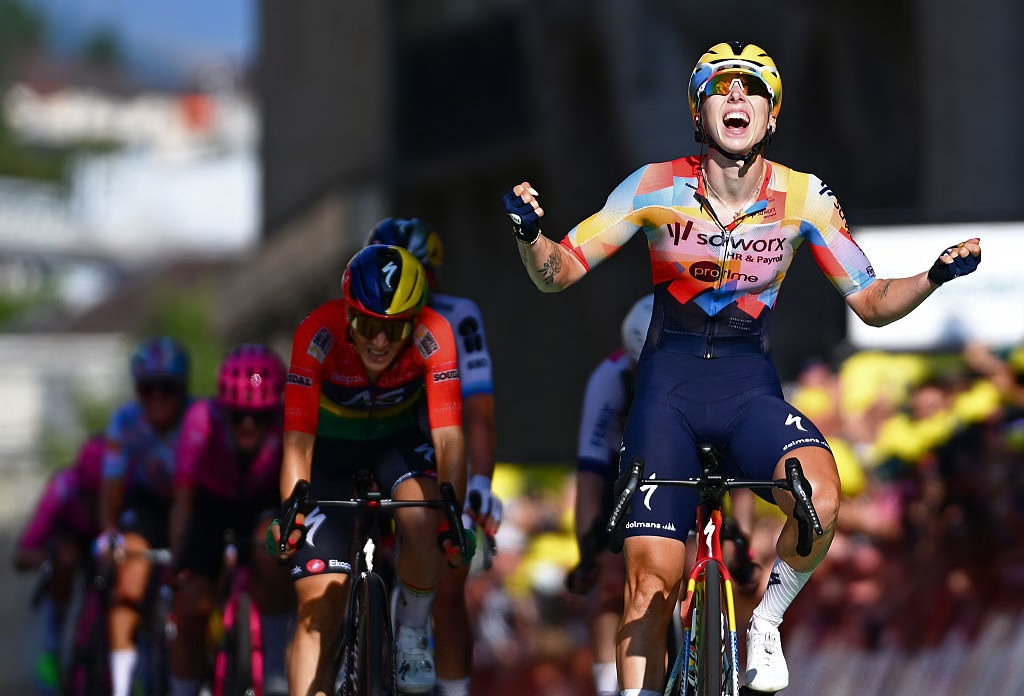
Côte de la Ginestière is the real obstacle to Wiebes
The Côte de la Ginestière tops out with only 7.7 kilometres remaining.
At 2.5km and 4.4%, it is not especially difficult in isolation.
Its placement changes everything.
A fresh Wiebes should comfortably survive a climb averaging 4.4%.
A Wiebes carrying seven previous stages, Mont Ventoux and more than 160 kilometres through the legs may find an all-out sequence of attacks rather more uncomfortable.
This is where teams without a realistic chance of beating her in a sprint have to race.
There is little value in riding steadily and delivering the strongest sprinter in women’s cycling to the final seven kilometres.
Puck Pieterse, Kim Le Court-Pienaar, Noemi Rüegg and other versatile fast finishers all benefit from making Ginestière as aggressive as possible.
The challenge is producing enough separation.
Wiebes has developed into much more than a flat-road sprinter. Her ability to survive harder racing is one of the reasons she remains the clear benchmark among the riders highlighted in our Tour de France Femmes 2026 riders to watch.
The final 7.7km favour the peloton
Once Ginestière is crossed, there are no more categorised climbs.
That swings the advantage back towards the chase.
A solo rider with ten seconds is unlikely to survive if several teams organise immediately.
A small group is more dangerous.
If Pieterse, Le Court-Pienaar or another fast rider gets clear with representation from several major teams, responsibility behind becomes much less obvious.
SD Worx-Protime will chase for Wiebes if she is present.
But why should another team spend its final domestiques delivering Wiebes to a sprint?
That hesitation is the attackers’ best weapon.
The technical process of bringing those moves back and rebuilding a sprint train is covered in our guide to how sprint lead-outs work in women’s cycling.
 Photo Credit: Getty
Nice is Wiebes’ final obvious opportunity
For Wiebes, Stage 8 has one straightforward objective.
Survive.
The Dutch rider remains the outstanding pure sprinter in the race and has enough climbing ability to handle all four categorised climbs if they are ridden at a manageable tempo.
If she reaches the final seven kilometres inside the front group, she becomes extremely difficult to beat.
The finish also awards 50 points towards the green jersey, compared with 25 at the intermediate sprint in Puget-Théniers.
That gives her another strong reason to make Stage 8 a priority.
SD Worx-Protime’s Tour has also changed with Anna van der Breggen leaving the race before Stage 7. Without a GC campaign to protect, the team’s objectives are increasingly centred around Wiebes, Lotte Kopecky and stage success.
Wiebes’ dominance of the current sprint hierarchy is examined in our guide to the best sprinters in women’s cycling.
Marianne Vos needs the final climbs to matter
Marianne Vos is one of the riders who benefits if Stage 8 becomes selective without becoming genuinely mountainous.
She does not want to face Wiebes fresh in a large peloton.
A group of 30 or 40 riders is much more interesting.
Vos has built much of her career around surviving terrain that removes faster specialists and then using her own sprint against whoever remains.
Colomars and Ginestière offer exactly that possibility.
Visma | Lease a Bike can therefore help make the finale difficult rather than simply waiting for SD Worx-Protime to dictate the approach.
The problem is finding the balance.
Make the climbs too easy and Wiebes remains.
Make the race too hard and riders such as Pieterse or Le Court-Pienaar may attack away from Vos as well.
Le Court-Pienaar has already shown why Stage 8 suits her
Kim Le Court-Pienaar already has her Stage 6 victory from Tournon-sur-Rhône, but Saturday offers another route towards a stage win.
She is fast enough to win from a reduced group and strong enough to survive the final hills.
That combination makes her particularly dangerous.
AG Insurance-Soudal do not need to make the entire stage brutally hard. They simply need enough attrition during the final 20 kilometres to remove Wiebes or at least leave her isolated.
Le Court-Pienaar has also demonstrated repeatedly during this Tour that she can race effectively after difficult, unpredictable stages.
That durability becomes particularly valuable immediately after Ventoux.
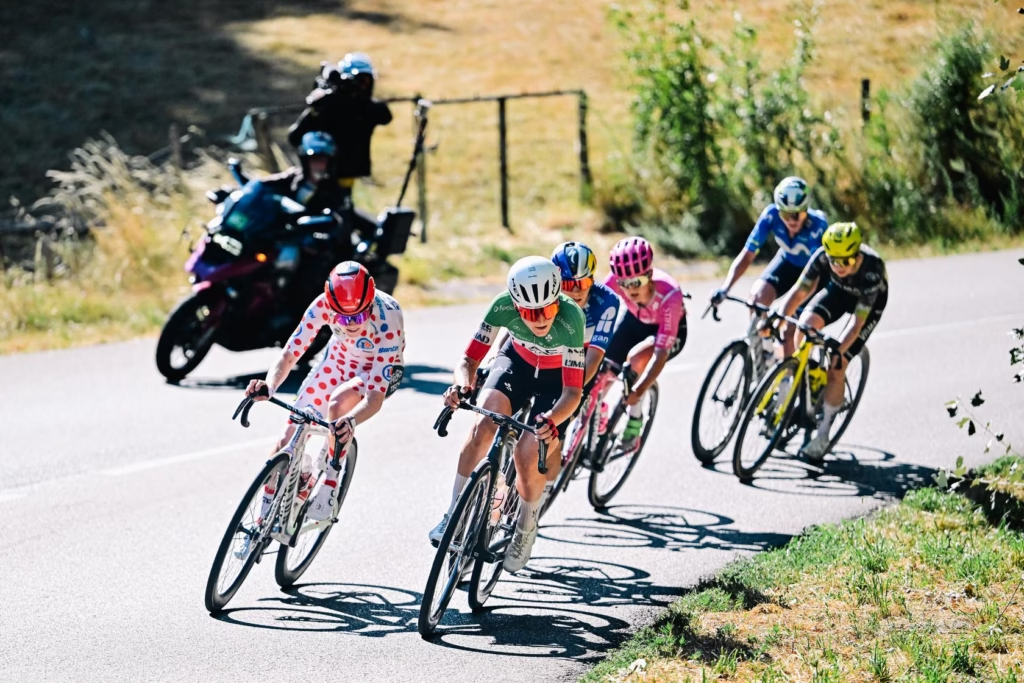
Pieterse has every reason to make the finish difficult
Pieterse has spent much of the Tour accumulating points towards the polka-dot jersey, and Stage 8 provides another four Category 4 climbs.
Each awards only two points to the first rider and one to the second, so the individual climbs are not especially valuable.
Collectively, they provide another opportunity to reinforce her position.
More importantly, the final two climbs suit Pieterse as a stage hunter.
She can attack.
She can follow another move.
She can descend aggressively.
And if a small group survives into Nice, she has enough speed to win the sprint herself.
That gives Fenix-Premier Tech several options.
The worst scenario is simply riding Ginestière steadily with Wiebes still attached.
Noemi Rüegg fits this finish extremely well
Rüegg is another rider who sits between conventional sprinter and puncheur.
She has enough speed to win from a reduced group but is unlikely to beat Wiebes consistently from a full peloton.
The late climbs therefore give EF Education-Oatly an obvious tactical objective.
Make the last 20 kilometres harder than SD Worx-Protime want them to be.
Rüegg has already demonstrated her uphill finishing speed this season, including victory on the opening stage of La Vuelta Femenina 2026.
Stage 8 does not finish uphill, but the principle is similar.
Remove the purest speed before the sprint begins.
Kopecky gives SD Worx-Protime another option
Lotte Kopecky makes the Wiebes strategy harder for rival teams to disrupt.
If the race stays together, SD Worx-Protime have the best sprinter.
If Ginestière becomes too difficult for Wiebes, Kopecky is one of the riders most likely to survive.
That gives the team an unusual degree of tactical protection.
Opponents cannot simply make the finale harder and assume SD Worx-Protime disappear from the equation.
Kopecky is one of the strongest reduced-group finishers in the peloton and is perfectly capable of following the kind of attack designed to eliminate Wiebes.
The easiest route for other teams is therefore not merely dropping one SD Worx-Protime rider.
It is creating enough chaos that the entire race becomes difficult to control.
Could the breakaway survive?
Possibly, although the balance still favours a chase.
After Ventoux, there will be plenty of riders interested in spending the day ahead rather than sitting inside a tired peloton.
The opening half of Stage 8 provides enough distance for a breakaway to establish itself before the sprint teams begin controlling seriously.
The problem is how valuable Nice is.
There are very few remaining opportunities for the fast riders. Wiebes, Vos and the other sprinters have survived Ventoux specifically to reach a stage like this.
Their teams will not willingly give it away.
A conventional early break therefore probably needs an unusually large advantage entering the final 50 kilometres.
A late break is different.
If the race is already fragmented through Colomars and Ginestière, a powerful group can exploit the lack of organisation behind.
That is the scenario the sprint teams need to prevent.
-
 Photo Credit: Getty

The intermediate sprint comes at Puget-Théniers
The day’s intermediate sprint is at Puget-Théniers after 109.5 kilometres.
It awards 25 points to the first rider, with points available down to 15th.
Whether Wiebes contests it depends largely on the breakaway situation.
SD Worx-Protime are unlikely to spend large amounts of energy bringing back a useful escape purely for the intermediate points when 50 are available in Nice.
If the peloton arrives together, however, there is little reason for Wiebes not to add to her green jersey total.
The difference between the points, mountains and overall competitions is covered in our Tour de France Femmes jerseys guide.
Stage 8 is a strange day for the yellow jersey
Niewiadoma-Phinney’s position creates a difficult balance.
She needs recovery after the biggest effort of the race.
She also cannot relax.
Fifteen seconds is too small a lead to allow Vollering freedom anywhere near the front of the race, and the summit of Ginestière comes close enough to the finish for an unexpected split to become awkward.
Canyon SRAM therefore need to keep the race controlled without spending riders unnecessarily before Sunday.
The best outcome remains a conventional sprint.
Let the sprint teams chase.
Keep Niewiadoma-Phinney near the front through Colomars and Ginestière.
Follow Vollering.
Avoid crashes and splits.
Finish safely.
Then prepare for the Col d’Èze.
Everything more complicated than that favours the challenger rather than the yellow jersey.

