
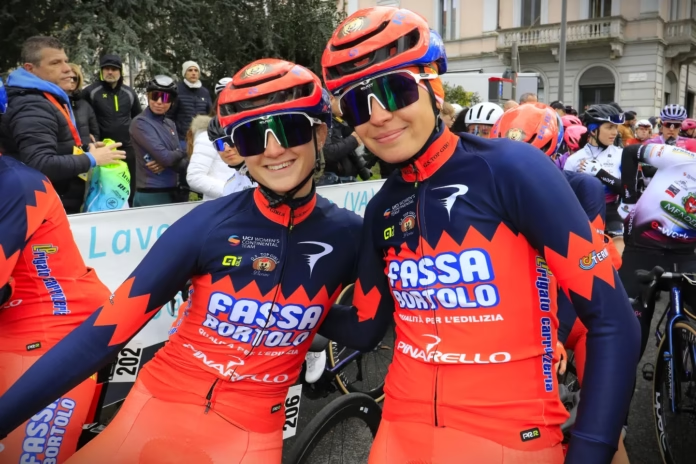
Top Girls Fassa Bortolo is set to step down from UCI Women’s Continental status and compete as a club team in 2027, a significant change for one of Italian women’s cycling’s longest-running development programmes. The organisation led by Lucio Rigato is not being described as closing outright, but its move out of the UCI Continental tier raises questions about the opportunities available to young riders.
The team’s position is the subject of new reporting by Italian cycling publication Bici.Pro, which examines the step back and the questions surrounding Top Girls’ future. Separately, Tuttobiciweb reported on 9 November that the team would have club rather than UCI Continental status next year, identifying the change as one factor behind Irma Siri’s departure to Horizons.
A club team rather than a UCI Continental squad
The distinction matters. Top Girls spent 2026 racing as a registered UCI Women’s Continental team, a status that has allowed its riders to compete internationally and, where selected, line up against substantially better-funded teams. Operating at club level in 2027 would mean a different set of race-entry opportunities, rather than simply a different label on an otherwise unchanged programme.
The precise calendar, roster and competitive structure planned for 2027 have not been fully set out in the available announcements. Nor should the change be confused with a confirmed end to the wider Top Girls club, which existed before its UCI-registered team was established in 2005.
For riders seeking an intermediate step between junior competition and professional racing, losing another Continental option is important. Moving directly into the Women’s WorldTour or Women’s ProTeam ranks is not realistic for every promising 19- or 20-year-old. A smaller development-focused organisation can offer regular racing, individual responsibility and the time to mature.
 Photo Credit: ProCyclingUK archive (original photographer unverified)
Why Lucio Rigato has warned about the Continental model
Rigato has raised concerns about the sustainability of the level before. In an earlier interview with Bici.Pro, he questioned how smaller Continental teams could keep financing their programmes if the introduction of Women’s ProTeams reduced their opportunities to race against stronger opposition.
He pointed to the imbalance between the resources required to maintain a UCI-registered squad and the uncertainty surrounding invitations, accommodation expenses and access to major races. The issue is structural: women’s cycling has attracted stronger sponsors and more professional support at its highest level, but that growth does not automatically finance the teams responsible for developing riders below it.
Bici.Pro has also reported on the difficulty facing Italian junior women trying to find places in the elite peloton. The loss of a Continental licence would narrow those choices further, even if Top Girls continues to operate within the domestic club structure.
A development pathway with world champions among its alumni
The Top Girls project began in Spresiano in the Veneto region in the 1990s and entered the UCI team structure in 2005. Its history includes riders who went on to become world road champions, notably Giorgia Bronzini and Tatiana Guderzo, as well as Elisa Longo Borghini, who spent part of her early senior career with the organisation.
Those names help explain why the team’s status attracts attention beyond Italy. Top Girls has rarely competed with the largest squads financially, but it has provided a place for riders to experience international racing before taking the next step. ProCyclingUK’s history of Top Girls Fassa Bortolo traces that role across more than three decades.
More recently, Chiara Reghini secured a move to Mayenne Monbana My Pie for 2027, another example of a rider progressing from the Italian development team into a stronger international programme. Siri’s move to Horizons illustrates a different consequence of the impending status change, with riders weighing up where they will have the best opportunities to race.
A wider problem for the next generation of Italian riders
As the Women’s WorldTour and Women’s ProTeam levels expand, their development structures increasingly recruit talented juniors at an early age. That can create good opportunities for the strongest prospects, but it also leaves fewer places in the independent teams that traditionally provided a route into elite competition.
The rules governing Continental teams’ entry into top-level races have already made that middle tier more difficult to navigate. Top Girls’ planned move to club status is therefore significant even without a final 2027 calendar: one of the sport’s longstanding pathways is changing shape.
What remains to be established is how Rigato’s organisation will operate next season, how many riders it can accommodate and which races it will be able to contest. The confirmed category change should not be reported as the disappearance of Top Girls, but it is a notable reduction in the team’s place within the international women’s peloton.
-
 Photo Credit: ProCyclingUK
-
 Photo Credit: Markus Spiske / Unsplash
-
 Photo Credit: Cor Vos


