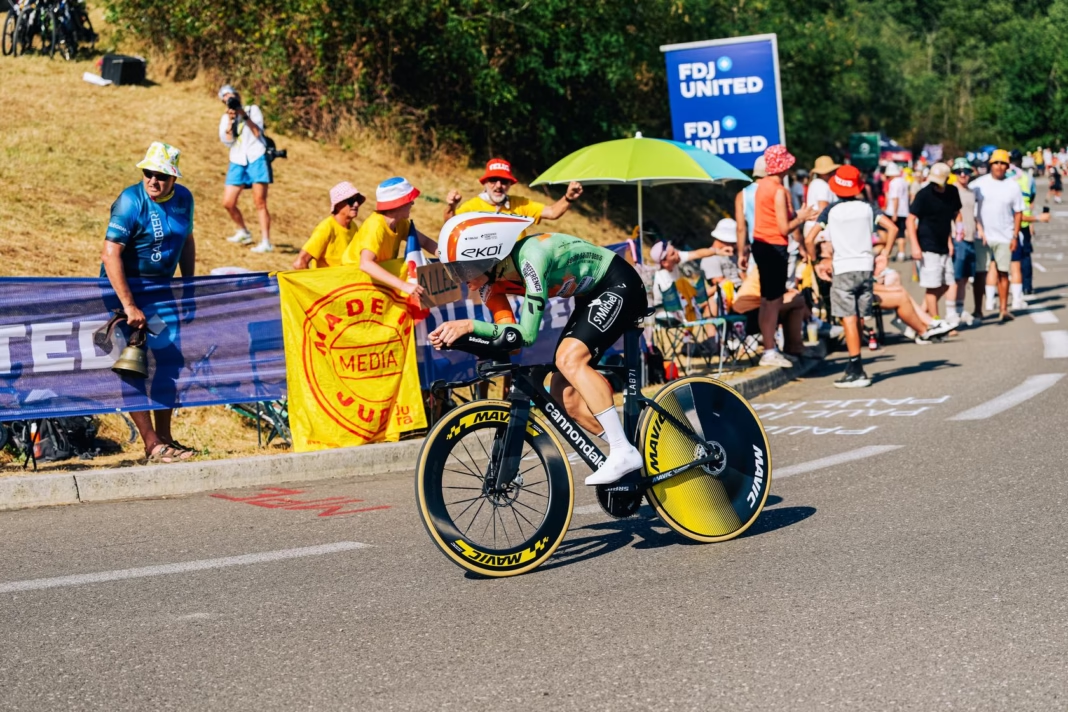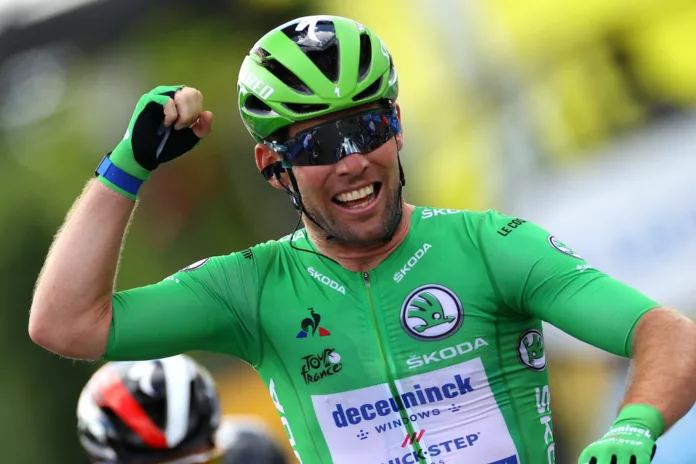
The Tour de France green jersey is worn by the leader of the points classification. Riders collect points at stage finishes and intermediate sprints, with the biggest rewards available on stages suited to sprinters. The rider who finishes the Tour with the most points wins the jersey.
Known as the maillot vert, it rewards speed, consistency and the ability to keep collecting points across three weeks. Peter Sagan holds the record with seven victories, ahead of Erik Zabel on six and Sean Kelly on four.
What does the Tour de France green jersey mean?
The green jersey identifies the leader of a competition running alongside the race for overall victory. The yellow jersey is decided by cumulative time, while the green jersey is decided by points. A rider can finish well behind the overall contenders in the mountains and still lead the points classification.
The different competitions explain why several teams might be chasing different objectives on the same stage. A sprint team wants to deliver its fastest finisher to the line, while a team defending yellow may simply want its leader to finish safely. Our guide to how the Tour de France general classification works explains the race for overall victory.
| Jersey | Competition | How the leader is decided |
|---|---|---|
| Yellow | General classification | Lowest cumulative time, including applicable bonuses and penalties |
| Green | Points classification | Most points from eligible stage finishes and intermediate sprints |
| Polka dot | Mountains classification | Most points at categorised climbs |
| White | Young rider classification | Best eligible young rider on cumulative time |
How are green jersey points awarded?
The points available depend on the stage category. Under the 2026 rules, a flat stage victory is worth 70 points, while an intermediate sprint victory earns 25. The table below shows the points awarded to the winner in each category.
| Stage or sprint category | Winner’s points in 2026 |
|---|---|
| Flat road stage, coefficient 1 | 70 |
| Slightly rolling road stage, coefficient 2 | 50 |
| Rolling road stage, coefficient 3 | 30 |
| Very difficult road stage, coefficients 4 and 5 | 20 |
| Individual time trial | 20 |
| Intermediate sprint | 25 |
Lower finishing positions also earn points. The official stage category determines the scale, so two stages described casually as “hilly” can offer different rewards. Points systems have changed over the Tour’s history, which also makes direct comparisons between winning totals from different years misleading.
Why do intermediate sprints matter?
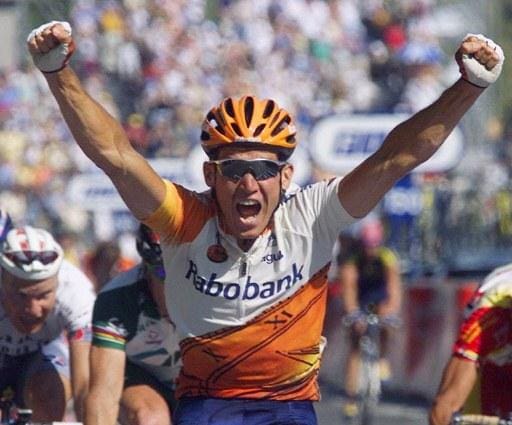
An intermediate sprint gives riders a chance to score before the finish. Its location can shape the day’s tactics: a sprint before the major climbs may draw out the main green jersey contenders, while one beyond difficult terrain can favour a rider who climbs better than the pure sprinters.
A breakaway can take the highest-scoring places before the peloton arrives. That gives a points contender two possible approaches: join the escape and collect points directly, or ask teammates to control the gap and bring the race back together. Both cost energy that might otherwise be saved for the final sprint.
Does the fastest sprinter always win green?
No. Winning stages helps enormously, but the classification rewards the points collected across the whole race. A rider who regularly finishes near the front and targets intermediate sprints can beat someone with more stage victories.
The route matters too. Repeated flat finishes give pure sprinters more opportunities, while difficult approaches and uphill finishes can favour stronger all-rounders. Sagan was particularly effective because he could compete in bunch sprints, survive selective terrain and score on days when some of his rivals were dropped.

Who has won the most Tour de France green jerseys?
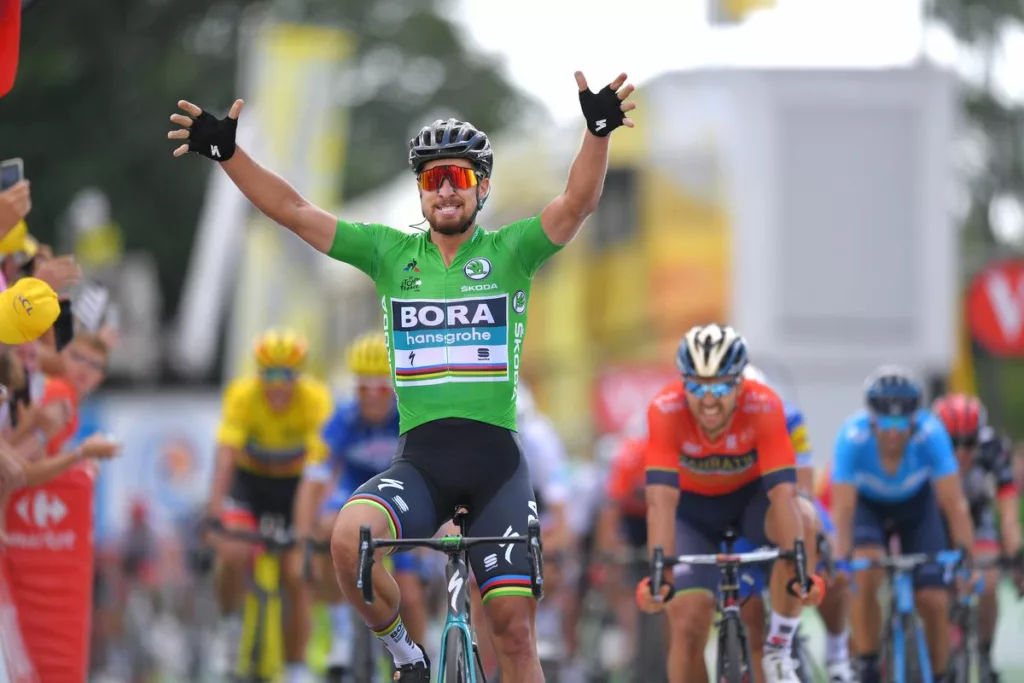
Peter Sagan has won the points classification seven times. His first five victories came consecutively from 2012 to 2016, followed by further wins in 2018 and 2019. Erik Zabel’s six victories all came in succession, from 1996 to 2001.
| Rider | Green jersey victories | Winning years |
|---|---|---|
| Peter Sagan | 7 | 2012, 2013, 2014, 2015, 2016, 2018, 2019 |
| Erik Zabel | 6 | 1996, 1997, 1998, 1999, 2000, 2001 |
| Sean Kelly | 4 | 1982, 1983, 1985, 1989 |
| Jan Janssen | 3 | 1964, 1965, 1967 |
| Eddy Merckx | 3 | 1969, 1971, 1972 |
| Freddy Maertens | 3 | 1976, 1977, 1981 |
| Djamolidine Abdoujaparov | 3 | 1991, 1993, 1994 |
| Robbie McEwen | 3 | 2002, 2004, 2006 |
The list includes riders with very different strengths. Kelly’s versatility and Sagan’s ability to score across varied terrain sit alongside the sprinting speed of McEwen and Abdoujaparov. There is more than one way to build a winning points total.
How many times did Mark Cavendish win green?
Mark Cavendish won the green jersey twice, in 2011 and 2021. Those victories were separated by a decade, with his second coming during a remarkable return to Tour stage-winning form.
Cavendish also reached 35 Tour de France stage victories in 2024, moving beyond Eddy Merckx’s total of 34. The stage-win record and the green jersey record measure different achievements: Cavendish set the benchmark for individual Tour stage victories, while Sagan won the points classification most often.
Why is the jersey green?
The green jersey was introduced in 1953, when the Tour celebrated 50 years since its first edition. Its colour was associated with its original sponsor, the clothing retailer La Belle Jardinière. Switzerland’s Fritz Schär became the first winner.
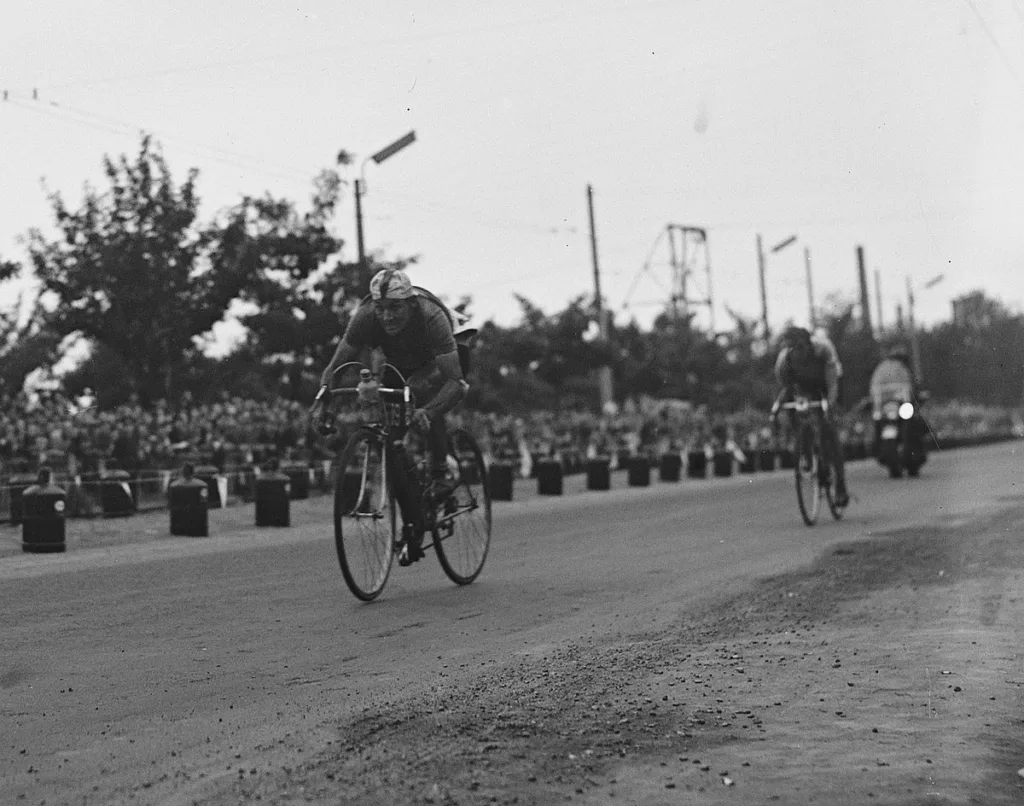
The competition has changed over time, including its scoring system. There was also a brief change of colour: the points leader wore red in 1968 before green returned the following year.

Do riders have to finish the Tour to win green?
Yes. Only riders who complete the race are included in the final points classification. A rider who abandons or is eliminated cannot win green, regardless of the lead they held.
Mountain stages can therefore be decisive even when the main contenders are far from the front. Sprinters often ride in the gruppetto, managing their effort while staying inside the Tour de France time limit. Under the 2026 rules, riders reinstated after finishing outside the limit lose their accumulated points.
What happens if riders finish level on points?
The tie is broken first by stage victories, then by intermediate sprint victories, and finally by position in the general classification.

How tactics can decide the green jersey
A close points contest affects much more than the final few hundred metres. Teams must decide whether to chase a breakaway, send riders up the road, contest an intermediate sprint or conserve their lead-out riders for the finish.
A contender with a comfortable lead can concentrate on following rivals and avoiding costly mistakes. A rider chasing a deficit may need to seek points in breakaways or on terrain that disadvantages the leader. Teammates can help by controlling the race and taking scoring positions away from opponents.
How to follow the points competition during a stage
Start with the gap between the leading riders, then check where the intermediate sprint falls and which points scale applies at the finish. Those details help explain why a team is chasing early, why a contender has joined a breakaway or why a rider is sprinting for a minor placing.
Watch who survives the climbs as well as who wins the sprint. A difficult day can remove scoring opportunities for one contender while opening them up for another. Across three weeks, those smaller gains can matter as much as the most memorable stage victories.