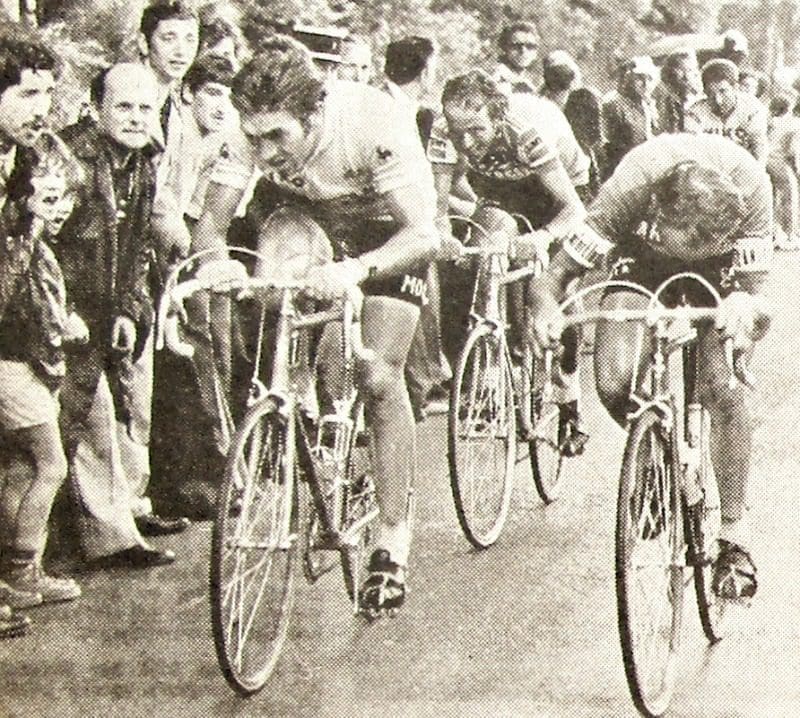
Eddy Merckx is the benchmark against which almost every other rider is measured. When cycling history turns into a quiz, a debate or a ranking exercise, Merckx is usually the safest answer because his palmarès is broader and deeper than anyone else’s. Describing him as a Classics all-rounder is accurate, but it still only captures one part of what made him unique. He won Monuments, Grand Tours, world titles and the Hour Record, often with a level of dominance that made the sport revolve around him. That is why he still stands as the defining figure in men’s cycling history.
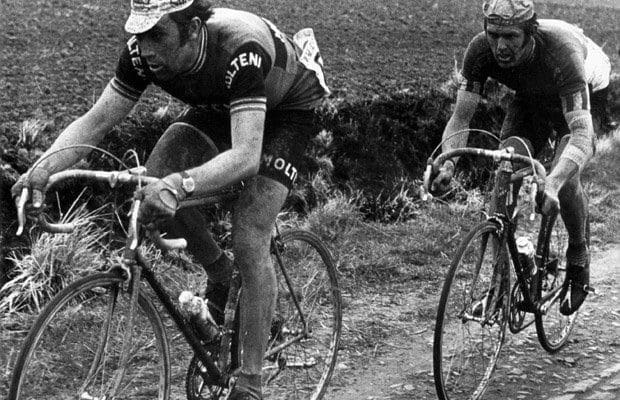
Rider history
Merckx turned professional in 1965 and wasted little time establishing himself. A year later he won Milan-San Remo for the first time, then repeated the feat in 1967. Those victories were the start of a remarkable relationship with the race, which he would go on to win seven times in total: 1966, 1967, 1969, 1971, 1972, 1975 and 1976. That remains the record. Milan-San Remo alone would be enough to guarantee him a place among the greatest Classics riders, but for Merckx it was only one strand of a much bigger story.
His Monument record remains unmatched in both scale and consistency. Alongside those seven wins at Milan-San Remo, Merckx won Liège-Bastogne-Liège five times, Paris-Roubaix three times, the Tour of Flanders twice and Il Lombardia twice. He is one of only three men to have won all five Monuments, and the only one to have won each of them at least twice. In other words, he did not merely complete the set, he mastered it.
The same pattern ran through the Grand Tours. Merckx won the Tour de France five times, the Giro d’Italia five times and the Vuelta a España once, giving him 11 Grand Tour overall victories, still the record. He was not content simply to win the general classification either. In several of those campaigns, he also took the points and mountains competitions, most famously at the 1969 Tour de France, where he won the overall, points and mountains classifications together. He also remains the record holder for total Grand Tour stage wins with 64, while his 34 Tour de France stage victories remain the benchmark there too.
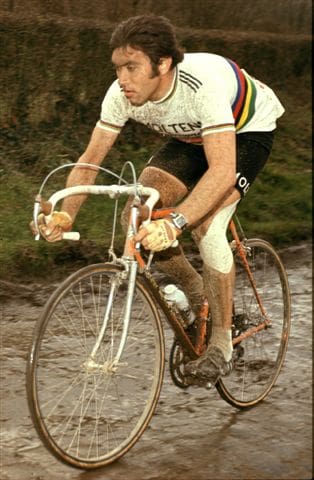
Beyond the Monuments and Grand Tours, Merckx also won the World Championships three times, in 1967, 1971 and 1974, which leaves him tied on the all-time men’s record. In 1972, he set the Hour Record in Mexico City at 49.431 kilometres, pushing the mark forward by almost 800 metres. His peak years are usually framed as 1968 to 1975, and that feels fair given the sheer volume of wins concentrated into that period. Even after that peak, he was still good enough to win Milan-San Remo again in 1976 and remain competitive at the top level before illness and physical wear finally caught up with him. He retired on the 18th May 1978.
What separates Merckx from every other great is not only the number of major victories, but the way he collected them. He could win uphill, alone, in a sprint, in the rain, over cobbles and through three weeks of stage racing. Riders such as Roger de Vlaeminck, Felice Gimondi and Raymond Poulidor could each test him in different ways, but none could match his full range. He remains the sport’s ultimate standard because there was never a single version of Merckx. There were several, and nearly all of them were better than everybody else.
Greatest race victory
1969 Tour of Flanders
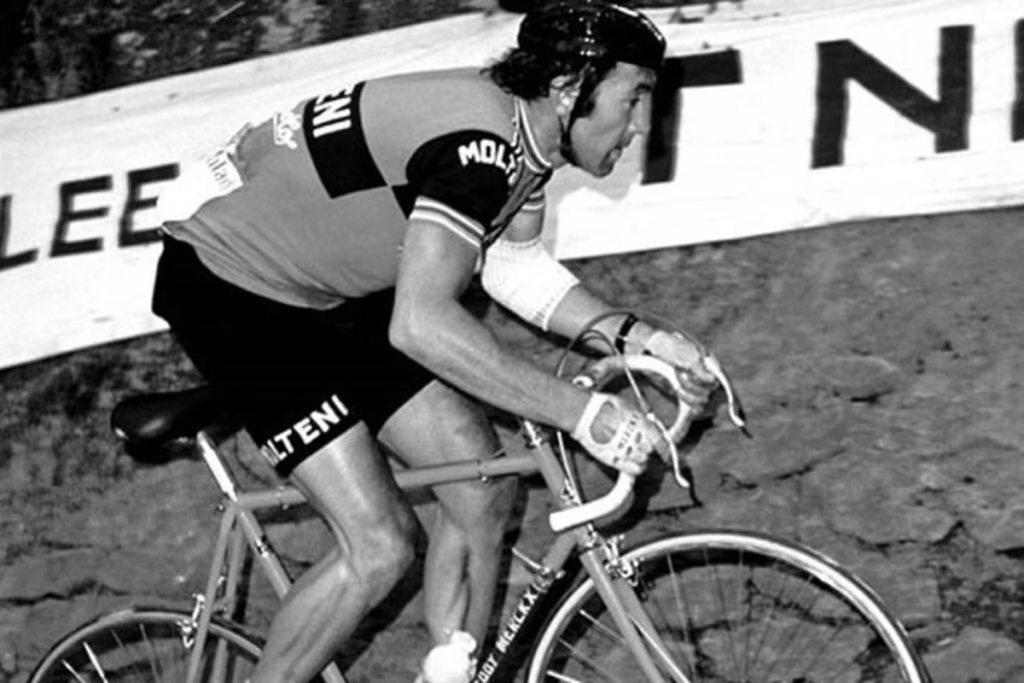
There is a strong case for several Merckx victories as the greatest of his career, but the 1969 Tour of Flanders stands out because it captures both the brutality of his racing style and the scale of his superiority. The race was held in dreadful weather, with rain, cold and wind turning the day into a war of attrition. Merckx had already helped reduce the front group before making earlier moves on the Oude Kwaremont and later around Geraardsbergen, but the moment that defined the race came with roughly 70 kilometres still to go, when he simply rode away from everyone else.
What followed was one of the most devastating solos in Monument history. Despite the headwind and despite warnings from team manager Lomme Driessens that the move was too early, Merckx kept pushing. The elastic did not just snap; it vanished. By the time he reached the finish he had put 5 minutes and 36 seconds into Felice Gimondi, still the biggest winning margin in the history of the Tour of Flanders. Third-placed Marino Basso came in more than eight minutes down.
That victory matters not only because of the margin, but because of what it announced. Merckx was still only 23, yet he had turned one of cycling’s hardest and most prestigious races into a demonstration. Plenty of riders have won the Tour of Flanders. Very few have made it look as if the race had been designed around their strengths alone. In that sense, the 1969 edition feels like one of the clearest expressions of Merckx at full force.
Spring Classics palmarès
Monuments
Milan-San Remo
1966, 1967, 1969, 1971, 1972, 1975, 1976
Liège-Bastogne-Liège
1969, 1971, 1972, 1973, 1975
Paris-Roubaix
1968, 1970, 1973
Tour of Flanders
1969, 1975
Il Lombardia
1971, 1972
Classics
La Flèche Wallonne
1967, 1970, 1972
Gent-Wevelgem
1967, 1970, 1973
Amstel Gold Race
1973, 1975
Scheldeprijs
1972
Omloop Het Nieuwsblad
1971, 1973
-
 Photo Credit: quentinphotographiebe
 -
 Photo Credit: Getty