

Paul Magnier reaches the first rest day of the Giro d’Italia 2026 with the maglia ciclamino firmly on his shoulders and a race that has already tilted towards him. Two wins from the opening three stages is a statement in any Grand Tour. Doing it against a sprint field containing Jonathan Milan, Dylan Groenewegen, Tobias Lund Andresen and other proven fast men makes it more than an early flourish.
The question is no longer whether Magnier can win stages at this Giro. He has answered that emphatically. The more interesting question is whether he can turn this opening burst into a three-week points jersey campaign.
That is a different challenge. Winning the maglia ciclamino is not just about being the fastest sprinter on the cleanest days. It is about surviving difficult stages, scoring when the route is awkward, taking points at intermediate sprints, staying healthy, and keeping enough focus deep into the race when the mountains begin to dominate the wider story.
Magnier has given himself the best possible start. Now he has to prove he can manage the race rather than simply light it up.
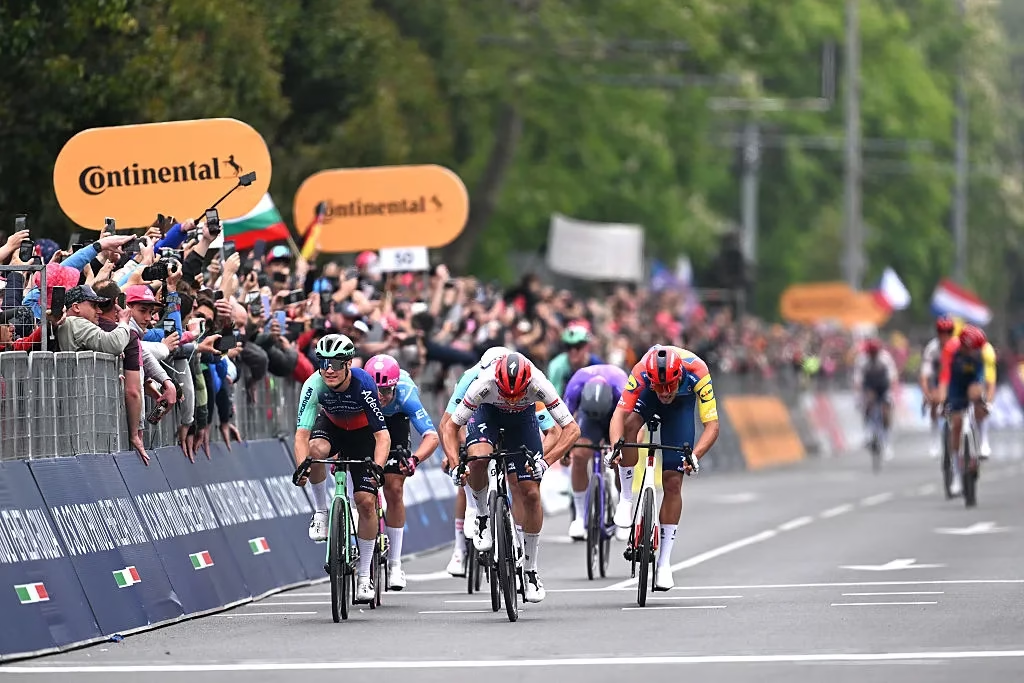 Photo Credit: Getty
Why Magnier already has control of the points race
Magnier’s early advantage is not accidental. He has won the two clearest sprint opportunities so far, taking stage 1 in Burgas and stage 3 in Sofia. Stage 2 went a different way, with Guillermo Thomas Silva winning in Veliko Tarnovo and taking the maglia rosa, but Magnier has still maximised the days that suited him best.
That is exactly how a points jersey campaign begins. The Giro rarely gives sprinters a flat, predictable route all the way through the opening week. If a rider wants the ciclamino jersey, he cannot afford to waste the obvious chances. Magnier has not wasted them.
The gap to Milan is already significant. It is not race-winning on its own, because one stage win and one poor day can change the picture quickly, but it gives Magnier space. Milan now has to chase. Lund Andresen and the rest are even further back. That means Magnier can start riding like the leader of the competition, not just a sprinter hunting individual stage wins.
That changes his tactical position. He can afford to score consistently rather than needing to win every sprint. Milan, by contrast, needs to start taking bigger chunks of points soon.
The Milan threat is still very real
Jonathan Milan has not started badly. That is important to say. He has been close, including second on stage 3 in Sofia, and he remains one of the most powerful sprinters in the race. If this becomes a long, grinding points battle, Milan still has the engine, speed and team structure to make Magnier work for the jersey.
The problem is that close results do not slow the scoreboard enough when Magnier keeps winning. A second place is useful, but it does not carry the same weight as a victory. After two bunch sprint defeats, Milan’s Giro has already taken on a slightly different tone. He is still a major contender, but he is now trying to change momentum rather than build on it.
Stage 4 into Cosenza could be important in that sense. The route from Catanzaro to Cosenza is not a pure sprint stage, with the Cozzo Tunno climb and a rising finish making it more complicated than the Bulgarian sprint days. If Milan can survive comfortably and contest the win, it keeps him in the race psychologically as well as mathematically. If he loses more ground to Magnier, the ciclamino battle becomes harder.
Milan does not need to panic, but he does need a response. The longer Magnier keeps scoring at this rate, the more Milan will need something bigger than consistency.
 Photo Credit: RCS
Stage 4 will tell us more than stages 1 and 3
Magnier’s two victories have shown his speed and confidence. Stage 4 will tell us more about his adaptability.
The first Italian stage is short, awkward and harder to control. The route from Catanzaro to Cosenza includes enough climbing to make life difficult for pure sprinters, while the final 450 metres rise at around 3.7 per cent. That does not turn it into a puncheur’s finish, but it does reward a rider who can sprint after a more uncomfortable final hour.
This is where the points jersey picture starts to become more layered. If Magnier can win or score heavily on a day like this, his case becomes much stronger. It would show that he is not dependent only on flat, high-speed bunch finishes. It would also suggest that Soudal Quick-Step can protect him through more complicated terrain.
Tobias Lund Andresen and Corbin Strong look especially dangerous on this type of stage. Both sit in that useful space between sprinter and punchy finisher, and both could benefit if the heavier fast men lose support over the climb. Magnier does not necessarily need to beat them all to strengthen his points lead, but he cannot afford to disappear from the front of the race.
This is the kind of stage where points jersey campaigns are often shaped quietly. A win would be spectacular. A top-five finish might be almost as important.
The Giro points jersey rewards more than pure speed
The maglia ciclamino is often described as the sprinters’ jersey, but that is only partly true. The Giro’s route rarely gives the pure sprinters enough simple days to reduce the competition to repeated drag races. A rider who wants to win it must score across different types of stages.
That means Magnier needs three things.
First, he needs to keep taking full advantage of the obvious sprint days. That is where Milan, Groenewegen and the other pure fast men will expect to score heavily. Magnier has already shown he can beat them there.
Second, he needs to remain competitive on the awkward stages. Stage 4 is the first example, but more will follow. These are the days where a sprinter with slightly better climbing legs can add points while rivals are either dropped, isolated or too tired to finish properly.
Third, he needs to survive the mountains. He does not need to be visible every day once the Giro becomes a GC race, but he does need to stay in the race, manage time cuts and avoid losing the jersey by absence. Points classifications can look secure until a rider has one bad mountain stage, one crash, or one illness.
Magnier’s opening speed gives him an advantage. His durability will decide whether it becomes a winning campaign.
 Photo Credit: Getty
Soudal Quick-Step now have a clear race to ride
Magnier’s start also gives Soudal Quick-Step clarity. Two stage wins and the ciclamino jersey mean the team already has a successful Giro, but it also gives them a reason to keep investing in control.
That can be a blessing and a burden. On sprint days, the team will be expected to work. On intermediate stages, they will need to decide whether to chase for Magnier, allow breakaways more freedom, or let other teams take responsibility. The points jersey changes the calculation because scoring opportunities are not limited to stage finishes.
If Magnier keeps leading the classification, Soudal Quick-Step may have to think about intermediate sprints as well as final sprints. That does not mean chasing every move, but it does mean being attentive. A few points here and there can matter if Milan starts winning later in the race.
The team also has to protect Magnier physically. Grand Tour sprinting is stressful. The crashes, the fights for position, the repeated accelerations and the mental energy of every finale all add up. A sprinter trying to win a points jersey needs a team that saves him from unnecessary effort, not just one that launches him in the final kilometre.
So far, Soudal Quick-Step have looked organised. The question is whether they can maintain that structure once the race becomes less predictable.
Magnier’s biggest advantage is momentum
Points matter, but momentum matters too. Magnier is racing like a rider who believes every sprint is winnable. That is powerful in a Grand Tour.
A sprinter in form does not just produce more speed. He makes better decisions. He trusts gaps. He commits earlier or later with conviction. His lead-out rides with more belief. Rivals begin to second-guess themselves. Milan launching slightly too early in Sofia, with Magnier coming past him at the line, is exactly the kind of moment that can sit in the mind after the stage.
That does not mean Magnier is unbeatable. Sprinting can turn quickly. One boxed-in finish, one mistimed lead-out, one bad day over a climb and the picture changes. But through three stages, he has looked like the rider with the clearest rhythm.
The maglia ciclamino often rewards repeatability. Magnier has already shown that his stage 1 win was not a one-off. That alone makes him a much more serious points jersey candidate than he was at the start in Bulgaria.
 Photo Credit: RCS
Where could the jersey be lost?
The obvious danger is the mountains. Magnier does not need to compete there, but he does need to get through them. The Giro has a habit of reshaping secondary classifications through attrition. A sprinter can look comfortable after the first week, then suddenly find the route offering fewer chances and more survival days.
Another danger is Milan’s response. If Milan wins the next clear sprint stage, the points gap begins to feel different. If he wins two, the entire classification reopens. Magnier’s current lead is strong, but not decisive enough to remove pressure.
There is also the reduced sprint problem. Stages like the one into Cosenza can be good for Magnier, but they can also bring other riders into the race. Lund Andresen, Strong, Kaden Groves, Madis Mihkels and even puncheur-style finishers can take points away from both Magnier and Milan. If those riders begin scoring regularly, the classification becomes more complicated.
The final danger is tactical fatigue. Chasing the points jersey requires attention on days when other riders can switch off. Magnier must decide when to contest, when to conserve, and when to let points go. That balance is not easy for a young sprinter who has started the race by winning almost everything available.
Can Milan still overhaul him?
Yes. Milan remains the biggest threat because he has the speed to win multiple stages and the power to score heavily whenever the race comes back together.
The difference is that Milan now needs the race to start turning his way. He needs cleaner sprint opportunities, better final positioning, and ideally a stage where Magnier misses out. If the next sprint goes Milan’s way, the points competition immediately feels alive again. If Magnier beats him again, the psychological gap becomes much larger than the numerical one.
Milan’s best route back into the contest is simple: win soon, then keep scoring on every flat day. He does not need to do anything unusual yet. He just needs to turn his near-misses into victories.
But that is easier to write than to do. Magnier has already beaten him twice in the moments that counted most. Until Milan changes that pattern, Magnier remains in control.
-
 Photo Credit: A.S.O./Gaëtan Flamme
Why Magnier can win the maglia ciclamino
Magnier can win the Giro d’Italia points jersey because he has already built the foundation that every ciclamino campaign needs: stage wins, a clear points lead, team commitment and confidence.
He has also shown that he can handle pressure. Winning the opening stage of a Grand Tour brings attention immediately. Losing pink on stage 2 could have shifted the story away from him. Instead, he answered with another sprint win in Sofia. That response showed a rider focused on the next opportunity rather than caught up in what had just changed.
The remaining question is range. If Magnier can keep scoring on slightly harder days, not just flat ones, he becomes very difficult to beat. If he is limited to the pure bunch sprints, Milan and others still have a route back.
Right now, the balance is clearly in Magnier’s favour. He has the points, the wins and the momentum. Milan is still close enough to make it a contest, but he is chasing a rider who has already made the Giro sprint hierarchy look different from what many expected.
Verdict: Magnier is the favourite, but not safe yet
Paul Magnier should now be considered the favourite for the Giro d’Italia 2026 points jersey. Two wins from three stages have given him control of the maglia ciclamino, and his lead over Jonathan Milan is already large enough to shape how the next sprint stages are raced.
It is not over. Milan is too strong, the route is too varied, and the Giro is too unpredictable for that. The points jersey can still swing through one bad day, one missed sprint or one strong Milan response. But Magnier has moved beyond being an early-stage winner. He has become the reference point of the competition.
If he keeps surviving the harder days, keeps scoring when the route is messy, and keeps turning sprint chances into podiums or wins, the maglia ciclamino is not just possible. It is now his race to lose.

