
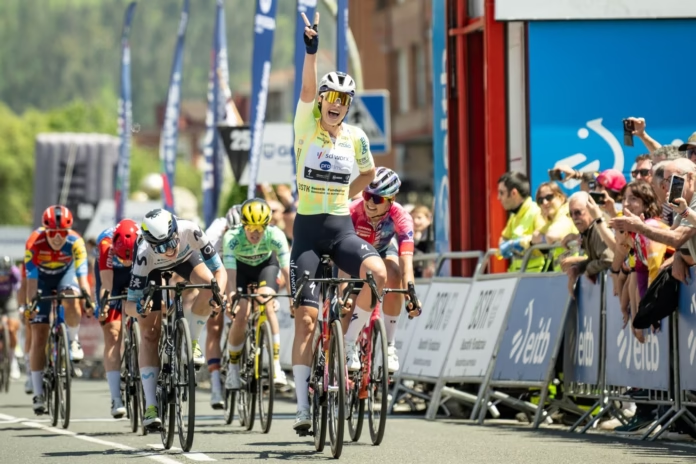
Itzulia Women 2026 begins on Friday, 15th May, with a stage that immediately sets the tone for the race. There is no gentle opening day, no flat procession, and no obvious sprint stage for the peloton to settle into the rhythm of the Basque Country. Instead, stage 1 starts and finishes in Zarautz, covers 121.3km, and includes six climbs across a route that should begin shaping the general classification straight away.
That is typical Itzulia. The race is only three days long, which means there is no time to repair a bad opening stage. A missed split, a poorly timed mechanical, a bad descent or a moment of hesitation before the final climb can all carry real consequences. Stage 1 may not decide the race outright, but it should quickly show which riders are comfortable on this terrain and which teams have enough strength to control it.
The key climbs include Santa Ageda and Etumeta, while the run back towards Zarautz after the final descent from Garate gives the stage a slightly unusual shape. The hardest work comes before the finish rather than right on the line, so this could be won by a reduced group, a late attack, or a rider who times the final descent and flat run-in perfectly.
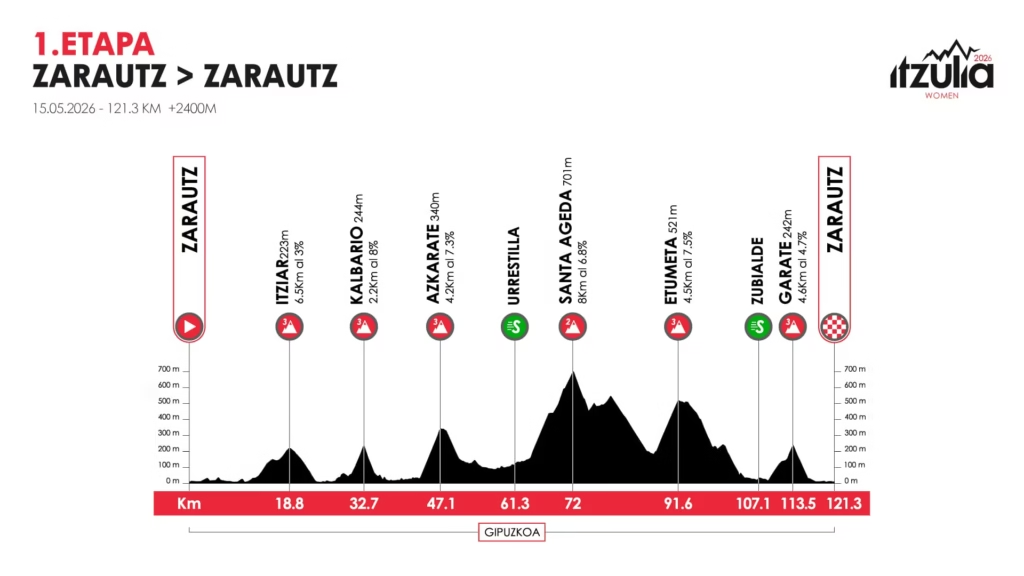
Itzulia Women 2026 stage 1 route
Stage 1 runs from Zarautz to Zarautz over 121.3km, with more than 2,200 metres of climbing. The route loops through classic Basque terrain, with repeated climbs, technical descents and very little space for the race to become fully settled.
The opening part should already be active. With six climbs on the day, teams will know that allowing the wrong breakaway too much freedom could become dangerous. At the same time, the strongest squads may not want to spend the whole day chasing before two more demanding stages.
Santa Ageda is one of the main climbs, at around 8km with an average gradient close to 6.8 per cent. That is long enough to test the field properly, particularly if the pace is high. It is not a climb that should automatically decide the stage, but it can remove weaker riders and reduce the number of teammates around the leaders.
Etumeta is shorter but sharper, at around 4.5km and 7.5 per cent. That profile is more obviously suited to attacks. It gives punchier climbers a place to make the race harder, especially if the group has already been thinned by the earlier climbs.
After the final descent from Garate, the finish in Zarautz is relatively flat. That means the stage does not automatically favour the pure climbers. The winner will need to climb well enough to survive or create the selection, but still have speed, positioning and nerve for the run back to the line.
What time does Itzulia Women stage 1 start?
Stage 1 starts at around 10:16 local time in Spain, which is 09:16 in the UK.
The finish is expected between 13:20 and 13:40 local time, which is between 12:20 and 12:40 in the UK. With repeated climbs throughout the stage, the race could become important well before the final 30 minutes.
Key stage details:
- Date: Friday, 15th May
- Route: Zarautz to Zarautz
- Distance: 121.3km
- Elevation gain: around 2,200 to 2,400 metres
- Main climbs: Santa Ageda, Etumeta and Garate
- Stage start: around 09:16 UK time
- Expected finish: around 12:20 to 12:40 UK time
- Likely outcome: reduced sprint, late attack or small-group finish
Why stage 1 matters for the GC
In a three-day race, the opening stage cannot be treated as a warm-up. Itzulia Women does not give riders much time to recover from mistakes, and stage 1 has enough climbing to create gaps if the strongest teams decide to race early.
The most important point is the accumulation. None of the climbs has to be decisive on its own. The repeated effort, the positioning before each ascent, the descents and the lack of easy recovery can all reduce the bunch gradually. That is often how Itzulia works. The race is not always blown apart by one single move. It is often shaped by repeated pressure until only the strongest and best-positioned riders remain.
Stage 2 and stage 3 both offer more chances to reshape the standings, but losing time on stage 1 would immediately force a rider onto the defensive. That makes the opening day tactically awkward. GC teams have to stay alert without overcommitting. Stage hunters will sense an opportunity. Teams with multiple leaders can use the terrain to test rivals early.
The bonus seconds also matter. If the stage finishes from a small group, the winner could take an early hold on the race. In a three-day event, even a few seconds can alter the entire tactical picture.
Who does the stage suit?
Stage 1 should suit riders who can climb repeatedly and still finish quickly. The flat finish after the final descent means pure climbing is not enough. A rider who can survive the hardest sections and then sprint from a reduced group may have the best profile.
That brings several types of rider into the picture. Puncheurs will like the shorter, sharper climbs. Stage-race climbers will like the accumulation of climbing. Fast finishers who can survive hills will look at the flat run-in and see a real chance. It is not a day for pure sprinters, but it is not quite a pure climbers’ stage either.
Positioning will be central. Riders who drift too far back before Santa Ageda or Etumeta may find themselves burning energy to close gaps rather than following the race. The descents also matter. A rider who can descend confidently after the final climb could create or protect a small advantage before the flat approach to Zarautz.
This is exactly the sort of stage where a team with more than one option can be difficult to control. If one rider attacks on the climb and another waits for the sprint, rivals are forced to choose which threat matters most.
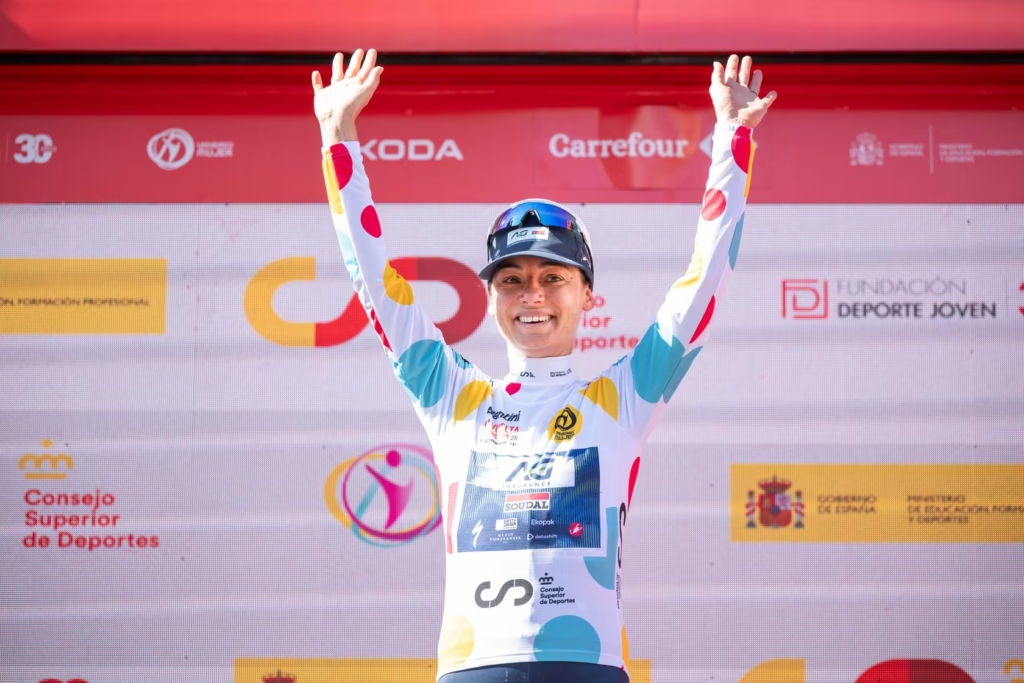 Photo Credit: Aritz Arambarri
Riders to watch on stage 1
Ashleigh Moolman-Pasio is one of the clearest names for a selective opening stage. She has the experience, climbing strength and patience for a day where the race is likely to be reduced through accumulation rather than one single decisive climb. AG Insurance-Soudal also have Justine Ghekiere, who gives them another strong card if the climbs are raced hard. Ghekiere’s ability to handle repeated climbing efforts makes her especially useful on a Basque stage where the difficulty comes in layers.
FDJ-Suez have several riders who fit the opening stage well. Evita Muzic is a natural contender if the race becomes a climbing-heavy selection, while Juliette Berthet should be dangerous if the steepest sections create a smaller front group. Eglantine Rayer gives the team another option for a tactical finale, particularly if the decisive move comes from a reduced group rather than a pure climbing battle.
Canyon SRAM zondacrypto brings a line-up that should be well-suited to the route. Antonia Niedermaier is the obvious climbing card and could use the repeated ascents to test the field early. Soraya Paladin is dangerous if the race comes back together in a reduced group, while Chiara Consonni gives the team a faster option if the climbs do not remove enough riders. Maike van der Duin may also be useful in a controlled but selective finish, although the stage probably needs to be less aggressive for that scenario to work.
Ella Wyllie looks like Liv AlUla Jayco’s strongest option if the climbs do real damage. She has the right profile for a hard Basque stage and should be more comfortable if the final selection is small. Mackenzie Coupland gives the team support on rolling terrain, while the overall approach will likely depend on how quickly the race starts to split on the key climbs.
Movistar Team still have reasons to be active, even without some of their most obvious climbing names. Paula Ostiz gives them a young home option with clear motivation, while Marlen Reusser’s presence changes the tactical picture if she starts. Reusser is not a pure climber, but she can make rolling and hilly terrain extremely uncomfortable through sustained power. If the stage becomes more about pressure between climbs than one direct uphill attack, she becomes much more dangerous.
Team SD Worx-Protime remain difficult to ignore because of their depth. Mischa Bredewold is a strong option for a reduced finish, especially if the race is hard but not fully broken apart. Niamh Fisher-Black is another important card on this terrain, with the punch and climbing ability to follow moves on the sharper sections. If the race turns tactical, SD Worx-Protime have the strength to place riders in the right move rather than simply wait for the finale.
UAE Team ADQ should look towards riders who can handle a selective day without needing a pure summit finish. Silvia Persico is dangerous if she survives the repeated climbs and reaches the final group, while Erica Magnaldi gives them a more climbing-focused option if the race becomes harder. The route is awkward enough for UAE to avoid committing too early, but they have the riders to stay involved if the front group is gradually reduced.
Laboral Kutxa-Fundación Euskadi should be highly motivated on the Basque roads. Usoa Ostolaza is a serious contender if she starts in the same climbing form she showed during La Vuelta Femenina. Ane Santesteban also suits this kind of terrain, with the experience and climbing ability to survive repeated pressure. The team may not control the race, but they have every reason to race aggressively and use the local terrain to their advantage.
Human Powered Health also have interesting cards for this sort of opening stage. Thalita de Jong can be dangerous in a reduced group if she survives the hardest sections, while Yurani Blanco has the climbing strength to get involved if the race becomes more selective. Mona Mitterwallner is another rider to watch if the repeated climbs start to split the field properly.
Could a breakaway win?
A breakaway has a chance, but it will need the right mix. The route is hard enough for strong riders to get clear, yet the stage is important enough that GC teams may not want to give too much away on day one.
The most likely successful move would be one that forms after the race has already become selective, rather than an early breakaway that goes from the opening kilometres. A small group of strong climbers and puncheurs over Etumeta or Garate would be much harder to control than a long-range move given a predictable gap.
The flat finish also makes the chase more possible. If a reduced peloton is organised after the final descent, a lone attacker may struggle to hold on into Zarautz. But if the front group is small, tired or tactically divided, a late move could survive.
That is the tactical tension of the stage. The climbs are hard enough to create separation, but the finish gives teams a reason to chase if they still have numbers.
What will the main teams do?
The strongest teams need to decide how aggressive they want to be. With only three stages, waiting too long can be dangerous. But using up support riders on stage 1 could leave a team exposed on stages 2 and 3.
FDJ-Suez, Canyon SRAM zondacrypto, AG Insurance-Soudal, Team SD Worx-Protime, Movistar Team, UAE Team ADQ, Laboral Kutxa-Fundación Euskadi and Human Powered Health all have riders who can benefit from a selective opening stage. The question is whether they want to create that selection themselves or simply be ready when another team does it.
A team with a fast finisher from a reduced group may prefer a controlled but hard race. A team with pure climbers may want to make Etumeta and Garate more decisive. A team with several options can send riders forward, forcing rivals into difficult choices.
The first stage should tell us a lot about team hierarchy. If one rider is protected all day, the GC plan is clear. If teams attack with multiple riders, the race could become much more chaotic.
Itzulia Women 2026 stage 1 prediction
Stage 1 should be selective, but the flat finish in Zarautz makes it difficult to call. The climbs are hard enough to reduce the bunch, especially Santa Ageda and Etumeta, but the final descent and run-in could allow a small group to contest the stage.
That points towards a rider who can climb repeatedly without losing finishing sharpness. Mischa Bredewold looks like a strong pick if the front group is reduced but not completely stripped down to pure climbers. She has the strength to survive the Basque climbs, the tactical support of Team SD Worx-Protime and the speed to finish it off in Zarautz.
Moolman-Pasio, Muzic, Berthet, Niedermaier, Wyllie, Fisher-Black, Persico, Ostolaza and Santesteban all make sense depending on how hard the race becomes. But for an opening stage with repeated climbing and a flat finish after the final descent, Bredewold offers the best blend of resilience and finishing speed.
Prediction: Mischa Bredewold to win stage 1 in Zarautz.

