
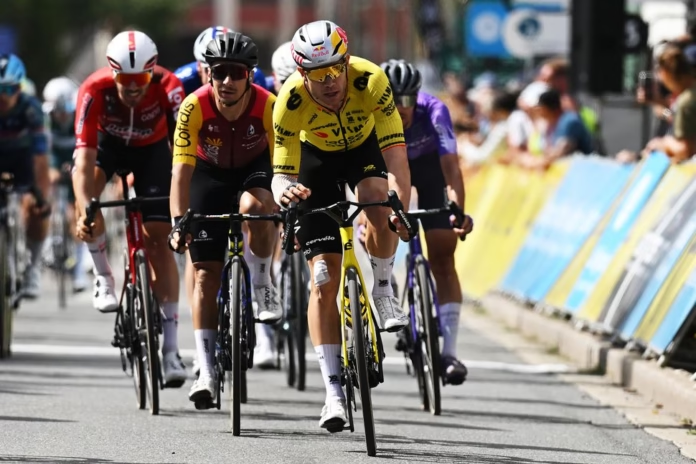
The Tour Auvergne – Rhône-Alpes 2026 reaches its fifth stage on Thursday, 11th June, with the race travelling 195.8km from Saint-Chamond to the Parc des Oiseaux – Villars-les-Dombes. After the repeated hilly tests of the opening four days and before the race turns decisively towards the mountains, this is the clearest remaining chance for the faster riders.
It is not a completely flat stage, despite looking like the most sprint-friendly day of the race. The climbing comes early, with two category 4 ascents inside the opening 8km, before a rolling middle section through the Rhône and Beaujolais terrain. Once the race reaches the Ain, the final 65km flatten out considerably, giving the sprint teams a long enough runway to bring things back together if they have the numbers and motivation.
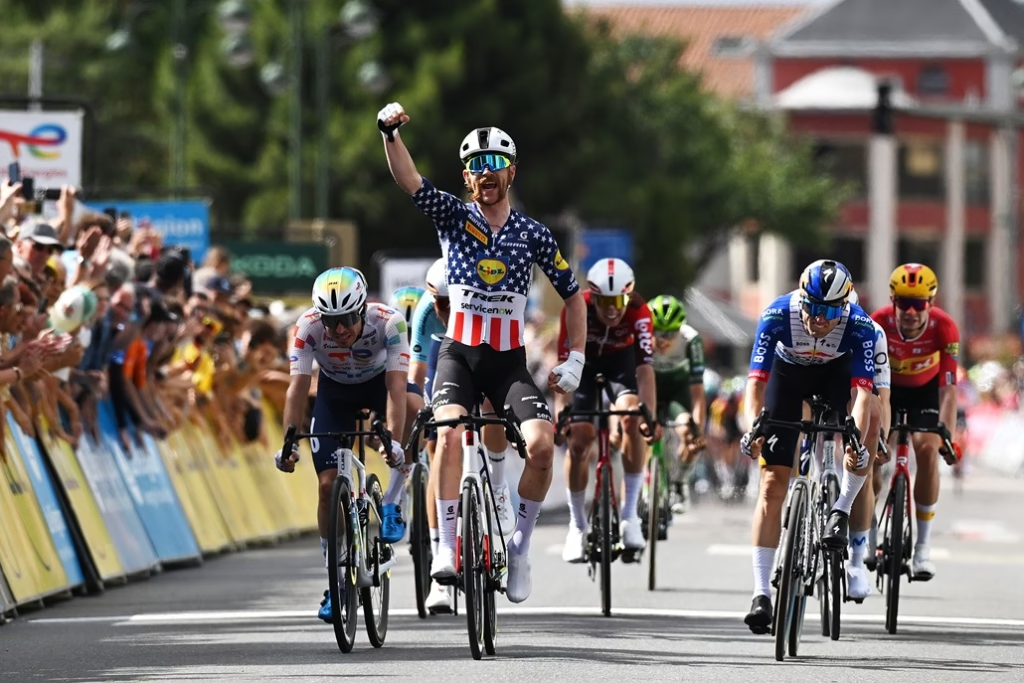
Quinn Simmons won stage 4 from a strong breakaway that only just held off the peloton in Montrond-les-Bains, while Alex Baudin retained the yellow jersey for another day. That result matters for stage 5 because it should sharpen the sprinters’ teams. They missed one opportunity on Wednesday, and with three summit-finish days to follow, Thursday looks like the last realistic chance to control the race before the GC battle takes over.
The Tour Auvergne – Rhône-Alpes 2026 full route guide sets out the whole eight-stage structure, while the How to watch Tour Auvergne – Rhône-Alpes 2026 in the UK guide covers the broadcast picture for UK viewers.
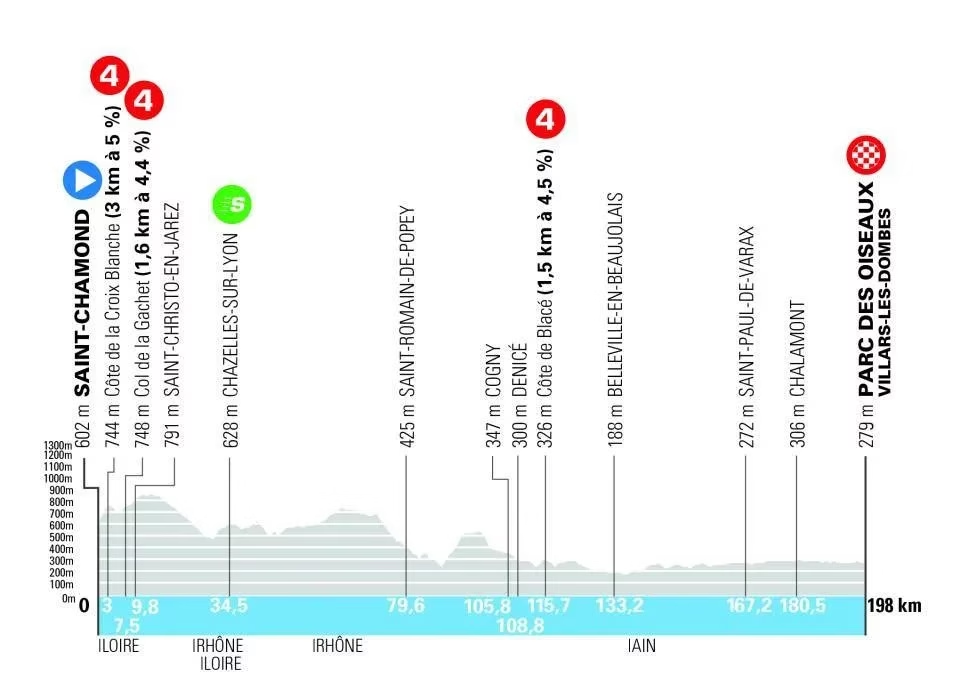
Tour Auvergne – Rhône-Alpes 2026 stage 5 route
Stage 5 starts in Saint-Chamond and finishes at the Parc des Oiseaux – Villars-les-Dombes after 195.8km. The official classification labels the stage as accidentée, but the profile is really a split day: climbing and rolling roads early, then a much flatter approach to the finish.
The two categorised climbs come almost immediately. The Côte de la Croix-Blanche arrives after 3km, measuring 3km at 5%. The Col de la Gachet follows at 7.5km, with 1.7km at 4.4%. Both are category 4 climbs, and both are more important for shaping the early breakaway than deciding the stage. They will give attackers a platform, but they are too far from the finish to trouble the main sprinters if the pace settles afterwards.
The route then rolls north through Saint-Symphorien-sur-Coise, Sainte-Foy-l’Argentière, Saint-Laurent-de-Chamousset and the Val d’Oingt area. This section is not flat, and it could keep the breakaway alive for longer than the sprint teams want if the peloton hesitates. The road towards Oingt and Blacé also gives the stage its final real undulations before the race settles into the flatter roads of the Ain.
The intermediate sprint comes at Blacé after 108.7km. From there, the route passes through Saint-Étienne-des-Oullières, Odenas, Belleville-en-Beaujolais, Montceaux, Chaneins, Saint-Paul-de-Varax and Chalamont before the finish at the Parc des Oiseaux – Villars-les-Dombes.
The final kilometres should be much easier to control than the first half of the stage. The run-in is flat, and the finishing straight has only a minimal gradient. If the race is together inside the final 10km, this should become a sprint.
Stage 5 timings
The stage is scheduled to begin at 12:30 local time, which is 11:30 BST. The finish is expected between 16:55 and 17:18 local time, or 15:55 and 16:18 BST, depending on the average speed.
That makes it a relatively straightforward viewing day for UK fans. The early climbs will decide the breakaway, but the main action should come in the final hour as the sprint teams try to control the gap and position their fast riders for Villars-les-Dombes.
What is on offer?
Côte de la Croix-Blanche
Category 4
3km at 5%
Summit after 3km
Col de la Gachet
Category 4
1.7km at 4.4%
Summit after 7.5km
Intermediate sprint
Blacé
After 108.7km
Finish
Parc des Oiseaux – Villars-les-Dombes
195.8km
How the stage could unfold
The start should be lively because the first two climbs come almost immediately. Riders targeting the mountains jersey, breakaway specialists and teams without sprint options should all be interested in the opening kilometres. With only one point available on each categorised climb, the mountains classification may not be the only motivation, but those early ascents give the breakaway a natural launchpad.
The question is whether the peloton allows a strong group to go. Stage 4 showed how difficult it can be to bring back a committed breakaway, especially when the move contains powerful riders and the peloton hesitates. Stage 5 is longer and flatter in the finale, which helps the sprinters, but the rolling first half could still make the day awkward.
Once the race passes Blacé and moves towards Belleville-en-Beaujolais, control should become easier. The final 65km are flat enough for teams to organise, and the sprint squads will know that chances disappear quickly after this stage. Stage 6 finishes at Crest-Voland, stage 7 goes to the Grand Colombier and stage 8 ends at Plateau de Solaison. For the fast men, Villars-les-Dombes may be the last real opportunity.
That should create a more committed chase than on stage 4. If the break is made up of riders with no GC threat and no major sprint-team representation, it should be kept within reach. If a powerful group goes with several teams represented, the race could again become more complicated.
Why stage 5 matters for the GC
Stage 5 is unlikely to decide the general classification, but it still matters for the GC riders. This is the day before the race turns sharply uphill, and nobody will want to lose time, crash or waste energy before the final mountain block.
Alex Baudin’s yellow jersey has survived the team time trial and stage 4, but the hardest part of the race is still ahead. Kévin Vauquelin, Oscar Onley and Matteo Jorgenson remain close enough to keep the overall battle tense, with Juan Ayuso, Mattias Skjelmose, Jørgen Nordhagen and others still waiting for the climbs to reshape the standings.
For the GC teams, the aim is simple: stay safe, avoid splits and save as many riders as possible for stages 6, 7 and 8. The final 20km may be flat, but sprint finales are rarely comfortable for climbers. Positioning will be important, especially with nervous teams trying to protect leaders before three consecutive mountain stages.
The real GC race resumes on Friday, but stage 5 can still punish inattention. A crash, a split in the final kilometres or a badly timed mechanical could undo the work of the first half of the race.
-
 Photo Credit: A.S.O./Gaëtan Flamme

Who does stage 5 suit?
Stage 5 suits sprinters who can handle a long day with early climbing. It is not a pure pan-flat procession, but the hard terrain comes far enough from the finish that the fastest riders should survive if their teams control the race properly.
Wout van Aert is an obvious name to watch, although his form has been a question across the opening days. This is the kind of stage where Team Visma | Lease a Bike could either chase for him or use him in a wider tactical role, depending on how they want to manage their resources before the mountains.
Dorian Godon should also be suited to this type of stage. He has the strength for rolling terrain and the sprint to finish from a reduced or organised group. Per Strand Hagenes is another rider who fits the profile well, particularly if Team Visma | Lease a Bike want a second option alongside Van Aert.
Bryan Coquard is a dangerous choice if Cofidis commit to the chase. The stage is not too hard for him, and the flatter finale gives him a clearer chance than the hillier finishes earlier in the week. Hugo Hofstetter is another rider who can survive rolling terrain and compete if the bunch sprint is slightly reduced.
The breakaway cannot be dismissed. Simmons’ stage 4 win will encourage attackers, but it may also make the peloton less generous. If the sprint teams sense one of their final chances slipping away, they should ride much more decisively.
Prediction
This looks like the best remaining chance for a sprint before the Tour Auvergne – Rhône-Alpes turns into a mountain race. The early climbs and rolling first half will make the breakaway fight lively, but the long flat approach to Villars-les-Dombes gives the peloton enough road to organise.
Van Aert remains hard to read because of his slow start to the race, but this is exactly the kind of day where he can ride himself back into the conversation. If Team Visma | Lease a Bike commit to him, he has the strength to handle the early terrain and the finishing speed to win from a reduced or full bunch.
Prediction: Wout van Aert

