
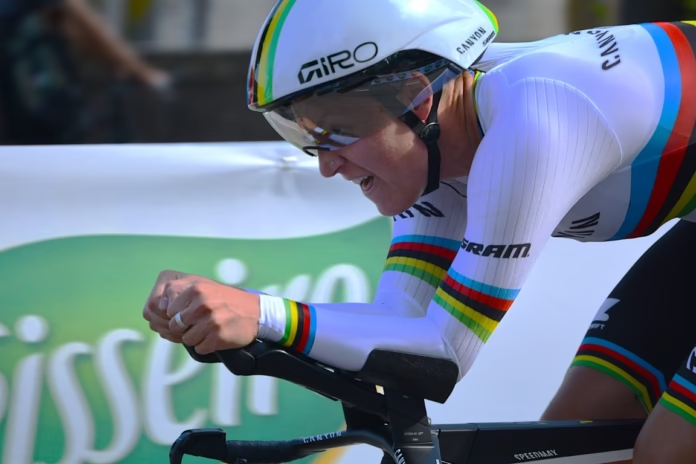
Chloé Dygert’s attempted return to full training has suffered another setback, with the American confirming she has been diagnosed with RED-S, picked up a virus, and now requires further surgery on both her shoulder and nose.
The update comes during what is expected to be Dygert’s final season with Canyon SRAM, bringing a difficult personal and sporting period into sharper focus after a long spell defined by major highs, repeated setbacks and constant attempts to rebuild momentum.
Dygert confirms RED-S diagnosis and further setbacks
Dygert had been working back towards racing after a long rehabilitation spell, but her latest update makes clear that the comeback has not progressed as hoped.
“Well, that comeback lasted about two rides,” Dygert wrote. “After months of rehab, it became clear that something still wasn’t right.”
She confirmed that she has now been officially diagnosed with RED-S, Relative Energy Deficiency in Sport, a condition that can affect health, recovery and performance when the body does not have enough available energy to support training demands and normal physiological function.
Dygert also said she had picked up a virus, while blood markers “continue to trend in the wrong direction”. Taken together, that points to a rider whose body is not yet ready to absorb the workload needed for a return to elite competition.
Shoulder injury from Roubaix crash needs surgery
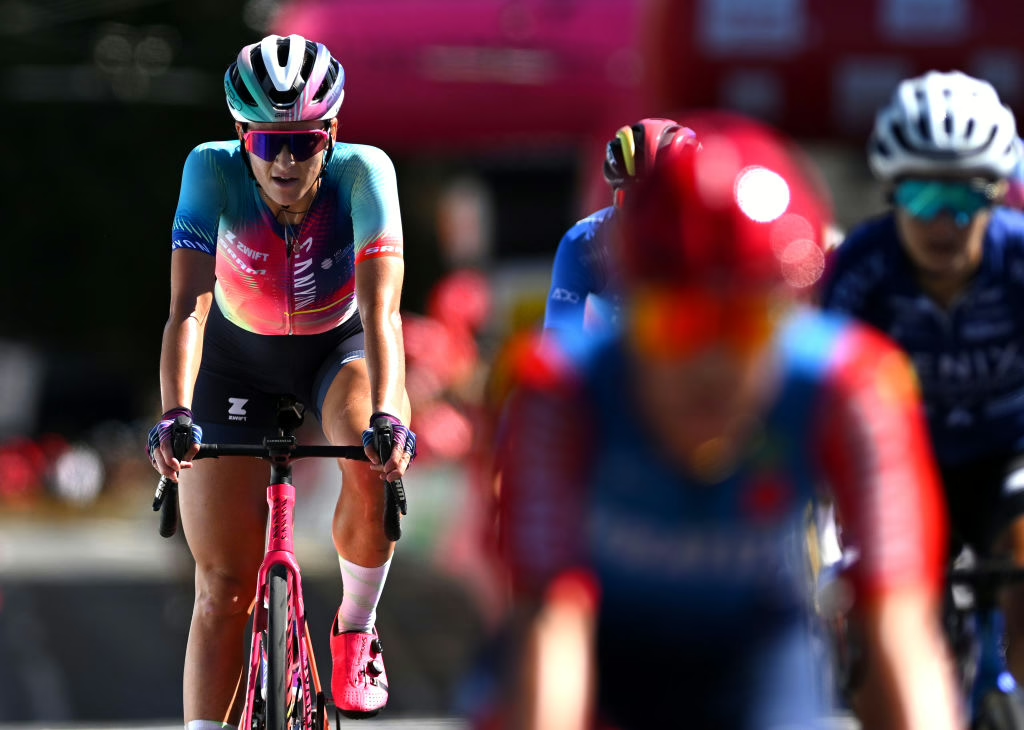
The physical issues have also extended beyond general health. Dygert confirmed that an MRI showed the shoulder damage from her Paris-Roubaix crash still requires surgery after rehabilitation did not solve the problem.
That is a major blow because shoulder injuries can be especially difficult for road riders. Even once a rider can pedal normally, pain, instability or weakness in the upper body can affect handling, sprinting, descending, braking and confidence in the bunch.
Dygert had hoped rehab would be enough, but the latest imaging has changed the plan. She will now need surgery, adding another recovery block to an already disrupted season.
Further imaging also revealed a collapsed nasal valve, which will also require surgery. That adds another layer to the picture, especially for a rider trying to rebuild full training capacity.
A difficult final chapter with Canyon SRAM
The timing is significant because Dygert is expected to leave Canyon SRAM at the end of the season after six years with the team. Her time with the squad has run through one of the most visible periods in the Women’s WorldTour, but it has also been repeatedly interrupted by injury, illness and difficult recovery blocks.
Her spell with the squad has included major highs, but continuity has often been the missing piece. Dygert has long been one of the most powerful and distinctive riders in women’s cycling, capable of producing world-class performances against the clock and on the track, yet the road back from setbacks has rarely been straightforward.
That contrast has shaped much of her Canyon SRAM story. When she has been healthy, Dygert has shown the raw level that made her such a major signing. When setbacks have arrived, they have tended to interrupt precisely the periods when she looked ready to build momentum.
 Photo Credit: Getty
Wider change around Canyon SRAM
Dygert’s situation also comes during a wider period of change for the team. Canyon SRAM recently terminated its partnership agreement with zondacrypto with immediate effect, citing breaches of contract, and returned to the Canyon SRAM name before the Giro d’Italia Women.
That team-level reset is separate from Dygert’s health situation, but it adds to the sense of transition around the squad. Canyon SRAM remain a major force, with a history that includes a Tour de France Femmes overall victory, world titles and one of the most distinctive development pathways in the women’s peloton. Still, the expected departure of a rider of Dygert’s profile would mark another notable change before 2027.
For Dygert, the sporting picture is more immediate. The goal is still to return, but the route back has become longer and less straightforward.
“Not exactly the update I was hoping to share,” Dygert said. “But for now it’s back to focusing on recovery, getting healthy, goals haven’t changed. Just the path getting there has. I’ll be back.”
-
 Photo Credit: Getty


Recovery becomes the only priority
For now, there is no meaningful race target to discuss. Dygert’s immediate focus has to be health, surgery and recovery rather than a return date.
That is particularly true with RED-S involved. The condition requires careful management because it is not simply a matter of fitness or form. It affects the broader balance between energy intake, training load, hormonal function, immune response and recovery, all of which are central to whether an elite rider can safely train and compete.
Dygert’s message still carried defiance, but it also made clear that forcing the process is no longer an option. After a comeback that barely got going, the next step is another reset.
Her Canyon SRAM chapter now appears likely to end without the racing block she would have wanted, but Dygert’s own message leaves little doubt that she still sees a future beyond this setback.

