
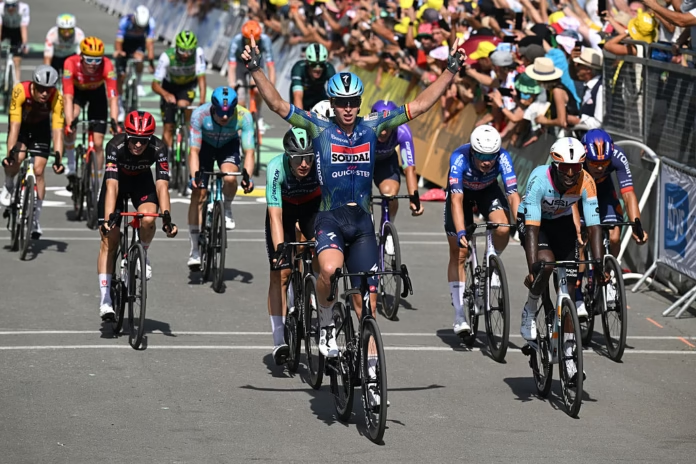
Tim Merlier won stage 8 of the 2026 Tour de France in Bergerac, producing a huge late surge to beat Biniam Girmay and Olav Kooij after a long-range attack from Liam Slock was caught just before the final kilometre. The Soudal Quick-Step sprinter had looked boxed in as Alpecin-Premier Tech launched Jasper Philipsen through Mathieu van der Poel, but Merlier came from behind with the speed to pass the front line and take his second stage win in two days.
Girmay finished second for NSN Cycling Team, with Kooij third for Decathlon CMA CGM. Philipsen, who had again been placed by Van der Poel, had to settle for fourth, while Pavel Bittner completed the top five for Team Picnic PostNL.
The victory gave Merlier back-to-back Tour stage wins after his success in Bordeaux, making him the first sprinter to do so since Philipsen in 2023. It also pulled him much closer to Mads Pedersen in the points classification, turning the green jersey fight into one of the sharper subplots of the race.
Another sprint day, but not a straightforward one
Stage 8 took the race over 180.4 kilometres from Périgueux to Bergerac, offering the sprinters another opportunity after Merlier’s win in Bordeaux the previous day. On paper, it was another controlled transition stage, but the terrain was a little more awkward than stage 7, with rolling roads, two category 4 climbs and a finish that rose slightly towards the line.
Tadej Pogačar started the day in yellow after his dominant stage 6 win at Gavarnie-Gèdre. There was little expectation that the GC contenders would be tested directly, but with heat, narrow roads and a late sprint all in play, it was still a day where avoiding trouble mattered.
The main sprint teams had clear incentives to keep the stage under control. Soudal Quick-Step had won in Bordeaux with Merlier, Alpecin-Premier Tech were still chasing a first sprint win of the race with Philipsen, and NSN Cycling Team had Girmay in the green jersey fight.
For Pedersen, the day was more about points management than outright victory. The Lidl-Trek rider had built his green jersey lead through intermediate sprints and harder stages, but flat finishes offered chances for Merlier, Girmay, Philipsen and Kanter to claw back ground.
Slock, Guernalec and Otruba form the break
The opening was more animated than the previous day. Kasper Asgreen tried to get clear early and was immediately marked, with NSN Cycling Team alert to the danger posed by a rider capable of making a sprint stage far more difficult.
Eventually, Liam Slock of Lotto Intermarché got clear and was joined by Thibault Guernalec of TotalEnergies and Jakub Otruba of Caja Rural-Seguros RGA. The peloton sat up soon afterwards, and the three became the day’s breakaway.
It continued Lotto Intermarché’s aggressive approach after losing Arnaud De Lie earlier in the race. Baptiste Veistroffer had already become one of the most visible attackers of the opening week, and Slock now carried that same responsibility on another stage where the team needed to find a different route into the race.
The gap rose to 1:50, then just over 2 minutes, but the sprinter teams never allowed the break much more. Soudal Quick-Step and Alpecin-Premier Tech controlled from early on, keeping the move close enough to manage without having to chase hard too soon.
Sprint teams keep the move on a short leash
Soudal Quick-Step did much of the work on the front, using the momentum from Merlier’s Bordeaux win to take responsibility again. Alpecin-Premier Tech shared the load, still confident that Philipsen could convert one of these flat opportunities if the team delivered him properly.
NSN Cycling Team were happy to let others work for much of the day. Their race radio made the logic clear: if Soudal Quick-Step and Alpecin-Premier Tech wanted to hold the break close, Girmay’s team could save energy and look after themselves in the bunch.
The break’s advantage was never large enough to suggest the sprinters had misjudged it. At 130 kilometres to go, the trio had around 2:10. By 100 kilometres to go, it had already come down to 1:30.
Slock, Guernalec and Otruba still had enough firepower to make the bunch work, but they had to ride carefully. With the gap being held so tightly, their only chance was to conserve something for the final 40 kilometres and hope the chase became disorganised.
Slock takes the first KOM point
The first categorised climb, the Côte de Domme, was modest at 3.7 kilometres and 3.3 per cent, but it still forced the break to work after a long spell out front. Slock was the sharpest of the three and took the single mountain point ahead of Otruba and Guernalec.
The climb also carried the race through narrow streets, with the peloton briefly slowed by a pinch point through Domme. It did not change the race tactically, but it reinforced that the stage was not quite the flat, frictionless sprint day it might have looked like on a broader profile.
The intermediate sprint followed soon afterwards. Otruba beat Slock from the break after the Belgian opened his sprint early, while the real green jersey action came from the peloton behind.
Philipsen produced a late charge to take the best of the remaining points, beating Kanter and Pedersen. Merlier and Girmay followed, keeping the points battle alive without changing the order at the top.
EF attack as the break splits
The second climb, the Côte du Buisson-de-Cadouin, brought more disruption. The break split on the ascent, with Slock and Otruba dropping Guernalec. Slock again took the KOM point, giving him both categorised climbs on the day.
Behind, EF Education-EasyPost woke the peloton up. Asgreen accelerated on the climb after being denied a place in the break earlier, forcing a split and briefly dragging a group of around 10 riders clear. The move swelled as others joined, with Jonas Abrahamsen also trying to attack over the top.
The split was eventually closed, but it made the stage more complicated for the sprint teams. It also hurt the break’s cohesion. Slock, Otruba and Guernalec were no longer riding together by the time the race moved inside the final 30 kilometres, with Slock alone at the front, Otruba chasing behind and Guernalec fading further back.
That changed the tone of the finale. What had been a straightforward three-rider break became a lone Belgian trying to hold off an increasingly anxious peloton.
Slock threatens to survive
Inside the final 20 kilometres, Slock still had 1:20. Soudal Quick-Step and Alpecin-Premier Tech had increased the pace, and Otruba and Guernalec had both been swallowed up, but the Lotto Intermarché rider was not collapsing.
His advantage was still 1:05 with 10 kilometres to go, enough to force more teams into the chase. Decathlon CMA CGM began helping for Kooij, NSN Cycling Team came forward for Girmay, and Uno-X Mobility joined in for Søren Wærenskjold.
The run-in was cruel for Slock. The road gradually rose, and after a full day in the break, the effort began to bite. He still held 50 seconds with 8 kilometres to go and 35 seconds with 6 kilometres remaining, while Lotto Intermarché tried to help by slowing the bunch through a corner.
With 4 kilometres to go, the gap was down to 25 seconds. XDS Astana Team and Team Picnic PostNL had long trains on the front, and the balance finally swung towards the peloton.
Slock held 10 seconds at 2.5 kilometres to go, but the catch came just before the final kilometre. His move had been doomed for most of the day, yet he had taken it far enough to make the sprinters sweat.
Alpecin lead it out, Merlier comes from behind
Once Slock was caught, the sprint trains took over. XDS Astana Team led into the final turn, with Alpecin-Premier Tech also well placed. The expected Alpecin plan began to form, with Van der Poel again putting Philipsen into position.
Van der Poel’s lead-out was strong enough to split the sprint. He, Philipsen and a small group of riders opened a gap over the next line, briefly making it look as if Philipsen had the launchpad he needed.
Merlier, though, had been further back and not ideally positioned. He had been boxed in before the final corner and looked as though the sprint might have slipped away. Instead, he accelerated onto the back of the leading riders, closed the gap himself and then came past with the speed to win.
It was a different kind of sprint win to Bordeaux. There, Merlier had been delivered cleanly. In Bergerac, he had to improvise, recover position and still find enough power to finish it off.
Merlier makes it two in two days
Merlier crossed the line in 3:52:50, ahead of Girmay and Kooij. Philipsen was fourth, another frustrating result for Alpecin-Premier Tech after committing strongly to the finale. Bittner finished fifth, followed by Rick Pluimers, Pascal Ackermann, Clément Russo, Kanter and Milan Fretin.
After the finish, Merlier made clear how difficult the sprint had been. He had to fight for position all the way to the line, admitted he had been boxed in before the corner and said he almost thought the chance had gone. Once he saw 250 metres remaining, he committed fully and held on despite fading in the final 50 metres.
The win confirmed him as the fastest sprinter in the race at this point. From three clear sprint opportunities, he now has two victories. Kooij has one, while Philipsen is still waiting despite having arguably the strongest lead-out on paper.
For Soudal Quick-Step, it also confirmed the value of their sprint-first Tour approach. After controlling the stage and winning in Bordeaux, they repeated the result in Bergerac, even if the final sprint was far less controlled than planned.
Green jersey race tightens
The points classification moved closer again. Pedersen remains in green, but Merlier’s two wins in two days have cut the gap sharply. After stage 8, Pedersen leads on 228 points, with Merlier up to 213 and Girmay third on 203.
Philipsen sits fourth on 175, while Kanter remains close on 172. The spread at the top means the contest is no longer just about Pedersen trying to defend a lead through versatility. Merlier’s raw sprint speed has turned him into an immediate threat.
Girmay’s second place was also important. He has not yet won a stage in this Tour, but he has scored consistently and is now firmly in contention for the jersey he won two years ago.
Pedersen still has the advantage of range. He can score in intermediate sprints, tougher stages and breakaway situations. But if Merlier continues winning the flat finishes, the Dane’s margin could disappear quickly.
-
 Photo Credit: Getty


Quiet day for the GC contenders
For Pogačar and the other overall contenders, the stage passed without major incident. The yellow jersey stayed safe in the peloton, with the main GC names content to avoid unnecessary risks after the huge time gaps created on stage 6.
Vingegaard and Team Visma | Lease a Bike again kept a lower profile in the bunch, staying away from the front-end fight unless they had to move up. After the late crash chaos of stage 5 and the Tourmalet damage of stage 6, this was a day to conserve energy and stay upright.
Evenepoel’s Red Bull-Bora-Hansgrohe squad also had no reason to complicate the day, even if the internal dynamic between Evenepoel and Florian Lipowitz remains a story around the team. On the road, the GC group stayed calm.
The general classification remained unchanged, with Pogačar leading Vingegaard by 2:42, Del Toro third at 3:27, Evenepoel fourth at 3:30 and Juan Ayuso fifth at 3:34. Paul Seixas remains sixth at 3:55 after another stress-free day in the front half of the race.
Merlier takes control of the sprint narrative
The first week has already given the Tour a dominant GC rider and now, perhaps, a dominant sprinter. Merlier has not had every sprint under control, but in Bordeaux and Bergerac he has shown two different routes to the same outcome.
In Bordeaux, he finished off a fast run-in with timing and speed. In Bergerac, he had to rescue the sprint after being boxed in, close down a gap created by Van der Poel’s lead-out and still beat Girmay and Kooij to the line.
That makes this win arguably more impressive than the first. It was less tidy, more improvised and came after Slock had forced the peloton to chase deep into the finale.
For Philipsen, it was another missed chance. For Girmay, it was another strong step towards green. For Kooij, third kept him in the sprint hierarchy after Pau. But for Merlier, Bergerac confirmed the shift: he is now the sprinter everyone else has to beat.
Tour de France 2026 stage 8 result
Results powered by FirstCycling.com

