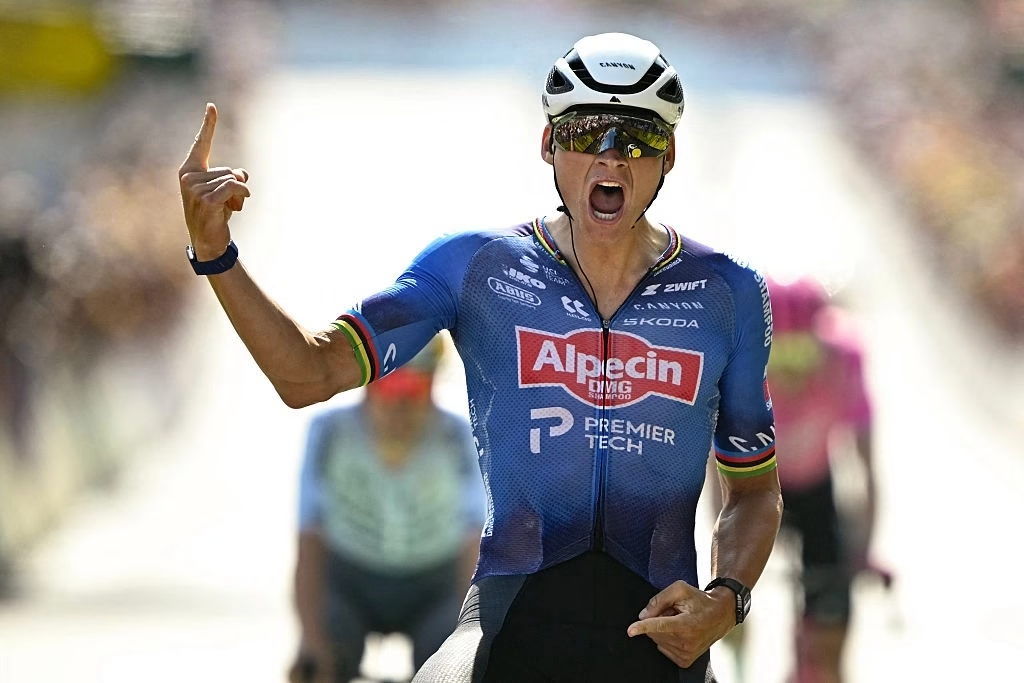
Mathieu van der Poel won stage 9 of the 2026 Tour de France in Ussel, beating Tobias Halland Johannessen, Tom Pidcock and Alex Baudin from a four-rider breakaway after a ferocious, heat-hit day in the Massif Central. The Alpecin-Premier Tech rider made the decisive selection on Mont Bessou, then trusted his sprint in the uphill finish to take his first stage win of this Tour.
Johannessen finished second for Uno-X Mobility, with Pidcock third for Pinarello-Q36.5 Pro Cycling Team and Baudin fourth for EF Education-EasyPost. Filippo Ganna led the chasing group home 6 seconds later, ahead of Mads Pedersen, Michael Matthews, Nicolas Breuillard, Jordan Jegat and Sean Quinn.
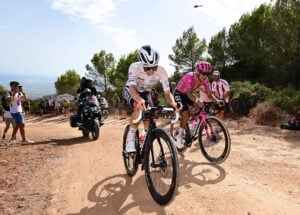
The stage had been shortened by 30 kilometres because of a red heat alert in the Corrèze department, but the reduced distance did not make it any easier. The route from Malemort to Ussel still packed in four categorised climbs, constant rolling terrain and suffocating conditions, with parts of the road surface softening in the heat.
A shortened stage, but no easy day
Stage 9 was originally expected to be a classic Tour breakaway day, and the late route change only sharpened that feeling. The riders faced 155.5 kilometres to Ussel rather than the planned longer route, with the first section altered because of extreme heat warnings.
The climbs still remained: the Côte de Naves, Suc au May, Côte de la Croix du Pey and Mont Bessou. None of them was long enough to create a full GC mountain day, but together they made the stage too hard for the pure sprinters and too open for the overall teams to ignore.
That combination produced one of the most chaotic days of the race so far. Almost every team wanted a rider in the break, but almost every move was missing someone important. That meant the first half of the stage became a rolling series of attacks, counter-attacks and regroupings.
Tadej Pogačar began the day in yellow and, for long spells, UAE Team Emirates-XRG seemed unwilling to give the stage away. That made the day even harder. The breakaway had to be strong enough to get clear, but also strong enough to hold off a team that had spent much of the first week imposing its will on the race.
Pedersen wins early green jersey battle
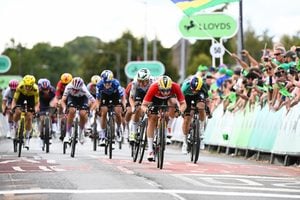
The intermediate sprint came after just 13.9 kilometres in Beynat, and Lidl-Trek made it clear from the start that they wanted maximum points for Pedersen. The road dragged up towards the sprint, making it a good opportunity for the Dane, while also serving as the launchpad for the real breakaway battle.
Lidl-Trek committed numbers early, with Derek Gee-West and Mathias Vacek helping put Pedersen into position. Girmay, Philipsen and Merlier were all close behind, but Pedersen had the best lead-out and took the 25 points.
Girmay crossed second, with Philipsen third. Merlier, who had won the previous two sprint stages, was already struggling in the heat and slipped backwards soon after. By the time the green jersey standings were recalculated, Pedersen had extended his lead to 253 points, with Girmay up to 223, Merlier on 213 and Philipsen on 191.
That was Lidl-Trek’s first objective complete. The second was to place riders in the break, and they soon did that as the race blew apart after the sprint.
Attacks come in waves
The fight for the break was immediate and relentless. Maxim Van Gils, Chris Harper, Kévin Vauquelin and Richard Carapaz were among the first riders to move after the intermediate sprint. Filippo Ganna and Van der Poel then appeared in another counter-move, alongside Felix Engelhardt and others.
Julian Alaphilippe tried to use a twisting descent with Marco Haller. Riders from Netcompany INEOS and Movistar tried to bridge. Then, on the Côte de Naves, Pinarello-Q36.5 Pro Cycling Team moved up and Pidcock began to test the race.
Valentin Paret-Peintre took the points over the top, but the bigger story was the damage behind. The front group had been reduced to around 70 riders, with Tim Merlier already well behind and several domestiques under pressure.
Vauquelin and Matteo Jorgenson tried another move over the top, with Carapaz chasing. That was brought back too. The race had not settled, but the repeated accelerations were stripping the peloton down and forcing the strongest riders to the front.
The right move finally forms
The move that finally mattered was instigated by Gee-West. Around ten riders went with him, including Van der Poel, Quinn Simmons, Lennert Van Eetvelt and Jordan Jegat. It was the first move to build a meaningful gap after more than 50 kilometres of attacking.
UAE Team Emirates-XRG briefly looked content to let it go, but only briefly. Pogačar’s team put Tim Wellens and Felix Großschartner on the front, with Adam Yates also visible in the chase. The gap was kept tight, and the move had to keep working to survive.
Pidcock then attacked from the Pogačar group to bridge across. He was encouraged from the team car and used the steeper parts of the Suc au May to close ground, with Gee-West and Van Eetvelt on his wheel. Van der Poel, Pablo Castrillo and Baudin also bridged across, and by the top of the climb the main front groups had merged.
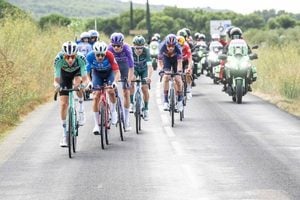
That created a strong lead group of eight: Van der Poel, Johannessen, Pidcock, Baudin, Simmons, Gee-West, Van Eetvelt and Castrillo. It had the right mix of engines, punchers and tactical options, but it still had UAE chasing behind and only a little over a minute in hand.
UAE keep the pressure on
For much of the middle of the stage, it was hard to read UAE Team Emirates-XRG’s intention. Wellens and Großschartner worked for a long time, reducing the gap and making the front group fight for every second. Pogačar had teammates around him and the uphill finish into Ussel would have suited him, so the possibility of another yellow jersey stage hunt never disappeared.
The chase also had a second effect: it made the day brutally hard for everyone. In temperatures above 30°C, with riders using water, ice and every cooling measure available, UAE’s pressure turned a breakaway stage into something closer to a selective one-day race.
The gap dipped under a minute on the Côte de la Croix du Pey, and for a moment the break looked vulnerable. Lidl-Trek had Simmons and Gee-West in front, but Pedersen, Skjelmose and Ayuso behind, which created a tactical tension. They could win from the break, or they could bring it back for Pedersen.
That hesitation became important later. The front group had enough quality to stay away, but only if everyone had a reason to commit.
Van der Poel changes the race on Mont Bessou
As the race moved towards Mont Bessou, the collaboration in the break began to falter. The gap dropped towards 40 seconds, then 30 seconds. Castrillo tried to reassert some momentum, but the looking around had already begun.
Then Van der Poel attacked.
The final classified climb was short and steep, but it was enough for the Dutchman to split the race. His acceleration distanced the two Lidl-Trek riders, Simmons and Gee-West, and created a new front selection with Johannessen and Pidcock chasing across. Baudin also made the move, giving the race a committed four-rider front group.
That was the decisive tactical shift. With Lidl-Trek out of the front, the leading quartet had no reason to hesitate. Behind, the chasers now had to reorganise, with Simmons and Gee-West dropping back to help the pursuit rather than continuing in the winning move.
Pidcock then suffered a mechanical on the descent, a cruel moment after looking one of the strongest riders in the race. He lost contact, but managed to chase back to Van der Poel, Johannessen and Baudin before the final run-in.
Chase runs out of road
Behind the four leaders, the chase never fully settled. UAE eventually pulled off the front, having spent Wellens and Großschartner for much of the day. Netcompany INEOS took over through Tobias Foss, with Ganna still in the group and Egan Bernal’s GC position also part of the calculation.
Lidl-Trek had to chase after losing its riders from the front, with Carlos Verona adding his legs while Simmons and Gee-West dropped back from the break. Vauquelin also contributed, and later Ion Izagirre appeared near the front, but the organisation came too late.
At 15 kilometres to go, the gap was 55 seconds. At 10 kilometres, it was 45 seconds. At 5 kilometres, it had come down to 40 seconds, but the effort was draining from the chase. Simmons had emptied himself, Gee-West was giving the last of what he had, and Foss had already faded from the front.
The heat mattered here. The chase had enough horsepower on paper, but not enough freshness. The road to Ussel was dragging upwards, the leaders were still committed, and Van der Poel was doing enormous work on the faster sections to keep the group moving.
Van der Poel leads out and still wins
Inside the final 2 kilometres, the gap was still 29 seconds. At the flamme rouge, it was down to 20, but the stage was in the hands of the leading quartet as long as they kept riding.
Van der Poel took responsibility. He stayed on the front for the final kilometre, even as the road began to rise, and did not allow the group to stall. It was a calculated risk. In most circumstances, leading into a sprint from so far out would be a gift to the riders behind. Here, it was also the safest way to stop the chase coming back.
Johannessen sat on his wheel and waited for the launch. Pidcock and Baudin were still there, but neither had the same sprint profile. Van der Poel opened up and held the Norwegian off to take the win, thumping his chest as he crossed the line.
Johannessen took second, Pidcock third and Baudin fourth. Ganna then led the chase home 6 seconds later, ahead of Pedersen, Matthews, Breuillard, Jegat and Quinn.
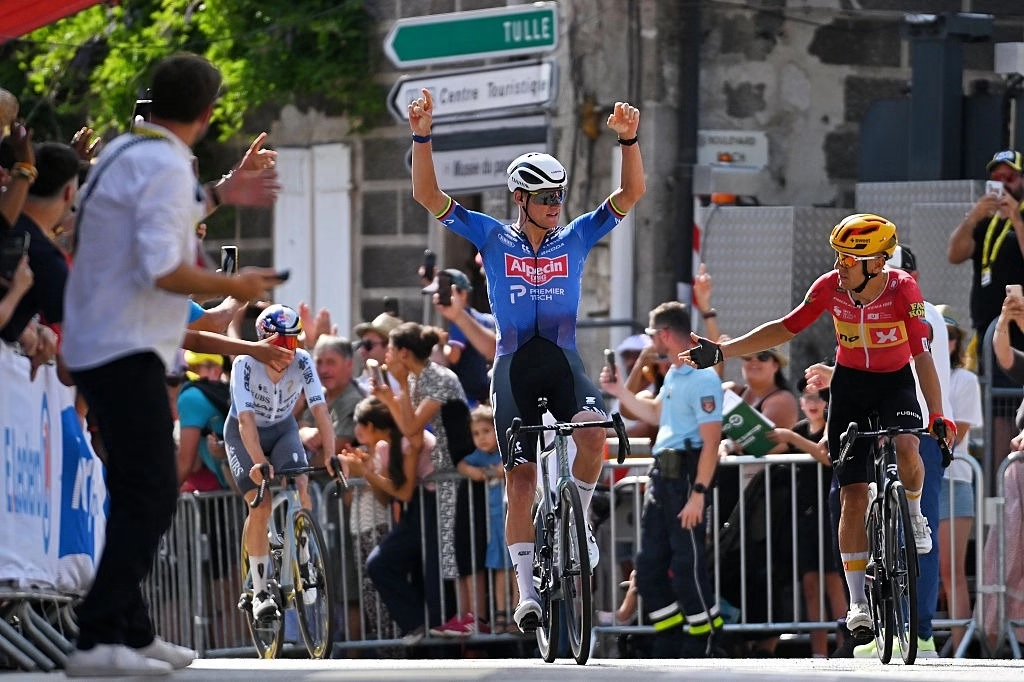 Photo Credit: Getty
A badly needed Alpecin-Premier Tech win
For Alpecin-Premier Tech, this was an important reset before the first rest day. The team had endured a difficult start to the Tour, with Philipsen missing out in the sprints and Van der Poel not yet fully able to impose himself on the race.
Stage 9 changed that. Van der Poel had not looked at his best in the opening days, later saying that the heat had affected his recovery early in the race. By Ussel, his legs had finally returned.
That was visible in the way he raced. He was active early, present when the decisive move formed, strong enough to follow the selections and then ruthless enough to attack on Mont Bessou. Once the front group was reduced to four, he became the rider the others had to beat.
It was also a win built on race intelligence. Van der Poel did not simply wait for a sprint. He removed the riders who complicated the break’s cooperation, kept the group moving when the chase came close, then accepted the responsibility of leading out because the stage win depended on momentum.
Johannessen and Pidcock take positives
Johannessen came close to a major stage win, but second was still a strong result for Uno-X Mobility. He had started the day just outside the top 10 on GC, close enough to make UAE watch him but far enough down to earn some freedom. He rode aggressively, made the decisive selection and looked closer to his best after a difficult opening week.
Pidcock’s third place was also encouraging after his disappointment in the high mountains. He had lost significant time to Pogačar on stage 6 and came into this stage almost 10 minutes down, which gave him room to attack. His bridge on the Suc au May was one of the key moves of the day, and his recovery from the late mechanical showed how strong he was.
Baudin’s fourth continued his aggressive Tour too. He had already been visible in the mountains classification earlier in the race, and in Ussel he again showed the ability to make hard, selective breakaways.
All three lost out to a rider with a bigger sprint and a bigger engine on the run-in, but they helped make the move work. Without that cooperation after Mont Bessou, the chasing group would likely have brought everything back.
Pogačar keeps yellow as GC stays unchanged
For the GC contenders, the day was hard but not decisive. Pogačar remained in yellow, with the top of the general classification unchanged before the first rest day. He leads Vingegaard by 2:42, with Isaac Del Toro third at 3:27 and Remco Evenepoel fourth at 3:30.
Juan Ayuso remains fifth at 3:34, ahead of Paul Seixas at 3:55, Florian Lipowitz at 4:00, Lenny Martinez at 4:21 and Mattias Skjelmose at 4:57. Egan Bernal moved into 10th overall at 9:12, a detail that partly explained why Netcompany INEOS were willing to chase late in the stage.
There was still stress along the way. Lenny Martinez had a mechanical on the Côte de la Croix du Pey and had to chase back. Mathias Vacek, who had started the day 10th overall, was distanced during the early chaos. Tim Merlier, so dominant in the sprints of stages 7 and 8, was also dropped early in the heat.
But the main yellow jersey picture stayed stable. Pogačar did not add another stage win, but UAE had made the day hard enough to remind everyone that even a breakaway stage can become part of their wider control of the race.
-
 Photo Credit: Getty
Pedersen strengthens green before the rest day
The green jersey battle also shifted again. Pedersen’s early intermediate sprint win strengthened his position, pushing him to 253 points before the stage had properly opened. Girmay moved back into second on 223, while Merlier stayed on 213 after being distanced early and unable to score.
Philipsen rose to 191, but another day passed without a sprint finish or a stage win for Alpecin-Premier Tech’s fast man. Van der Poel’s victory will ease pressure on the team, but Philipsen’s search for a Tour stage win continues.
Pedersen’s sixth place at the finish added further value to a day where Lidl-Trek had several tactical options. They placed riders in the break, chased behind and still scored heavily in the points competition. They did not win the stage, but Pedersen reached the first rest day in a stronger green jersey position.
The classification remains alive, but the terrain of stage 9 suited Pedersen’s range perfectly. It was too hard for Merlier, not quite a sprint for Philipsen, and just selective enough for Pedersen to keep building his margin.
A classic breakaway day before the rest day
Stage 9 had everything a Tour breakaway day should have: an early points fight, a brutal struggle for the move, a strong break that took an age to form, a controlling yellow jersey team, tactical hesitation, a late split and a charging bunch that ran out of road.
The heat added another layer. This was not a normal medium-mountain stage. It had been shortened because of dangerous conditions, yet still became one of the hardest days of the race. Riders were cooling themselves constantly, the road surface was under stress, and the intensity never truly dropped.
Van der Poel was the rider who understood the day best. He made the move, forced the selection, kept the group alive and then finished it himself. After a subdued first week by his standards, he arrived at the rest day with a stage win that felt fully earned.
The Tour pauses now before stage 10 to Le Lioran, where the GC race is expected to restart. Pogačar remains in control overall, but stage 9 belonged to the breakaway, and to Van der Poel’s ability to turn a chaotic day into a very familiar kind of win.
Tour de France 2026 stage 9 result
Results powered by FirstCycling.com
Main photo credit: Getty