
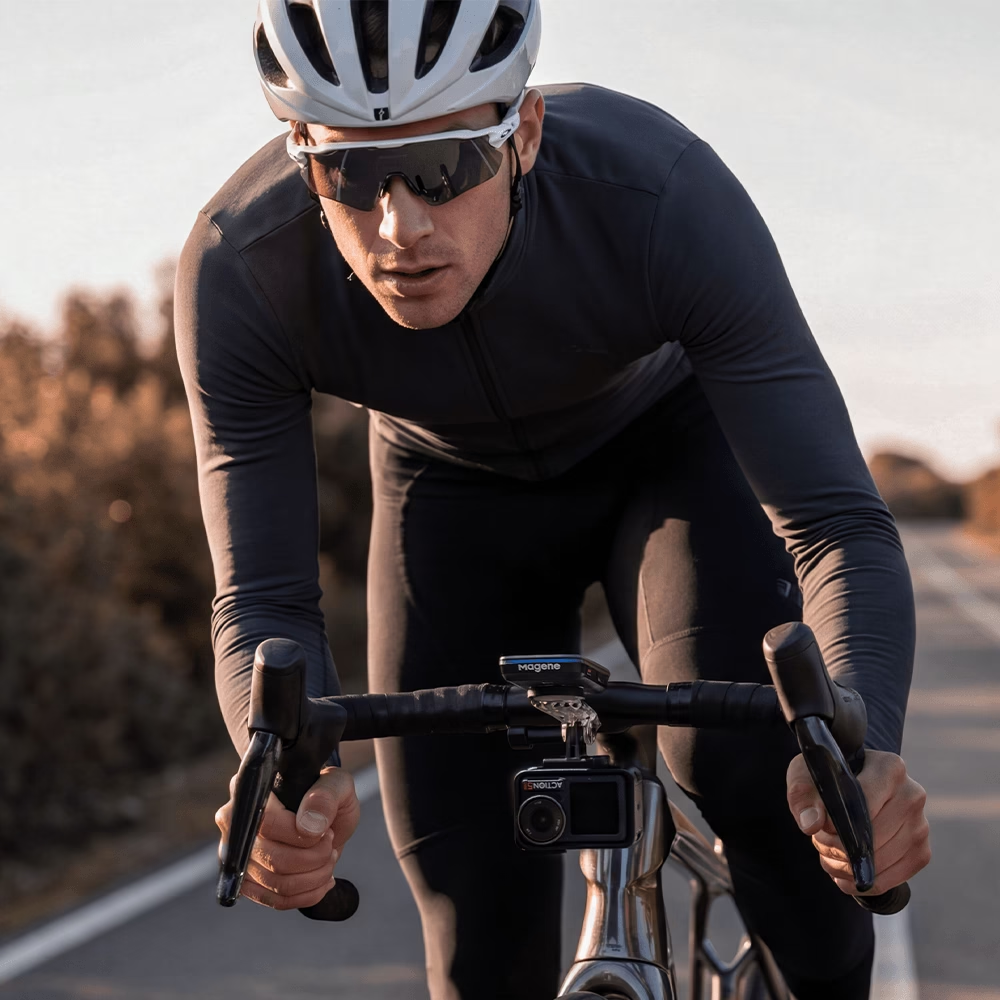
The Magene C706 is the point where Magene stops looking like a budget-bike-computer brand and starts taking aim at the established premium names. It has a 3.3-inch colour touchscreen, dual-band satellite positioning, full mapping, ClimbPro, Strava Segments, power-meter and radar support, smart-trainer control and enough connectivity to sit at the centre of a fairly complicated bike setup. At £239, it costs far less than the most expensive Garmin and Wahoo head units while covering most of the functions many riders actually use.
The hardware is the strongest part of the package. The C706 feels closer to a flagship computer than its price suggests, with a metal mounting boss, five physical buttons alongside the touchscreen and a compact body despite the large display. The compromises appear further down the stack. Navigation works particularly well when following an imported route, but route creation and re-routing have produced less consistent results in independent testing, while Magene’s OnelapFit software still lacks the depth of Garmin’s training ecosystem.
This article contains affiliate links. ProCyclingUK may earn a commission if you buy through them, at no extra cost to you. The C706 is currently available from several UK retailers, and you can check the current Magene C706 price and availability at Tredz.

Magene C706 specifications
| UK list price | £239 |
| Screen | 3.3-inch TFT colour touchscreen |
| Dimensions | 97 × 55 × 14.8mm |
| Weight | 111g |
| Controls | Touchscreen plus five physical buttons |
| Battery life | 17–25 hours claimed |
| Storage | 8GB |
| Water resistance | IPX7 |
| Charging | USB-C |
| Positioning | Dual-band GPS plus Beidou, GLONASS, Galileo and QZSS |
| Connectivity | Wi-Fi, Bluetooth 5.0 and ANT+ |
| Ride profiles | 12 maximum, with two supplied and 10 customisable |
| Data fields | 110+ across 14 categories |
| Third-party services | Strava, TrainingPeaks and Komoot |
The C706 hardware is much closer to premium territory
Magene’s cheaper computers have always made a strong case on specifications, but the C706 is more convincing because the physical product has moved with the feature list. At 111g it is not especially light, yet the 97 × 55mm footprint keeps it compact enough for normal road-bike cockpits. The metal quarter-turn mounting boss is a reassuring touch, particularly on a device intended to spend years being clipped in and out of mounts.
The five buttons are equally useful. Touchscreens work well for maps and menus, but rain, winter gloves and rough surfaces are exactly the moments when physical controls earn their place. Magene has kept both, rather than forcing the rider to choose one interface. The supplied TPU case and tempered-glass screen protector also add some value, although the basic rubber-band stem mount in the box feels less sophisticated than the computer itself.
The 3.3-inch display is large enough for maps without making the C706 enormous, and independent testing has generally praised its responsiveness and clarity. There is one notable caveat. Cycling Weekly reported that its test unit became effectively black when viewed through polarised sunglasses, although the UK distributor said visibility varies between units and viewing angles. Riders who regularly use polarised lenses should therefore check the display in person if possible rather than assuming every pair of glasses will behave the same way.
Magene also adds a narrow 12-colour light strip around the front edge, voice alerts and an electronic bell. The light can be tied to conditions such as heart-rate warnings through the Smart Assistant, although it is more novelty than essential cycling-computer function. The speaker has a more practical job, handling navigation and radar alerts, but its position inside the mounting boss has drawn criticism because the mount can muffle the sound in traffic and wind.
Navigation is good when the route is already planned
Navigation is where the C706 becomes more interesting than Magene’s cheaper models. The dual-band receiver works with GPS, Beidou, GLONASS, Galileo and QZSS, while offline maps are downloaded through the OnelapFit app and stored on the computer. GPX files can be imported, routes can sync from services including Komoot and Strava, and the map can switch between heading-up and north-up views.
For riders who normally plan a route elsewhere and send it to the head unit, the experience appears strong. Independent testers have consistently described imported-route guidance as clear and easy to follow, helped by the large display and straightforward turn prompts. ClimbPro can also identify climbs on a loaded route and, in FreeRide mode, detect nearby climbs without one. The information covers gradient, distance remaining, ascent remaining and the profile of the climb.
Creating and changing routes is less settled. One detailed UK test found that routes generated through the Magene ecosystem could favour major roads in one situation and bridleways in another, while automatic re-routing occasionally failed. A destination address also has to be entered through OnelapFit rather than typed directly into the computer. For riders already using Komoot or another route planner, that is more inconvenience than deal-breaker. Anyone expecting Garmin-level route intelligence entirely on the head unit should adjust expectations.

If navigation is your main reason for upgrading, the C706 is a substantial step beyond the Magene C606. It is also worth comparing with the iGPSPORT BiNavi, another lower-cost computer trying to offer large-screen mapping without Garmin pricing.
The current UK retail price is important here because value is one of the C706’s strongest arguments. You can check the latest C706 price at Tredz here.
Sensor support is broad, but Garmin still has the deeper ecosystem
The C706 supports the equipment most performance-focused riders are likely to connect. ANT+ and Bluetooth cover heart-rate monitors, cadence and speed sensors, power meters, smart trainers, radar tail lights and smart lights. Shimano Di2 and SRAM eTap are supported, while compatible Garmin Rally and Favero Assioma pedals can provide cycling-dynamics information such as power phase and seated-versus-standing time.
There is also unusually deep integration with selected DJI and Insta360 cameras. The C706 can display camera status and trigger recording, while compatible footage can use ride data for overlays afterwards. That will be a niche feature for most buyers, but it illustrates how much Magene has tried to pack into one computer.
Radar support is less polished. The computer can show approaching vehicles and work with Magene’s own L508 as well as compatible radar systems, but independent testing has criticised the visual implementation. The vehicle lane uses pale chevrons at the edge of the display rather than the high-contrast strip seen on several rival computers, making it easy to miss on busy data pages or maps. Given that radar alerts are supposed to demand attention quickly, this is exactly the sort of detail firmware needs to improve.
The broader software gap is harder to fix overnight. OnelapFit handles setup, mapping, ride syncing, workouts and basic analysis competently, and the C706 can import structured sessions from TrainingPeaks. Garmin Connect still goes much further with training-readiness tools, adaptive suggestions, recovery interpretation and a much larger collection of proprietary metrics. Riders who mainly want speed, heart rate, power, navigation and sensor connectivity may barely care. Those who use their head unit as part of a full training-and-recovery platform will notice the difference.
E-bike integration is another current omission. The C706 can see a power meter on an e-bike, but independent testing found no support for information such as motor mode, remaining battery or assisted range. A separate long-term test also highlighted the lack of a LiveTrack-style location-sharing feature. Neither matters to every rider, but both are areas where the established brands remain ahead.
Battery life looks genuinely competitive
Magene quotes 17 to 25 hours from a charge, depending on settings and conditions. That figure is unusually believable because a recent independent test exhausted the C706 after roughly 20 hours while running a radar and power meters in warm conditions. Charging from 20% to full took around an hour and 40 minutes in the same test.
That is enough for ordinary training weeks, sportives and most long one-day events without turning battery management into a concern. The Resume Later function also lets riders pause a recording and continue it on a subsequent day, which makes sense for touring and bikepacking. It is not trying to match the extreme runtime of specialist ultra-endurance computers, but it is competitive with mainstream performance head units.
How the C706 compares with Garmin and Magene’s cheaper computers
The obvious comparison is Garmin, but the most expensive Edge models are not necessarily the right benchmark. The C706 has flagship-style hardware at a price that sits much closer to the middle of the market. Our Garmin Edge 850 review shows why Garmin still commands a premium: the software ecosystem, routing maturity and training analysis are part of what buyers are paying for, not simply the screen and satellite chip.
Within Magene’s own range, the older C506 remains the more obvious choice for riders who primarily want basic GPS recording, sensor support and a lower purchase price. The C706 earns its extra cost through the larger display, much more capable mapping, ClimbPro, wider integration and more ambitious training functions. It is a different class of product rather than a cosmetic upgrade.
The question is therefore less about whether the C706 matches every Garmin feature and more about which missing features matter to you. If imported navigation, power data, radar, smart-trainer control and a large screen cover the essentials, paying substantially more for a deeper wellness ecosystem can be hard to justify. If sophisticated route generation, mature re-routing, e-bike integration and detailed training interpretation are central to how you ride, the cheaper price comes with compromises.
For riders comparing current UK deals rather than specifications alone, Tredz has the C706 listed here.
Who should buy the Magene C706?
The C706 makes the most sense for road, gravel and endurance riders who want a large mapped display and broad sensor compatibility but do not need Garmin’s entire training ecosystem. It also suits riders already comfortable planning routes in Komoot or another service, because that sidesteps one of the weaker parts of Magene’s own routing experience.
It is less convincing for riders who rely on on-device destination search and automatic route generation, want strong e-bike data support, or use advanced training-readiness and recovery features every day. Polarised-glasses users should also check screen compatibility before buying if possible, because the issue reported in independent testing is too significant to ignore even though it does not appear identical on every unit.
Verdict
The Magene C706 succeeds because the headline specification is backed by hardware that feels appropriate for the job. The large touchscreen, five-button control layout, metal mount interface, broad sensor support and credible battery life make it much easier to take seriously than a head unit that simply competes on a long feature list.
Its weaknesses are mostly software and interface details. Native routing and re-routing need more consistency, the radar display deserves a redesign, the speaker placement is questionable and OnelapFit cannot yet match the depth of Garmin Connect. Those compromises become easier to accept when the core navigation works well with imported routes and the computer costs £239 rather than approaching the price of a premium smartphone.
-
 Photo Credit: Flavia Ossola
 -
 Photo Credit: AusCycling/Chris Auld

For riders who want premium-style hardware without paying premium-brand prices, the C706 is one of Magene’s most convincing computers so far. The strongest case is for someone who already plans routes elsewhere and wants mapping, power, radar and training support in a single unit. If that sounds close to your use case, you can check the current Magene C706 price and stock at Tredz.

