
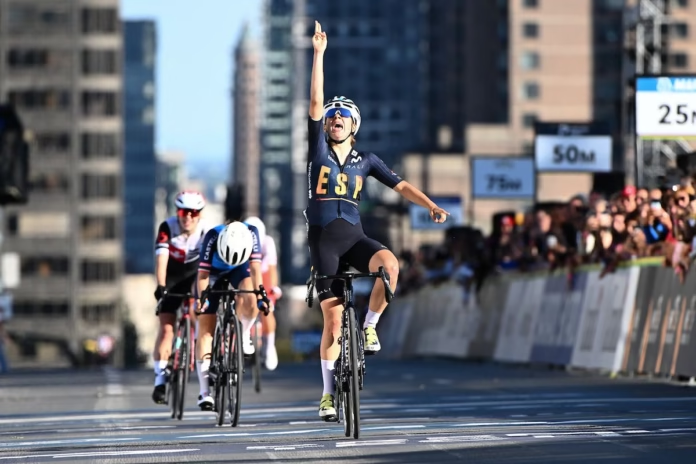
Alejandra Neira won the 2026 World Championships women junior road race in 2:21:00 after a late sequence of accelerations split the leading group. Matilde Rossignoli and Anja Grossmann finished on the same time, while Maria Okrucińska was fourth at four seconds and Mirthe Mons fifth at five seconds.
The race was shaped less by one long escape than by repeated pressure in the final 30 kilometres. Earlier attacks were absorbed, but Neira’s acceleration with 25 kilometres remaining and her further move inside the final seven kilometres gave her control of the decisive selection. The result was an unusually compressed podium, with the first three riders separated by no recorded time at the finish.
Behind them, the gaps opened quickly. Okrucińska was four seconds down and Mons five seconds behind, while Edda Bieberle, Thais Poirier, Justine Baud, Amandine Jakob and Scout Wellmeier were all 42 seconds from the winner.
How it unfolded
The first meaningful signs of strain came with 79 kilometres remaining, when riders were being dropped from the back of the peloton. That phase also included a crash involving Maria Acuti. The incident was reported separately from the general attrition, and the available race evidence does not establish a link between the crash and any later result.
Jiménez Lluna attacked with 76 kilometres left, providing the first clear move from the bunch. The race remained unsettled rather than decisive, however, and the next major incident came at 59 kilometres to go when Sofia Tripcevich crashed. Again, the event was recorded without evidence that it determined the final outcome.
The pressure increased after the halfway point. Lise Revol attacked at 47 kilometres and opened a small gap, while Gemma Toledo was dropped from the peloton with 46 kilometres remaining. Justine Baud then attacked at 44 kilometres and gained a small gap, followed shortly afterwards by Sidonie Vachet.
France keeps the race moving
Vachet’s move remained close to the peloton, with the gap down to 30 metres at 39 kilometres to go. She was caught two kilometres later. The sequence mattered because it showed how quickly an attack could become exposed, but it did not create a lasting breakaway or separate the eventual podium contenders.
Great Britain was reported pulling in the peloton at 31 kilometres remaining. That effort was followed by another attempt from Zara Sofía Lamprea at 30 kilometres, then a counter-attack from one rider in the peloton at 28 kilometres. The race was repeatedly being tested, but each move still left the main contest unresolved.
An acceleration in the peloton at 25 kilometres to go marked the beginning of the decisive phase. Neira was specifically identified as part of that acceleration, and Lamprea was dropped from the peloton shortly afterwards. The consequence was a sharper selection, with the earlier attacking pattern giving way to moves involving riders who would remain relevant much later.
Neira’s presence in that first decisive acceleration was important without immediately settling the race. Lidia Castro attacked with 21 kilometres left, followed by Nabyenka Valentina García at 18 kilometres. Azzurra Ballan counter-attacked at the same distance, showing that the group was still responding to each move rather than allowing a single rider to establish a clear winning margin.
The favourites’ group takes shape
Mirthe Mons attacked with 13 kilometres remaining. García was caught by the group of favourites at 12 kilometres, bringing one of the recent moves back into the main selection. Neira then accelerated at the same point, followed by Rossignoli’s acceleration. Those efforts placed both eventual medal contenders directly into the race’s defining exchange.
The two moves at 12 kilometres changed the character of the contest. Instead of a broad peloton absorbing attacks, the race now revolved around a smaller group of favourites and the ability of individual riders to respond. Neira and Rossignoli were both active, while the catch of García confirmed that the chase behind the attacks was still being controlled.
Grossmann made her own acceleration with 7.3 kilometres to go. Her move came after the earlier attacks by Neira and Rossignoli and added a third name to the final contest. The podium was therefore not formed by one rider escaping uncontested, but by successive efforts that kept the strongest contenders connected to the decisive front.
Neira attacked again at 6.4 kilometres remaining. This was the clearest late attempt recorded in the race and came less than a kilometre after Grossmann’s acceleration. The next evidence of the split showed the leaders 160 metres ahead of the chase with 4.7 kilometres still to race, confirming that the final selection had gained a small but meaningful advantage.
Neira creates the decisive separation
The 160-metre gap did not translate into a separated finishing time for the podium, but it did establish the front group as the race’s controlling unit. Neira’s second late acceleration had followed the moves from Rossignoli and Grossmann, and the leaders were now clear enough to keep the chase from immediately closing the distance.
That gap also explains why the result was so close at the top while still opening a clear margin to the next riders. Neira, Rossignoli and Grossmann finished together on the official result, but Okrucińska was already four seconds behind and Mons five seconds down. The decisive action produced a compact winning group rather than a solo finish.
Mons remained active inside the closing kilometres, accelerating with 1.7 kilometres to go. Her move was the final recorded attack before the finish and came after she had already been involved in the late selection. It did not alter the official order at the top, but it underlined how close the fight remained immediately behind the leading trio.
The race therefore ended with two overlapping contests. Neira, Rossignoli and Grossmann arrived on the same time for the medals, while Okrucińska and Mons were close enough to finish within five seconds of the winner. The next group was much further back, at 42 seconds, making the final kilometres decisive for both the podium and the separation behind it.
Why the podium stayed together
Neira’s winning performance was built through successive moments rather than a single early break. She was present in the acceleration at 25 kilometres, moved again at 12 kilometres and attacked once more at 6.4 kilometres. That progression placed her at the centre of the decisive phase and created the small front gap recorded before the finish.
Rossignoli reached the same final time after answering the late selection and accelerating at 12 kilometres to go. Grossmann also stayed with the decisive group after her move at 7.3 kilometres. Their matching final gaps show that neither rider was separated from Neira by the finish, even though Neira’s late attacks were the clearest attempts to reshape the race.
Okrucińska’s fourth place was the closest result outside the medal positions, four seconds down. Mons was another second behind in fifth after her late activity at 13 and 1.7 kilometres remaining. Their finishes show that the final selection was not limited to three riders, but the small gap to the podium could not be closed before the line.
The remaining top 10 were separated from that front contest. Bieberle, Poirier, Baud, Jakob and Wellmeier all finished 42 seconds behind Neira. Baud had attacked earlier at 44 kilometres, but the final result placed her in that larger group rather than with the late medal fight.
A race decided by repeated late pressure
The chronology points to a race that became progressively more selective. Early drops and attacks did not produce a lasting break, while the moves between 47 and 28 kilometres repeatedly narrowed the possibilities without determining the winner. The key change came once the peloton accelerated at 25 kilometres and Neira became directly involved.
From there, the race was defined by responses among the favourites. Castro, García, Ballan and Mons all tried to alter the order, but García was caught and the later attacks by Neira, Rossignoli and Grossmann shaped the final group. Neira’s acceleration at 6.4 kilometres was followed by a measurable gap to the chase, giving her the platform for the winning result.
Rossignoli and Grossmann retained contact through that final sequence and finished alongside Neira, while Okrucińska and Mons were close but not close enough. Neira therefore won the one-day world title on the strength of her repeated presence in the decisive moves, with the final result recording Rossignoli and Grossmann on the same time and the next challengers four and five seconds behind.
World Championships Women Junior Road Race 2026 Result
| Pos. | Rider | Time / gap |
|---|---|---|
| 1 | Alejandra Neira | 2:21:00 |
| 2 | Matilde Rossignoli | Same time |
| 3 | Anja Grossmann | Same time |
| 4 | Maria Okrucińska | +4 |
| 5 | Mirthe Mons | +5 |
| 6 | Edda Bieberle | +42 |
| 7 | Thais Poirier | +42 |
| 8 | Justine Baud | +42 |
| 9 | Amandine Jakob | +42 |
| 10 | Scout Wellmeier | +42 |

