Magdeleine Vallières began the final lap of her world champion’s year with a very different ending in mind. On Saturday, 26th September 2026, the Canadian should have been testing her legs against the best riders on the Mount Royal circuit in Montréal, with friends and family close enough to watch. Instead, a mass crash in the elite women’s road race took away her chance to defend the title. She remounted, chased and eventually abandoned. The scene gave her reign a cruel final image, but it did not tell the whole story of the previous twelve months.
There is a danger that the abrupt ending obscures what came before it. Vallières did not add another victory to her record in 2026, yet she finished fifth at Strade Bianche, sixth at La Flèche Wallonne and eighth at Liège-Bastogne-Liège, then completed both the Giro d’Italia Women and the Tour de France Femmes avec Zwift inside the top 20 overall. For a 25-year-old learning to race as a leader after years spent supporting others, those performances matter.
The real question is not whether she matched the single defining result of Kigali. Few riders could be expected to do that every season. It is whether Vallières, formerly one of EF Education-Oatly’s most reliable support riders, had learned to compete at the front of major races when the rainbow jersey made her impossible to overlook. Her first full season as world champion offers a more useful answer than a simple tally of victories.
 Photo Credit: Szymon Gruchalski/Getty Images
From Kigali outsider to a marked rider
In September 2025, Vallières attacked on the decisive cobbled climb in Kigali, leaving Niamh Fisher-Black and Mavi García behind to win the elite women’s world road race. It was Canada’s first elite road race world title and only her second professional win, following the Trofeo Palma Femina in 2024. Our report on her Kigali victory explains how the race opened up and why committing to the attack proved decisive.
Kigali was a victory produced by timing, strength and a willingness to gamble. It was not the end of a long record of professional winning. Vallières had spent much of her career riding for others at EF, taking hard turns on climbs and helping teammates reach the moments that mattered. In the rainbow jersey she could no longer rely on going unnoticed, and an attack from her would attract a different reaction. A rider with only two professional wins was suddenly expected to behave like a serial winner.
She extended her contract with EF Education-Oatly through the end of 2028 and explicitly targeted the Ardennes Classics, a stronger general-classification role and a defence of the rainbow jersey at home. The transition was not a promise that every start would be ridden for herself. It was a chance to test what she could do when the decisive choice was hers. Her earlier career profile explores the Sherbrooke childhood, World Cycling Centre years and long route to that opportunity.
Australia and Valencia were the beginning of a different job
January’s Women’s Tour Down Under made that distinction visible straight away. Vallières finished 25th overall while EF teammate Noemi Rüegg retained the general-classification title. It would be misleading to read her result as an early failure by the reigning world champion. EF had a proven race winner to support, and Vallières was still part of the machinery that helped the team race decisively. The jersey did not abolish the work she had been good at before she won it.
Vallières later explained that the rainbow jersey had changed her confidence even when she was assigned a familiar supporting task. Where she might previously have questioned herself in a lead-out, she now trusted that she could carry it out properly. That distinction matters. Leadership in a WorldTour squad is not simply a question of being protected every day; it is also knowing when to take responsibility and when another rider has the better chance.
At February’s Setmana Ciclista Valenciana, she finished sixth overall. It was an early reminder that her strongest qualities were likely to emerge on rolling roads and repeated climbs rather than in an uncomplicated sprint. The result also provided a useful benchmark before a spring of races built around precisely the efforts she had handled so well in Rwanda.
Strade Bianche gave the rainbow jersey its first major result
The 2026 Strade Bianche Donne on Saturday, 7th March offered a demanding test of whether Vallières could be more than a champion in name. Its gravel sectors, steep ramps and constant fight for position leave little room for passengers. EF placed Vallières and Rüegg in the leading selection after the peloton split on the sterrato, with teammates helping them arrive at the sectors near the front.
Once the race splintered, Vallières and Rüegg remained in contention. Vallières attacked on the Santa Caterina climb as the leaders approached Siena, trying to impose her preferred finish rather than wait for a sprint. It did not split the group and she took fifth in Piazza del Campo. The move matters at least as much as the placing: in a race where selection comes through fatigue and positioning, she had enough left to take the initiative after surviving the toughest sectors.
Afterwards she credited the team’s positioning in the gravel sectors and acknowledged that she could not follow the very strongest on the last climb. Both observations were revealing. Her physical level was already good enough to fight for a major WorldTour one-day race, but the difference between fighting for fifth and finishing on the podium remained significant. Our Strade Bianche 2026 coverage looks at why the course demands such a complete performance.
The Ardennes showed she could repeat the effort
The Ardennes brought the targets Vallières had spoken about when she signed her contract extension. They also exposed the fine margins of racing in a jersey that everyone can see. She was 70th at Amstel Gold Race after a difficult day, then responded with sixth at La Flèche Wallonne Femmes on Wednesday, 22nd April and eighth at Liège-Bastogne-Liège Femmes four days later.
Flèche Wallonne is a particular measure of a puncheur’s ability to reach the final climb in contention and still produce the required acceleration. Vallières’ sixth place on the Mur de Huy was therefore more telling than an anonymous placing in a less selective race. She was close enough to the front to make herself relevant against the specialist climbers and established one-day winners, without quite reaching the fight for victory. Read our 2026 Flèche Wallonne report for the winning move.
Two top-eight finishes in four days made her Ardennes week one of the strongest passages of her season. They also illustrated the gap still separating a reliable contender from a winner. Flèche rewards a sharp final acceleration; Liège demands that a rider conserve something for the end of a long, bruising succession of climbs. Vallières could meet both tests well enough to finish near the front, but not yet impose the decisive move. There was progress without the neat satisfaction of another victory.
The Giro brought a quieter but substantial test
The Giro d’Italia Women ran from Saturday, 30th May to Sunday, 7th June and asked for a different version of the same consistency. The problem for a young one-day leader moving towards stage-race ambitions is not whether she can climb with the best on one chosen afternoon. It is whether she can limit damage on days that do not suit her and arrive at the hardest stages capable of racing rather than surviving.
Vallières finished 12th overall after nine stages. Her eighth place on stage five, the mountainous day to Santo Stefano di Cadore, was her best stage placing, followed by tenth on the final stage to Saluzzo. Those performances do not make her a proven Grand Tour podium candidate. They do, however, place her among riders able to handle the accumulating demands of a mountainous WorldTour stage race.
A 12th-place Giro and a spring of top-eight Classics performances should not be treated as interchangeable achievements. The first depends on managing nine consecutive days; the second on an explosive selection in a few hours. The combination is useful for EF, especially when a team wants to launch attacks without losing options on the climbs. Our final-stage Giro report provides the context of the overall race.
The Tour de France Femmes offered a broader measure of her season
Vallières started the Tour de France Femmes avec Zwift on Saturday, 1st August in a team with multiple ambitions. Over nine stages she was not a headline general-classification favourite, but she continued to ride through the selective terrain that shaped the race, including the mountain days towards Mont Ventoux and the final stage around Nice.
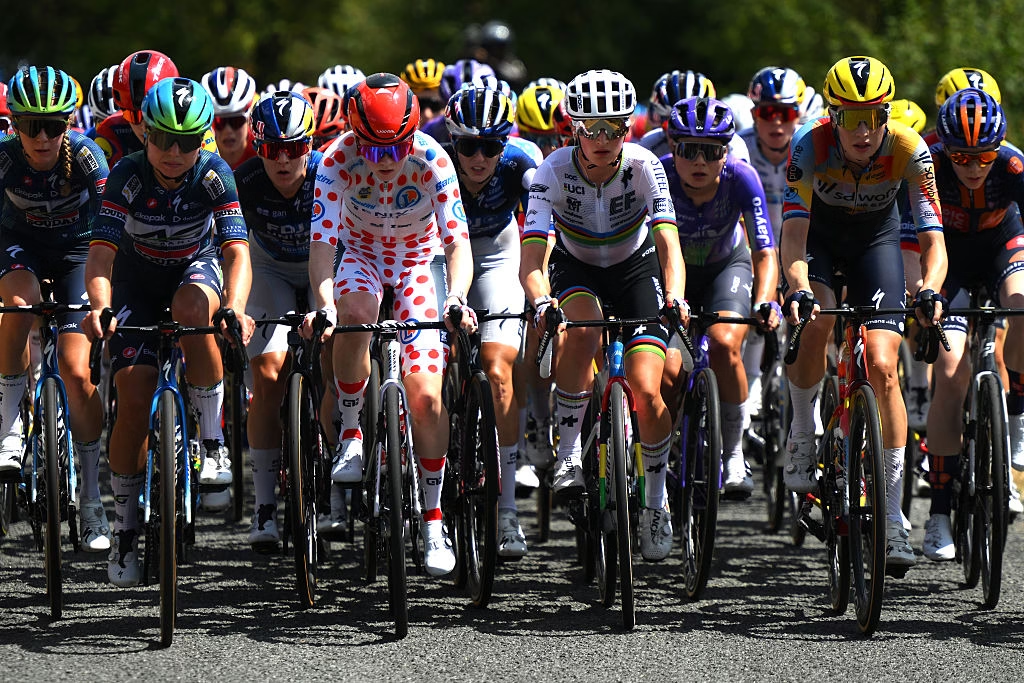 Photo Credit: Alex Broadway/Getty Images
At the finish in Nice, Vallières stood 18th overall, the same final GC position she had taken in 2025. She was 16th on stage nine, a demanding finale rather than an easy ceremonial roll-in. None of that should be sold as a breakthrough Tour. Yet a rider who excels on steep one-day courses and is still learning how far she can go in stage races has to build that knowledge somewhere. Completing a difficult nine-stage edition while contributing to a multi-leader EF squad was meaningful mileage, even without a headline finish.
For Vallières, the more interesting contrast was between the image of a world champion who could win any hilly race and the practical demands of racing in a strong squad. She was capable of making selections, protecting teammates and looking for openings, but not every course or team plan was built around her. The full 2026 Tour de France Femmes results underline how difficult it is to turn that range into a single standout result.
The key results from Magdeleine Vallières’ 2026 road season
Her season makes more sense when the WorldTour one-day results and Grand Tour general-classification finishes are placed alongside each other. The table also makes the absence of a 2026 victory clear rather than hiding it behind the prominence of the rainbow jersey.
| Race | Date | Result |
|---|---|---|
| Strade Bianche Donne | 7 March | 5th |
| La Flèche Wallonne Femmes | 22 April | 6th |
| Liège-Bastogne-Liège Femmes | 26 April | 8th |
| Itzulia Women | 17 May | 13th overall |
| Giro d’Italia Women | 7 June | 12th overall |
| Tour de France Femmes avec Zwift | 9 August | 18th overall |
| UCI Road World Championships, Montréal | 26 September | DNF after crash |
Montréal was meant to be the reward
The 2026 Road World Championships returned to Québec at the end of September. For Vallières, who grew up in Sherbrooke and had first found cycling with family trips and local club racing, defending the rainbow jersey at home was a rare convergence of sporting ambition and personal history. In the days before the race she spoke about how much more visible she had become and how the jersey had made her more prepared to speak up inside the team.
The elite women’s road race on Saturday, 26th September began in Brossard and continued towards eight demanding laps of the Mount Royal circuit. Vallières was expected to find the repeated short climbs attractive. Her original world title had been won by attacking when fatigue had reduced the front of the race, and this circuit offered repeated opportunities for exactly that kind of selection.
 Photo Credit: Dario Belingheri/Getty Images
A mass crash involving roughly 15 riders changed the race with approximately 95 kilometres left. Vallières went down along with other contenders, got back on her bike and was helped by Canadian teammate Adèle Normand in an attempt to rejoin the racing. The gap proved too large. According to the Québec cycling federation, she withdrew with five laps still to complete and was assessed by the Canadian team’s medical staff.
The title was eventually won by Demi Vollering, who survived the climbing and sprinted to victory in Montréal. To suggest that the crash cost Vallières a second world title would be speculation: the Dutch rider and other favourites still had to be beaten. What the crash certainly took away was a legitimate sporting contest for the defending champion. The first Canadian elite road race world champion had returned home to defend her stripes; she left the road before the decisive attacks had even begun. Our race report from the 2026 women’s Worlds follows the fight that continued without her.
What remains after a year in rainbow stripes
By September, Vallières had begun to describe the impact of the title in terms of confidence rather than celebrity. She told EF Education-Oatly that she still struggled to believe she was world champion when putting on the jersey, but had become more willing to trust her judgement, help younger teammates and voice her own opinions. She was also frank about the ambitions she had not yet met: winning an Ardennes Classic and taking stages at the major tours.
That distinction is important in assessing the 2026 season. The win column stayed empty, but her performances at Strade Bianche, Flèche Wallonne and Liège demonstrated a repeatable level in the very races she wants to win. The Giro and Tour added evidence that she can absorb multiple hard days; neither yet established her as a Grand Tour contender on the level of the very best.
Vollering now owns the rainbow jersey and Vallières will carry the former champion’s bands on her kit. Her contract with EF Education-Oatly runs through 2028, but there is little need to invent a new identity for her next campaign. Strade Bianche showed that she can attack with the strongest on broken terrain; the Ardennes proved that she can repeat that level; the Giro suggested there may be more to explore in the mountains. The unfinished business is specific: turning one of those chances into a win, preferably in the kind of race where she has already come close.