
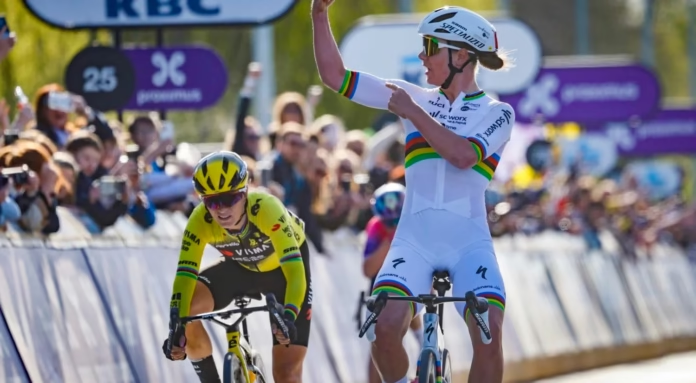
Tour of Flanders Women is still relatively young compared with the men’s race, but it has long since grown beyond the idea of being simply a sister event. First held in 2004, it became one of the defining races in women’s cycling remarkably quickly. That happened partly because of the name, but more importantly because of the route philosophy. From the beginning, this was built as a proper Flanders test, with cobbles, bergs, narrow roads and repeated pressure shaping the outcome.
That point matters when looking back at the race’s history. Tour of Flanders Women was not introduced as an exhibition or an afterthought. It arrived with clear sporting weight and, over the last two decades, it has become one of the races that best measures the spring classics strength in the women’s peloton.
If you want the current race identity alongside the history, ProCyclingUK’s Beginner’s guide to Tour of Flanders Women 2026 is the natural companion piece.
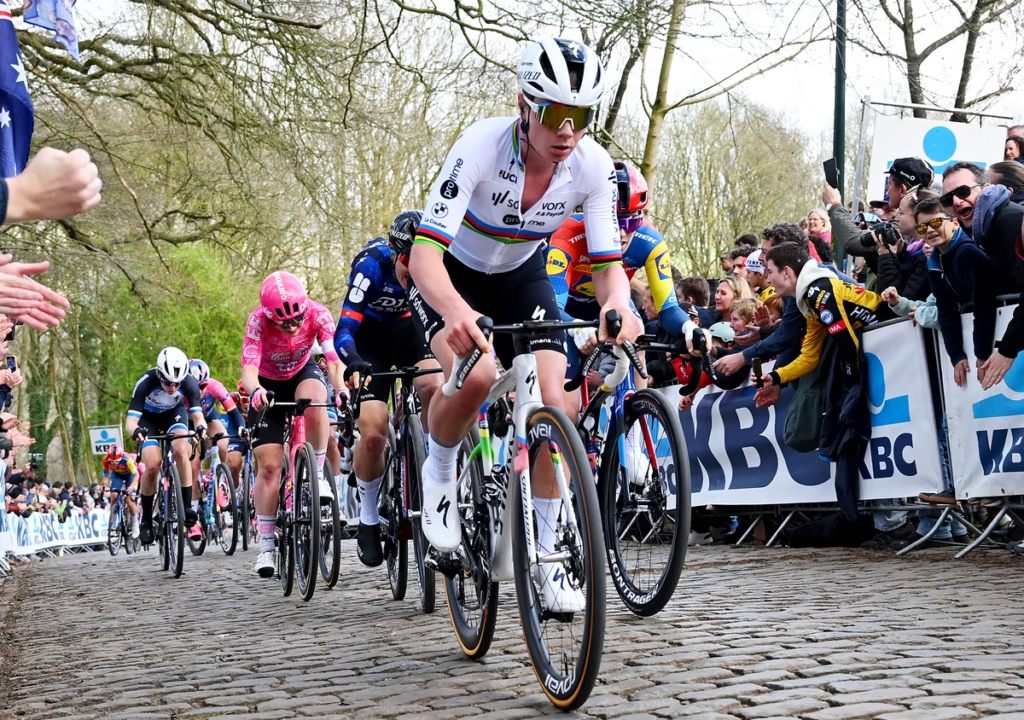 Photo Credit: Getty
The early years and the Muur-Bosberg era
The inaugural edition in 2004 was won by Zoufia Zabirova, who attacked on the Muur van Geraardsbergen and rode clear to win solo. That first race was only 94km long, the shortest edition in the event’s history, and finished in Ninove after using the same final 55km as the men’s race. In other words, the race began with a very direct link to the old men’s finale, and that gave it instant recognition.
Those early editions now feel like a distinct first era of Tour of Flanders Women. The Muur and Bosberg were central to the race’s identity, just as they were in the men’s event at the time, and the winners from those seasons reflect a race that was already selective but still slightly shorter and more open in shape than the modern version.
Mirjam Melchers-Van Poppel became the first repeat winner by taking back-to-back victories in 2005 and 2006. That mattered because it gave the race one of its first clear specialists, a rider who could repeatedly handle the peculiar rhythm of Flanders. Nicole Cooke won in 2007, then Judith Arndt took her first victory in 2008. By that point, the winners list was already starting to look serious.
The 2009 edition added another layer to the race’s evolution. By then the route had stretched to 131km and included not only the climbs but also long flat cobbled sectors. Ina-Yoko Teutenberg won that year from a 15-rider sprint, which is a useful reminder that Tour of Flanders Women has never been only for one type of rider. Even in the early years, it could still produce a finish where surviving the selection mattered just as much as making the decisive attack.
Grace Verbeke and the race’s first Belgian winner
One of the key moments in the race’s early history came in 2010, when Grace Verbeke became the first Belgian rider to win Tour of Flanders Women. In a race so central to Flemish cycling identity, that was always going to matter.
It mattered even more because Belgian winners had been absent up to that point despite the race’s location and prestige. Verbeke’s victory made the event feel more deeply rooted in the local sporting culture, and for years she remained the only Belgian woman to win it. That long gap helped underline just how difficult the race is to master, even for riders from the region that knows the roads best.
-
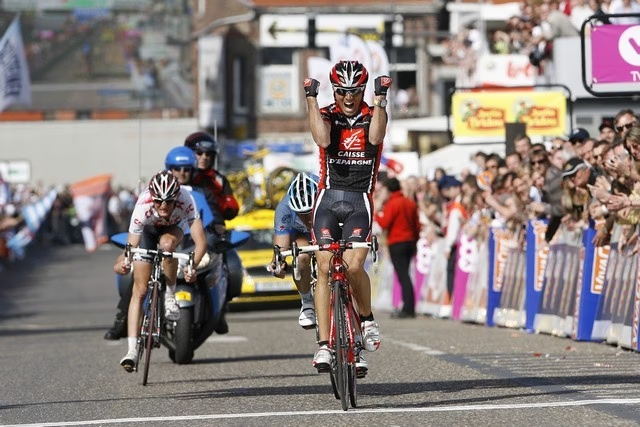
 Photo Credit: Luc Claessen/ISPA
 -
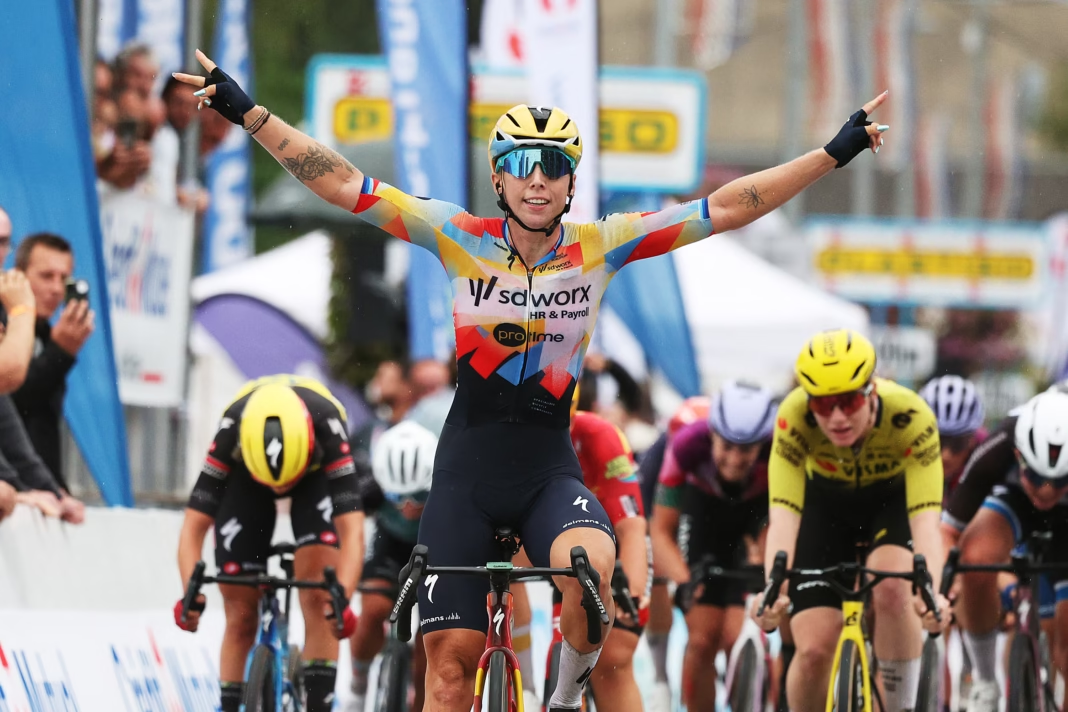
 Photo Credit: Unsplash / Chris Linnett

The 2012 route reset and the Oudenaarde era
A major turning point came in 2012, when the race changed along with the men’s event. The old Muur-Bosberg finale disappeared, the finish moved to Oudenaarde, and the route was restructured around the newer closing formula built on the Oude Kwaremont and Paterberg.
That change was significant because it created the second clear era in the race’s history. The first years had leaned heavily on the old Flanders mythology of Geraardsbergen and Meerbeke. From 2012 onwards, the women’s race moved into the modern Oudenaarde era, with repeated circuits and a more compressed closing sequence around Kwaremont and Paterberg.
Judith Arndt won that first edition on the new route in 2012, which gave her a second Tour of Flanders Women title and made her one of the race’s earliest multiple winners. That victory is one of the most important in the race’s history because it bridged the two eras. Arndt had won on the older route in 2008 and then again on the redesigned course in 2012. Few riders embodied the race’s continuity better than that.
The race grows into a modern classic
From there, Tour of Flanders Women settled into the structure most fans now recognise. Marianne Vos won in 2013, Ellen van Dijk in 2014 and Elisa Longo Borghini in 2015, a run that said plenty about the type of rider the race was attracting and rewarding. These were not opportunistic winners. They were among the biggest names in the sport, and their success helped confirm that the race had become a genuine pillar of the women’s spring.
The calendar status tells the same story. From 2004 to 2015, the race was part of the UCI Women’s Road World Cup. From 2016 onwards, it moved into the UCI Women’s WorldTour. That shift reflected the wider development of women’s cycling, but it also highlighted how central Tour of Flanders Women already was. It did not need prestige added to it. It already had it.
The winners from the first WorldTour years only reinforced that. Lizzie Armistead won in 2016, Coryn Rivera in 2017, Anna van der Breggen in 2018 and Marta Bastianelli in 2019. Again, the breadth of that list matters. The race could still reward a faster finisher in the right scenario, but only if she could survive the same brutal demands as the pure classics riders.

Previous winners of Tour of Flanders Women
The honours list now tells a rich story about the race’s development and identity. Recent winners are:
- 2025 – Lotte Kopecky
- 2024 – Elisa Longo Borghini
- 2023 – Lotte Kopecky
- 2022 – Lotte Kopecky
- 2021 – Annemiek van Vleuten
- 2020 – Chantal van den Broek-Blaak
- 2019 – Marta Bastianelli
- 2018 – Anna van der Breggen
- 2017 – Coryn Rivera
- 2016 – Lizzie Armistead
- 2015 – Elisa Longo Borghini
- 2014 – Ellen van Dijk
- 2013 – Marianne Vos
- 2012 – Judith Arndt
- 2011 – Annemiek van Vleuten
- 2010 – Grace Verbeke
- 2009 – Ina-Yoko Teutenberg
- 2008 – Judith Arndt
- 2007 – Nicole Cooke
- 2006 – Mirjam Melchers-Van Poppel
- 2005 – Mirjam Melchers-Van Poppel
- 2004 – Zoufia Zabirova
That list shows how many different kinds of champions the race has produced. There are sprinters who could survive the climbs, time trial-strength classics riders, punchy attackers and complete one-day specialists. The race has changed over time, but it has always demanded some version of the same thing – the ability to cope with Flanders itself.
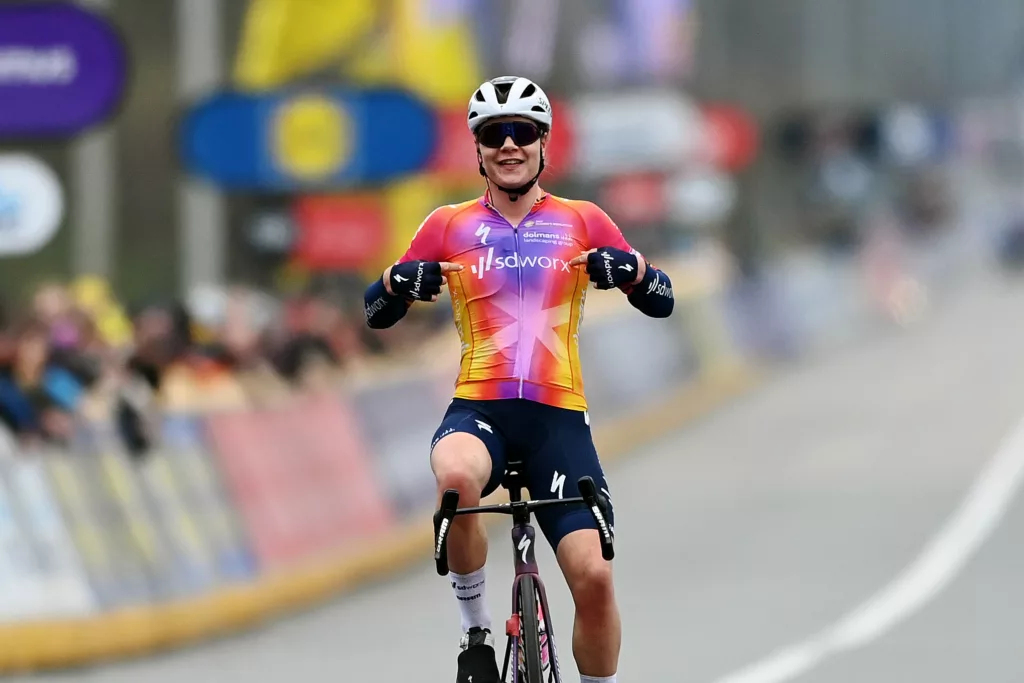
Lotte Kopecky and the modern record
The biggest modern statistical shift came in 2025, when Lotte Kopecky took her third victory and became the sole record holder. Before that, the race had several riders on two wins, including Mirjam Melchers-Van Poppel, Judith Arndt, Annemiek van Vleuten and Elisa Longo Borghini. Kopecky moving clear on three matters because it gives the race its first truly singular queen.
It also matters because of who she is and where she comes from. Grace Verbeke had been the only Belgian winner until Kopecky won in 2022. By taking victories in 2022, 2023 and 2025, Kopecky did not just become the race’s most successful rider. She became the home champion the event had rarely had, and then kept winning in an era of far greater depth and visibility.
That makes her place in the race’s history especially significant. She did not simply match the old record. She reset the benchmark.
What Tour of Flanders Women represents now
Tour of Flanders Women is now one of the cornerstones of the women’s WorldTour season. It has the prestige, the route identity and the winners list to stand comfortably among the biggest one-day races in the sport. It may not have the century-old history of the men’s event, but it no longer feels new in any meaningful sense.
That is what makes the history of the race so interesting. In just over two decades, it has moved through several distinct phases – the shorter Muur-Bosberg years, the Oudenaarde route reset, the WorldTour era and now the Kopecky era – while still keeping the same essential character. The roads may evolve, the final climbs may change emphasis, and the names on the podium may shift, but the race has stayed true to one idea. To win Tour of Flanders Women, you have to handle Flanders better than everyone else.
For more on how the race works on the road now, ProCyclingUK’s Beginner’s guide to Tour of Flanders Women 2026 and Beginner’s guide to Men’s Ronde van Vlaanderen 2026 are the best next reads.

