

Paris-Roubaix Femmes is still a relatively new race, but it has already built a deeper identity than many events manage in decades. Since its debut in 2021, it has quickly become one of the defining one-day races in women’s cycling, not simply because of the famous name attached to it, but because the race has repeatedly produced editions that feel distinctive, dramatic and genuinely memorable.
That matters. Plenty of races arrive with hype and then spend years trying to justify it. Paris-Roubaix Femmes did not need that long. From the first muddy edition won by Lizzie Deignan, through Elisa Longo Borghini’s solo move, Alison Jackson’s surprise breakthrough, Lotte Kopecky’s world champion display and Pauline Ferrand-Prévot’s home triumph, the race has already produced a sequence of winners and storylines that give it real weight.
If you want the modern race in a broader spring context, ProCyclingUK’s Beginner’s guide to Paris-Roubaix Femmes explains why the event matters so much, while the Paris-Roubaix Femmes 2026 route guide breaks down the sectors and the shape of the race today.
Why Paris-Roubaix Femmes took so long to arrive
For years, the absence of a women’s Paris-Roubaix felt increasingly difficult to defend. Other major races had women’s editions, women’s stage racing had grown significantly, and the broader push for greater visibility and parity in the sport had made the gap more obvious. Paris-Roubaix remained one of cycling’s great monuments, a race wrapped in myth, but for far too long that mythology had only been available in full to the men’s peloton.
The women’s edition was finally added to the calendar for 2020, and that alone felt historic. It would have been one of the most significant additions to the Women’s WorldTour in years. But the pandemic intervened, and the first edition was cancelled before it could be run. That delay matters in the history of the race because it gave the eventual debut in 2021 an even stronger sense of significance. By the time the riders finally lined up, this was no longer just a new race. It was an overdue one.
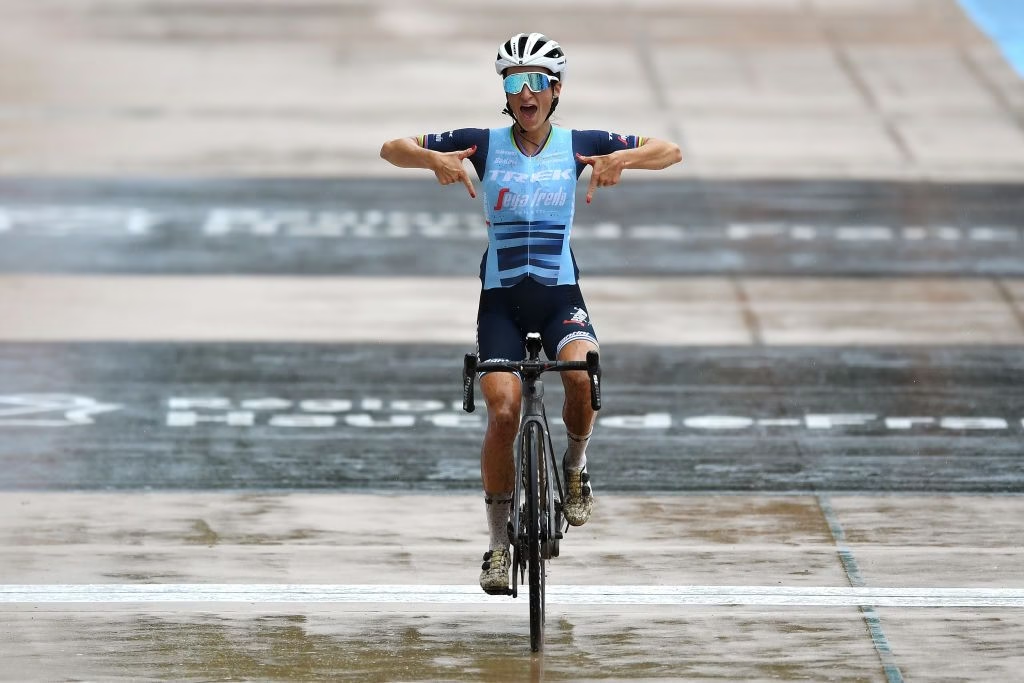 Photo Credit: Getty
2021 – Lizzie Deignan makes history in the mud
The first edition of Paris-Roubaix Femmes took place on the 2nd October 2021, and it could hardly have asked for a more dramatic beginning. The weather turned the cobbles into a slick, muddy mess, creating conditions that looked both epic and brutal. There was excitement around the race simply existing at all, but the state of the roads ensured that the first winner would immediately be remembered as someone who had survived a truly hard version of Roubaix.
Lizzie Deignan did far more than survive it. She attacked before the riders had even hit the first cobbled sector and then committed fully to a move that initially looked implausible. Going that early in Paris-Roubaix, especially in such conditions, seemed to invite disaster. Instead, it became a masterpiece. By attacking before the most chaotic phase of the race, Deignan avoided much of the turbulence behind her and forced everyone else to chase from a position of uncertainty.
She rode alone across all 17 cobbled sectors and reached the Roubaix Velodrome with enough time to savour the final lap. Marianne Vos finished second and Elisa Longo Borghini third, but the main story was Deignan’s scale of victory. It was the first edition and already the race had produced a performance that felt mythic.
That win shaped how people thought about Paris-Roubaix Femmes from the beginning. It suggested that the race would reward riders brave enough to commit early, and that the women’s peloton did not need a toned-down version of Roubaix to produce a compelling spectacle. It needed the real thing.

2022 – Elisa Longo Borghini times it perfectly
The second edition, held on the 16th April 2022, felt very different. The race was longer than in 2021, the conditions were not as extreme, and the tactical shape was more recognisable as a modern cobbled Classic rather than a survival epic. That contrast was useful for the race’s development, because it showed that Paris-Roubaix Femmes was not going to be defined by one kind of scenario alone.
Elisa Longo Borghini won with a beautifully judged attack after the race had already started to fragment. Rather than going from deep in the race like Deignan, she struck once the front of the race had reshuffled and hesitation opened a door. It was an intelligent Roubaix move, an attack delivered at exactly the moment others were deciding whether to chase or reset.
Lotte Kopecky won the sprint behind for second, with Lucinda Brand taking third. Trek-Segafredo, after Deignan’s win in the first edition, had now taken the first two runnings of the race. More importantly, Paris-Roubaix Femmes had already shown tactical variety. One year it had been won with a near-impossible long solo. The next, with a later and more precise attack after a selective race.
Longo Borghini’s victory also reinforced her place as one of the defining Roubaix riders of the early years. Even when she was not winning, she looked like someone who understood how the race should be ridden.
2023 – Alison Jackson turns chaos into a career-defining moment
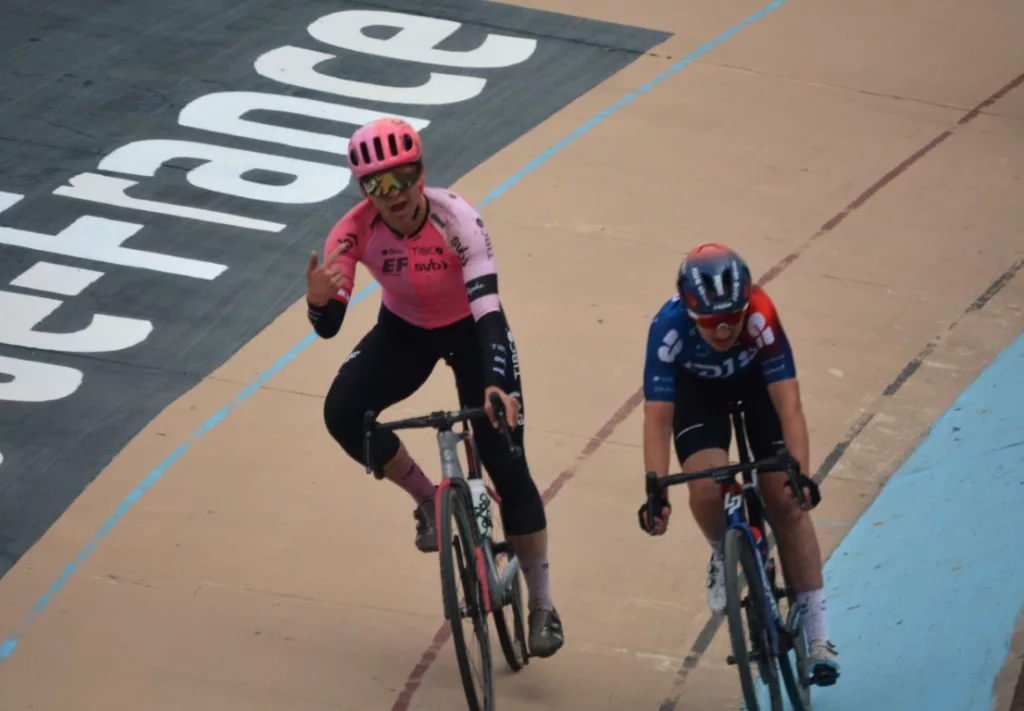
The 2023 edition, raced on the 8th April, remains one of the most chaotic and surprising of the race’s first years. This was the version of Paris-Roubaix Femmes that most fully embraced unpredictability. A large breakaway formed early, and instead of being reeled back in by the bigger teams, it stayed alive deeper and deeper into the race until it became increasingly clear that the winner would come from that move.
Alison Jackson, already well known within the peloton as an aggressive and instinctive racer, took the biggest win of her road career by sprinting to victory in the velodrome. Katia Ragusa and Marthe Truyen completed the podium, while the more obvious favourites arrived just behind.
The result was a reminder that Roubaix can turn hierarchy upside down. On paper, some races look open but still tend to fall to the biggest names. Paris-Roubaix Femmes in 2023 genuinely escaped that script. It became a race about judgment, positioning, collective hesitation and the willingness to believe the break really could stay away.
Jackson’s win also gave the event another layer of identity. It was no longer simply a race for the obvious stars. It was a race where making the right move at the right time could alter a career.
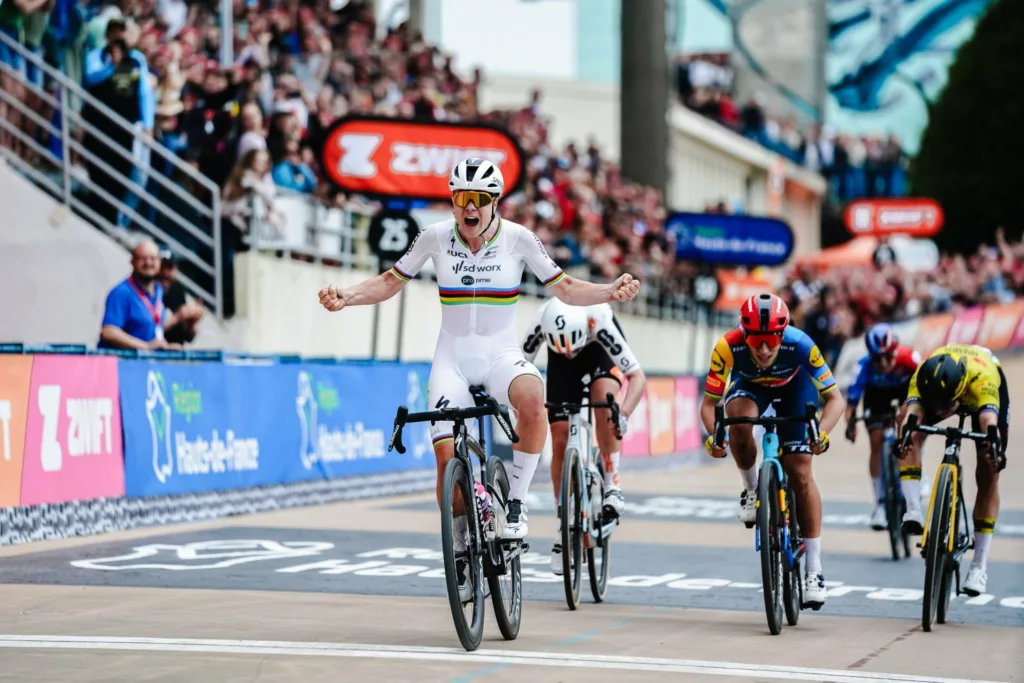 Photo Credit: Getty
2024 – Lotte Kopecky adds star power and authority
By the time the 2024 edition came around on the 6th April, Paris-Roubaix Femmes already had character, but it still benefited from a win by one of the central riders of the era. Lotte Kopecky provided exactly that.
She won from a small lead group after a hard, selective race, beating Elisa Balsamo and Pfeiffer Georgi in the sprint. It was not a shock result, not a chaotic longshot, and not a miracle recovery ride. It was the kind of victory that major champions deliver when they are among the strongest riders in the race and still have enough composure to finish it off.
That mattered for the race’s history. Kopecky arrived as one of the biggest names in women’s cycling, the reigning world champion, and one of the few riders capable of shaping almost any one-day race she entered. Her victory gave Paris-Roubaix Femmes another kind of legitimacy, not because it lacked prestige before, but because major races eventually need major champions on their honours list.
The 2024 edition also underlined how much the race was maturing. It no longer felt like a fascinating new addition. It felt established. Riders were targeting it specifically, teams were building plans around it, and the winners’ list was beginning to look serious.

2025 – Pauline Ferrand-Prévot gives France its first winner
If Kopecky’s win gave the race star power, Pauline Ferrand-Prévot’s 2025 victory gave it national resonance. On the 12th April 2025, Ferrand-Prévot became the first French winner of Paris-Roubaix Femmes, and that carried obvious emotional and symbolic weight.
Roubaix is one of the most French races in the sport, even if its mythology belongs to cycling more broadly. For the women’s event to gain a home winner so early in its existence felt important. Ferrand-Prévot was also a compelling rider to do it. Her background across road, cyclo-cross and mountain bike made her look almost built for a race like this, one where balance, technical skill and resilience matter as much as pure strength.
Her ride was not straightforward either. She crashed, got back into contention, attacked with around 25km to go, bridged to Emma Norsgaard and then dropped her on Camphin-en-Pévèle before riding solo to the velodrome. Letizia Borghesi took second and Lorena Wiebes finished third.
It was one of those victories that seemed to fit the event perfectly. Roubaix has always been a race where setbacks do not rule you out if you still have the legs and the nerve to keep fighting. Ferrand-Prévot’s win captured that quality beautifully.
How the race has evolved
One of the more interesting parts of Paris-Roubaix Femmes history is how quickly it has grown into itself. The organisers did not simply create a one-off novelty and leave it there. They gradually extended the race distance across its early editions, making it feel more and more like a fully formed Monument-style challenge rather than a shortened adaptation.
The identity of the race, though, has remained stable. The final cobbled sequence has always done the real damage. The race still builds towards the sectors that define the Roubaix myth, still demands supreme positioning before the pavé begins, and still ends with that lap of the Roubaix Velodrome, one of the most recognisable finishes in cycling.
That last detail matters more than it might seem. A race can borrow famous roads, but the velodrome gives Paris-Roubaix Femmes something deeper than route similarity. It gives it visual continuity with the wider history of Roubaix. When riders enter that track after surviving the cobbles, it feels like they are joining a story that long pre-dates them, even if the women’s chapter only began in 2021.
The themes that already define Paris-Roubaix Femmes
Even in a short history, clear themes have emerged.
The first is that conviction matters. Deignan won by going very early. Longo Borghini won by attacking at precisely the right moment. Jackson won by backing the break. Ferrand-Prévot won by refusing to let a crash end her day. Roubaix does not usually reward hesitation for long.
The second is that there is no single template for victory. Some races begin to look repetitive quite quickly, with similar rider types winning in similar ways. Paris-Roubaix Femmes has not done that. It has produced long solos, late solos, breakaway wins and selective group finishes.
The third is that the race rewards a wider skill set than many Classics. Raw power matters, of course. So does endurance. But bike handling, balance, calmness over rough ground and the ability to stay composed when everything is going wrong all matter just as much. That helps explain why the race has attracted such varied winners.

The riders who have shaped its early years
Although there have been five different winners in the first five editions, certain riders have still become closely tied to the race. Elisa Longo Borghini is the clearest example. She won in 2022 and podiumed in 2021, and her racing style has always looked naturally suited to Roubaix. Marianne Vos has also been a constant presence near the front, capable of reading the race and surviving deep into the decisive phases even without taking the win.
Lotte Kopecky’s second place in 2022 and victory in 2024 gave her a strong early record too, while Ferrand-Prévot’s 2025 success immediately placed her in the race’s emotional history because of what that first French win represented.
That spread of names says something useful about Paris-Roubaix Femmes. No single rider has dominated it yet. Instead, the race has been shaped by a collection of elite riders from slightly different backgrounds and with slightly different strengths. That feels appropriate for Roubaix, a race that tends to resist easy ownership.
Why Paris-Roubaix Femmes matters so much already
Part of the race’s prestige is inherited. Paris-Roubaix is one of cycling’s defining names, and any women’s edition was always going to arrive with attention and symbolism attached. But inherited prestige only goes so far. A race still needs editions that justify the emotional investment around it.
Paris-Roubaix Femmes has managed that quickly. The winners’ list is strong, the racing has been varied, and the images have already become part of the sport’s modern memory – Deignan covered in mud, Jackson celebrating wildly, Kopecky powering to the line, Ferrand-Prévot entering the velodrome alone.
It also matters because it closed one of the most obvious gaps in the sport. Once the race existed, it immediately felt strange that it had taken so long. That is usually a sign that something truly belongs.
If you are looking at the wider cobbled spring around it, the A brief history of the Tour of Flanders Women and A brief history of Scheldeprijs Women help place Paris-Roubaix Femmes within the broader growth of the women’s Classics calendar.
 Photo Credit: ASO
Paris-Roubaix Femmes winners list
2021 – Lizzie Deignan
2022 – Elisa Longo Borghini
2023 – Alison Jackson
2024 – Lotte Kopecky
2025 – Pauline Ferrand-Prévot
Final verdict
The history of Paris-Roubaix Femmes is still short, but it is already rich. The race began late, was delayed again by the pandemic, and then somehow managed to arrive with immediate authority once it finally got its chance. That is not easy to do.
What stands out most is not just that the race now exists, but that each edition has added something different to its identity. The inaugural mud-soaked solo of Lizzie Deignan gave it legend. Longo Borghini gave it tactical precision. Alison Jackson gave it unpredictability. Kopecky gave it star power. Ferrand-Prévot gave it national significance.
That is a remarkable foundation for a race only first held in 2021. Paris-Roubaix Femmes no longer feels like a welcome addition. It feels indispensable.

