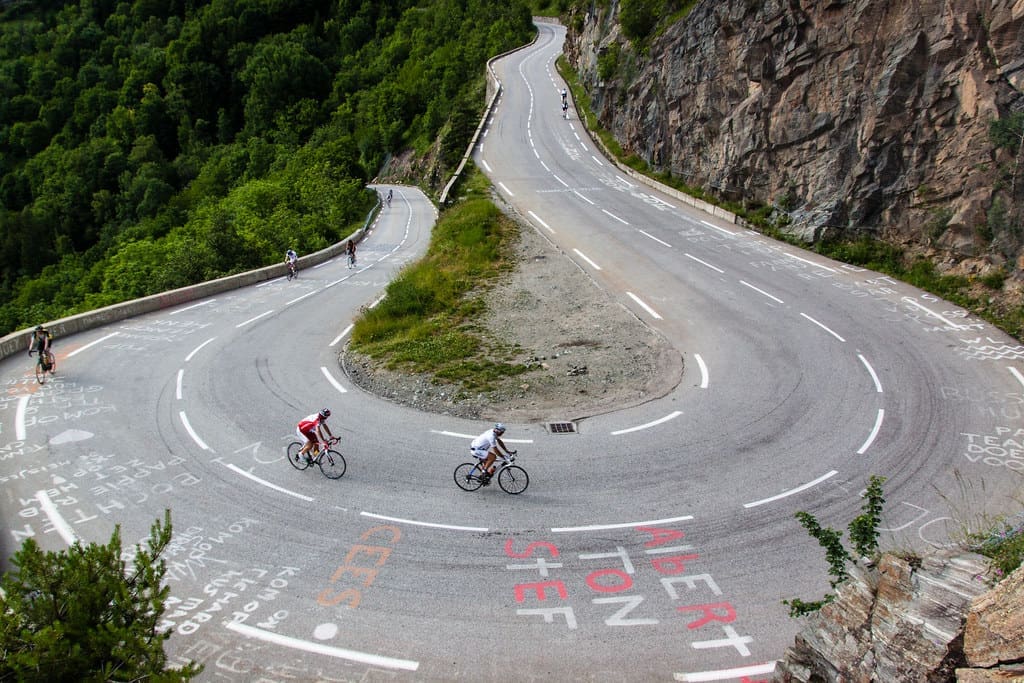
The legendary Alpe d’Huez, known for its 21 numbered bends and dramatic stage finishes the men’s Tour de France, will be the grand finale of the 2024 Tour de France Femmes. This marks a significant milestone in the race’s history, showcasing one of the most famous climbs in cycling.
The ascent of Alpe d’Huez is not just another climb. Measuring 13.8km with an average gradient of 8.1%, the route winds from Bourg d’Oisans to the summit, creating a gruelling challenge for the riders. The climb’s first two kilometres feature gradients over 10%, and the hairpin bends are known to test even the most seasoned climbers.
First featured in the men’s Tour de France in 1952, Alpe d’Huez has been the stage for numerous memorable battles. Names such as Fausto Coppi, Bernard Hinault, Marco Pantani, Thibaut Pinot, Geraint Thomas, and Tom Pidcock are etched in history, each having conquered this arduous ascent. Now, the women’s peloton will have the opportunity to etch their names alongside these legends.
Marion Rousse’s vision
Race director Marion Rousse expressed her excitement about including Alpe d’Huez in the Tour de France Femmes. “The legend of the Tour de France is often written in its mountain passes,” she said. “So it doesn’t get better than Alpe d’Huez – a climb known throughout the world, and with its 21 numbered bends, has been a dramatic stage in the men’s Tour. Of course, the winner will have her name written on one of the bends.”
Rousse emphasised the importance of integrating historic climbs into the women’s race, reflecting the rich heritage of the Tour de France. “We want to gradually build on the Tour’s history,” she explained. The Alpe d’Huez, a stage renowned for its epic battles and spectacular scenery, is a perfect fit for this vision.
 Photo Credit: ASO-Charly Lopez
Marion Rousse has seen the Tour de France Femmes evolve since its inaugural edition in 2022. She noted the increasing recognition and interest in women’s cycling, highlighting the importance of iconic stages in engaging spectators. “In the first edition, the questions were more around whether it’s a good thing to have a women’s Tour de France. Whereas in the second edition, they were asking about the favourites to win the different stages,” she observed.
Rousse is optimistic about the future of the race and its role in inspiring the next generation of female cyclists. “The Tour de France could serve a role as to inspire little girls to have a go at racing at this level,” she said. “They will switch on the TV and will see women on a bike, and they may even say to themselves ‘Well I could have a go at that too’.”
Impact on the race
The inclusion of Alpe d’Huez is set to significantly impact the race dynamics. The climb will be the final challenge on the last stage, ensuring that the battle for the yellow jersey remains intense until the very end. With accumulated fatigue from a week of racing and the additional strain from the Paris Olympic Games, riders will face a true test of stamina and climbing ability.
Demi Vollering, who claimed the yellow jersey in 2023, is a clear favourite to triumph again. Supported by a strong SD Worx-Protime team, including climber Niamh Fisher-Black, Vollering’s performance on Alpe d’Huez could seal her victory. However, other contenders like Kasia Niewiadoma, Neve Bradbury, Ashleigh Moolman Pasio, Elisa Longo Borghini, and French climbers Juliette Labous and Évita Muzic will also be vying for the top spot.
As the 2024 Tour de France Femmes approaches, the anticipation builds for what promises to be an exhilarating race, culminating in the challenging and prestigious ascent of Alpe d’Huez.