
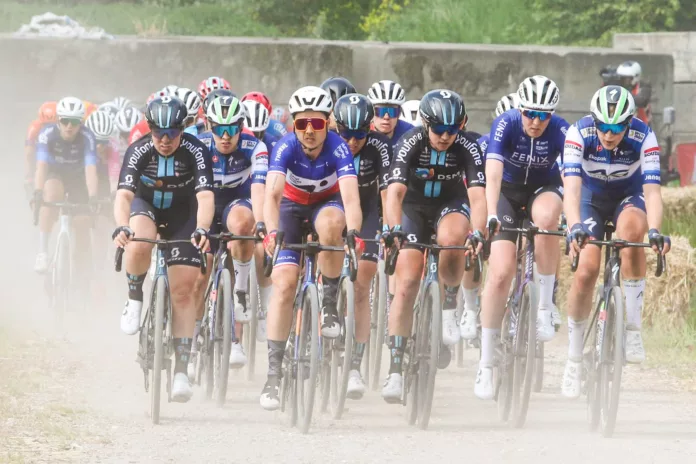
Antwerp Port Epic Ladies 2026 takes place on Sunday, 24th May, with the race starting and finishing in Antwerp. It is one of the more distinctive one-day races on the women’s calendar, not because of mountains, but because of the way the route turns flat terrain into something far more wearing.
The race sits at UCI 1.Pro level, which gives it proper sporting weight without making it part of the Women’s WorldTour. That position suits the event. Antwerp Port Epic Ladies is not trying to copy Tour of Flanders Women or Paris-Roubaix Femmes. Its identity is different: docklands, exposed roads, cobbles, gravel-style sectors, constant changes of rhythm, and a finish where the strongest surviving group is usually very different from the peloton that rolled out of Antwerp.
The organisers have the 2026 women’s race listed for a 14:00 local start and an expected finish around 17:45. The full detailed sector list and final distance have not yet been publicly confirmed, but recent editions make the route character clear. This is a flat race by profile, but not an easy one by feel.

What kind of route is Antwerp Port Epic Ladies?
The easiest way to understand Antwerp Port Epic Ladies is to think of it as a rough-surface Belgian one-day race rather than a traditional climbing Classic.
There is no Oude Kwaremont-style focal point, no Mur de Huy-style final climb, and no long mountain section where the race naturally sorts itself by climbing ability. Instead, the difficulty comes from repeated disruption. Riders have to deal with rough surfaces, cobbled roads, gravel tracks, exposed industrial roads, turns through the port area, and constant pressure to hold position.
That makes it a race where the route does not look brutal on a simple profile, but feels brutal in the bunch. Every rough section asks the same questions: who is near the front, who has teammates left, who can handle the bike cleanly, and who can avoid wasting energy every time the peloton stretches?
Where does the 2026 race start and finish?
The 2026 race starts and finishes in Antwerp, with the women’s race scheduled from 14:00 to around 17:45 local time.
That gives the race a clear city-and-port identity. Antwerp is not just a backdrop here. The port roads are central to the character of the event, giving the race its exposed, industrial, awkward feel. The race takes riders away from the neat visual template of the Flemish hill Classics and into a different kind of Belgian racing landscape.
The women’s race is also scheduled the day before the men’s Antwerp Port Epic, helping build the weekend around the same rough-road format.

Why the flat profile is misleading
Calling Antwerp Port Epic Ladies a flat race is technically accurate, but it risks missing the point. The absence of major climbing does not make it a sprinters’ procession.
In a normal flat race, teams can often organise around wide roads, predictable terrain and a controlled run-in. Here, control is harder to maintain. Rough sectors stretch the peloton, punctures break rhythm, crashes can split groups, and the wind can make any exposed section more dangerous. A rider can be strong enough to win and still lose the race by being too far back at the wrong moment.
The 2025 race showed that clearly. It was run over roughly 125km, with cobblestones, gravel tracks, rain, crosswinds, crashes and punctures helping to reduce the front of the race to around 25 riders before Susanne Andersen won a photo finish ahead of Clara Copponi and Eilidh Shaw.
That is the important lesson for 2026. Even if the profile says flat, the route is built to remove riders through attrition rather than elevation.
The role of the port roads
The port section gives Antwerp Port Epic Ladies much of its personality. These roads are open, exposed and functional rather than scenic in the traditional cycling sense. That creates a very different rhythm from the Flemish Ardennes or the Ardennes Classics.
Positioning becomes crucial because the peloton can stretch quickly on open roads. If the wind is active, the race can split even without a major attack. If the bunch is nervous before a rough section, the fight for position can be as costly as the sector itself.
This is also where teams with strong Classics habits come into their own. The best riders are not simply the strongest in isolation. They are the ones who know when to move up, when to stay calm, when to spend energy, and when to let others chase. In this race, energy lost through bad positioning can be just as damaging as energy lost through attacking.
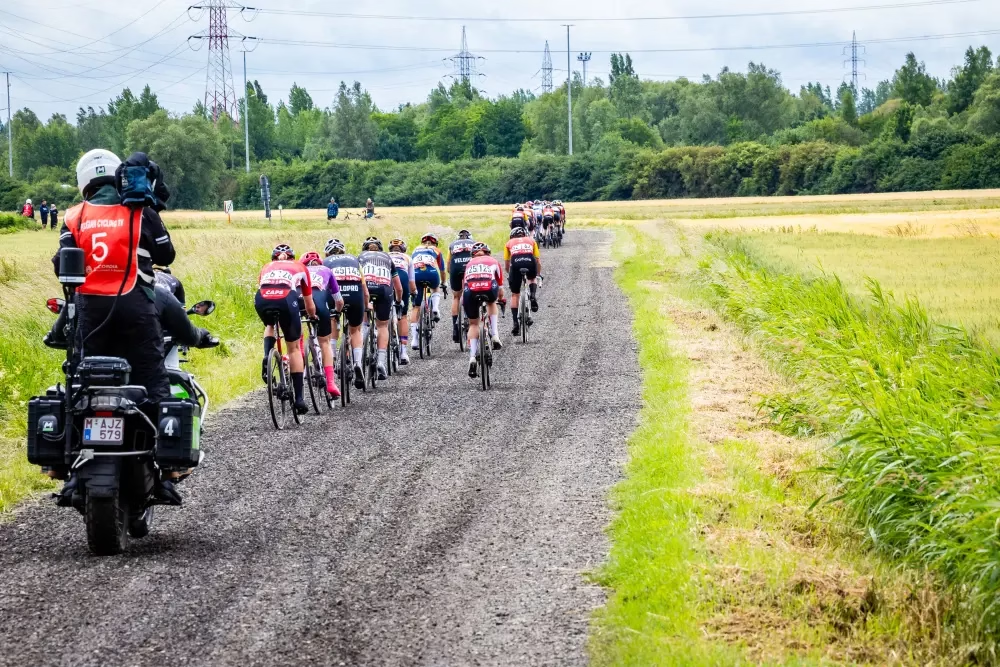 Photo Credit: Gregory Van Gansen
Cobbles, gravel and rough sectors
The Antwerp Port Epic format is built around mixed surfaces. The race identity comes from natural roads, cobbled sectors and port-area roads rather than long climbs or repeated bergs.
That gives the route a stop-start quality. A rider can be comfortable on the tarmac, then suddenly under pressure on a rougher section. A team can look organised, then lose three riders to a split, a puncture or a badly timed corner. The race rarely allows anyone to settle for long.
The cobbled and gravel-style sectors also change the type of rider who can win. Pure climbing is not the defining quality. Nor is pure sprinting. The ideal rider is powerful, resilient, technically secure, and still quick enough to finish from a reduced group.
Where can the race split?
The most dangerous parts of Antwerp Port Epic Ladies are not always the places that look hardest on a map. The decisive moments can come before a sector, during a run of turns, or immediately after a rough road when groups are trying to re-form.
There are three obvious pressure points.
The first is the approach to each rough section. Riders know that entering too far back is risky, so the bunch fights for position. That creates accelerations, braking, shoulder-to-shoulder racing and a constant demand for concentration.
The second is the sector itself. On cobbles or gravel, the race stretches naturally. Stronger riders move through, weaker riders lose the wheel, and mechanical problems become much more expensive. A puncture in a normal road race can sometimes be recovered from. A puncture when the race is already split can end a rider’s chance completely.
The third is the exit. This is where the strongest groups often consolidate. If a front group has formed, there may be a short moment of hesitation behind. A committed team can use that moment to press on, while riders caught in the second group are suddenly forced to chase rather than simply survive.
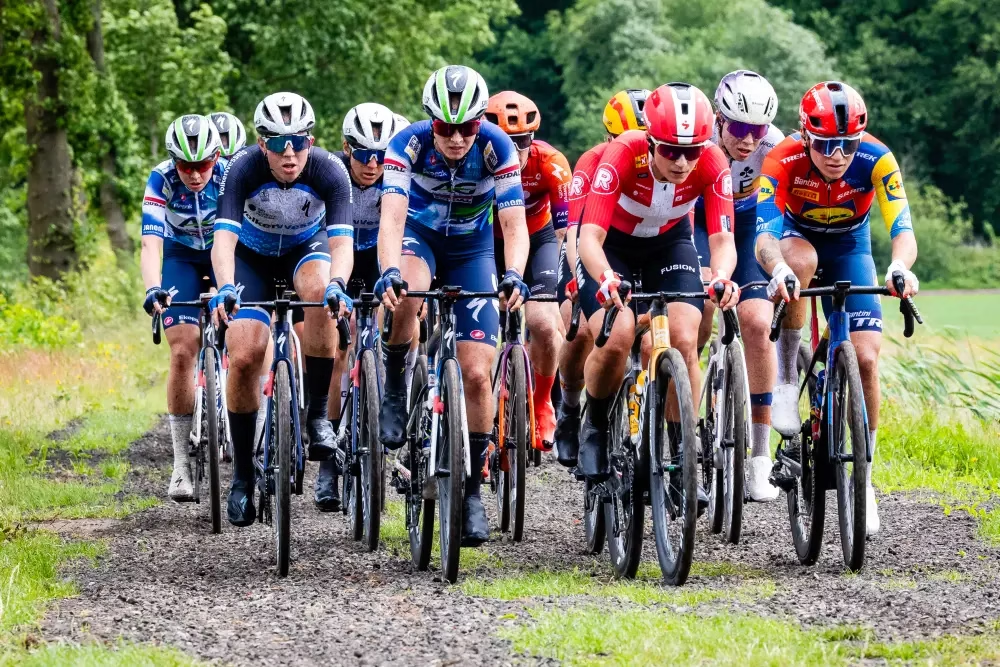 Photo Credit: Gregory Van Gansen
What sort of rider does the route favour?
This route favours Classics riders more than pure sprinters. The winner still needs speed, but it is speed after a hard, technical and fragmented race, not speed from a fresh, protected bunch sprint.
A rider like Susanne Andersen winning in 2025 made sense because she could survive the chaos and still sprint at the end. Lara Gillespie winning in 2024 also fits the race identity, with the event rewarding riders who can handle repeated pressure rather than wait for one obvious decisive climb.
The ideal Antwerp Port Epic Ladies contender has five qualities: strong positioning, bike-handling confidence, resilience on rough surfaces, the ability to follow repeated accelerations, and a fast finish from a reduced group. A team also needs numbers late on. Having two riders in a reduced front group can be decisive, especially if the group is tired and unwilling to chase every move.
How the finale usually develops
The finale is rarely as simple as a full bunch sprint. Even when the race ends in a sprint, it is usually from a reduced group shaped by everything that came before.
That changes the tactics. A sprint team cannot rely only on a lead-out train because the train may not survive the full route intact. An attacking team cannot assume the race will stay away because the run-in to Antwerp can bring groups back together if there is enough organisation behind.
Late attacks are always dangerous. In 2025, Marion Norbert-Riberolle attacked inside the final 10km and was joined by Kamilla Aaseb and Vera Tieleman before the chase brought them back. That move did not survive, but it showed how the race invites aggression late on.
The final kilometres are therefore about timing as much as strength. Go too early and the reduced group may still have enough cohesion to chase. Wait too long and the race becomes a sprint against riders who have survived the same selection.
Why the weather could change everything
Weather always matters in Belgian one-day racing, but it feels especially important here. Rain turns rough sectors into a bigger handling test. Wind makes exposed roads through the port more selective. Cold or damp conditions make repeated accelerations and mechanical stress even more draining.
The 2025 edition was shaped heavily by poor weather, with rain, crosswinds and rough roads helping to fracture the peloton. A dry 2026 race would still be selective, but a wet or windy edition would immediately make the race harder to control.
That is why pre-race forecasts will be worth watching. The route has enough difficulty on its own, but weather can turn Antwerp Port Epic Ladies from a reduced sprint race into a proper survival contest.
What should fans watch for?
The key is to watch the front of the bunch before the rough sectors, not just during them. That is where the race often begins to reveal itself.
If the same teams keep appearing near the front, they are probably trying to shape the race rather than survive it. If sprinters are repeatedly losing teammates, the finale becomes harder for them even if they remain in the front group. If the peloton starts splitting after each rough section, the winning move may not look dramatic at first. It may simply be the group that keeps growing more organised while everyone else runs out of road.
The other thing to watch is team depth. Antwerp Port Epic Ladies is exactly the kind of race where a rider can be strong enough to win but tactically isolated. A teammate in the final 25km can close gaps, mark attacks, or force rivals to chase. In a reduced group after a rough day, that can be the difference between a podium and a missed opportunity.
Antwerp Port Epic Ladies 2026 route verdict
Antwerp Port Epic Ladies 2026 should again be one of the more awkward and attritional one-day races of the women’s season. The race may be flat on paper, but that flatness is deceptive. The port roads, cobbles, gravel-style sectors and exposed terrain make it a race of constant pressure rather than one decisive climb.
The detailed 2026 route still needs final confirmation, but the race identity is already clear. This is not a day for passive racing. It is a day for riders who can stay near the front, absorb repeated shocks, handle rough roads cleanly, and still sprint or attack after three hours of disruption.
Expect a race that gradually removes options. It may end in a sprint, but it is unlikely to be a normal one. In Antwerp Port Epic Ladies, the route does not need hills to create selection. It does it through stress, surface, wind, and the simple fact that every mistake costs more than it would on smoother roads.

