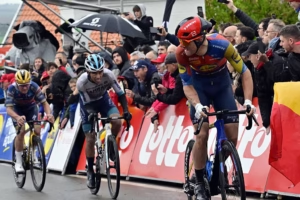
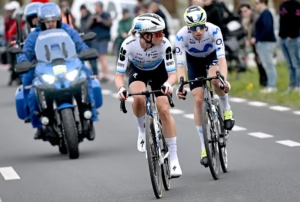
Itzulia Basque Country 2026 runs from 6 to 11 April and, for anyone new to the race, the first thing to understand is that this is not a stage race built around one giant summit finish and a few quiet days in between. Itzulia is usually tense from the start, awkward to control and often more selective than it first appears. The roads are tight, the climbs are short and sharp, and the racing rarely settles for long.
That is what gives the race its place on the calendar. It is one of the oldest and most respected one-week stage races in cycling, but it does not behave like a smaller Grand Tour. The difficulty comes through repetition, rhythm changes and technical terrain rather than sheer length. Riders who do well here usually need to climb, accelerate, recover and stay switched on all week.
If you want the wider stage-racing context first, ProCyclingUK’s Beginner’s guide to the Volta Ciclista a Catalunya 2026 is a useful companion piece, because Catalunya and Itzulia sit quite close together in the spring but ask slightly different questions of the peloton.
What is Itzulia Basque Country?
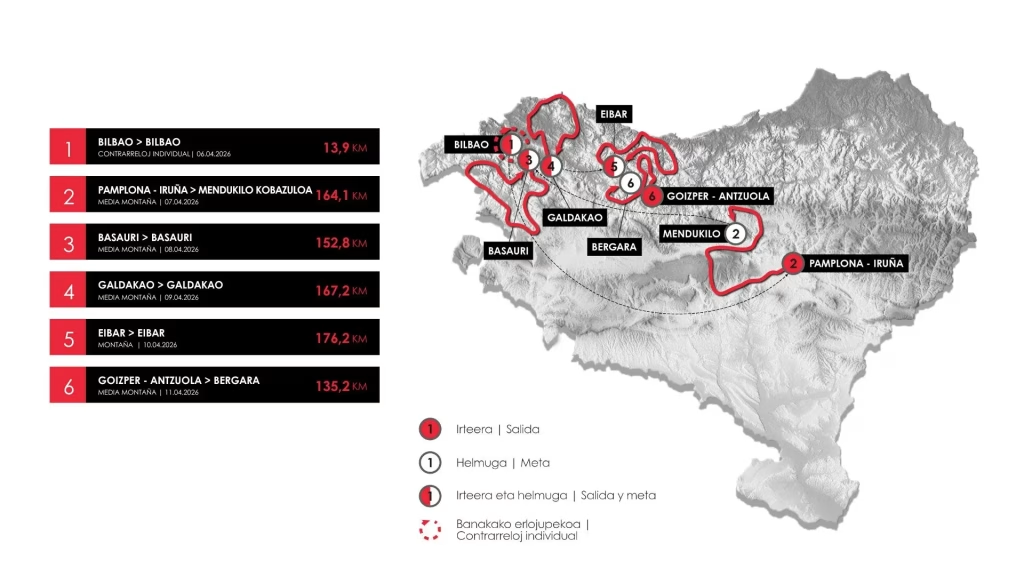
Itzulia Basque Country is the biggest stage race in the Basque Country and one of the key one-week events on the men’s WorldTour calendar. The 2026 edition starts in Bilbao and finishes in Bergara, with six stages packed into six days of racing.
For newer fans, it is best thought of as a climbers’ and stage-racers’ test, but not in the neat, predictable sense of a race that simply waits for the mountains. Itzulia tends to reward riders who can handle repeated efforts on punchy terrain, deal with nervous positioning and respond quickly when the race changes shape.
Why is Itzulia Basque Country so well-regarded?
Itzulia has built its reputation on the kind of terrain that creates uncertainty. The climbs are often not the longest in the sport, but they are steep enough and frequent enough to keep the race under pressure. That means there is rarely much room to hide. A rider can lose time through one bad moment, one missed move, or one section of road where they slip too far back.
That is a big part of the appeal. The race does not always need one giant mountain to create separation. Instead, it wears riders down through repeated decisions and repeated efforts. That tends to make the general classification feel alive for much longer than in more straightforward stage races.
How does the 2026 route look?
The 2026 edition opens with an individual time trial in Bilbao, which immediately gives the week a sense of structure. From there, the route moves through five road stages that steadily tighten the pressure rather than saving everything for one dramatic mountain showdown.
That matters because Itzulia often works through accumulation. The opening time trial can create the first meaningful gaps, but the real story of the race usually develops over the following days as riders try to defend, attack and recover on roads that rarely allow a comfortable rhythm.
The queen stage is expected to come later in the week, but one of the defining features of this race is that even the days that look manageable on paper can still reshape the standings.
What sort of rider wins Itzulia Basque Country?
The ideal Itzulia rider is usually a complete stage racer rather than a pure specialist. Short time trial ability helps, but the race is rarely decided by the clock alone. Climbing ability matters, but so does punch, recovery and confidence on technical roads.
That is why the winners here often look like riders who can do a bit of everything at a high level. They do not need to be the best at one discipline. They need to be consistently strong across a full week of awkward, demanding racing.
If you follow stage racing more broadly, that is also why Itzulia is often a useful marker for the spring and early summer. Riders who thrive here are usually already in serious condition.
What makes the race feel different from other week-long stage races?
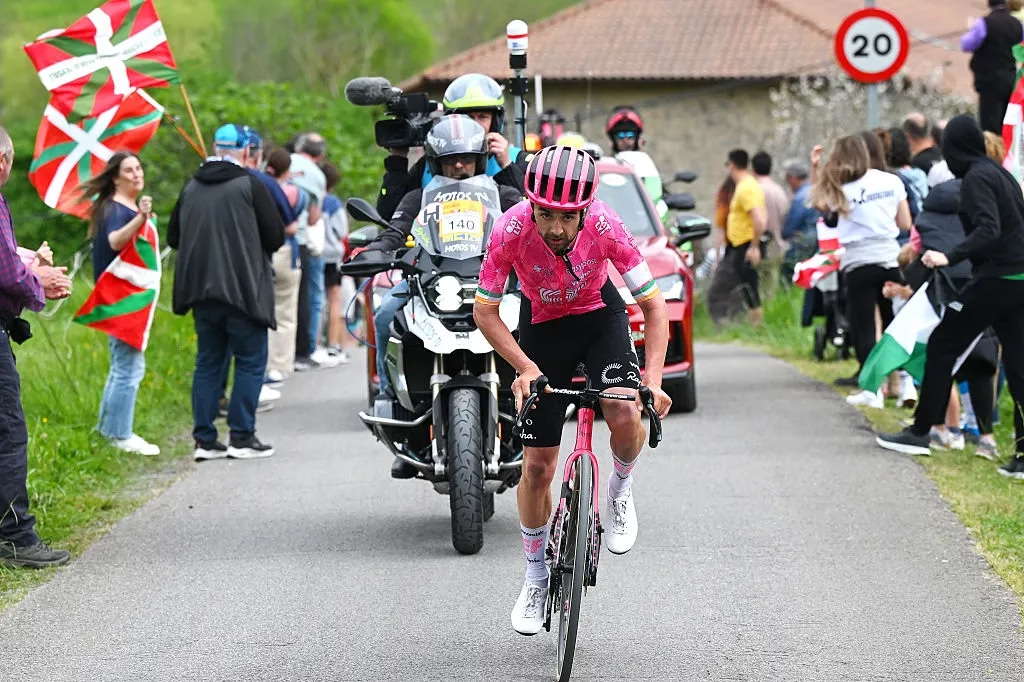
For beginners, this is where Itzulia really stands apart. The Basque roads tend to be narrow, twisting and physically demanding in a way that television does not always fully show. Even when the gradients are not extreme, the racing can still feel frantic because teams are constantly trying to protect their leaders and hold position.
That gives the race a compressed feel. There is often very little dead time, and the stages can feel denser than their distance suggests. A day that looks modest on paper can still become selective because of how the terrain strings riders out and how often the pace changes.
Which stages matter most?
The opening time trial matters because it creates the first pressure points. In a race like this, even small early gaps can become surprisingly important because there are so many awkward stages still to come.
Later in the week, the queen stage becomes the most obvious day for the main favourites to test each other directly. That is usually where the race’s climbing hierarchy is laid bare, or at least where teams try hardest to make it so.
Then there is the final stage, which in Itzulia is often still dangerous. This is not usually a race where the leader can simply ride conservatively to the finish without concern. If the general classification remains close, the last day can still reopen everything.
Why does Itzulia matter in the season?
Itzulia Basque Country comes at an important moment in April. It is a major race in its own right, but it also offers clues about who is thriving in stage-race mode before the next key part of the season. Some riders use it as a spring target, others as a stepping stone, but either way it tends to reveal real condition.
That is one reason the race feels so honest. Results here usually tell you something useful. A rider who wins Itzulia rarely does so by accident.
For more early-season context, ProCyclingUK’s Beginner’s guide to Men’s Milano-Sanremo 2026 and Beginner’s guide to In Flanders Fields 2026 show how different the biggest spring races can be, even when they fall quite close together on the calendar.
What should a first-time viewer watch for?
Watch how teams fight for position long before the final climb. Watch which riders look comfortable on repeated accelerations rather than one huge effort. Watch how the time gaps from the opening time trial shape the tactics later in the week.
Most of all, watch how fatigue changes the race. Itzulia often becomes more selective through accumulation than through one spectacular attack. That is its real identity. Itzulia Basque Country 2026 is a compact, high-pressure stage race where climbing strength matters, but so do sharpness, recovery and constant awareness.
That is what makes it such a rewarding race to follow, especially once you know what you are looking at.