
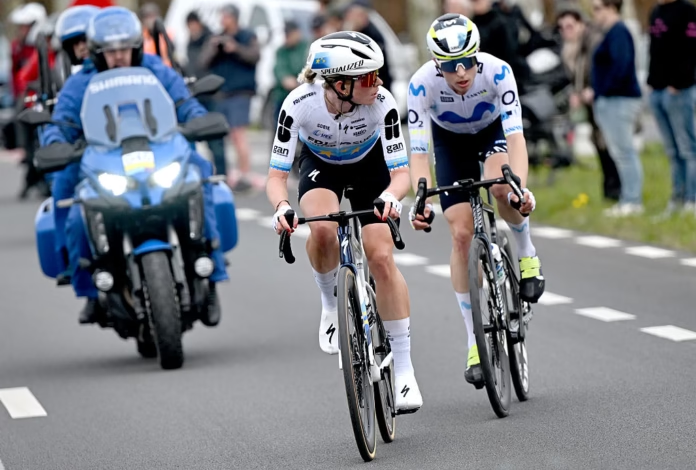
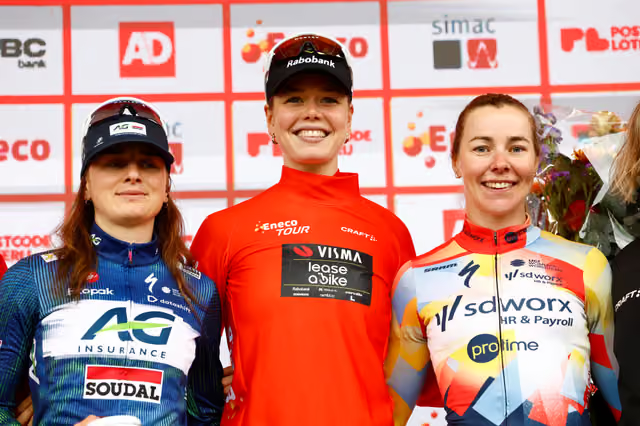
Marlen Reusser of Movistar won Dwars door Vlaanderen Women 2026 on Wednesday, beating Demi Vollering of FDJ United-SUEZ in a tense three-rider finish after Lieke Nooijen’s late attack briefly threatened to steal the race inside the final kilometre. What had begun as another wide-open Flemish one-day race gradually narrowed into a selective battle among many of the biggest names in the field, before Reusser finally proved strongest in Waregem after a day shaped by cobbles, repeated accelerations and a late tactical duel between the favourites.
The early break is given room before the favourites move
The first significant move of the day formed quite early, with Mia Gjertsen, Mia Griffin, Alison Avoine, Idoia Eraso and Natalie Quinn forcing themselves clear. They were later joined by Catalina Soto Campos and Célia Le Mouël after an intermediate chase developed behind, while Bodine Vollering was unable to stay with that bridging move and was eventually reabsorbed by the peloton.
For a while, the bunch allowed the move a generous advantage. The leaders pushed beyond four minutes as the race approached its first meaningful sectors, and that reflected the typical uncertainty of this race. Dwars door Vlaanderen can suit attackers, but a headwind or hesitation in the bunch can also keep hope alive for the faster finishers. At that stage, the bigger teams were still measuring the race rather than fully committing to control it.
That changed once the route began to tilt upwards and onto the first sectors of cobbles. Charlotte Kool crashed in the peloton before the Hellestraat, and the pressure steadily rose behind the break as teams such as FDJ United-SUEZ and UAE Team ADQ moved more prominently towards the front. The lead began to shrink from well over four minutes to under two as the race headed towards its decisive middle section.
Cobblestones and climbs strip the race back
The breakaway’s real resistance ended once the race hit the Mariaborrestraat and then the Eikenberg. Franziska Koch was one of the first major riders to really sharpen the race from the peloton, and her pressure over the Eikenberg split the bunch hard enough to bring the front of the race back into play.
Vollering then made the move that briefly looked like it might define the entire afternoon. She accelerated over the top of Koch’s effort, with Puck Pieterse, Letizia Borghesi and Fleur Moors able to go with her. That quartet built a small but meaningful gap, and for a few kilometres it looked like the race might settle into a selective front group without some of the other major favourites.
That advantage did not hold. Silvia Persico did a huge amount of work for UAE Team ADQ to bring the move back, and when the groups reformed there were around 25 riders left in serious contention. From there, the race became much more tactical. The strongest teams were all represented, and that made it harder for any single attack to fully commit the race in one direction.
The repeated cobbled sectors kept forcing riders into position battles. Chabbey tried to stretch things on the Doorn, Nooijen made a move of her own, and Bredewold attacked as well, but every time the bunch reshaped itself rather than fully splitting apart. It was attritional rather than explosive, and that often suits the most complete riders rather than the pure specialists.
Reusser and Vollering make the decisive move
The real winning move came on the first passage of the Nokereberg. Reusser attacked first and immediately forced the others into a decision. Longo Borghini tried to respond, but Cat Ferguson played the role of perfect team-mate behind, disrupting the chase rather than contributing to it. Then Vollering accelerated across herself, and once she reached Reusser the two strongest all-round riders in the race suddenly had daylight.
That pairing was dangerous for different reasons. Reusser is one of the last riders any peloton wants to hand a gap to on rolling roads, because once she settles into a rhythm she can turn a few seconds into half a minute very quickly. Vollering brought a different threat, the climbing depth and finishing kick to make the move dangerous both tactically and physically.
Behind them, the chase was complicated. UAE Team ADQ still had numbers, but Elisa Longo Borghini often found herself doing the work despite having team-mates still present. Ferguson and Liane Lippert disrupted effectively for Movistar. SD Worx-Protime eventually committed Julia Kopecky to the pursuit for Lotte Kopecky, and Le Court also took up the chase in support of Borghesi, but the rhythm never quite looked clean enough.
At one point the gap came down to five seconds, and it looked as though the catch might be inevitable. Yet just as the bunch appeared to be getting on terms, Reusser and Vollering lifted the pace again. That was probably the most important moment of the race. Instead of cracking under the pressure, they found another acceleration exactly when the group behind was least organised.
-
 Photo Credit: Cor Vos
 -
 Photo Credit: Cor Vos

Nooijen nearly steals it before Reusser finishes the job
Inside the final 10km, the tactical layer became even more pronounced. Reusser and Vollering were still clear, but there were visible conversations and moments of hesitation between them. Both knew the race was still catchable if they completely stalled, but both were also already thinking about how to win if they stayed away.
Behind them, the picture remained messy. Persico and Gasparrini returned to the front for UAE Team ADQ. Longo Borghini kept working hard. Pieterse, Bredewold and Le Court all contributed at different moments, but the chase never had that one decisive, collective commitment needed to fully erase the gap.
By the final Herlegemstraat sector, the lead was still intact and growing again. Reusser and Vollering had survived the worst of the pressure, and once they came through that final cobbled section still more than 15 seconds clear, the race was tipping in their favour.
Then came one last twist. As the pair slowed slightly and began to play the opening stages of their sprint too early, Lieke Nooijen attacked from behind and bridged across in the final kilometre. It was a superb move and, for a brief moment, gave the finale a completely different shape. Nooijen led out the sprint, trying to take advantage of the hesitation between the two leaders, but she had committed a little too early.
Reusser refused to come through at first, forcing Vollering to take the wind, and that proved crucial. Once the sprint fully opened, both came back at Nooijen. Reusser had the final surge, coming around to take the win ahead of Vollering, with Nooijen’s late gamble still earning a notable place on the podium after one of the sharpest moves of the closing kilometres.
It was a race won not only with strength, but with judgement. Reusser had attacked at the right moment, committed enough to make the move dangerous, then stayed calm enough in the finale to avoid dragging Vollering directly to the line on the Dutchwoman’s terms. In a finish full of hesitation, that made the difference.
Dwars door Vlaanderen Women 2026 Result
Results powered by FirstCycling.com
Main photo credit: Getty

