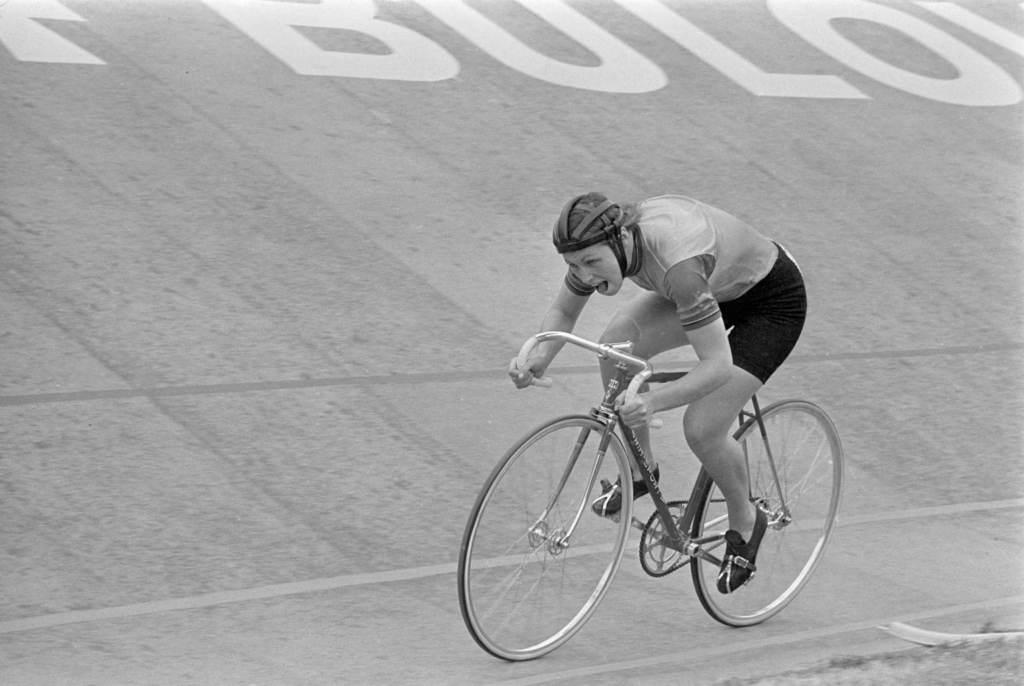
Standing at the crossroads of cycling history, few figures loom larger than Beryl Burton. Born in an era when women’s sport received minimal recognition or support, this Yorkshire cyclist didn’t just compete – she dominated. With more than 90 national championships, seven world titles, and records that stood for decades, Burton’s achievements continue to inspire cyclists worldwide. Her story is one of unwavering determination, breaking barriers, and proving that greatness knows no gender.
Early Life: Beryl Burton Overcame Adversity
Born Beryl Charnock on 12 May 1937 in the Halton area of Leeds, West Yorkshire, Burton’s early years were marked by significant health challenges. At just 11 years old, she suffered from chorea and rheumatic fever, requiring nine months in hospital. The illness left her paralysed down one side and barely able to speak – doctors warned she should avoid strenuous exercise for the rest of her life.
Yet this setback planted the seeds of her legendary determination. After spending 15 months in a Southport convalescent home run by nuns where family visits weren’t allowed, even over Christmas, young Beryl felt cheated by her illness. She was determined to make her mark on the world.
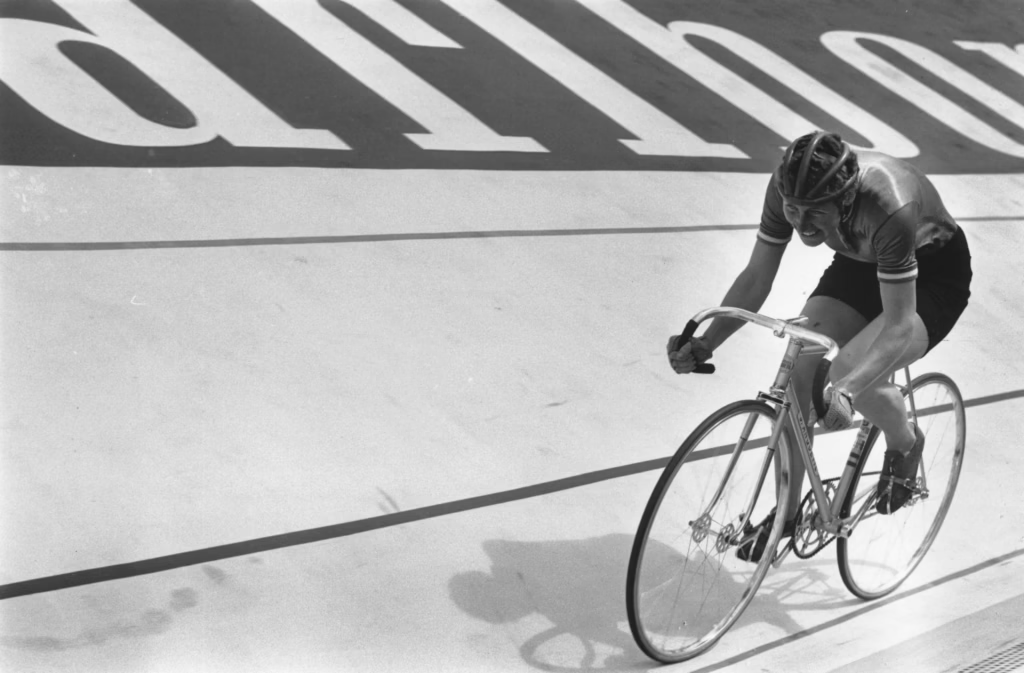
Introduction to Competitive Cycling
Burton was introduced to cycling through her husband, Charlie Burton, whom she married in 1955. Working together at a tailoring company in Leeds, Charlie, himself a keen cyclist with Morley Cycling Club, invited Beryl on club rides.
Charlie later described her remarkable progression: “First of all, she was handy but wasn’t that competent: we used to have to push her round a bit. Slowly, she got better. By the second year, she was ‘one of the lads’ and could ride with us. By the third year, she was going out in front and leading them all.”
She won her first national medal in 1957 – a silver in the national 100-mile individual time trial championship. This was just the beginning of an unprecedented career.
Unparalleled Dominance: The Numbers Tell the Story
Time Trial Supremacy
Burton’s mastery of time trialling was absolute. She won the Road Time Trials Council’s British Best All-Rounder Competition for 25 consecutive years from 1959 to 1983, a streak that remains unmatched in British cycling history.
Her national time trial record speaks for itself:
- 72 national individual time trial titles in total
- 26 titles at 25 miles, 24 at 50 miles, 18 at 100 miles, and 4 at 10 miles
- Her last national solo time trial titles were achieved in 1986 at 25 and 50 miles
Breaking Barriers: The Historic 1967 Season
The 1967 season stands as perhaps the pinnacle of Burton’s career. That year, she won her seventh world title and set the legendary 12-hour record within three weeks.
In 1967, she set a new 12-hour time trial record of 277.25 miles, a mark that surpassed the men’s record of the time by 0.73 miles and was not superseded by a man until 1969. Even more remarkably, this women’s record stood for 50 years until Alice Lethbridge of the Drag2Zero team finally broke it in 2017.
The story of how she set this record has become the stuff of legend. During the Otley CC 12-hour time trial, Burton caught and passed Mike McNamara, the men’s leader who was himself on his way to setting a new men’s record. As she overtook him, she is reputed to have given him a liquorice allsort. Burton later reflected with characteristic humility: “Poor Mac, his glory, richly deserved, was going to be overshadowed by a woman.”
World Championship Success
Burton’s dominance extended far beyond British shores:
On the Track: She was world champion five times in the pursuit: 1959, 1960, 1962, 1963 and 1966. She also earned silver medals three times (1961, 1964 and 1968) and bronze medals three times (1967, 1970 and 1973).
On the Road: She was Women’s World Road Race Champion in 1960 and 1967, and finished second in 1961.
The Amateur Ethic: Racing on Her Own Terms
Despite her extraordinary success, Burton was resolutely proud of her amateur status. In 1960, she consistently declined advances from the Raleigh Bicycle Company, which offered a contract for attacking place-to-place records.
Instead, she continued working, taking a job on a rhubarb farm run by fellow cyclist Nim Carline. Although in summer both Burton and Carline could afford to take the odd week off, in winter it was often 12 hours a day, seven days a week.
This working-class authenticity made her achievements all the more remarkable. While elite athletes today benefit from scientific training, nutrition plans, and full-time schedules, Burton juggled motherhood, manual labour, and cycling, all while setting records that would endure for generations.
Record Breaking Across All Distances
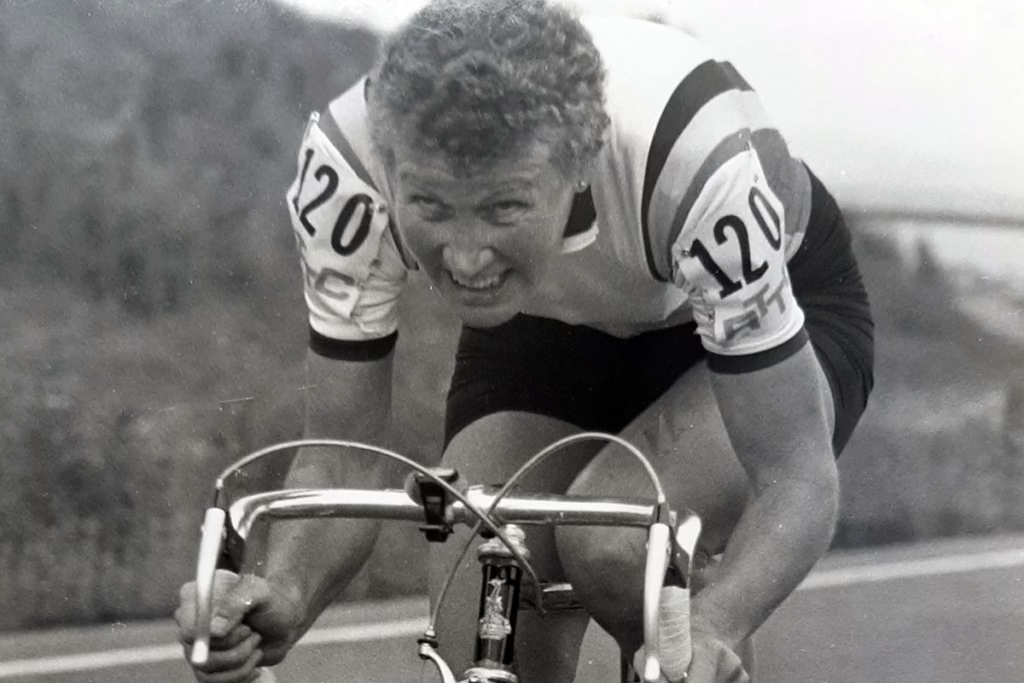
Burton set about 50 new national records at 10, 15, 25, 30, 50 and 100-mile distances. The longevity of these records demonstrates just how far ahead of her time she was:
- Her final 10, 25 and 50-mile records each lasted 20 years before being broken
- Her 100-mile record lasted 28 years
- Her 12-hour record stood for 50 years until 2017
In 1963, Burton became the first woman to break the hour barrier for the 25-mile time trial, subsequently also going below two hours for the 50-mile TT and four hours for 100 miles against the clock.
Family Legacy: Racing with Denise
Burton’s daughter, Denise Burton, was also a top cyclist, winning a bronze in the 1975 world individual pursuit championship. Mother and daughter were both selected to represent Great Britain in the 1972 World Championship.
Their relationship on the bike was complex. In 1976, when 20-year-old Denise beat her mother to win the national road race title, the pain of defeat was so strong that Beryl could not bring herself to congratulate her daughter. Burton later explained in her autobiography Personal Best: “I thought Denise had not done her whack in keeping the break away and once again I had ‘made the race’… It was not a sporting thing to do… I can only plead I was not myself at the time”.
However, the pair reconciled, and in 1982, with her daughter Denise, Burton set a British 10-mile record for women riding a tandem bicycle: 21 minutes, 25 seconds.
Beryl Burton Honours and Recognition
Burton’s achievements earned her official recognition:
- Appointed Member of the Order of the British Empire (MBE) in the 1964 Birthday Honours
- Appointed Officer of the Order of the British Empire (OBE) in the 1968 Birthday Honours, in both cases for services to cycling
- Won the Bidlake Memorial Prize, UK cycling’s top accolade, a record three times: 1959, 1960 and 1967
In the cycling press, her career was celebrated early and often. Burton’s career achievements were first celebrated in 1960 when Cycling Weekly awarded her a page in the Golden Book of Cycling. By 1991, her career had developed so far that she was accorded the unique honour of a second ‘Golden Book’ page.
Posthumously, her legend has only grown:
- In 2009, she was inducted into the British Cycling Hall of Fame
- In 2018, she was named as one of the first two inductees into the Rouleur Hall of Fame, alongside Eddy Merckx
The Philosophy of a Champion
Beyond statistics and medals, Burton’s approach to cycling offers profound insights into athletic excellence:
Relentless Consistency
Even as a schoolgirl playing ball by herself in the playground, she would set exacting standards. In her autobiography Personal Best, she explained that every time she failed to reach her target, it would result in an inward ticking off. “I would even bite the ball with frustration and annoyance,” she wrote.
This obsessive drive defined her career. Her daughter, Denise Burton-Cole, thinks that more so than any physical attributes, Burton’s gift was her determination.
Mental Fortitude
The mental toughness required to ride alone against the clock for 12 hours is almost incomprehensible. Yet Burton possessed this quality in abundance, pushing through pain barriers that would have defeated lesser athletes.
Humble Excellence
Burton had a simple motto: “Anything lads can do, I can do”. Yet despite proving this assertion time and again, she remained remarkably grounded. Shortly before her death, when asked about her greatest achievement, Burton simply replied: “It was the moment which counted. I savoured that. There are some who would say that the 1967 season was the best. The pinnacle. Maybe so, maybe no. For me, I enjoyed them all.”
A Tragic End and Lasting Legacy
Burton, who had always had a somewhat odd heart arrhythmia, died of heart failure during a social ride, when she was out delivering birthday invitations for her 59th birthday party on 5 May 1996. Her daughter suggested that Burton’s competitive spirit and drive eventually just wore her body out.
It was a poignant end for a woman who had defied medical advice her entire life. The rheumatic fever she suffered as a child had damaged her heart, yet she had spent decades pushing that organ to its absolute limits in pursuit of excellence.
Memorials and Tributes to Beryl Burton
Burton’s hometown of Morley has honoured her memory:
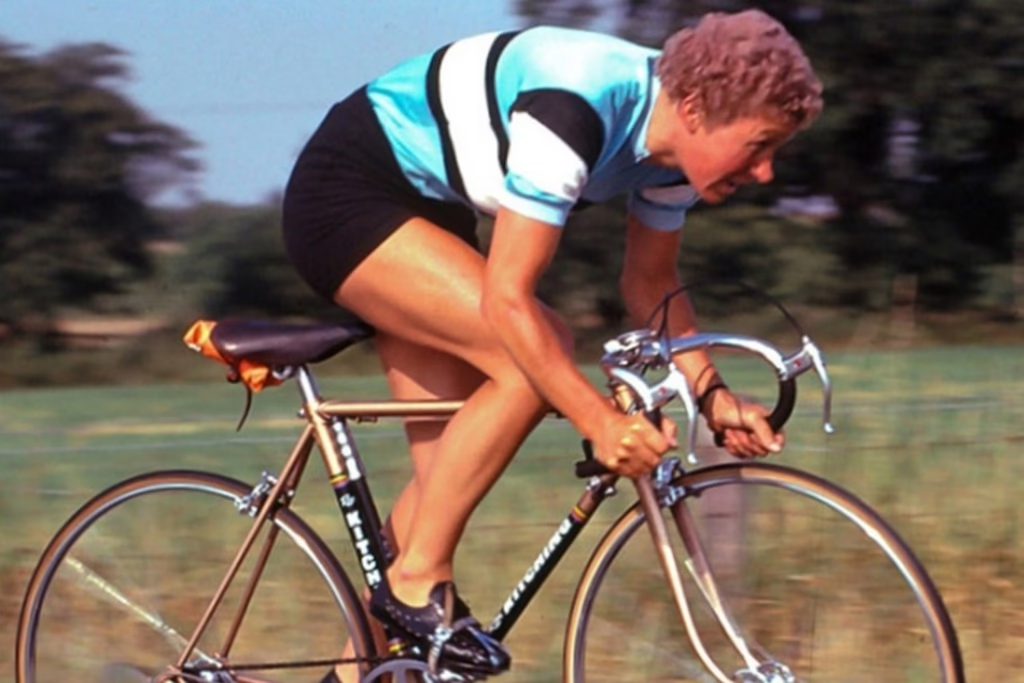
A memorial garden, Beryl Burton Gardens, was established in her hometown of Morley and includes a large mural. The artwork depicts her in her distinctive pale blue and white Morley Cycling Club kit, forever frozen in the time-trialling position that defined her career.
Morley Cycling Club donated a trophy (previously won 20 times by Burton) to the RTTC for a Champion of Champions competition for women of all ages: the Beryl Burton trophy.
Practical infrastructure also bears her name. The Beryl Burton Cycle Way allows cyclists to travel the 2.8 km between Harrogate and Knaresborough without using the A59 road.
Cultural Recognition
Burton’s story has reached wider audiences through various media:
On 27 November 2012, a radio play, Beryl: A Love Story on Two Wheels was broadcast by BBC Radio 4, written by and starring Maxine Peake. It included interview snippets with Burton’s husband and daughter. This was adapted by Peake for the stage to coincide with the start of the 2014 Tour de France in Leeds, and shown at the West Yorkshire Playhouse in June and July of that year, titled simply Beryl.
The documentary “Racing is Life: The Beryl Burton Story,” directed by Ray Pascoe and narrated by cycling commentator Phil Liggett, chronicles her extraordinary journey from modest Yorkshire beginnings to multiple world championships.
Burton’s Legacy in Modern Women’s Cycling
Beryl Burton’s pioneering achievements laid crucial groundwork for today’s women cyclists. While she competed in an era of minimal support and recognition, modern women’s cycling is experiencing what some call a “golden era.”
Progress Since Burton’s Era
The contrast between Burton’s time and today is stark. The UCI has announced that an equal number of qualification places will be available for men and women at the Los Angeles Olympics in 2028, with 257 for each across all cycling disciplines.
The 2025 Tour de France Femmes avec Zwift was broadcast in 190 countries and attracted a worldwide audience of 120 million, a level of exposure Burton could never have imagined.
Economic conditions have improved significantly. The UCI’s mandated minimum salary for women cyclists has increased from €15,000 in 2020 to €31,728 in 2025 for Women’s WorldTour riders, with an average 2024 salary of €40,000.
Ongoing Challenges
Yet significant challenges remain. While 2025 showed that women’s cycling is no longer just asking for space but learning how to use it, salary security remains fragile, media coverage is still inconsistent, and growth risks creating new inequalities if it isn’t managed carefully.
Burton never earned a living from cycling despite her dominance. Today’s professionals have better opportunities, but the Tour de France continues to favour male riders, with Tadej Pogačar winning 10 times Pauline Ferrand-Prévot’s €50,000, and a men’s Tour prize pot of over €2.5m versus €259,430 for the Tour de France Femmes avec Zwift.
What If Burton Had Today’s Opportunities?
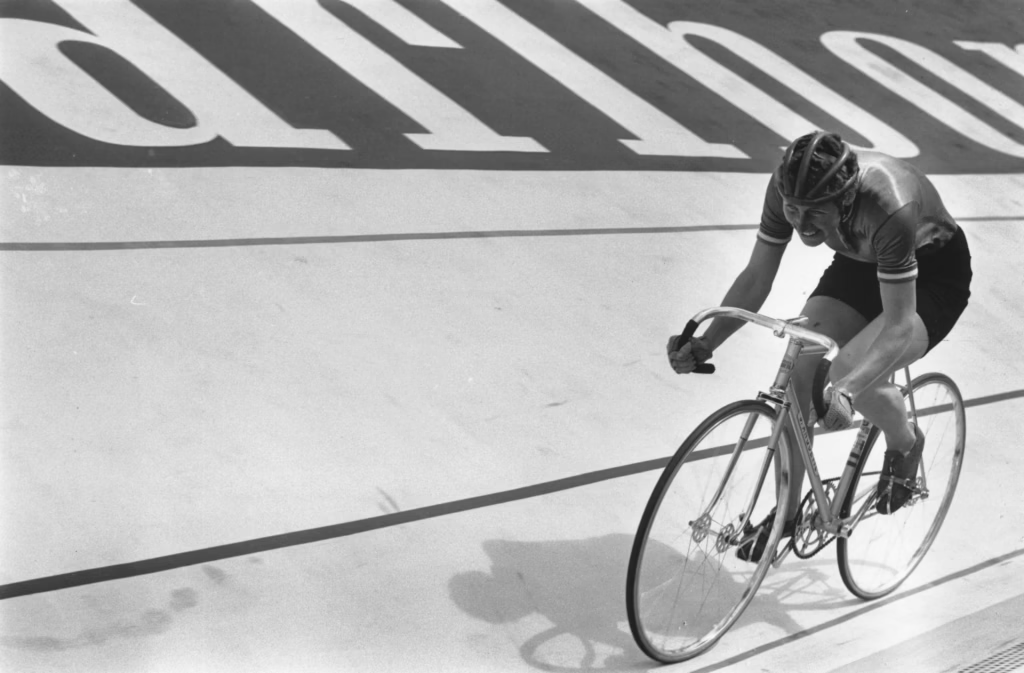
The question haunts cycling historians: what might Burton have achieved with modern equipment, training methods, and support?
“We always talk: ‘What would Beryl have done today with the track at Manchester, all the equipment and support’,” says Malcolm Cowgill of Burton’s Morley CC. “When you think about it, the Eastern Europeans were souped up to the eyeballs. How many gold medals did that cost her? Back then, the Women’s World Road Race was run over ridiculous distances like 25 miles. If it had been what it is now, say 80 miles, she’d have been the last one standing. It’d be tailor-made for her.”
Women’s cycling wasn’t introduced to the Olympics until 1984, too late for Burton, who was 47. The Olympic medals that should have been hers were denied by the simple accident of her birth timing.
Beryl Burton Quick Facts
| Category | Details |
|---|---|
| Full Name | Beryl Burton OBE (née Charnock) |
| Born | 12 May 1937, Leeds, West Yorkshire |
| Died | 5 May 1996 (aged 58), Harrogate |
| Clubs | Morley Cycling Club, Knaresborough CC |
| National Championships | 96 total (72 time trials, 12 road race, 12 pursuit) |
| World Championships | 7 total (5 pursuit, 2 road race) |
| Best All-Rounder | 25 consecutive years (1959-1983) |
| 12-Hour Record | 277.25 miles (1967, stood until 2017) |
| Career Span | 1950s–1986 |
| Honours | MBE (1964), OBE (1968) |
Frequently Asked Questions
Who was Beryl Burton?
Beryl Burton OBE was a British cyclist who dominated women’s cycling from the 1950s through the 1980s, winning more than 90 national championships and seven world titles while setting numerous records that stood for decades.
What was Beryl Burton’s most famous achievement?
In 1967, Burton set a 12-hour time trial record of 277.25 miles that exceeded the men’s record for two years and wasn’t beaten by another woman for 50 years. When she passed the men’s leader Mike McNamara during this record-breaking ride, she legendarily offered him a liquorice allsort.
Did Beryl Burton ever turn professional?
No. Burton remained an amateur throughout her career, declining lucrative contracts from companies like Raleigh. She worked full-time, including long shifts on a rhubarb farm, while simultaneously dominating competitive cycling.
What honours did Beryl Burton receive?
Burton was appointed MBE in 1964 and OBE in 1968 for services to cycling. She won the Bidlake Memorial Prize three times (1959, 1960, 1967) and was inducted into the British Cycling Hall of Fame in 2009 and the Rouleur Hall of Fame in 2018.
How did Beryl Burton die?
Burton died of heart failure on 5 May 1996, aged 58, while out delivering invitations for her 59th birthday party. She had suffered from rheumatic fever as a child which damaged her heart, but had defied medical advice to avoid strenuous exercise throughout her cycling career.
Did Beryl Burton’s daughter also race?
Yes, Denise Burton was also a top cyclist who won bronze at the 1975 world individual pursuit championship. Mother and daughter represented Great Britain together at the 1972 world championships and later set a British 10-mile tandem record together.
Further Reading and Resources
- Cycling UK’s Beryl Burton Profile
- British Cycling: 50 Years – The 1960s
- Book: The Greatest: The Times and Life of Beryl Burton by William Fotheringham
- Book: Personal Best: The Autobiography of Beryl Burton
- Documentary: Racing is Life: The Beryl Burton Story (narrated by Phil Liggett)
- Play: Beryl: A Love Story on Two Wheels by Maxine Peake