British women’s cycling in 2026 feels deeper than it has for some time. There is proven WorldTour quality at the top, a younger wave already starting to win meaningful races, and another group of riders who look close to turning potential into something more substantial. That matters not only for Britain, but for the shape of the women’s peloton this season. The country is no longer relying on one or two headline names. There is now a broader mix of riders who can influence very different races, from the cobbled Classics and reduced sprints to time trials and stage-race GC.

The established names still setting the standard
Anna Henderson remains one of the safest British picks for major results because of how complete her skillset is. She has the engine for tough stage races, the versatility for selective one-days and the race sense to stay relevant in chaotic finales. At her best, she can move between support and leadership without losing value, which is part of what makes her so important. Henderson is no longer simply a rider with promise or a useful option for harder terrain. She looks like one of Britain’s most reliable top-level performers.
Pfeiffer Georgi belongs firmly in that bracket as well, especially when the road turns rough and repeated accelerations start to matter more than a pure finishing kick. Georgi has developed into one of the most significant British riders in the northern Classics, the sort of rider teams have to take seriously when races such as the Tour of Flanders, Dwars door Vlaanderen or similar hard one-days begin to split apart. She still feels close to another step as a rider, which is why 2026 could be an especially important year for her.

The young British riders already forcing the issue
Cat Ferguson has moved well beyond the stage where she can be described only as a prospect. The raw talent has always been obvious, but what stands out now is how quickly she is learning to win at a higher level. Her early 2026 results have underlined that point. She looks increasingly comfortable in aggressive race situations, reads finales well and already has the sharpness to finish off selective groups. For Britain, that makes her one of the most exciting riders in the women’s peloton right now. For the rest of the sport, it means another rider is emerging who can shape races rather than just follow them.
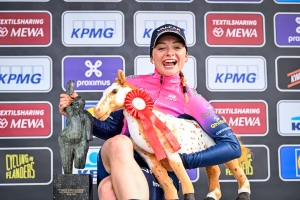
Carys Lloyd has also pushed herself into this conversation in a serious way. Her victory at Ronde van Brugge Women was the sort of result that changes how a rider is viewed almost immediately. Winning a reduced sprint against riders of that calibre told a much bigger story than simply landing a good day out. It suggested confidence, composure and the ability to deliver in a race that had already become selective and tactically awkward. Lloyd now looks like one of the British riders most likely to keep surprising people in 2026, though perhaps it is no longer a surprise once it has happened at that level.
Zoe Bäckstedt remains one of the most fascinating British riders to follow because her ceiling still looks open in several directions. She has the obvious time trial strength, she carries that cyclo-cross handling background into difficult race conditions, and she continues to look like a rider who can develop into a major force in more than one discipline on the road. Her stage win and leader’s jersey ride in Extremadura showed again how dangerous she can be when power and technical control matter. What makes Bäckstedt especially interesting this year is that she still feels like a rider in the process of defining exactly what her best version will be.
 Photo Credit: Getty
Riders who could take another step this season
Josie Nelson is one of the more intriguing British names just below the main headline group. She has already shown enough in reduced and messy sprint finishes to suggest there is another level there if the season comes together well. Nelson’s strength is not simply speed. It is that she can still be competitive after a harder day, which often matters more in women’s racing than a flat, textbook bunch sprint profile. A breakthrough season does not always begin with a win. Sometimes it begins with repeated signs that a rider is increasingly part of the decisive phase, and Nelson feels close to that point.
Imogen Wolff is another rider worth watching closely. She may not yet have the same profile as some of the more public British names, but there is a reason she continues to sit within conversations about the next generation. Riders like Wolff are often the ones who make a jump quite quickly once the right opportunity arrives. A stronger role within the team, the right race profile or one well-timed result can change the shape of a season. She feels close enough to that kind of movement to merit real attention in 2026.
Millie Couzens and Flora Perkins also fit into that same broader British story. Both still feel as though they are building towards something rather than having fully arrived, but that does not make them background riders. Perkins has shown enough on tougher terrain to remain interesting as a climbing and stage-race option, while Couzens brings all-round value that can translate well once the level rises. Neither needs to win a WorldTour race tomorrow to justify the attention. What matters more is that both still sit on upward development curves, and British cycling benefits from having several riders in that position at once.

Why 2026 feels important for British women’s cycling
The most encouraging part of this picture is the spread of talent across different race types. Britain has riders who can target hard one-days, riders who can shape stage races, riders who can win from selective sprints, and riders whose best years may still be ahead of them. That gives the country more relevance across the calendar rather than in only one corner of it.
Henderson and Georgi provide the established reference points. Ferguson, Lloyd and Bäckstedt bring the sense of momentum and possibility that makes a season feel alive. Behind them, riders such as Nelson, Wolff, Couzens and Perkins add depth that British women’s cycling has not always been able to rely on in the same way.
That is what makes 2026 feel different. It is not simply about one standout rider carrying the story. It is about a group of British riders beginning to occupy a wider share of the women’s peloton, and doing so across multiple kinds of racing. That is a far healthier position, and it gives this season more than one reason to follow closely.