Cian Uijtdebroeks will not start Stage 5 of the 2026 Vuelta a España after further medical examinations showed the ankle injury he suffered in his Stage 2 crash was more serious than first thought.
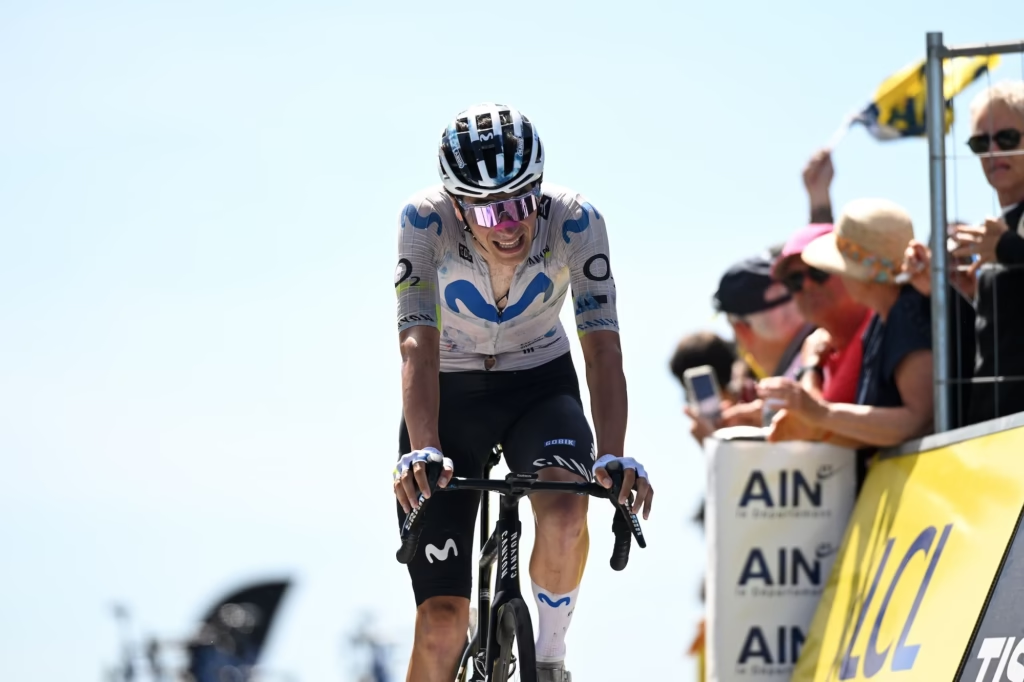
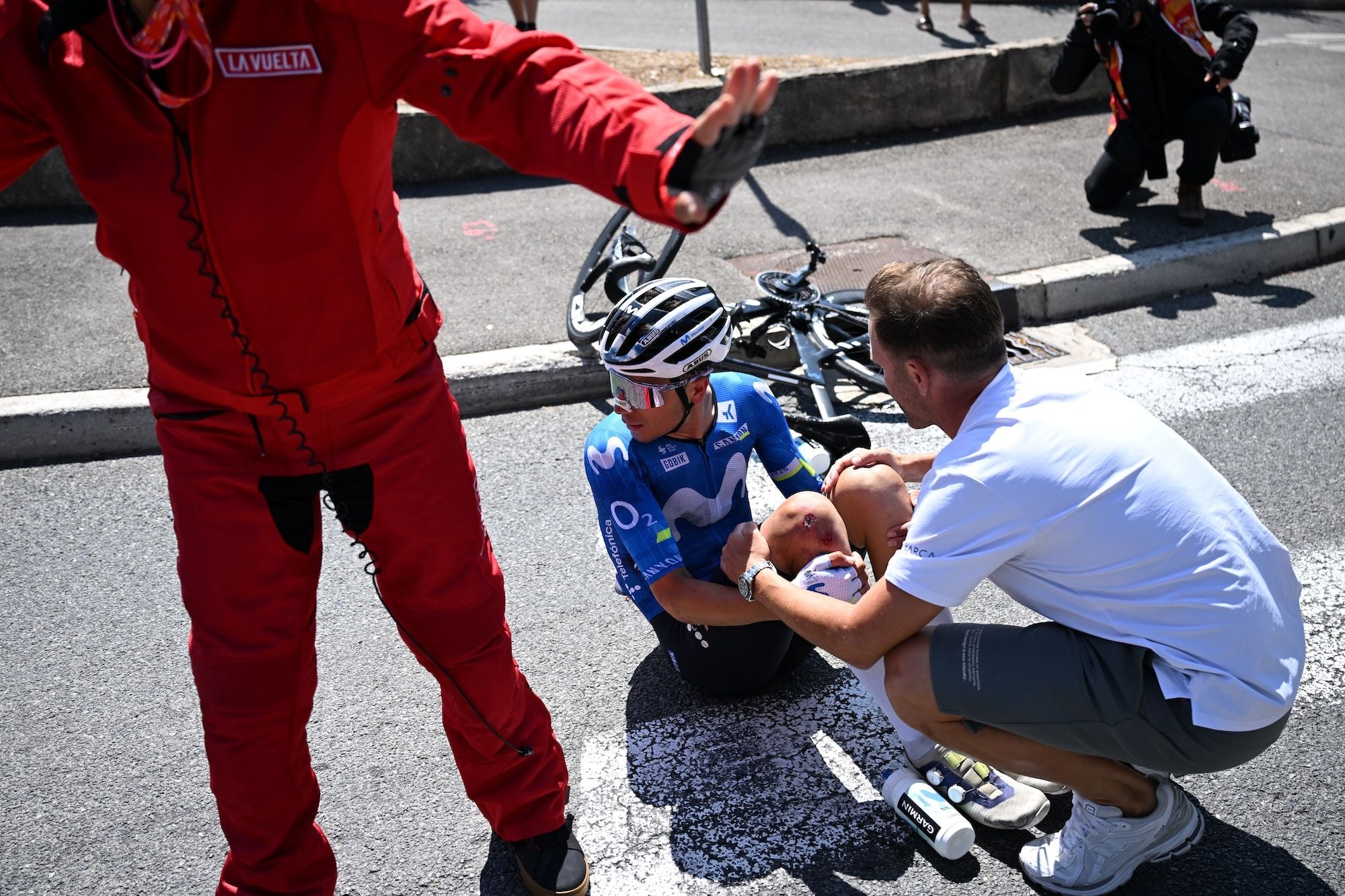
The decision ends a brutal opening week for the 23-year-old Belgian, who somehow completed Tuesday’s mountain stage through Andorra despite a fracture in his left ankle. Uijtdebroeks was dropped on the opening climb, spent most of the 104.8km stage fighting simply to remain inside the time limit and eventually crossed the line in 182nd and last place, more than 26 minutes behind Tadej Pogačar. He was visibly emotional at the finish, breaking down in tears as Movistar staff and team-mates gathered around him.
For Uijtdebroeks, the circumstances made the day particularly cruel. He lives in Andorra and regularly trains on the roads used during Stage 4, which under normal circumstances could have been one of the stages best suited to him. Instead of racing alongside Enric Mas near the front, he spent his home stage alone at the opposite end of the race while Pogačar produced the 50km solo attack that transformed the Vuelta.
Movistar confirmed on Wednesday morning that Uijtdebroeks would now leave the race after further testing established that the injury from his Stage 2 crash was “more serious than initially estimated”. That wording is important because it also leaves an uncomfortable question behind: if Uijtdebroeks was already known to be racing with a fracture and struggling even to walk, should he ever have been sent into an Andorran mountain stage in the first place?
The problem began with Uijtdebroeks’ Stage 2 crash
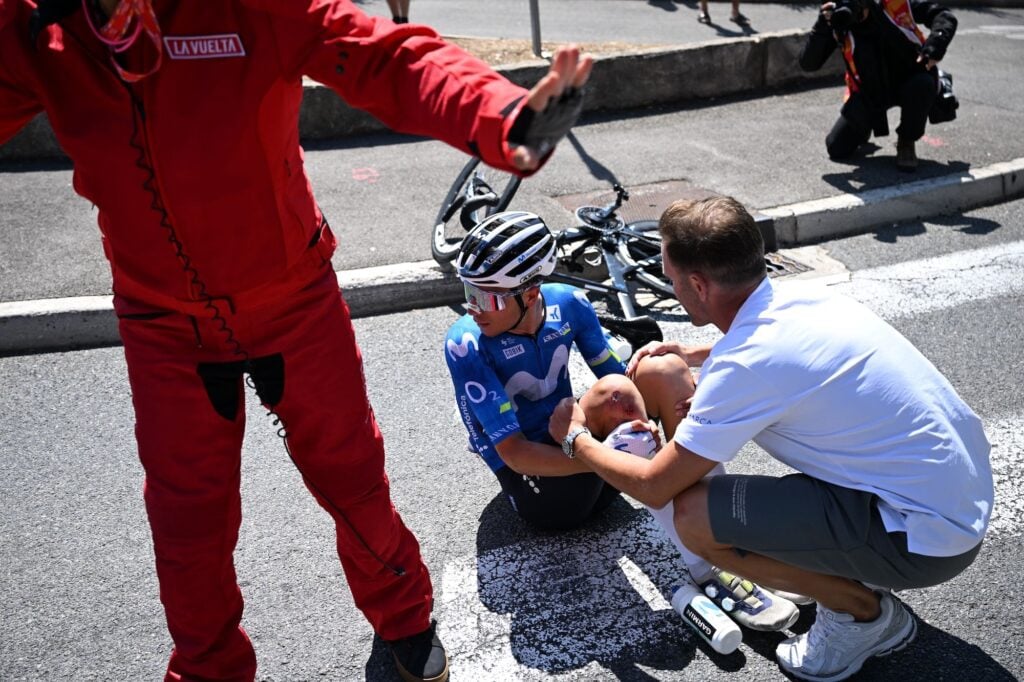
Uijtdebroeks crashed during Sunday’s 214.3km second stage from Monaco to Manosque and initially suffered wounds, abrasions and trauma around his left ankle. The swelling around the joint complicated the early assessment, but subsequent examinations revealed a small fracture before he lined up for Stage 4.
By then it was already obvious that the injury was significantly affecting him away from the bike. Uijtdebroeks admitted before the Andorra stage that walking was difficult, although he tried to make light of the situation by pointing out that fortunately he did not need to walk while racing.
The medical advice available to him at that stage was that he could continue. Uijtdebroeks himself clearly wanted to try, and there is an important distinction between a rider choosing to push through pain after being medically cleared and a team knowingly asking someone to race with an injury considered unsafe.
What happened once the flag dropped nevertheless demonstrated how badly compromised he was.
Andorra became a battle simply to reach the finish
Under different circumstances, Stage 4 could have provided an important test of Uijtdebroeks’ Vuelta ambitions.
Movistar had arrived at the race with Enric Mas as their principal GC leader but also with Uijtdebroeks as a genuine second option, as outlined in ProCyclingUK’s Vuelta a España team-by-team guide. His climbing ability and eighth place in his first Vuelta in 2023 meant there was still considerable interest in how he might perform across three weeks.
The fracture ended that possibility almost immediately.
Uijtdebroeks was among the first riders dropped on the Port d’Envalira and effectively spent the remainder of the afternoon competing against the time limit rather than the riders he had expected to measure himself against.
At the front of the race, Pogačar attacked with exactly 50km remaining and completed the longest solo Grand Tour victory of his career. Uijtdebroeks was experiencing almost the inverse version of the same stage, isolated behind and trying to survive each successive climb.
He eventually reached Andorra la Vella more than 26 minutes down, last of the 182 riders who completed the stage.
The result itself barely conveys what the television pictures showed. Uijtdebroeks crossed the line exhausted and in tears, later saying that he could no longer really feel the pain. His team-mates immediately gathered around him, while Movistar publicly praised him for fighting through what had already been a difficult year.
It was a striking image, but also one that inevitably prompted a different question: admirable determination and sensible medical decision-making are not necessarily the same thing.
Movistar withdraw him after further testing
Movistar’s decision came before Wednesday’s Stage 5 from Falset to Roquetes.
The team said additional tests and examinations had shown that the injury caused by the Stage 2 crash was more extensive than first estimated and that Uijtdebroeks should withdraw immediately to begin his recovery.
That clarification matters because the full extent of the damage was apparently not understood when he started Stage 4.
At the same time, the basic outline was already known. Uijtdebroeks had a fracture in the ankle, was struggling to walk and had spent the previous stages managing significant discomfort. Even without the later diagnosis showing the injury to be worse than originally thought, there was enough information for the decision to allow him to race through Andorra to attract scrutiny.
Professional cycling has always contained a strong culture of riding through pain. Fractures, wounds and other injuries do not automatically lead to withdrawal if medical staff believe a rider can continue safely, and riders themselves are often extremely reluctant to abandon a Grand Tour.
The problem comes when that mentality begins to blur the distinction between tolerating pain and exposing a rider to unnecessary harm.
The criticism around Movistar has a recent precedent
The debate is especially sensitive because this is the second Grand Tour of 2026 in which Movistar’s handling of Uijtdebroeks’ health has attracted attention.
At the Tour de France, Uijtdebroeks continued racing while suffering with illness and a fever before eventually abandoning during Stage 6. Former professional Thomas De Gendt publicly questioned the decision at the time, asking how Movistar’s doctors could allow him to continue racing with a fever, while other observers raised concerns about the risks of high-intensity endurance exercise when a rider is clearly unwell.
Uijtdebroeks’ Tour eventually ended before the race had properly entered its decisive mountain phase, with ProCyclingUK covering his Stage 6 abandonment.
It is important to be precise about that criticism. De Gendt’s documented comments concerned Uijtdebroeks racing the Tour with a fever, rather than the ankle fracture at this Vuelta. The two incidents are medically very different and should not simply be merged into one accusation.
The reason the earlier episode matters is that the same broad question has returned only weeks later: at what point should a team overrule a rider’s determination to continue?
Two Grand Tours, two early exits
The Vuelta was supposed to offer Uijtdebroeks another opportunity after his Tour ended in disappointment.
His move to Movistar had been intended to give him more room to develop as a Grand Tour rider, with the Spanish team signing him through to 2029 and making him one of the central pieces of its longer-term stage-racing plans. ProCyclingUK covered the original Uijtdebroeks move to Movistar when the four-year deal was announced.
His first season has instead become defined by interruptions.
The Tour ended through illness. The Vuelta has now ended following a crash and fractured ankle. Those are very different causes, and there is clearly a large element of bad luck involved, but the combined effect is still significant for a young rider trying to establish himself as a reliable Grand Tour contender.
The original Vuelta plan reflected that ambition. Mas was the established leader, but Uijtdebroeks gave Movistar a second GC card rather than arriving purely as a mountain domestique. That role disappeared as soon as the Stage 2 crash compromised his ankle.
Instead of using the Vuelta to rebuild his season, he leaves before the race has even completed its first stage on Spanish roads.
Movistar’s encouragement after Stage 4 makes the situation more complicated
There was nothing unusual in Movistar praising Uijtdebroeks after he reached Andorra.
He had endured an extraordinary day and still managed to finish. From the perspective of resilience and personal determination, the achievement was obvious.
The difficulty is that the heroic framing can obscure the medical issue.
Cycling has historically celebrated riders continuing despite broken bones and severe injuries, often treating simply reaching the finish as evidence of character. That mentality remains deeply embedded in the sport, even as teams have become more sophisticated about concussion, illness and long-term athlete welfare.
Uijtdebroeks unquestionably demonstrated toughness.
The harder question is whether he should have needed to.
If subsequent examinations had shown nothing more serious and he had recovered quickly, the decision to let him continue might have looked entirely reasonable. The fact that further testing instead led to immediate withdrawal inevitably changes how Tuesday’s stage is viewed.
Uijtdebroeks had already endured a difficult Tour debut
The Vuelta setback also needs to be understood against his wider 2026 season.
Uijtdebroeks joined Movistar after leaving Team Visma | Lease a Bike early, with the promise of greater space to pursue his own Grand Tour ambitions. His new team initially planned around him as a major part of their Tour de France project, and he entered July hoping to establish himself in the general classification.
That campaign deteriorated rapidly once illness struck.
By Stage 6 he was unable to continue, ending a Tour in which Movistar had hoped to test whether Uijtdebroeks was ready to move towards the next level of Grand Tour leadership.
The Vuelta therefore carried more significance than it might normally have done. It offered another chance to accumulate three weeks of racing, work alongside an established leader in Mas and rebuild confidence after July.
Instead, another setback has cut the race short.
That does not change Movistar’s long-term investment in him. A contract through 2029 gives both sides far more time than one difficult season, and there is still obvious evidence of the climbing ability that persuaded the team to sign him.
What 2026 has lacked is continuity.

The Stage 4 result tells only a fraction of the story
On the official classification, Uijtdebroeks’ final Vuelta stage will appear simply as a last place more than 26 minutes behind Pogačar.
In reality, he was barely competing in the same sporting contest.
Pogačar’s Andorra ride changed the race for red, opening a 3:21 advantage over Primož Roglič and establishing a completely different hierarchy after the first proper mountain stage. Uijtdebroeks’ day was about something much more basic: whether he could physically make it to the finish.
That contrast is one reason the images travelled so strongly.
Grand Tours usually tell their stories through the front of the race, where attacks, victories and classification battles provide obvious drama. Uijtdebroeks showed another version of what three-week racing can demand, riding alone through familiar mountains with an injury that had removed any competitive purpose from continuing.
There is little doubt about what the performance said about his willingness to suffer.
The debate is whether professional cycling should always regard that willingness as something to be used.
Now recovery has to take priority
There is at least no ambiguity about what happens next.
Uijtdebroeks’ Vuelta is finished and Movistar have made clear that recovery from the ankle injury now takes priority. With the full extent of the damage only becoming clear after further examinations, there is little value in speculating about when he might race again until the team establishes an appropriate rehabilitation plan.
The immediate sporting loss for Movistar is softened by Mas’ position near the front of the Vuelta. He emerged from Andorra third overall after riding with the strongest chasing group behind Pogačar, meaning the team still has a major GC objective despite losing its second option.
For Uijtdebroeks, the calculation is different. His first season with Movistar has already contained two unfinished Grand Tours, and trying to rescue a few more race days from an injured ankle would achieve little compared with allowing it to heal correctly.
His decision to fight through Andorra will probably be remembered because of the images at the finish. They showed exactly how much finishing the stage meant to him and how much it had cost.
But the more important lesson may be the one that comes afterwards.
Uijtdebroeks proved again that he is willing to keep riding when almost everything is telling him to stop. Movistar’s responsibility now is to make sure that, when stopping is the better decision, he does not have to make it alone.