
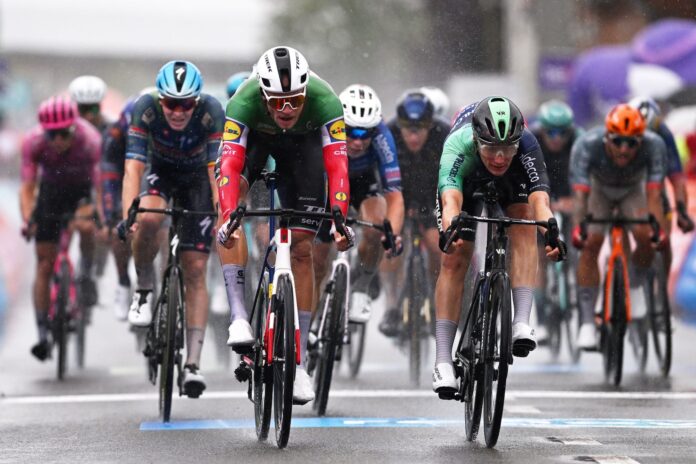
The Renewi Tour 2026 moves into Limburg on Saturday 22 August for Stage 4, a 187.3-kilometre circuit stage from Riemst to Bilzen-Hoeselt that should reopen the door to the sprinters without giving the general classification contenders an easy afternoon.
Friday’s queen stage in Geraardsbergen changed the race substantially. Jenno Berckmoes won Stage 3 after an aggressive finale and now carries the leader’s jersey into Saturday, but Jasper Philipsen is only six seconds behind, Olav Kooij sits at 12 seconds and Arnaud De Lie remains within striking distance at 19 seconds. Those margins mean the battle for the stage and the battle for the overall classification are now directly connected.
Stage 4 is considerably less severe than the Muur and Bosberg stage, but it is not a conventional flat sprint. The riders face repeated laps through the rolling roads around Riemst and Bilzen-Hoeselt, with around 1,450 metres of climbing and a succession of short ascents before a slightly rising finish. As the Renewi Tour 2026 route guide explains, this was always the stage most likely to reward the increasingly common modern sprinter who can absorb repeated climbing rather than needing an entirely flat approach.
That puts Jasper Philipsen, Olav Kooij, Tim Merlier, Jonathan Milan and Arnaud De Lie at the centre of the stage battle, while the Green Kilometre means Berckmoes cannot simply sit in the peloton and assume his six-second advantage will survive until Sunday’s finale in Leuven.
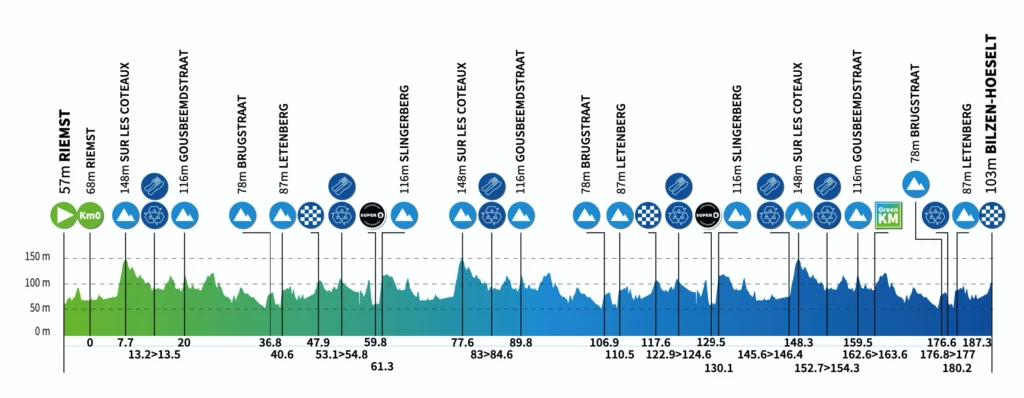
Renewi Tour Stage 4 route
Date: Saturday 22 August 2026
Start: Riemst
Finish: Bilzen-Hoeselt
Distance: 187.3km
Elevation: Around 1,450m
Stage type: Rolling / sprint
Key feature: Repeated Limburg circuits
Final important climb: Letenberg, around 7.5km from the finish
The stage begins in Riemst near the Belgian-Dutch border before moving onto the local circuit around Bilzen-Hoeselt. The riders repeatedly tackle short climbs including the Slingerberg, Côte Sur les Coteaux, Gousbeemdstraat, Brugstraat and Letenberg, making accumulation more important than any individual ascent.
The Letenberg is the final significant opportunity to disturb the sprint, with its last passage coming inside the final 10 kilometres. It is not long enough to automatically eliminate the fastest riders, but a hard pace could remove lead-out riders and leave the biggest sprinters isolated before the run into Bilzen-Hoeselt.
That distinction should shape the stage. Teams with Milan, Merlier, Philipsen and Kooij will want enough control to produce a sprint, while those without one of the fastest finishers have every incentive to use the repeated climbs to make the final circuit more chaotic.
The full Renewi Tour 2026 start list underlines the depth of the sprint field, with several of the world’s quickest riders still having realistic opportunities to win before the race reaches its harder Leuven finale.
Stage 3 has transformed the GC battle
Berckmoes’ victory in Geraardsbergen did far more than add another stage win to Lotto-Intermarché’s race.
His aggressive ride and use of the bonus opportunities moved him into the overall lead, but the classification remains extremely compressed. Philipsen is close enough to take the jersey purely through finish bonuses, Kooij is within range if he combines the sprint with Green Kilometre seconds, and De Lie remains close enough that Lotto have two genuine cards to play.
That creates an unusual situation for a stage which, on paper, should be principally about the sprinters.
Berckmoes cannot simply finish safely in the bunch and expect to retain the lead. If Philipsen wins and Berckmoes does not collect bonuses of his own, the race can change without a single physical time gap appearing on the road.
The same applies to Kooij. He needs slightly more than the stage winner’s bonus alone, but the Green Kilometre gives Decathlon CMA CGM a realistic route towards closing that deficit before the final sprint.
The importance of these seconds is central to the beginner’s guide to the Renewi Tour 2026, because this is a race where the GC can be transformed through bonuses even when the leading riders finish on the same time.
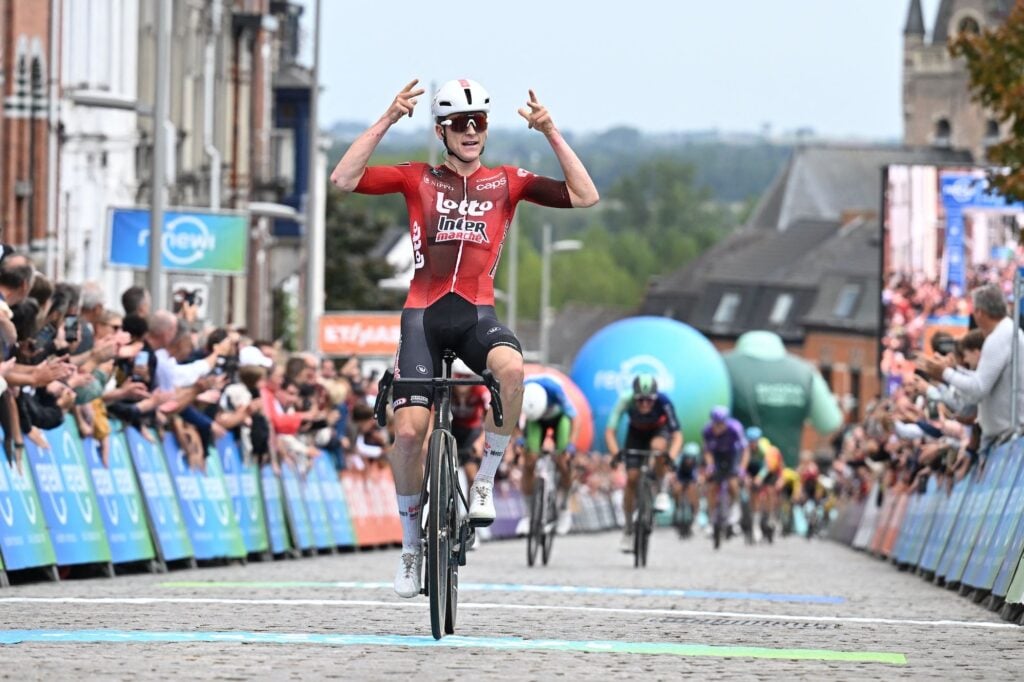
Jenno Berckmoes has a very different race to ride
Jenno Berckmoes begins Stage 4 in a position few would have predicted before Geraardsbergen.
Friday rewarded aggression. Saturday demands control.
His first priority is avoiding splits and arriving in the final kilometres with the overall contenders around him. The rolling Limburg roads should not present the same climbing challenge as Stage 3, but repeated accelerations and positioning battles create their own danger when the race leader has only seconds to spare.
Lotto-Intermarché also have the luxury of Arnaud De Lie sitting close on GC. That means Berckmoes does not necessarily need to contest every bonus personally. De Lie can take seconds away from Philipsen and Kooij while simultaneously moving closer to the lead himself.
That gives Lotto a much more flexible position than a conventional leader’s team. They can defend through Berckmoes while still racing offensively through De Lie.
The team’s broader strength was one of the reasons Lotto entered the race prominently in the Renewi Tour 2026 team-by-team guide, and Stage 4 is exactly the kind of situation where having several riders suited to the same terrain becomes particularly valuable.
Jasper Philipsen can take the race lead with a stage win
Jasper Philipsen may be the most important rider on Saturday.
He sits only six seconds behind Berckmoes and has already demonstrated both sides of his Renewi Tour form. He won Stage 2 in Ardooie and then survived the much harder Geraardsbergen stage well enough to finish second.
That combination makes Stage 4 close to ideal.
Philipsen should have no difficulty with the basic profile if he reproduces Friday’s legs, and the slightly rising finish suits a rider who can continue producing power after a demanding day rather than relying exclusively on one explosive acceleration.
The GC calculation is equally straightforward. A stage victory carries enough bonus time to put Philipsen ahead of Berckmoes if they finish together and the race leader fails to offset that gain elsewhere.
Alpecin-Premier Tech therefore have every incentive to control the breakaway and keep the race together.
They do not need Philipsen to attack the GC.
They simply need him to sprint.
Olav Kooij still has a realistic route into the leader’s jersey
Olav Kooij begins Stage 4 12 seconds behind Berckmoes, keeping the Decathlon CMA CGM sprinter firmly involved in the overall battle.
His performance in Geraardsbergen was particularly encouraging because he finished third despite terrain much harder than anything he will face around Bilzen-Hoeselt. That confirms that the repeated short climbs should not be enough to remove him unless another team deliberately turns the stage into an attritional contest.
Kooij still needs more than the winner’s bonus alone to overhaul Berckmoes, but that is where the Green Kilometre becomes important.
A successful move for bonus seconds before the finish can change the equation completely.
Decathlon therefore have two objectives which complement one another: bring Kooij towards the Green Kilometre in position to collect seconds, then keep the stage controlled enough that he can sprint for victory.
The race has already shown how narrow the margins are between Kooij and the other elite sprinters. Stage 1 came down to the smallest of differences, and Saturday gives him another opportunity to convert his speed into a victory with potentially much greater GC consequences.
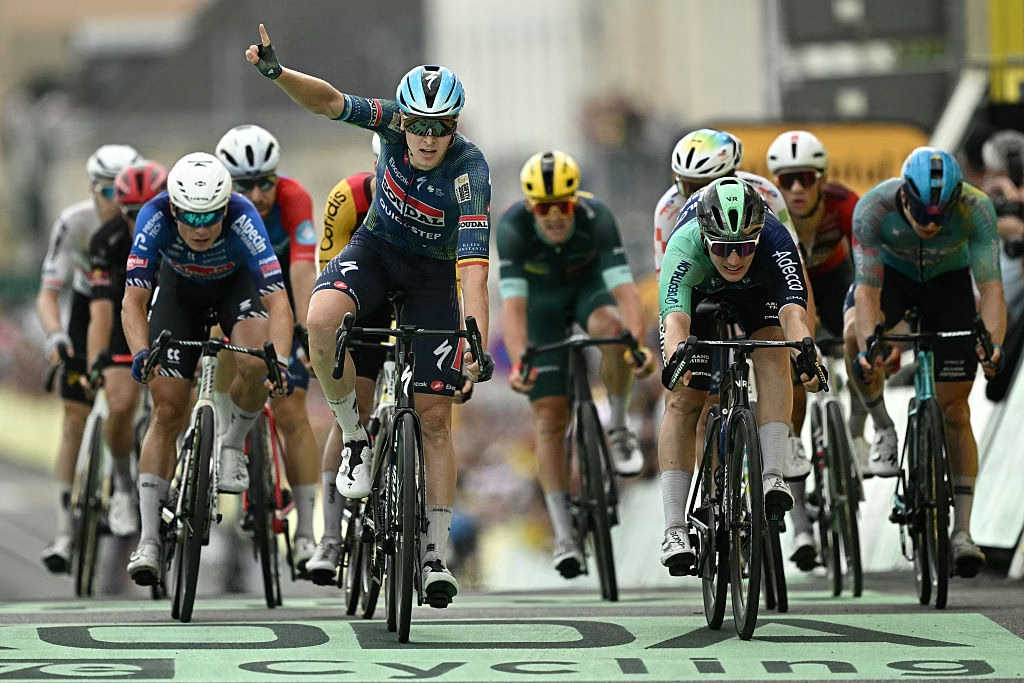 Photo Credit: Getty
Tim Merlier gets another excellent sprint opportunity
Tim Merlier should be one of the strongest favourites for the stage itself.
Soudal Quick-Step no longer have the same GC complication as Lotto, Alpecin or Decathlon, which allows the team to approach Stage 4 with a relatively simple objective: deliver Merlier into the final 300 metres in the best possible position.
The rolling circuit should not concern him unduly.
There is enough climbing to make the stage tiring, but nothing individually severe enough to remove a sprinter with Merlier’s durability if the race is controlled. The slightly rising finish should also suit his ability to sustain speed once the sprint is launched.
His main problem is the depth of opposition.
Philipsen and Kooij are not merely sprinting for the stage. They have GC reasons to fight for every position, which should make their teams even more committed to controlling the finale.
Merlier nevertheless has the raw speed to beat both.
Jonathan Milan can finally race without thinking about GC
Jonathan Milan’s Renewi Tour changed completely when he crashed heavily on Stage 2.
The Lidl-Trek sprinter had taken the opening stage in Diest and the first leader’s jersey, but his time loss in Ardooie effectively removed him from the overall classification before the race reached Geraardsbergen.
That simplifies Saturday.
Milan has no reason to think about bonuses or protecting a GC position. His only objective is the stage.
If he has recovered physically from Thursday’s crash, the profile suits him extremely well. The repeated climbs are short enough for Milan’s enormous power to carry him through, while the slightly rising finish could reward his ability to sustain a long sprint.
The uncertainty is entirely about recovery. A heavy crash followed immediately by the hardest stage of the race is not ideal preparation for another high-speed sprint.
If Milan is close to his normal level, however, he remains one of the riders most capable of beating Philipsen, Kooij and Merlier outright.
Arnaud De Lie can protect Berckmoes by racing for himself
Arnaud De Lie gives Lotto-Intermarché the most interesting tactical option of Stage 4.
He sits 19 seconds behind Berckmoes, which is too much for one conventional stage-winning bonus to overturn, but close enough for the Green Kilometre and finish bonuses to remain relevant.
More importantly, anything De Lie takes is potentially something Philipsen or Kooij cannot.
If De Lie wins the stage, he denies Philipsen the ten-second bonus that could cost Berckmoes the jersey.
If he contests the Green Kilometre, he can prevent Kooij or Philipsen closing their deficits while simultaneously moving himself closer to the overall lead.
That means supporting Berckmoes and pursuing his own result are not contradictory objectives.
The harder the final circuit becomes, the better De Lie’s chances should be. He has already shown that he can survive much more difficult Classics terrain than Saturday offers, and a reduced sprint would only increase his relative chances.
The Renewi Tour 2026 route guide identified Stage 4 as a particularly good opportunity for exactly this type of durable sprinter.
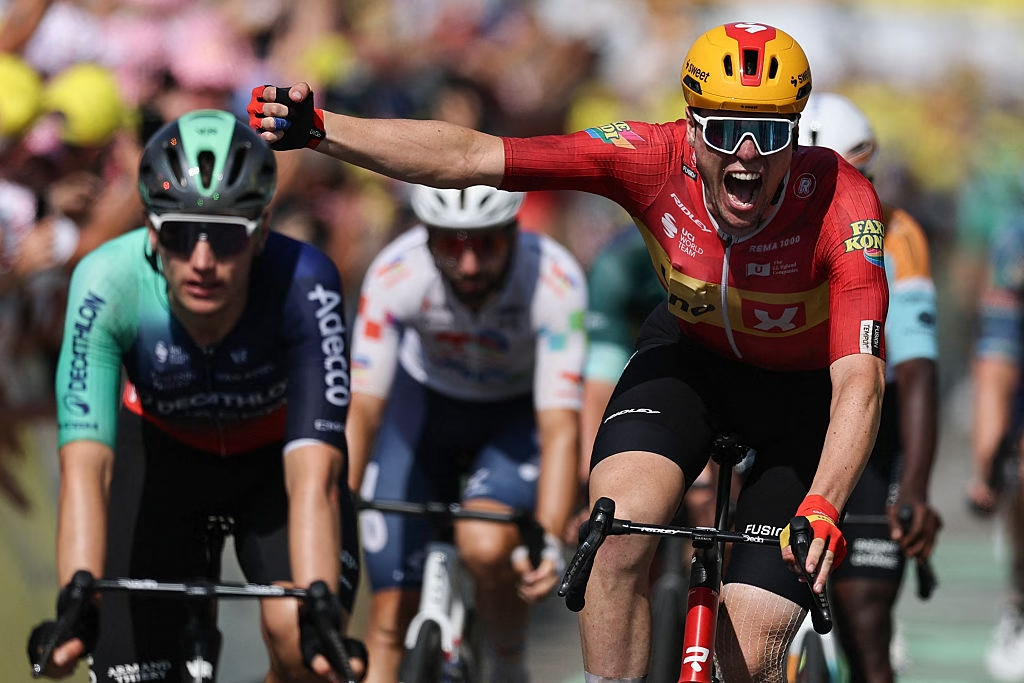
Søren Wærenskjold remains a dangerous alternative
Søren Wærenskjold continues to produce strong results without yet landing the stage victory.
His combination of size, power and ability over rolling terrain makes him particularly well suited to Bilzen-Hoeselt. He does not require a perfectly flat stage and may actually benefit if the repeated climbs remove lead-out riders from the faster pure sprinters.
Wærenskjold’s challenge is still the level of opposition.
Even a reduced field is likely to contain several riders who can outsprint him in a straightforward finish.
That means Uno-X Mobility should welcome a messy finale. The fewer organised trains remaining after the Letenberg, the better Wærenskjold’s chances of turning his all-round strength into a decisive positional advantage.
Biniam Girmay needs the final circuit to be hard
Biniam Girmay has similar reasons to want an attritional race.
A perfectly controlled sprint involving Milan, Merlier, Philipsen and Kooij gives him a difficult task.
A smaller group after a hard final circuit changes the equation.
Girmay is at his best when repeated climbing has taken something out of the pure sprinters and the finish rewards riders capable of combining endurance with speed.
The Letenberg therefore matters more to NSN Cycling Team than it does to some of the favourites.
If they can help increase the pace there and remove several of the major lead-out riders, Girmay becomes much more dangerous in the final kilometres.
Dylan Groenewegen wants the opposite race
Dylan Groenewegen would prefer Stage 4 to be considerably less complicated.
His raw finishing speed keeps him among the contenders, but the repeated climbing and slightly rising finale do not play towards his strengths as clearly as they do for Philipsen, Kooij or De Lie.
Groenewegen’s ideal race reaches the final five kilometres with a large peloton and an organised Jayco-AlUla lead-out still intact.
The difficulty is that several rival teams have every reason to prevent that.
Teams without a top-tier sprinter will attack. Girmay benefits from attrition. De Lie benefits from selective racing. GC teams have bonus seconds to consider.
Jayco therefore need to contribute to control rather than assuming the race will naturally end in a conventional bunch sprint.
The Green Kilometre could decide who wears the leader’s jersey
The most strategically important part of Stage 4 may arrive well before Bilzen-Hoeselt.
The Green Kilometre offers three bonus sprints within a single kilometre, providing several opportunities for riders to reduce their overall time before the stage finish.
That mechanism has already proved decisive in this Renewi Tour.
Berckmoes used the bonus opportunities brilliantly on Stage 3, and the tiny GC gaps mean Saturday’s Green Kilometre could be even more important.
Philipsen begins only six seconds behind. Kooij is 12 seconds down. De Lie trails by 19.
Every second changes the calculation for the finish.
If Philipsen collects a significant bonus, Berckmoes could enter the final 20 kilometres with virtually no effective advantage. If De Lie takes the seconds instead, Lotto strengthen their control of the race while denying them to a direct rival.
Expect the Green Kilometre to look much more like a sequence of three miniature sprints than a normal intermediate classification point.
Lotto cannot defend Stage 4 conventionally
Berckmoes wearing the leader’s jersey naturally puts responsibility on Lotto-Intermarché, but a conventional day-long chase may not actually be their best strategy.
A breakaway containing riders far down the GC can be useful.
If it survives long enough to take the Green Kilometre bonuses, Philipsen and Kooij lose one route towards closing the gap. If it remains ahead at the finish, it could even remove the stage bonuses completely.
The problem is De Lie.
Lotto also have a genuine stage winner, so allowing a harmless breakaway to stay clear protects Berckmoes but sacrifices one of their own opportunities.
That tension should make their tactics particularly interesting.
They have to decide whether maintaining the jersey is worth more than maximising the possibility of another victory.
With Stage 5 in Leuven still to come, the answer may depend heavily on how the race develops rather than being fixed before the start.

Sunday’s Leuven finale makes every second more valuable
The Renewi Tour 2026 route guide identifies Sunday’s final stage around Leuven as the most important remaining day for the general classification.
Its Classics-style circuit is harder than Saturday and provides repeated opportunities for attacks.
That makes Stage 4 particularly important for Philipsen and Kooij.
Bilzen-Hoeselt is their clearest remaining chance to take large bonus seconds without needing to escape from the GC group. Any advantage they can build before Leuven reduces the amount of defensive work required on Sunday.
For Berckmoes, the objective is the reverse.
If he can survive Stage 4 with the jersey and most of his advantage intact, he reaches terrain on Sunday where his aggressive Classics-style racing is again highly relevant.
The overall race is therefore finely balanced between what the sprinters can gain on Saturday and what the harder riders can do in Leuven.
Who wins Renewi Tour 2026 Stage 4?
Jasper Philipsen has perhaps the strongest overall case. He has already won Stage 2, survived the much harder Geraardsbergen stage brilliantly and knows that victory in Bilzen-Hoeselt could also move him into the overall lead.
Olav Kooij is almost equally compelling. His third place on Stage 3 suggests the Limburg climbing should present no problem, while both the Green Kilometre and finish bonuses give him a realistic route towards the jersey.
Tim Merlier remains one of the strongest options in a conventional sprint, while Jonathan Milan has enough raw speed to beat everyone if his recovery from the Stage 2 crash is complete.
Arnaud De Lie becomes more dangerous the harder the final circuit is raced, and his tactical role is particularly important because a strong result simultaneously advances his own position and protects Berckmoes.
Søren Wærenskjold and Biniam Girmay are the strongest alternatives if the repeated climbing creates a reduced sprint, while Dylan Groenewegen becomes more relevant if the race remains controlled.
The most likely outcome remains a bunch or reduced bunch sprint in Bilzen-Hoeselt, but the consequences should reach much further than the stage result.
Berckmoes leads Philipsen by six seconds and Kooij by 12. With the Green Kilometre and finish bonuses still available, Stage 4 could decide who carries the Renewi Tour leader’s jersey into Sunday’s final showdown in Leuven.
For UK viewers, the Renewi Tour 2026 viewing guide has the latest TNT Sports and streaming information for following the race live.

