
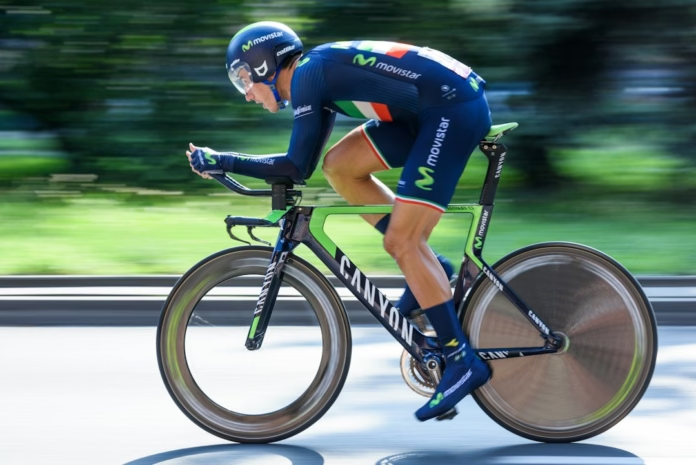
Two cyclists can ride side by side at the same speed and be doing completely different workouts. The rider who has to concentrate to hold the wheel may be in tempo, while the other is barely above recovery intensity. Speed on the road is influenced by wind, gradient, position and drafting. Training zones are an attempt to describe how hard the body is actually working instead.
Cycling training zones group effort into recognisable intensities, from gentle recovery to short maximal sprints. Riders use them to plan purposeful sessions, avoid turning every ride into the same middling effort and monitor progression. The most common systems use power or heart rate, but a zone number on a bike computer only makes sense when you know which system and threshold produced it.
 Photo Credit: Aditya Wardhana / Unsplash
What are the seven cycling power zones?
One widely used framework comes from exercise physiologist Andrew Coggan. It sets training levels relative to Functional Threshold Power, or FTP, an estimate of a rider’s sustainable high-intensity cycling power. The first six levels have approximate percentage boundaries; the seventh describes maximal neuromuscular efforts that are better understood by their very short duration and individual sprint power than by a fixed percentage of FTP.
| Zone | Broad intensity | Approximate power relative to FTP | How it feels |
|---|---|---|---|
| 1 | Active recovery | Below 55% | Very easy pedalling, relaxed conversation |
| 2 | Endurance | 56–75% | Steady effort, full sentences still comfortable |
| 3 | Tempo | 76–90% | Purposeful riding, breathing noticeably harder |
| 4 | Threshold | 91–105% | Demanding, sustained focus required |
| 5 | VO2 max | 106–120% | Hard intervals, difficult to talk |
| 6 | Anaerobic capacity | Above roughly 120% | Short, very hard efforts |
| 7 | Neuromuscular power | No useful fixed FTP percentage | Explosive accelerations and sprints |
These are descriptive training ranges, not sharp physiological switches. Coggan’s seventh neuromuscular level is especially easy to misrepresent: it is not supposed to be calculated from a universal threshold percentage, because peak sprint abilities vary enormously between riders. A rider does not change energy systems the instant the display moves from 75 to 76 per cent. Different platforms also offer different zone models and sometimes different cut-offs. TrainingPeaks publishes Coggan’s original framework, while British Cycling uses its own testing and zone guidance within training plans. Use one consistent set of definitions when comparing sessions.
How to calculate training zones from your FTP
Start with a recent, credible FTP estimate. Imagine a rider whose FTP is 250 watts. In the Coggan-style system, Zone 2 at 56–75 per cent corresponds to approximately 140–188 watts. Zone 3 at 76–90 per cent works out at roughly 190–225 watts. Those numbers are calculated from the rider’s own threshold, not borrowed from a professional’s training file.
The arithmetic is simple: multiply FTP by the lower and upper percentage of the desired zone. For 250 watts, 0.56 × 250 gives 140 watts. At the top of Zone 2, 0.75 × 250 gives 187.5 watts. Rounding to sensible whole-watt targets is adequate for most workouts, especially on the road where power naturally fluctuates.
The calculation is only as useful as the FTP value behind it. An estimate from an unusually good short effort may overstate sustainable threshold power, while a test completed when ill or exhausted may underestimate it. Our guide to professional cyclists’ FTP offers context for how power numbers are discussed, but a rider’s training zones should be personal rather than aspirational.
What is Zone 2 cycling and why is it so popular?
Zone 2 is generally associated with sustainable aerobic endurance training. In the power framework above, it is an intensity at which continuous conversation remains possible and the rider can continue for an extended period, provided the session is supported by appropriate fitness and fuelling. It can form the bulk of a longer endurance ride.
Its appeal is partly practical. You can accumulate significant riding time without turning every session into a race, and an endurance session can complement harder intervals later in the week. The difficulty is that road conditions continually push power above the nominal range. A short rise on a steep climb is not automatically a failed Zone 2 ride, but spending half the session chasing wheels at threshold changes its purpose.
It is also important to distinguish an FTP-based Zone 2 from a laboratory-defined low-intensity domain established through measured lactate or ventilatory thresholds. They are related concepts, not guaranteed to line up precisely for every cyclist. Marketing that presents one simple wattage percentage as the exact metabolic threshold for everyone is overstating what an FTP table can tell you.
Zone 3, Zone 4 and the difference between tempo and threshold
Tempo is a useful pace for long intervals and sustained riding when the goal is to work harder than an endurance spin without sitting at the limit. A commuter riding briskly through rolling terrain may spend substantial time there. Threshold training, by contrast, deliberately takes the rider close to the power they can sustain for a demanding prolonged effort.
For a rider with a 250-watt FTP, a structured threshold workout might prescribe several controlled intervals near 240–250 watts with recovery between them. A tempo session could instead involve longer blocks around 200 watts. Those are illustrative workloads, not prescriptions that suit every cyclist; the amount of time spent at intensity and the recovery needed depend on fitness and recent training.
The danger for a time-limited amateur is that every ride becomes an improvised tempo workout. Riding too hard on intended easy days can make the next quality session less effective. British Cycling’s guidance on understanding training intensity similarly warns against accumulating fatigue by drifting into the middle of the intensity spectrum without a clear purpose.
Zones 5, 6 and 7 are not just faster versions of endurance riding
At VO2 max intensity, intervals are hard enough that talking becomes difficult and repetitions need recovery. Anaerobic capacity work is shorter and more demanding. Neuromuscular efforts are the explosive end of the spectrum: jumping out of a corner, launching a sprint or making a very short maximal acceleration.
Power is useful here because heart rate responds too slowly to capture the true intensity of a five-second sprint or a sharp thirty-second acceleration. Your pulse may still be climbing when the effort is finished. That is one reason to avoid treating the zone numbers from heart rate and power as identical measurements.
These harder efforts have value for riders whose events require changes of pace, but they also create considerable fatigue. An off-season plan for someone riding three times a week will not necessarily resemble a programme for a criterium specialist or professional road racer.
Power zones versus heart rate zones
A power meter measures the mechanical output at the bicycle, giving nearly immediate feedback when effort changes. Heart rate reflects a physiological response that lags behind changes in power and varies with heat, hydration, caffeine, illness, altitude and accumulated fatigue. Neither measurement tells the whole story in isolation.
Heart rate training is entirely workable without a power meter. It is especially useful for longer steady efforts and recognising when a familiar pace is unusually taxing. But heart rate zones should be built from an appropriate threshold or other tested protocol, not copied from the wattage percentages above. A heart-rate Zone 2 of 56–75 per cent of FTP is a category error: watts and beats per minute are different quantities with different scaling methods.
The best approach for riders with both devices is to use power to control short intervals and heart rate as an additional check on response, particularly during endurance rides. If a normally comfortable wattage produces a markedly higher heart rate than usual, fatigue, heat or poor recovery may be part of the explanation.
Can you train by feel without a power meter?
Yes, provided you are willing to judge effort consistently. Rate of perceived exertion, breathing and the ability to talk are useful indicators. A recovery spin feels genuinely easy. Endurance riding permits conversation. Tempo demands more concentration, threshold makes sustained talking difficult and maximal intervals remove any ambiguity.
There are limitations. The talk test is less precise than a calibrated power meter, especially close to boundaries, and a fast group can pressure riders into going harder than intended. Nevertheless, it is often better to complete a properly easy ride by feel than to chase a dubious number from an outdated FTP estimate.
If winter leaves little time for structured outdoor training, the indoor cycling setup guide explains how to obtain repeatable conditions. The winter base-fitness guide covers how endurance work fits into a broader programme.
How to use the zones in a normal training week
Consider a rider with three sessions available. A long weekend ride may focus on endurance, with tempo appearing naturally on hills. A shorter weekday session can include a specific interval target, perhaps threshold or VO2 max work depending on the rider’s goal. The remaining ride might be easy recovery or relaxed riding with friends. The important point is not to force every zone into every week.
Fuel and recover for the work you actually do. An extended endurance ride is not a fasted challenge by default, and hard sessions may demand more carbohydrate during and after the ride. Our carbohydrate-per-hour guide gives practical quantities for different ride durations.
Reassess FTP when training has changed substantially or the targets stop matching the effort you can really sustain. An accurately set Zone 2 should feel like endurance work, not a hidden threshold interval. The purpose of the numbers is to help plan riding, not to make riders obey the screen at the expense of what their body and the road are telling them.

