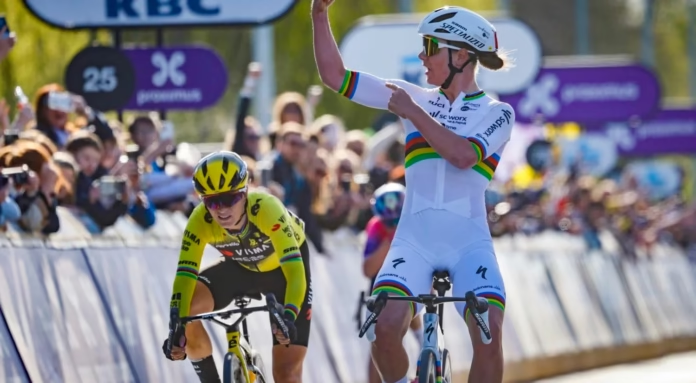
Fabiana Luperini climbed to the first women’s La Flèche Wallonne victory in 1998. Twenty-three years later, Lizzie Deignan rode alone across the cobbles to become the first Paris-Roubaix Femmes winner. Between those two races, other names were added to the roll of honour: Debby Mansveld at Amstel, Zoulfia Zabirova in Flanders and Megan Guarnier on the gravel roads of Tuscany.
The story is not a single moment when women finally started riding famous roads. There were earlier women’s races, established champions and different versions of events that later disappeared or returned. The most useful history identifies which edition is being counted, who won it, and what its creation changed for the riders who followed.
What counts as a first women’s Classic winner?
The men’s Classics have long histories, but their women’s counterparts were introduced at different times, often on different routes and sometimes with long interruptions. The first winner must be attached to the actual women’s edition being counted, not inferred from the men’s race or from a later relaunch.
One of the clearest examples is Sanremo. A women’s event called Primavera Rosa ran from 1999 to 2005. Racing was absent for two decades before Sanremo Women returned in 2025. Sara Felloni was therefore the first winner of that earlier race; Lorena Wiebes was the winner of the revived modern event, not the first woman ever to win in Sanremo.
This guide concentrates on major European one-day road races that now anchor the women’s professional calendar. It also includes milestones where a current race has an interrupted history. Other women’s Classics were established much earlier, so this is not a list of the first women to race competitively or of the first women’s road races anywhere.
| Race or edition | Year | First winner |
|---|---|---|
| La Flèche Wallonne Femmes | 1998 | Fabiana Luperini |
| Primavera Rosa (original Sanremo) | 1999 | Sara Felloni |
| Amstel Gold Race Women | 2001 | Debby Mansveld |
| Tour of Flanders Women | 2004 | Zoulfia Zabirova |
| Gent-Wevelgem Women | 2012 | Lizzie Armitstead |
| Strade Bianche Donne | 2015 | Megan Guarnier |
| Liège-Bastogne-Liège Femmes | 2017 | Anna van der Breggen |
| Paris-Roubaix Femmes | 2021 | Lizzie Deignan |
| Sanremo Women (revival) | 2025 | Lorena Wiebes |
The broader ProCyclingUK women’s cycling history hub brings together the riders, teams and events that pre-date and surround these modern calendar milestones.
Fabiana Luperini started the women’s Flèche Wallonne story in 1998
La Flèche Wallonne Femmes has been held since 1998, far longer than several other races in today’s women’s spring programme. The first winner was Italian climber Fabiana Luperini, whose strength on steep gradients helped establish the event’s reputation as a genuine test for punchy climbers.
The Mur de Huy shaped this race’s identity. Positioning at the bottom is only the beginning: the steepening slope demands a controlled effort followed by the ability to accelerate when riders are already close to their limit. Luperini set that standard in 1998, and the race soon attracted specialists rather than simply riders looking for one more spring start.
Luperini won again in 2001 and 2002, but her name is most significant here because she set the first mark in 1998. The race became a showcase for riders including Nicole Cooke, Marianne Vos, Anna van der Breggen and later generations. Van der Breggen’s seven consecutive wins from 2015 through 2021 showed just how specialised mastery of Huy could become.
The women’s version did not wait for the modern Women’s WorldTour to make itself important. By the time that circuit began in 2016, Flèche Wallonne Femmes had already accumulated nearly two decades of history and its own list of dominant champions.
Sara Felloni and the original Primavera Rosa in 1999
Sanremo requires an important correction to many simplified lists of women’s firsts. The original Primavera Rosa was organised by RCS Sport from 1999 to 2005 and followed much of the familiar Ligurian finale, including the Cipressa and Poggio, before finishing on Via Roma.
Sara Felloni won the first Primavera Rosa in 1999 over 118km, beating Gabriella Pregnolato in the sprint. The finish was on Via Roma, and the route included the familiar Ligurian climbs, making the race a genuine predecessor rather than an entirely unrelated women’s event sharing a city name.
The women’s race disappeared from the calendar after that seventh edition. When RCS launched Sanremo Women in 2025, the event was appropriately celebrated as a long-awaited return. Lorena Wiebes won the revived event ahead of Marianne Vos and Noemi Rüegg, after Lotte Kopecky had helped bring back a late move by Elisa Longo Borghini.
That gives Sanremo two milestones worth remembering rather than one false ‘first’. Felloni opened the original list in 1999; Wiebes supplied the first name of the current revival in 2025. They should not be collapsed into a single winner when discussing the history of women racing to Via Roma.
Debby Mansveld at Amstel Gold in 2001 and Zoulfia Zabirova in Flanders in 2004
Debby Mansveld won the inaugural women’s Amstel Gold Race in 2001, ahead of Mirjam Melchers and Leontien van Moorsel. It ran for only three editions before disappearing after 2003, when Nicole Cooke won. Anna van der Breggen became the first winner of the revived race in 2017. That gap of fourteen years is an important part of its history.
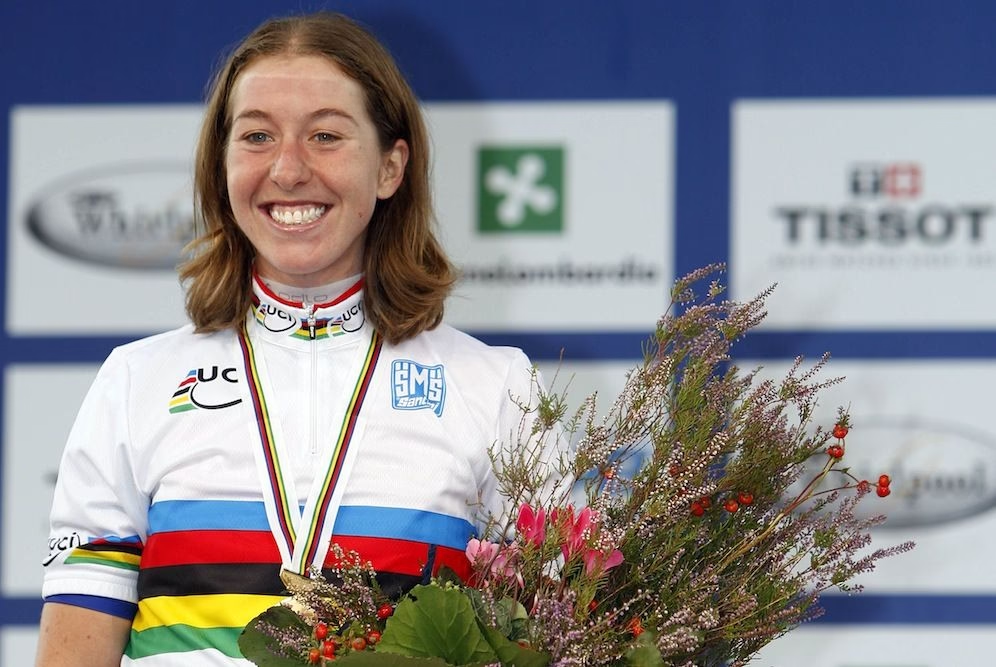 Photo Credit: Yuzuru Sunada
Those two phases show how fragile women’s race continuity could be. A successful first edition did not guarantee that the event would survive commercially or organisationally. Our Amstel Gold Race Women history follows that interrupted timeline and why its return was important for the Ardennes sequence.
Three years after Mansveld’s Amstel victory, Zoulfia Zabirova became the inaugural women’s Tour of Flanders champion in 2004. That first edition covered 94km from Oudenaarde to Meerbeke and included the Muur van Geraardsbergen and Bosberg. Zabirova attacked on the Muur and held off the chase to win alone, a fitting opening chapter for a race where positioning and decisive attacks would become central.
The women’s Tour of Flanders grew longer and more demanding over the following decades, but its 2004 winner should not be treated merely as a footnote to the men’s race. Zabirova won a fully contested women’s World Cup event and established the first benchmark for one of cycling’s defining cobbled Classics. Our history of Tour of Flanders Women follows that development.
Lizzie Armitstead at Gent-Wevelgem in 2012 and Megan Guarnier at Strade Bianche in 2015
Gent-Wevelgem Women was introduced in 2012 and Lizzie Armitstead, later known as Lizzie Deignan, won the opening edition. It quickly demonstrated the value of a race that sits between the traditional sprinter’s Classic and a genuinely selective challenge, with the Kemmelberg and exposed roads helping to make the result unpredictable.
Armitstead’s result mattered beyond a British victory in Belgium. It gave the event a first champion already able to combine endurance, position and a sprint after a demanding afternoon. Later winners such as Kirsten Wild, Marianne Vos, Marlen Reusser and Lorena Wiebes illustrated the different ways the race can be won. The Gent-Wevelgem Women history sets out those changes.
At Strade Bianche Donne in 2015, Megan Guarnier made the new race her own with a late solo move. Lizzie Armitstead and Elisa Longo Borghini completed the first podium in Siena. The result immediately established a distinct kind of Italian Classic, defined by repeated gravel sectors, positioning and the final climb to Piazza del Campo.
The women’s Strade Bianche joined the first UCI Women’s WorldTour calendar in 2016, giving the discipline a high-profile Italian event whose appeal depended on handling, repeat accelerations and the ability to make a move when the surface was least forgiving. Guarnier’s victory remains the starting point of the race’s women’s roll of honour.
Anna van der Breggen opened Liège-Bastogne-Liège Femmes in 2017
The women’s Liège-Bastogne-Liège began in 2017, bringing the oldest of the famous men’s Ardennes races into the modern women’s calendar. Anna van der Breggen was the first winner and she defended the title in 2018, immediately setting a high standard for a race built around repeated hard climbs rather than a single uphill finishing sprint.
Liège gave women’s cycling a fuller Ardennes block alongside Amstel Gold Race Women and Flèche Wallonne Femmes. The races have different characters even though the same strong climbers can contend in all three. Amstel involves repeated smaller climbs and position battles, Flèche tends to focus attention on Huy, while Liège rewards surviving a much longer sequence of decisive attacks.
The introduction of Liège-Bastogne-Liège Femmes gave climbers another genuine target in the spring. In 2017, riders could contest Amstel, Flèche and Liège as an Ardennes sequence, each demanding a different sort of finish. Van der Breggen’s first Liège victory therefore marked an expansion of the sporting calendar, not simply another trophy.
Our history of Liège-Bastogne-Liège Femmes examines why 2017 mattered as a sporting addition, rather than simply the first use of a familiar race name on a women’s start list.
Lizzie Deignan’s 2021 Paris-Roubaix made a new kind of history
The first Paris-Roubaix Femmes finally took place on Saturday, 2nd October 2021. A women’s edition had been planned for 2020, but the pandemic delayed its debut. Lizzie Deignan ensured the race’s inaugural running would be remembered for far more than the calendar date.
Lizzie Deignan attacked on the first cobbled sector of the inaugural Paris-Roubaix Femmes in 2021 and held a remarkable solo lead for approximately 82km. She reached the velodrome ahead of Marianne Vos and Elisa Longo Borghini after a wet, testing edition. The race did not need a manufactured narrative: its first winner had produced one of the great long-distance Classics rides.
Deignan had already won major Classics, but her Roubaix victory carried different weight. The cobbles demanded repeated forceful efforts, technical judgement and a willingness to keep riding when the conditions made mistakes costly. The first women’s edition was an immediate race of consequence rather than a ceremonial addition to the men’s weekend.
Paris-Roubaix Femmes also changed what could be expected of the calendar. A dedicated women’s event on one of cycling’s most recognisable courses became a focus in its own right. The complete history of Paris-Roubaix Femmes traces how later winners built on that debut.
What the first winners reveal about modern women’s racing
These first champions did not all win the same sort of race. Luperini conquered a steep uphill finish, Felloni sprinted on the Ligurian coast, Zabirova attacked on a Flemish climb, Guarnier used the Tuscan gravel to break clear and Deignan rode solo for more than an hour on the cobbles. The variety is the point. The modern women’s Classics calendar developed distinctive tactical tests rather than one interchangeable style of one-day racing.
Nor did the sport arrive fully formed when these famous race names appeared. Women’s racing had established champions and international competitions well before the late 1990s, and the gaps at Amstel and Sanremo remind us that progress was uneven. A new race could be prestigious without its future being secure.
A first winner is therefore a useful historical marker, but the questions that follow are just as important: whether the race survived, what sort of contest organisers built, and whether it offered riders a meaningful new chance to compete. The winners listed here shaped the answers through their attacks, sprints and endurance, not through symbolism alone.
These results deserve their correct dates and contexts. Felloni in 1999 and Wiebes in 2025 mark different phases of Sanremo’s history. Mansveld in 2001 and Van der Breggen in 2017 do the same for Amstel. Preserving those distinctions gives women’s racing its own accurate chronology, including the years when organisers could not or would not keep major events on the calendar.