
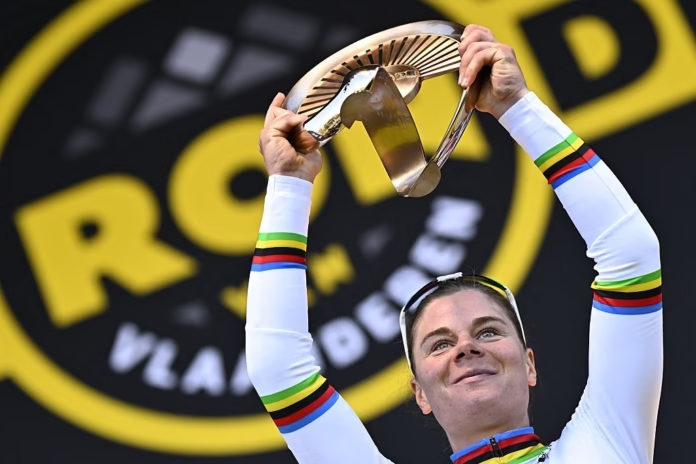
The Women’s Tour of Flanders has grown into one of the defining races of the spring and one of the most important one-day races in women’s cycling. What began in 2004 as a shorter event using the closing roads of the men’s race has become a fully established cobbled Classic with its own identity, its own champions and its own catalogue of defining moments. By 2026, it stands comfortably as one of the sport’s great tests of power, positioning, timing and nerve.
What gives the Women’s Tour of Flanders its lasting appeal is that it has never belonged to just one type of rider. Some editions have been won through overwhelming solo strength. Others have been decided by tiny front groups or by riders who judged the final sequence of climbs more sharply than everyone else around them. If you are new to the race, the Beginner’s guide to Tour of Flanders Women 2026 is the best place to start. If you already know the event and want to understand why it has become such a cornerstone of the women’s spring, its history tells the story even better.
How the Women’s Tour of Flanders began
The first Women’s Tour of Flanders took place in 2004. It was only 94km long and followed the final part of the men’s race, including the Kapelmuur and Bosberg. Zoulfia Zabirova won that inaugural edition with an attack on the Muur itself, immediately tying the women’s race to one of the sport’s most recognisable climbs. That early version of the race was shorter and simpler than what followed, but the foundations were already there, cobbles, climbs, positioning stress and the need to make a move at exactly the right moment.
The second edition in 2005 remains one of the strangest in the race’s history. A chasing group went the wrong way in the closing kilometres and crossed the finish line from the opposite direction, which led to the disqualification of around 20 riders. Mirjam Melchers still emerged as the winner and then defended her title in 2006, becoming the first rider to win the Women’s Tour of Flanders more than once. Those early editions mattered because they established that the race was never going to be a token addition to the calendar. It already had unpredictability, difficulty and enough chaos to create lasting memories.
How the route evolved into the modern Women’s Tour of Flanders
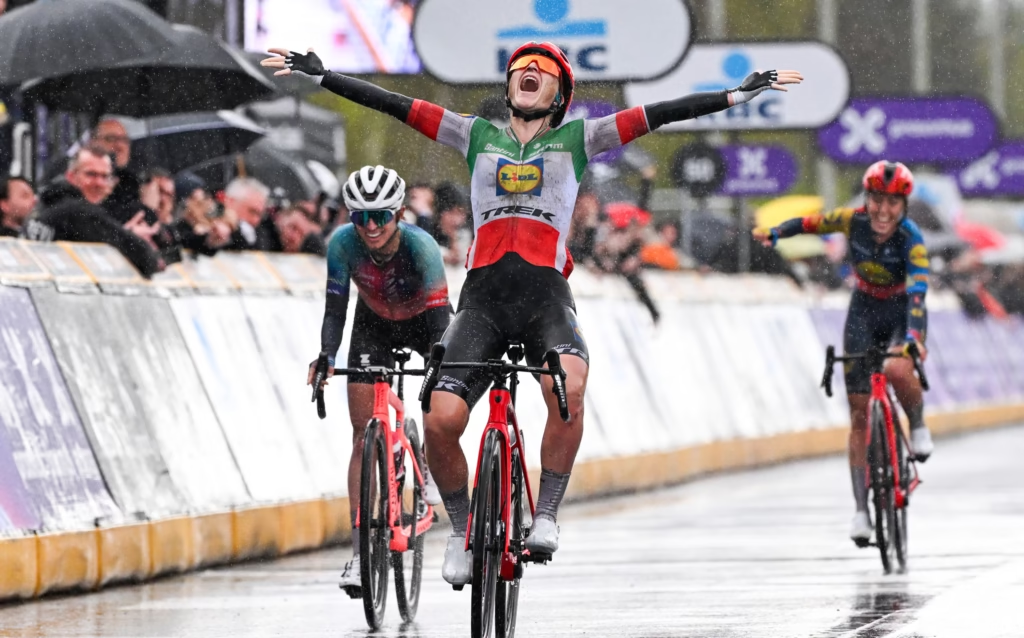
As the race developed, it gained both distance and importance. Nicole Cooke won in 2007 when the route had already stretched to 122km, and over time the event became more substantial in almost every sense. The decisive turning point came in 2012 when the finish moved to Oudenaarde. That shift effectively created the modern Women’s Tour of Flanders, with the late sequence of climbs around the Oude Kwaremont and Paterberg becoming central to the finale. Since then, the route has varied in detail, but the race’s identity has stayed much more consistent.
That route identity is a huge part of why the race has become so important. The most important climbs of the Women’s Tour of Flanders explain the geography of the race well, but in simple terms the event now works by accumulating pressure. There is rarely one single moment that decides everything on its own. Instead, the race hardens climb by climb until only the strongest and most tactically alert riders are still in position to win. That makes the Women’s Tour of Flanders one of the clearest tests of a rider’s complete one-day skill set.

The winners who shaped Women’s Tour of Flanders history
The winners list tells you a lot about the race. Judith Arndt won twice, in 2008 and 2012. Annemiek van Vleuten also won twice, first in 2011 and then again in 2021. Elisa Longo Borghini added victories in 2015 and 2024. That alone would make the roll of honour feel strong, but then you add names like Marianne Vos, Ellen van Dijk, Lizzie Deignan, Anna van der Breggen and Marta Bastianelli. The Women’s Tour of Flanders consistently crowns riders who can handle the hardest and most tactically complex kind of spring racing.
More recently, the race has become inseparable from Lotte Kopecky. She won in 2022, repeated in 2023, and then claimed a third title in 2025 to become the outright record holder in the race. That matters historically because multiple winners have always been rare here. Flanders does not forgive weakness, but it also does not forgive predictability. Riders can come in with excellent legs and still lose through one missed move, one bad line into a cobbled sector or one hesitation on the final climbs. Kopecky winning three times in that environment says a great deal about her place in the race’s history.
The greatest editions of the Women’s Tour of Flanders
There is a strong case for 2018 as the most dominant edition in modern Women’s Tour of Flanders history. Anna van der Breggen attacked from distance and simply broke the race apart. It was one of those performances where the tactical discussion quickly gave way to a more basic truth, nobody else could match her. The size of the winning margin only reinforced that. For a race that is often decided by tiny separations, 2018 felt like total control.
Yet 2020 deserves just as much respect for the opposite reason. Chantal van den Broek-Blaak won not through the most overwhelming display of the decade, but through perfect race reading. Anna van der Breggen and Annemiek van Vleuten, the two towering figures of that era, became too focused on each other and allowed Blaak to escape their orbit. That is one of the purest examples of what makes the Women’s Tour of Flanders such a compelling race. Strength matters, but timing and judgement matter almost as much.
The 2023 and 2024 editions also deserve to be treated as important historical markers. In 2023, SD Worx turned the race into a display of team control, with Kopecky beating Demi Vollering in a one-two that underlined how difficult it is to race against a squad that can dominate both tactically and physically. In 2024, Longo Borghini interrupted that run with a beautifully judged ride that reminded everyone how often Flanders still rewards experience and composure over sheer numerical strength. The 2025 Tour of Flanders Women race preview captured that wider context well before Kopecky then returned to win again in 2025.

Why the Oude Kwaremont and Paterberg define the race
Every great race has a stretch of road that feels bigger than the map. In the Women’s Tour of Flanders, that is the combination of the Oude Kwaremont and Paterberg. They do not just shape the route, they shape the psychology of the race. Riders and teams know that if they are out of position before those climbs, they may never get back into contention. That creates tension long before the key attacks begin.
The Oude Kwaremont is long enough to exhaust riders who are already on the edge. It forces a more honest selection because there is no easy way to bluff your way over it when the pace is high. Then the Paterberg arrives like a final exam, short, steep, crowded and brutal. If you want a deeper look at why those roads matter so much, The most important climbs of the Women’s Tour of Flanders breaks the terrain down in more detail. What matters most here is that the Women’s Tour of Flanders usually reaches its clearest moment of truth around those final ramps.
Women’s Tour of Flanders previous winners
A complete Women’s Tour of Flanders winners list is one of the best ways to see how the race has evolved.
- 2004 – Zoulfia Zabirova
- 2005 – Mirjam Melchers-van Poppel
- 2006 – Mirjam Melchers-van Poppel
- 2007 – Nicole Cooke
- 2008 – Judith Arndt
- 2009 – Ina Teutenberg
- 2010 – Grace Verbeke
- 2011 – Annemiek van Vleuten
- 2012 – Judith Arndt
- 2013 – Marianne Vos
- 2014 – Ellen van Dijk
- 2015 – Elisa Longo Borghini
- 2016 – Lizzie Deignan
- 2017 – Coryn Rivera
- 2018 – Anna van der Breggen
- 2019 – Marta Bastianelli
- 2020 – Chantal van den Broek-Blaak
- 2021 – Annemiek van Vleuten
- 2022 – Lotte Kopecky
- 2023 – Lotte Kopecky
- 2024 – Elisa Longo Borghini
- 2025 – Lotte Kopecky
-
 Photo Credit: Getty
Who has won the Women’s Tour of Flanders the most times?
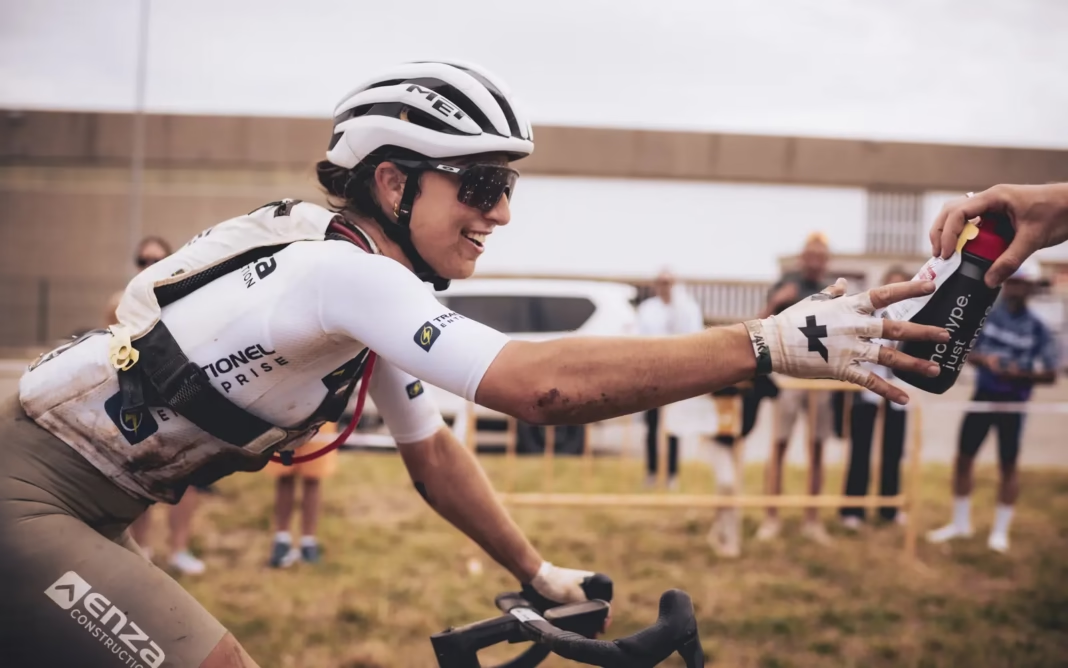
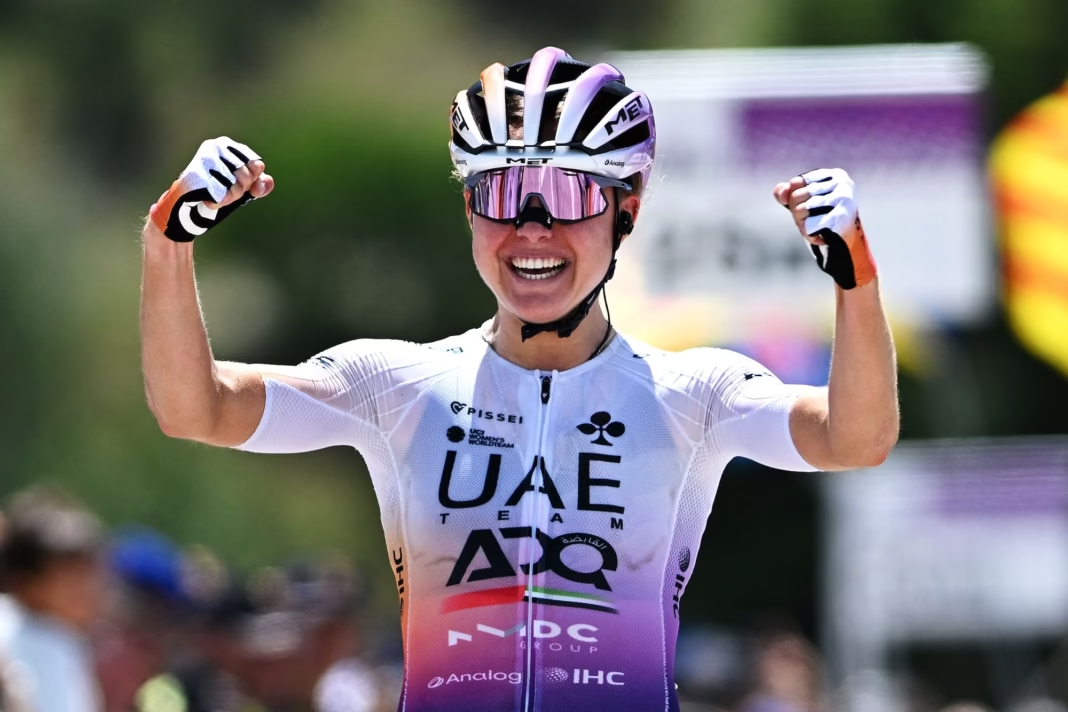
As of the 2026 edition, Lotte Kopecky is the most successful rider in Women’s Tour of Flanders history with three wins. Behind her sit Mirjam Melchers-van Poppel, Judith Arndt, Annemiek van Vleuten and Elisa Longo Borghini on two victories each. That is not just a useful statistic for trivia or SEO, it tells you how hard this race is to master more than once. Even the greatest Classics riders often get only one perfect day in Flanders.
Why the Women’s Tour of Flanders matters so much
The Women’s Tour of Flanders matters because it captures so much of what makes spring racing special. It is prestigious without feeling ceremonial. It is tactical without becoming passive. It is selective without ever being completely predictable. If best women’s cycling races in 2026 for new fans tries to explain why races like this pull people in, Flanders is one of the clearest examples. You can see the race tightening one climb at a time until the strongest riders are left exposed in front of everyone.
That is why the Women’s Tour of Flanders now stands comfortably as one of the greatest races of the spring. It has history, character, iconic roads and a winners list full of riders who define eras. The race may have started as a shorter companion to the men’s event, but it has long since become one of the central fixtures of women’s cycling in its own right. For more on that wider context, the Women’s cycling history hub and A brief history of Tour of Flanders Women are natural next reads.

