

Leontien van Moorsel belongs in any serious conversation about the greatest riders in women’s cycling history. She was not simply a champion who had one dominant phase. She won before her career crisis, rebuilt herself after it, then came back to reach an even higher level. By the time she retired after the 2004 Olympics, she had become a four-time Olympic champion, a multiple world champion on road and track, an hour record holder and one of the defining Dutch riders of any era.
That makes her story more than a list of medals. Van Moorsel’s career was not one smooth line upwards. It had an early phase of rapid success, a deeply difficult period shaped by anorexia and bulimia, then one of the most remarkable comebacks the sport has seen. If you are working through the wider women’s cycling history hub, she is one of the clearest examples of how women’s cycling in the 1990s and early 2000s could still produce legends whose stories feel modern, vulnerable and complicated at the same time.
Before cycling, Leontien van Moorsel was already special
Born in Boekel on the 22nd March 1970, Leontien van Moorsel emerged as a top rider while women’s cycling was still far less structured and far less visible than it is now. She was winning major races by the early 1990s and quickly established herself as one of the few riders capable of challenging the dominance of Jeannie Longo.
That early range is important. Van Moorsel was never just one type of rider. She could dominate stage races, win major one-day races and produce elite performances on the track. That makes her fit naturally into several different strands of women’s cycling history at once, whether you approach the sport through A brief history of the road cycling world championships, The Tour de France Femmes: Most Asked Questions or Women’s Olympic road race winners.
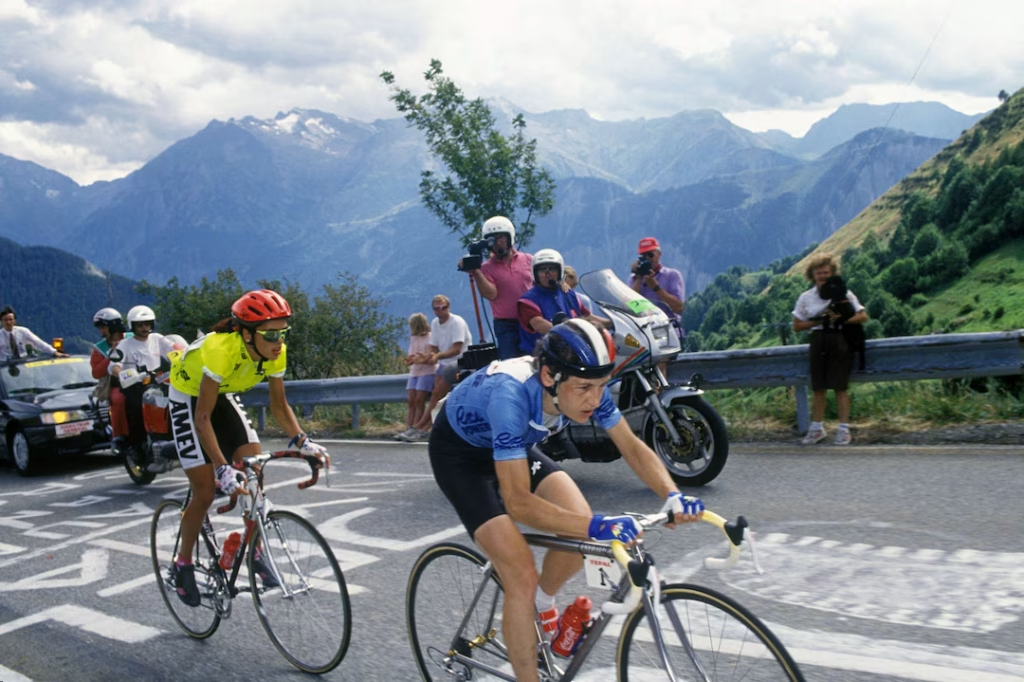 Photo Credit: ANP/Presse Sports
The first great phase of her career
Van Moorsel’s first major peak came in the early 1990s. She won the road race world title in 1991 and 1993, and she won the Grande Boucle Féminine Internationale in 1992 and 1993. Those results alone would have been enough to establish her as one of the strongest riders in the world, but they mattered even more because they arrived against the backdrop of a still-forming international peloton where the best riders had to be adaptable and resilient across very different race types.
She was also already succeeding on the track. Her individual pursuit world title in 1990 showed that she was not only a road rider with strong legs, but an athlete with the sort of controlled power that could dominate against the clock too. That track-road combination sharpened the qualities that came to define her as a rider: pace judgement, sustained strength and the ability to stay composed when racing became highly individual.
The eating disorder that stopped everything
What makes Van Moorsel’s story so striking is that this first phase did not simply continue. In the mid-1990s, her career was interrupted by anorexia nervosa and bulimia. She stepped away from the sport at a point when she should still have been deep in her prime.
This part of the story matters for more than biography. It changes how her later achievements should be understood. Van Moorsel was not a champion who just stayed there. She disappeared from the summit of the sport, dealt with a severe illness, and then came back to become even more successful. That second act is one of the reasons she still stands apart. Many riders have brilliant careers. Very few have careers that contain both collapse and reconstruction on that scale.
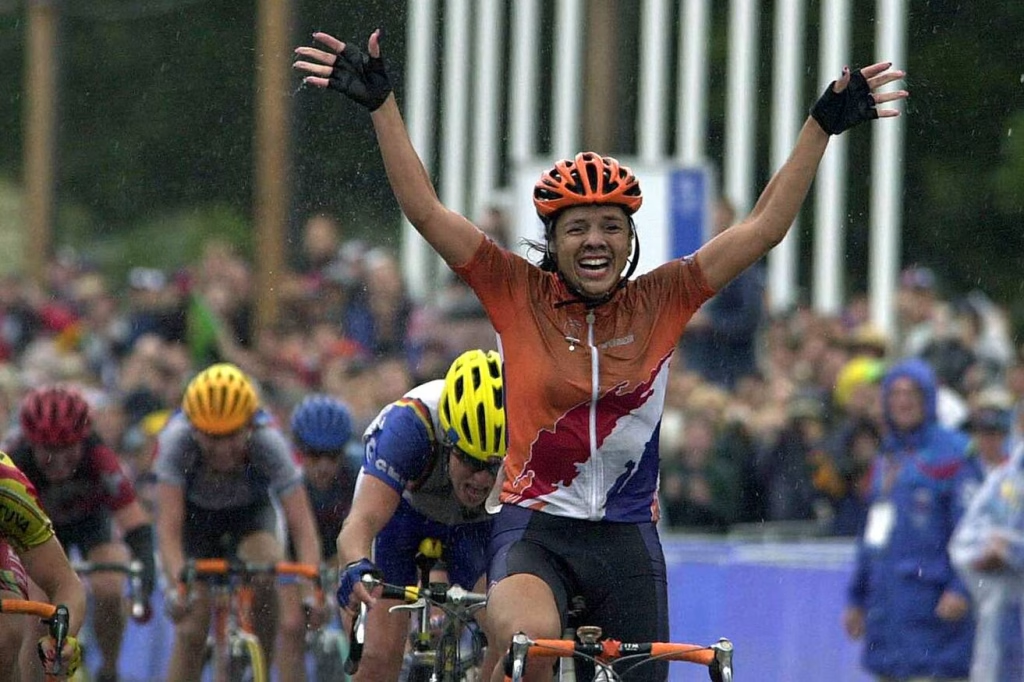 Photo Credit: Imago/Sven Simon
The comeback that changed everything
By the late 1990s, Van Moorsel was back, and not in a sentimental way. She returned as a rider capable of winning the biggest races again. Her world time trial titles in 1998 and 1999 were the clearest sign that her comeback was real, but they were still only the beginning of her greatest period.
Her return also fitted into a broader transition in women’s cycling. Riders were becoming more specialised, time trialling was gaining more status, and the biggest events increasingly rewarded riders who could dominate through raw engine rather than only race craft. Van Moorsel had both. That combination turned her comeback into something bigger than a personal story. It became one of the defining competitive narratives of the era.
Sydney 2000: one of the greatest Olympic performances in cycling
The high point came at the Sydney Olympics in 2000. Van Moorsel won gold in the road race, gold in the time trial and gold in the 3km individual pursuit, as well as silver in the points race. It remains one of the greatest all-round Olympic performances the sport has seen.
That Sydney performance is the core of her legacy. Plenty of riders are world champions. Far fewer dominate the Olympics in multiple disciplines at the same Games. Van Moorsel managed it across road and track, which says almost everything about her range. If you look at Women’s Olympic road race winners, her 2000 road title sits alongside the very best of the sport’s one-day champions, but the wider Sydney haul is what turns the result into legend.
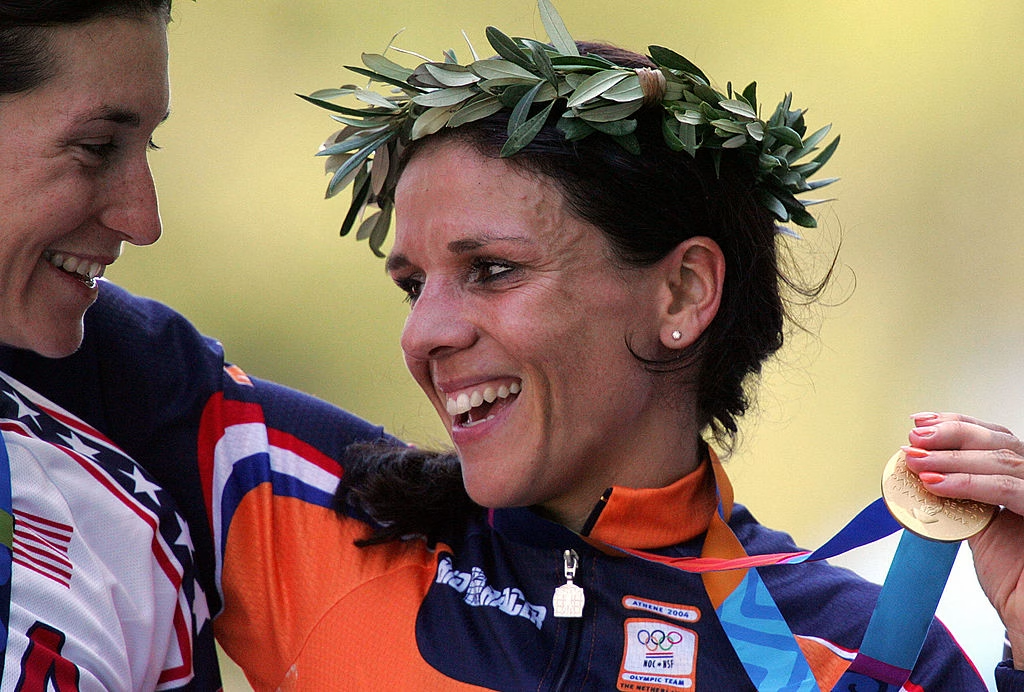 Photo Credit: DAMIEN MEYER/AFP/Getty Images
The years after Sydney
What is easy to forget is that Sydney was not the end of the story. Van Moorsel remained one of the best riders in the world after 2000. She added further world titles on the track in the individual pursuit in 2001, 2002 and 2003. In 2003 she also set a women’s hour record of 46.065km in Mexico City, a mark that stood until 2015.
That hour record gives her a natural place in Women’s hour record: a history. It also helps explain the sort of rider she was. Van Moorsel did not rely on ambiguity. At her best, she could simply overpower events. The hour record is the purest version of that, because it reduces cycling to one rider, one bike and one effort against time.
Athens 2004 and the final elite chapter
Van Moorsel’s final Olympics in Athens in 2004 were dramatic enough to feel almost scripted. She crashed heavily in the road race and was stretchered away, yet came back two days later to defend her Olympic time trial title. She also won bronze in the individual pursuit on the track, taking her Olympic medal total to six, including four golds.
She retired after those Games, which gave her elite career an unusually strong ending. Many all-time greats fade away over several seasons. Van Moorsel left after defending an Olympic title. That matters in how she is remembered. Her final image as an elite cyclist is not one of decline, but of resilience and control.
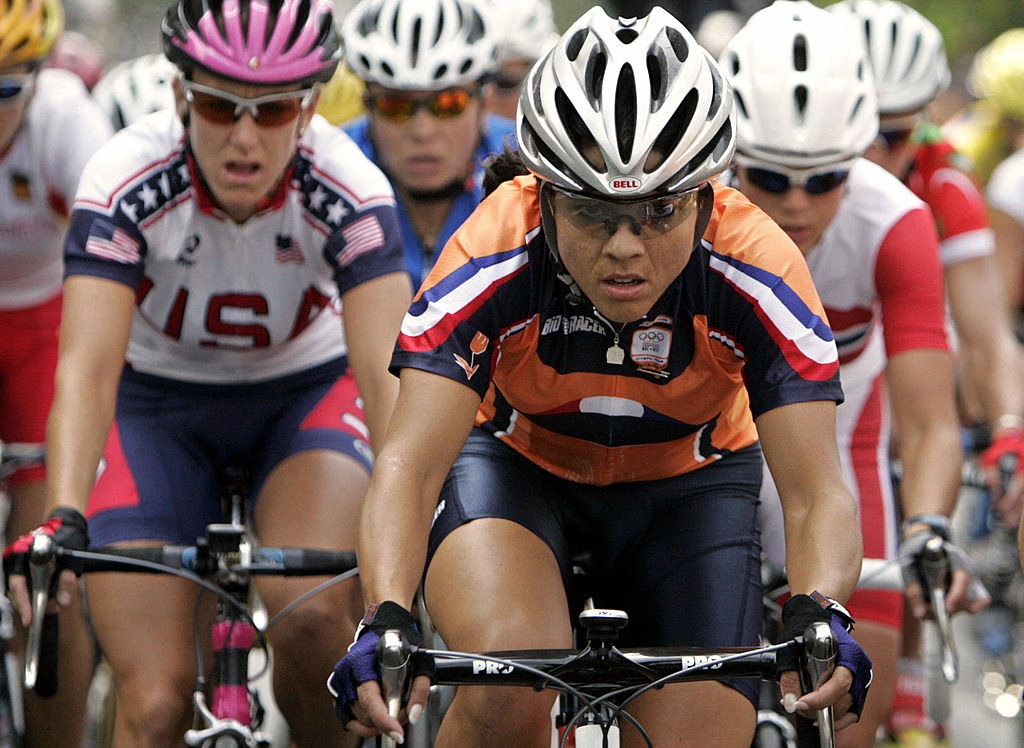 Photo Credit: LAURENT REBOURS/AFP/Getty Images
What kind of rider was Leontien van Moorsel?
Van Moorsel was not a pure sprinter and not only a climber. She was a complete rider with exceptional time trial and pursuit strength, but she was also good enough uphill and tactically sharp enough in one-day races to win across different formats. Her best results came when races rewarded sustained power, disciplined positioning and the ability to control pace rather than react to it.
That helps explain why she appears so naturally across different pieces of women’s cycling history. She belongs in the world championships story, in Olympic road racing, in track pursuit history and in the evolution of the women’s Tour line. She is one of the few riders whose career cannot really be boxed into one tradition of the sport.
The controversy around later allegations
Any full feature also has to acknowledge the controversy. In 2017, former sports doctor Peter Janssen accused Van Moorsel of using EPO in 2000 and 2001. The allegation was widely reported and became part of the public discussion around her career, but it did not lead to a formal sporting sanction against her.
That distinction matters. It would be wrong to present the allegation as a proven doping case. It would also be wrong to ignore it, because it forms part of how Van Moorsel’s career has been discussed in more recent years. For historical writing, the fairest position is the simple one: the allegation exists, it affected conversation around her legacy, but it did not produce a formal anti-doping sanction.
Leontien van Moorsel’s post-cycling career
Van Moorsel did not disappear after retirement. One major strand of her post-cycling life has been public advocacy and organisational work around cycling and health. In 2008, she founded what is now the Leontienhuis, originally the Leontien Foundation, to support people dealing with eating disorders. That gives her post-racing life a direct connection back to the hardest part of her own story.
She has also had an influential role in women’s racing itself. When the women’s Amstel Gold Race returned in 2017, Van Moorsel became its race director. That is a significant part of her post-cycling legacy because it means her influence did not end with her own results. She also became part of the modern structure that newer riders race within. You can see the broader relevance of that in A brief history of the Amstel Gold Race Women, where the modern race owes something to figures who insisted women’s events deserved to return and grow.
That post-cycling role matters because it broadens the way she should be remembered. Van Moorsel was not only a rider who left behind a huge palmarès. She also helped shape part of the current women’s calendar and used her experience to support people facing the kinds of struggles that once disrupted her own life.
Why Leontien van Moorsel still matters
Van Moorsel matters because she compressed several careers into one. She was an early road world champion, a stage-race leader, a rider brought down by illness, a comeback story, an Olympic legend, an hour record holder and then an organiser and advocate after retirement. Not many riders cover that much ground.
She also matters because her story is one of the clearest bridges between older and newer women’s cycling. If Jeannie Longo represents one strand of that older world, Van Moorsel represents another: a rider who dominated in a less professional era, then returned and succeeded inside a sport that was beginning to modernise around her. In that sense she belongs alongside the biggest names in women’s cycling history, not simply as a Dutch great, but as one of the riders who helped define what greatness in women’s cycling could look like.
Leontien van Moorsel career highlights
- Road world champion in 1991 and 1993, and elite time trial world champion in 1998 and 1999
- Track world champion in the individual pursuit in 1990, 2001, 2002 and 2003
- Winner of the Grande Boucle Féminine Internationale in 1992 and 1993
- Four Olympic gold medals, three of them at Sydney 2000 and one in the Athens 2004 time trial
- Women’s hour record holder from 2003 to 2015 with 46.065km
- Founder of the Leontienhuis support foundation and race director of the modern women’s Amstel Gold Race

