

The 2026 Giro d’Italia reaches one of its most important mountain stages on Saturday, 23rd May, with stage 14 taking the race from Aosta to Pila. After several days where the breakaway, points race and awkward medium-mountain terrain have carried the story, this is a very different kind of test. The GC riders can no longer hide behind stage-hunting tactics. The race returns to the high mountains, and the pink jersey battle should come back to the centre of the Giro.
Afonso Eulálio starts the stage still in the maglia rosa, with Jonas Vingegaard just 33 seconds behind after Eulálio added bonus seconds on stage 12 and then came through the difficult Verbania stage without losing time. That is a narrow enough margin to make stage 14 feel decisive. Vingegaard does not need a huge attack to take pink. Eulálio does not have much room left to manage losses.
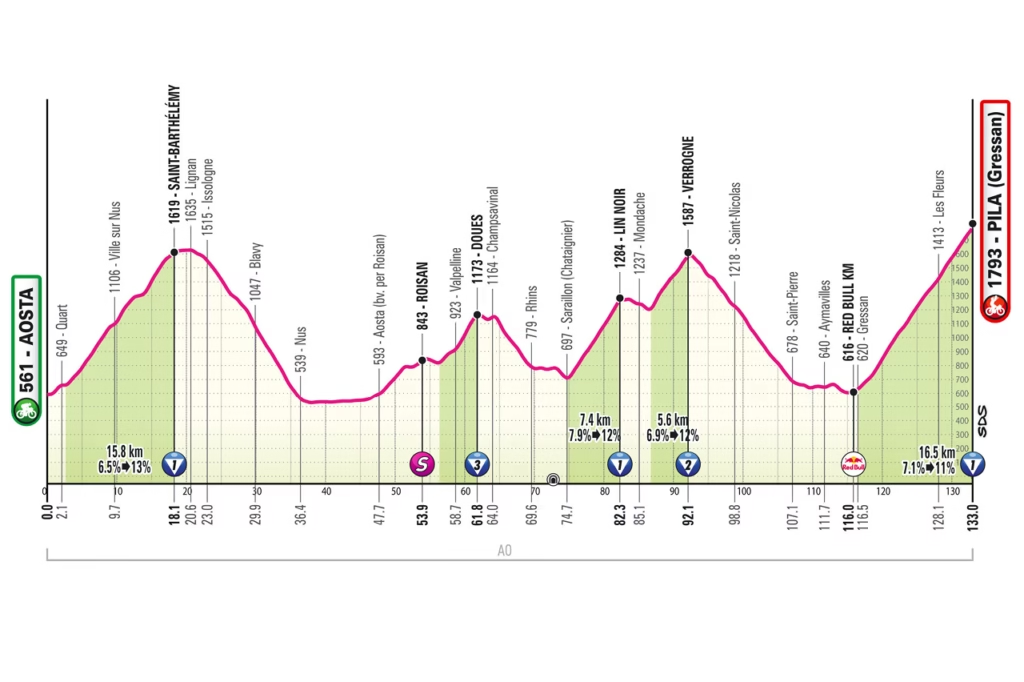
The route is only 133km, but that number is misleading. This is a major Alpine mountain stage, built almost entirely around climbs and descents with very little recovery. The stage starts climbing almost immediately, passes through a sequence of demanding Aosta Valley ascents, then finishes with the final climb to Pila from the Gressan side. It is short, sharp, dense and dangerous.
The route
Stage 14 starts in Aosta and finishes at Pila, above the valley on the Gressan side. The distance is relatively short, but the structure makes it one of the hardest days of the race so far. There are no long flat sections where a struggling rider can fully recover. Instead, the route keeps forcing repeated efforts.
The opening climb to Saint-Barthélémy comes right from the start. That is important because it gives attackers an immediate platform and makes it difficult for teams to impose a calm early rhythm. Riders hoping to get into the breakaway will have to climb hard from kilometre zero, and any GC team that wants to test rivals early has the terrain to do it.
After Saint-Barthélémy comes a long, fast descent of nearly 20km before the route briefly returns towards Aosta. From there, the race climbs again through the Valpelline towards Doues. This is described as the least demanding climb of the day, but on a stage like this, even the “easier” climb matters because it keeps the pressure constant.
The route then descends again near Aosta before the key middle section: Lin Noi and Verrogne. These climbs are separated by only a short descent, which means the race can become very difficult to control if attacks begin before the final ascent. After returning to the valley, the riders face the final climb to Pila.
The last kilometres are all uphill, at around 9 per cent, with gradients touching roughly 11 per cent around 3km from the finish. The final straight is only 100 metres and still rises to the line. There will be no soft finish here. Any rider already at the limit before the final 3km could lose meaningful time very quickly.
What’s on offer
- Stage: 14
- Date: Saturday, 23rd May
- Route: Aosta to Pila
- Distance: 133km
- Stage type: major Alpine mountain stage
- Start time: around 11:55am BST
- Expected finish: around 3:58pm BST
- Main climbs: Saint-Barthélémy, Doues, Lin Noi, Verrogne and Pila
- Likely winner type: GC climber or elite breakaway climber
- Main tactical point: the repeated climbs before the final ascent to Pila
Why stage 14 is so dangerous
The danger of stage 14 is not only the final climb. It is the lack of calm before it. A long summit finish after a flat valley approach can sometimes become a controlled tempo ride until the final 8km. This stage is different. It asks the peloton to climb from the start, descend quickly, climb again, descend again, then keep repeating the pattern.
That rhythm creates three problems for the GC teams.
First, it makes the breakaway harder to control. A strong group can form on the opening climb, and because the route stays difficult, it can build momentum rather than simply being managed on flat roads.
Second, it increases the chance of team isolation. Domestiques who are comfortable on flat terrain may disappear early. Even climbing domestiques can be burned before Pila if the pace is high on Saint-Barthélémy, Lin Noi and Verrogne.
Third, it gives aggressive teams choices. They do not have to wait for the final climb. If a rider like Vingegaard wants to test Eulálio earlier, or if podium contenders need to move before the obvious moment, the route gives them several launchpads.
That is why stage 14 has the feel of a real GC pivot. It is not just a finish-line test. It is a full-stage mountain examination.
The GC context
Eulálio’s Giro has already been more resilient than many expected. He survived Blockhaus, Corno alle Scale, the long time trial to Massa, the hilly roads to Chiavari and Verbania, and he even added time through bonus seconds on stage 12. Yet the margin remains small. Thirty-three seconds is not a cushion in a stage that finishes at Pila.
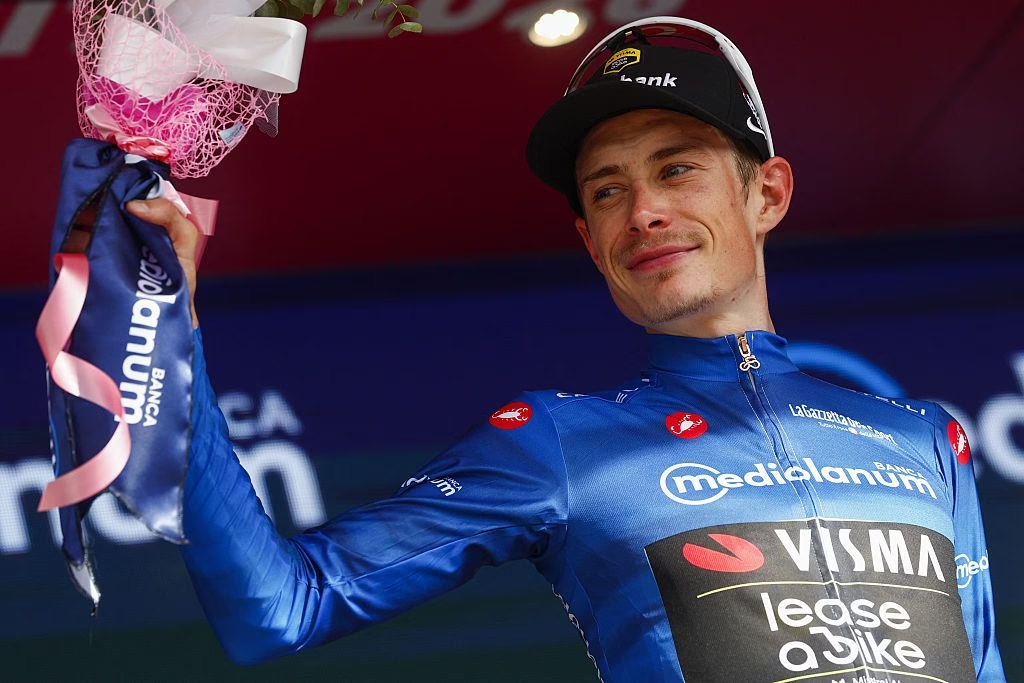
Vingegaard is still the rider setting the climbing standard. He has already won the major summit finishes on Blockhaus and Corno alle Scale, and this stage gives him another terrain package that suits sustained pressure. The final climb is hard enough for him to make a difference, but the earlier climbs may be just as important if Team Visma | Lease a Bike want to weaken Bahrain Victorious before the finale.
Eulálio’s best-case scenario is clear: keep the race controlled, avoid isolation before Pila, then limit any losses on the final climb. He does not need to win the stage. He needs to keep the maglia rosa intact heading into the following transition stage to Milano and the next block of mountains.
For Vingegaard, the calculation is different. He can take pink with a relatively small gain, especially if bonus seconds are involved. That means the stage does not need to become a long-range raid for him. A decisive acceleration on Pila may be enough. But if Bahrain look vulnerable earlier, Visma may be tempted to make the day much harder before the final climb.
The podium battle
Behind the top two, stage 14 could be just as important. Thymen Arensman sits in a strong podium position after his time trial, but this is the kind of mountain day where his climbing will be tested under different pressure. A steady summit finish is one thing. A short Alpine stage with repeated climbs and little recovery is another.
Felix Gall should be much more comfortable here than he was in the time trial. He has already looked like one of the strongest climbers in the race, and Pila gives him a route back towards the podium if Arensman begins to struggle. The Austrian may not need to attack from far out, but he does need to use the mountain stages to regain what he lost against the clock.
Ben O’Connor and Jai Hindley are also firmly in the conversation. O’Connor has been consistent and gained from the time trial, but he will need to prove he can stay with the best climbers when the stage becomes selective. Hindley is further back than he would like, which may eventually force Red Bull-Bora-hansgrohe to race more aggressively.
Giulio Pellizzari, Michael Storer, Derek Gee-West and Chris Harper also have different incentives. Some will be defending top-10 places, others may look for a chance to move up if the stage becomes chaotic. With so many climbs, a rider outside the top five can still change the shape of the race if they attack before Pila.
Could the breakaway win?
The breakaway has a real chance, but only if the GC teams hesitate. The opening climb makes it easier for strong climbers to get away, and the repeated climbing gives the move the right terrain to survive. Stage 14 is short enough to be intense, but long enough for a good break to build a meaningful advantage if the peloton allows it.
The problem is the GC situation. With Eulálio only 33 seconds ahead of Vingegaard, Visma may have every reason to keep the stage under control. If they want bonus seconds and a summit finish showdown, the breakaway’s chance falls sharply.
The type of breakaway rider who can win here is a proper climber, not a rouleur hoping to survive. The winner would need to handle Saint-Barthélémy, recover through the descents, stay strong over Lin Noi and Verrogne, then still have enough left for Pila. A stage hunter who has deliberately lost time and preserved energy could be dangerous, especially if the GC favourites mark each other behind.
But if Visma, Bahrain or the podium teams race hard, this should come back to the GC group.

What kind of rider can win stage 14?
Stage 14 favours an elite climber with recovery and repeatability. It is not enough to have one explosive acceleration. The winner needs to absorb climbing from the start and still produce a final effort on gradients around 9 per cent.
That naturally points towards Vingegaard. He has already shown that he can finish off summit stages in this Giro, and the final climb to Pila gives him the kind of sustained gradient where he can apply pressure without needing a tactical surprise.
Gall is another strong option. If he can follow Vingegaard deep into the final climb, he has a chance to challenge for the stage and regain time in the podium fight. Hindley is also suited to the terrain, especially if the race becomes more attritional before the final ascent.
Eulálio’s stage-winning case is less obvious, but he should not be written off. He has defended the jersey through several different tests, and if he is still with the best riders inside the final kilometre, he could turn defence into opportunity. His main priority, though, is time.
A breakaway winner would likely need to come from the group of climbers far enough down overall to be given freedom. The stage is too hard for opportunists who cannot climb at a high level.
How the stage could unfold
The start should be aggressive. Because the road climbs almost immediately, the breakaway could take time to form and may include genuine climbing quality. Teams with stage ambitions will want representation, while GC teams will need to decide quickly whether the move is acceptable.
Saint-Barthélémy should be the first filter. If the pace is high, some riders will be under pressure from the opening hour. The descent afterwards may allow regrouping, but the repeated climbs mean the race is unlikely to fully settle.
Doues may be the least demanding climb, but it can still keep the breakaway under pressure and prevent the peloton from easing too much. The more important middle section comes with Lin Noi and Verrogne. This is where domestiques could start disappearing, especially if Visma or another GC team decides to increase the tempo.
By the time the riders return to the valley before Pila, the race should already be reduced. If a breakaway remains ahead, its advantage will need to be substantial. The final climb is hard enough for the GC favourites to take back time quickly if the gap is small.
Pila should then decide the stage. The gradients around 9 per cent favour sustained climbing strength, and the section around 3km to go, where the road reaches roughly 11 per cent, looks like the natural place for the decisive attack. From there, the final straight still climbs, so any gap over the last kilometre could grow rather than shrink.
Prediction
Stage 14 should bring the GC favourites back to the front of the Giro. The route is too hard, too short and too important to be treated as a quiet breakaway day, especially with only 33 seconds between Eulálio and Vingegaard.
The early climbs will make the stage difficult to control, but the final climb to Pila is the obvious place for the race to split. Eulálio has defended pink impressively, but this is the kind of stage where Vingegaard can use both his climbing strength and the pressure of the narrow time gap.
Prediction: Jonas Vingegaard to win stage 14 on Pila and take the maglia rosa, with Eulálio limiting the damage but finally losing the race lead after another sustained Alpine climbing test.

