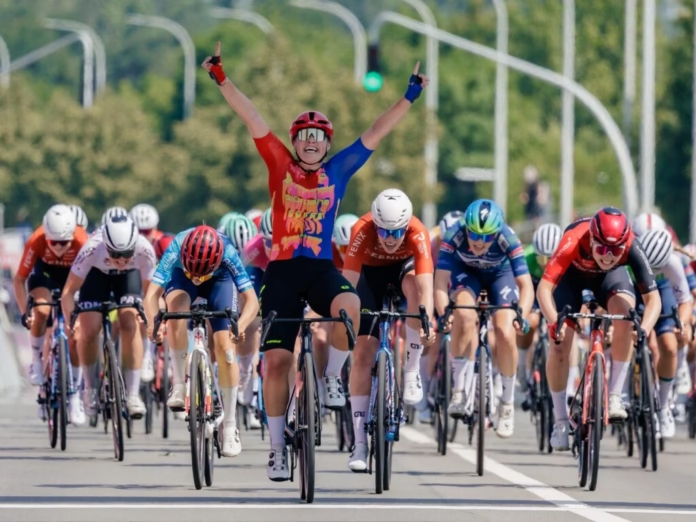
Dina Scavone won the 2026 Dwars door het Hageland Women with a powerful bunch sprint in Aarschot, taking victory ahead of Puck Langenbarg and Falke Kerkhof after the day’s main late move was brought back in the finale. The Carbonbike Giordana Sofré by Gen Z rider survived the selective Hageland hills, stayed in contention when the race briefly looked as though it might split apart, and then finished it off from the reduced peloton.
The Belgian already came into the race as leader of the Lotto Belgium Cup, and this win strengthens that position. It also continues an excellent season in which she had already won Brussel-Opwijk, the Kermisprijs van Lutlommel, Imde-Wolvertem and Puurs-Sint-Amands before adding one of the tougher national-level races on the Belgian calendar.
Scavone succeeds Lorena Wiebes as the winner of Dwars door het Hageland, although the 2026 edition had a very different character from recent years. With the familiar gravel sections removed and the finish moved to Aarschot rather than the Citadel of Diest, the race became a short, hot and hilly test that still ended with the fastest rider in the front group taking the honours.
A changed route in the Hageland
The 2026 Dwars door het Hageland Women was held over 83.4 kilometres, with start and finish in Aarschot. The race was shorter than many editions and carried a changed identity, with no gravel sections and no finish on the Citadel of Diest. Instead, the riders faced repeated climbs before a finish on the Oostelijke Ring in Aarschot.
The route still had enough difficulty to make it selective. The peloton had to tackle the Schoonhovendreef, Nopstal, Blereberg, Houwaartseberg and Het Rot twice, creating a race that suited riders who could handle repeated changes of rhythm rather than a pure flat sprint.
The heat made the course harder still. Even without the gravel that has often defined this race, the repeated climbing and warm conditions meant the bunch had to work throughout the morning. For a rider like Scavone, the challenge was not simply having the fastest sprint, but surviving long enough to use it.
That became the defining point of her win. She later admitted that she had not expected to be sprinting for victory on a parcours like this, and that the shorter distance helped her stay in contention.
Early attacks fail to stick
The opening part of the race produced attacks, but nothing that immediately looked capable of deciding the day. The peloton kept the first moves under control, with teams aware that the repeated climbs later in the race would provide more natural selection.
Unlike some previous editions of Dwars door het Hageland, where surfaces and positioning could create chaos early, this version was more about attrition. The climbs gradually reduced the bunch, but the race needed time before the stronger riders began to separate themselves.
Scavone’s team did not have to chase everything immediately. As leader of the Lotto Belgium Cup, she was always one of the riders others would watch, but the shape of the race meant patience was just as important as aggression.
The first half therefore became a contest of positioning and energy management. Riders tried to get ahead of the pressure before the climbs, but the bunch remained close enough to keep the race open.
Six riders force the decisive chase
The most important move came in the selective hill zone, where six riders broke clear and briefly looked as though they might decide the race. Katrijn De Clercq of Lotto Intermarché Ladies, Katja Verkerk of Minimax Cycling Team, Anna Bruneel of AG Insurance-Soudal Devo Team, Flora Perkins of Fenix Premier-Tech Development Team, Anneke Dijkstra of VolkerWessels Cycling Team and Kate Richardson of Handsling Alba Road Development Team made the split.
It was a dangerous move because several strong teams were represented. De Clercq later said she felt she had to react when five other riders went clear, especially because the better teams had riders in the attack. With Lotto Intermarché Ladies reduced to only three riders after illness in the team overnight, she was also the only rider from her squad in the front of the race.
The six worked together as the race moved through its decisive phase, with a larger chase group and the peloton behind. For a while, the move looked strong enough to survive, particularly on a course where the climbs had already forced many riders into damage limitation.
But the chase did not disappear. The broader race came back together in the finale, and the attackers were eventually caught before they could turn the race into a small-group contest.
Everything comes back for the sprint
Once the six-rider move was brought back, the race reset for a bunch sprint in Aarschot. That was not guaranteed before the start, and several riders had expected the selective route to reward an escape, but the final kilometres pulled the race back into the hands of those who had survived with a sprint left.
Scavone was one of them. She had spent parts of the race hanging on over the climbs, particularly when the pace lifted on the repeated hills, but she stayed close enough to make the finale. She later said that if the race had included one more lap, the outcome might have been different.
The finish gave her the chance she needed. Once the race came back together, there was no sign of anyone faster on either side of her, and she launched her sprint to take a clear victory.
Langenbarg finished second, while 18-year-old Kerkhof took third for Cycling Team Van Eyck/Belco. For Kerkhof, it was a significant result after admitting she had not expected to sprint onto the podium on a course with so many climbs. She described it as a day where she was in the right place at the right time and everything came together.
Scavone continues strong 2026 season
For Scavone, the win was another marker of progress. She has already been winning consistently this season, but Dwars door het Hageland asked a different question from a straightforward sprint race. The climbs, heat and repeated accelerations made it a test of endurance before speed.
She said afterwards that she would not have won this race last year, a reflection of the progress she has made on selective courses. That was the most important part of the result. The sprint confirmed her speed, but staying with the front group over the Hageland climbs showed a broader range.
The Belgian also strengthened her position in the Lotto Belgium Cup, taking full points as the series leader. With the Belgian championships and the Baloise Belgium Tour still to come, this was a useful confirmation of form rather than just another win on the record.
Scavone also becomes the first Belgian winner of Dwars door het Hageland Women since Lotte Kopecky in 2023. That gives the result an extra domestic note, especially in a race that has often rewarded riders with enough power to handle rough, selective Belgian terrain.
Belgian championship form takes shape
The result also offered a useful form guide before the Belgian championships in Brasschaat. The parcours there will be much flatter than Dwars door het Hageland, but the heat and the need for sharp sprint positioning could again be relevant.
Scavone said she would like to win the Belgian title and jersey, where she is eligible among the club riders for Carbonbike Giordana Sofré by Gen Z, but also noted that everyone will arrive with ambition. Her Hageland win does not change the pressure, but it does show that her preparation is on track.
De Clercq, despite finishing 36th after being caught from the late move, also leaves with positive signs. She had intended to save herself for the sprint but was forced to follow the dangerous attack because Lotto Intermarché Ladies had limited numbers. With a full squad expected at the Belgian championships and Sandrine Tas among the team’s other options, she will have more tactical support next weekend.
Kerkhof’s podium adds another interesting name to the domestic picture. Her third place was her second podium of the season after a stage podium at the Vermarc Cycling Project, and it came on a course she had expected to enjoy but not necessarily contest at the finish.
Scavone proves she can survive and sprint
Dwars door het Hageland ended in the kind of sprint many had expected, but the route made that sprint harder to reach than the result sheet alone suggests. The climbs repeatedly tested the bunch, the six-rider move forced a real chase, and the heat added to the fatigue before the final run into Aarschot.
Scavone’s win came because she was able to stay in the race when the terrain asked more than pure speed. Once the late move was caught, the sprint played to her strengths, but the work had already been done on the climbs.
For Langenbarg and Kerkhof, the podium confirmed they had also managed the demands of the route well. For De Clercq and the rest of the late break, the disappointment was that a promising move came back just before the finish. For Scavone, it was proof that she has become a more complete rider.
The 2026 edition may have lost the gravel that once defined the race, but it still produced a selective Belgian test. Scavone passed it, then sprinted faster than everyone else.
Dwars door het Hageland Women 2026 result
| Position | Rider | Team | Time/gap |
|---|---|---|---|
| 1 | Dina Scavone | Carbonbike Giordana Sofré by Gen Z | 2:03:59 |
| 2 | Puck Langenbarg | Fenix-Premier Tech Development Team | same time |
| 3 | Falke Kerkhof | Cyclingteam Belco / Van Eyck | same time |
| 4 | Camilla Rånes Bye | Minimax Cycling Team | same time |
| 5 | Billy Goossens | AG Insurance-Soudal Devo Team | same time |
| 6 | Kate Richardson | Handsling Alba Development Road Team | same time |
| 7 | Lien Schampaert | Keukens Redant Cycling Team | same time |
| 8 | Marte Dolven | KDM-Pack Women Cycling-Team | same time |
| 9 | Lidia Cusack | Smurfit Westrock Cycling Team | same time |
| 10 | Olivia Vercruysse | Fenix-Premier Tech Development Team | same time |
Main photo credit: Lotto Belgium Cup