
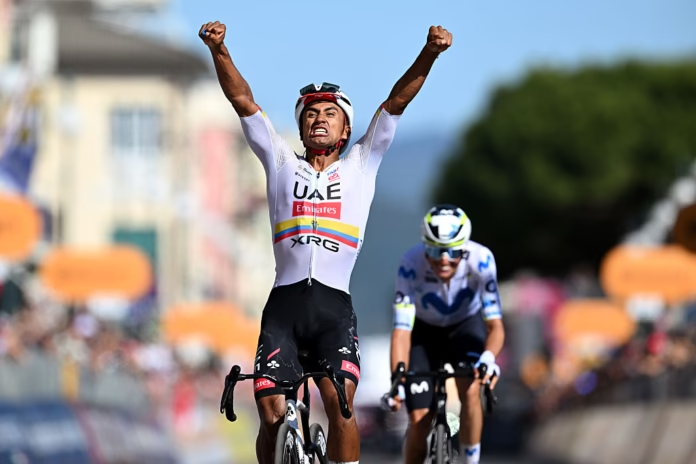
Jhonatan Narváez claimed his third stage win of the 2026 Giro d’Italia after beating Enric Mas in a two-up sprint in Chiavari, as the breakaway survived a testing stage 11 from Porcari.
The UAE Team Emirates-XRG rider had already been one of the defining figures of this Giro, but this was another reminder of his range. He had to chase into the day’s move, survive repeated climbing pressure, follow Mas on the final ascent and then finish the job with the faster sprint. Mas tried to make the race as hard as possible late on, but could not distance the Ecuadorian before the downhill run into the finish.
Behind them, Diego Ulissi took third ahead of Chris Harper and Aleksandr Vlasov, with Christian Scaroni salvaging sixth after crashing on the descent with around 40km remaining. The GC group arrived safely together several minutes later, meaning Afonso Eulálio retained the maglia rosa for another day.
Early attacks make the break hard to settle
Stage 11 always looked like a day for the breakaway, but the opening phase was far from simple. The 195km route from Porcari to Chiavari began with flatter roads before the hills returned later in the day, bringing around 2,500 metres of climbing and a final sequence that gave the attackers enough terrain to shape the race.
The first move went almost immediately after the official start, with a sizeable group going clear that included Giulio Ciccone, Jasper Stuyven, Davide Ballerini, Christian Scaroni, Luca Mozzato, Johan Jacobs, Ivo Oliveira, Mikel García Cortina, Nickolas Zukowsky and others. It looked dangerous from the off, but not every team was satisfied. UAE Team Emirates-XRG had missed the move, while several wildcard teams also tried to correct their absence.
That kept the gap under pressure. UAE sent riders on the counter, including Igor Arrieta and later Jhonatan Narváez, while the peloton refused to let the first break settle. The opening hour became a rolling series of attacks, brief regroupings and counter-moves, with the bunch repeatedly stretching and splitting on small uncategorised rises.
Davide Ballerini was caught up in a crash during this early phase. He initially got back on and returned to the peloton, but later abandoned the race, ending a difficult day for the XDS Astana rider.
Harper, Bais and Leknessund open the road
The race began to take clearer shape when Chris Harper, Mattia Bais and Andreas Leknessund opened a gap and worked well together. They were soon pursued by another chase group featuring riders such as Aleksandr Vlasov, Nico Denz, Alberto Bettiol, Diego Ulissi, Jasper Stuyven, Edward Planckaert, Markus Hoelgaard, Luca Crescioli and Tim Naberman.
That chase eventually made contact, creating a stronger lead group while the peloton sat around a minute and a half behind. The intermediate sprint came and went without the points contenders being involved, with the break mopping up the available ciclamino points and Jonathan Milan and Paul Magnier left in the bunch.
Even then, the race refused to fully calm down. UAE and Lidl-Trek both tried to reignite the action from the peloton, having missed the most useful phase of the break. Enric Mas attacked on one of the uncategorised climbs, while Lennert Van Eetvelt also pushed across. Narváez, still alert to the danger of the day slipping away, launched his own counter and rapidly bridged into the front group.
That move changed the complexion of the stage. Once Narváez made it across, UAE finally had their stage-winning option in the break. From that point, the peloton’s interest softened and the day tilted firmly towards the attackers.
Climbing pressure reduces the front group
The Colle di Guaitarola, the hardest classified climb of the stage at 9.6km and a little over 6%, began to thin the front of the race. Ulissi, Mas, Harper, Narváez, Bais, Barguil and Crescioli were among those driving the selection, with Scaroni, Zana and Van Eetvelt also trying to stay in range.
Polti VisitMalta used their numerical strength to collect mountains points for Diego Pablo Sevilla’s classification ambitions, but the battle for the stage was already moving away from a simple breakaway collaboration. The road and the repeated changes of pace began to split riders by role, not just by strength. Some were riding for points, others for survival, and a smaller number were clearly thinking about the win.
Warren Barguil briefly attacked on a plateau after the climb, though he was soon brought back. Stuyven and Vlasov also worked their way back into the main move after a long chase, increasing the lead group to around a dozen riders. The peloton, meanwhile, allowed the gap to sit above three minutes, with the GC teams content to avoid unnecessary risks.
That calm did not last at the front. On a descent with just over 40km remaining, Van Eetvelt, Filippo Zana and Scaroni crashed. Stuyven, Narváez and Vlasov emerged ahead in the aftermath, with the rest of the break briefly disrupted behind. Scaroni was able to remount, but had to chase through pain for the remainder of the stage.
Ulissi attacks before Mas makes the decisive move
The Colla di Scioli sharpened the race again. Ulissi attacked first, forcing a reaction from the strongest climbers in the break. Harper, Vlasov, Mas and Narváez closed him down, while Stuyven and Barguil were distanced. Crescioli managed to regain contact near the summit, but the front group was now under clear strain.
Harper led the reduced group over the top, with the stage looking increasingly likely to come from that selection. Scaroni, despite his earlier crash, was still fighting behind and managed to catch riders ahead of him, but the winning move was forming up the road.
The final unclassified climb became the decisive point. Mas, knowing Narváez was the quickest finisher in the group, had little choice but to attack. He accelerated hard, first distancing Harper, but Narváez locked onto his wheel. Harper, Vlasov and Ulissi briefly regrouped behind, but the damage had been done.
Mas and Narváez crested the climb together with a gap of more than 20 seconds. Narváez then took over on the technical descent, using his descending ability and confidence to keep the move clear. Behind, Harper, Vlasov and Ulissi chased, but the gap held just well enough.
-
 Photo Credit: A.S.O./Gaëtan Flamme
Narváez finishes it in the sprint
Inside the final 10km, the stage had narrowed to two riders. Mas tried to unsettle Narváez on a gentle uphill drag, but he could not open daylight. The Spaniard then became reluctant to keep pulling, aware that taking Narváez to the line was a dangerous proposition. Narváez, equally confident in his sprint, was content to mark the Movistar rider and wait.
With 5km remaining, the chasers were still close enough to create some tension, but not close enough to change the outcome. Mas and Narváez began watching one another, the gap dropping to around 15 seconds inside the final kilometre, but the sprint still belonged to the front pair.
Mas opened first, trying to surprise Narváez before the Ecuadorian could properly wind up. It was not enough. Narváez came around him decisively to take his third stage victory of the race and the fifth Giro stage win of his career.
Ulissi won the sprint for third ahead of Harper and Vlasov, while Scaroni capped a bruising day by taking sixth ahead of Crescioli. The peloton came in later with the main GC contenders together, leaving Afonso Eulálio still in pink and Jonas Vingegaard safely through another potentially awkward day.
For Narváez, this was more than another opportunistic breakaway win. He had missed the first major move, chased across when the stage was still unstable, survived the hardest climbing pressure and then refused to give Mas the separation he needed. On a day built for a strong breakaway, he was the rider with the best mix of timing, resilience and finishing speed.
Giro d’Italia 2026 stage 11 result
| Position | Rider | Team | Time/gap |
|---|---|---|---|
| 1 | Jhonatan Narváez | UAE Team Emirates XRG | 4:33:43 |
| 2 | Enric Mas | Movistar Team | same time |
| 3 | Diego Ulissi | XDS Astana Team | +0:11 |
| 4 | Chris Harper | Pinarello-Q36.5 Pro Cycling Team | +0:11 |
| 5 | Aleksandr Vlasov | Red Bull-BORA-hansgrohe | +0:11 |
| 6 | Christian Scaroni | XDS Astana Team | +1:13 |
| 7 | Ludovico Crescioli | Team Polti VisitMalta | +1:15 |
| 8 | Simone Gualdi | Lotto Intermarché | +2:17 |
| 9 | Warren Barguil | Team Picnic PostNL | +2:19 |
| 10 | Andrea Raccagni Noviero | Soudal Quick-Step | +2:19 |
Main photo credit: Getty

