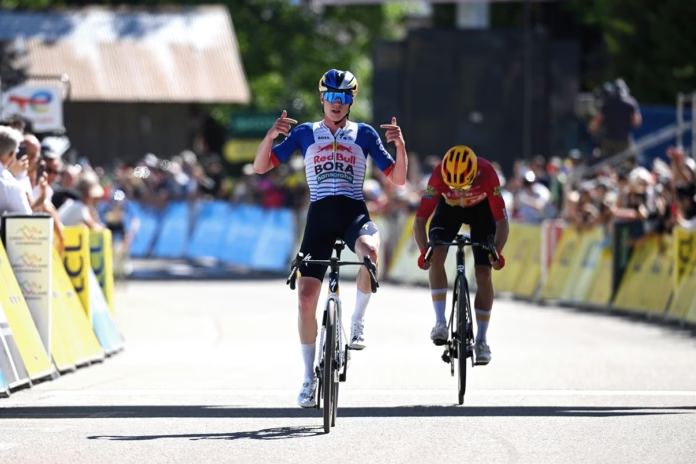
Maxim Van Gils won stage 6 of the 2026 Tour Auvergne – Rhône-Alpes on the summit finish at Crest-Voland, finishing off a remarkable day for Red Bull-Bora-Hansgrohe after a 60-rider breakaway reshaped the race. The Belgian was part of the decisive front selection on the final climb, where Luke Tuckwell also rode himself into the yellow jersey after starting the day just 1:03 behind Alex Baudin.
Tobias Halland Johannessen was one of the last riders able to challenge Red Bull’s strength on the climb, while Pablo Torres also fought his way into the final selection before fading inside the last kilometre. Behind them, the general classification favourites fought a separate race, with Paul Seixas attacking from the peloton and distancing most of his rivals, while Isaac del Toro and Matteo Jorgenson were the only riders initially able to follow.
Baudin’s spell in yellow ended early on the final climb. The EF Education-EasyPost rider had led since his stage 1 breakaway win in Saint-Ismier, but once Decathlon CMA CGM lifted the pace on the ascent to Crest-Voland, he was dropped and the race moved into a new phase. With Tuckwell already several minutes ahead from the break, the Australian became the clear virtual leader before the final kilometre.
Early split changes the entire stage
The 182.3-kilometre stage from Saint-Vulbas to Crest-Voland was always expected to begin the decisive mountain phase of the race, but the way it unfolded was far more chaotic than a controlled summit-finish stage. There were no climbs at the very start, yet the peloton split almost immediately, with a huge move going clear on flatter terrain.
The front group eventually contained 60 riders, with almost every team represented except Decathlon CMA CGM. That immediately created a tactical problem. Paul Seixas had been one of the pre-race favourites and Decathlon wanted to keep the stage under control, but they were isolated in the chase while the rest of the peloton had riders up the road.
The composition of the break made it dangerous for both the stage and the general classification. Tuckwell was only 1:03 down on GC, Bruno Armirail was at 1:20, and Guillaume Martin was at 1:51. Those gaps meant EF Education-EasyPost could not ignore the move either, even if Baudin had teammates Max Walker and Alastair MacKellar in the front group.
Uno-X Mobility were active early with four riders in the split, while Red Bull-Bora-Hansgrohe also placed numbers in front, including Tuckwell, Van Gils, Callum Thornley and Gianni Vermeersch. The gap was already 1:45 with 140 kilometres remaining, then climbed beyond 2 minutes as Decathlon were left to chase largely alone.
Raisberg strengthens green before the climbs
The leading group worked well enough to stretch the race before the first climbs. Nadav Raisberg took the intermediate sprint at Les Échelles, adding another 10 points to his points classification lead. Raúl García Pierna took second there, with Martin Urianstad third.
That was one of the last relatively controlled moments before the race moved into the climbing phase. The first classified ascent, the Côte de Châtelard, came after a long, fast opening section. Clément Braz Afonso took the maximum points there, extending his lead in the mountains classification.
The day also began to take its toll through incidents and abandons. Josh Tarling crashed on the climb and was later forced out of the race, a bitter blow for Netcompany INEOS so close to the Tour de France. Kevin Geniets also abandoned, while Santiago Buitrago crashed later after hitting street furniture. Earlier in the morning, Wout van Aert, Michael Matthews, Matevž Govekar, Hannes Wilksch and Pau Martí Soriano had all been listed among the non-starters.
Over the Col du Granier, Braz Afonso again took maximum points, strengthening his grip on the mountains jersey. But the bigger story was the gap. With Decathlon still getting limited help behind, the break’s lead was 2:55 after the second climb and then continued to grow on the descent and valley roads.
Breakaway wins the arm wrestle
The 55 kilometres of flatter valley road before the final pair of category 1 climbs became the tactical hinge of the stage. Decathlon were still chasing behind for Seixas, but the front group contained riders from nearly every team, and several squads had a clear reason to keep the move alive.
Uno-X Mobility worked for Tobias Halland Johannessen. Red Bull-Bora-Hansgrohe worked for Tuckwell and Van Gils. Tudor and Lotto-Intermarché also spent energy in the break, while the peloton behind looked increasingly disorganised. EF eventually sent Ben Healy to help chase for Baudin, but by then the damage was already mounting.
With 60 kilometres to go, the gap was 3:22. By 50 kilometres, it had reached 4 minutes. At 35 kilometres, with the final climbs approaching, it had gone out to 4:20, and it was clear the stage win was almost certainly gone from the GC peloton.
That meant the race had split into two contests: the breakaway fighting for stage victory and yellow, and the favourites behind fighting to establish hierarchy before the weekend’s mountain stages. Tuckwell was the central figure in the first race. Starting the day just over a minute down, he had the biggest GC opportunity of his career and Red Bull-Bora-Hansgrohe had the numbers to help him take it.
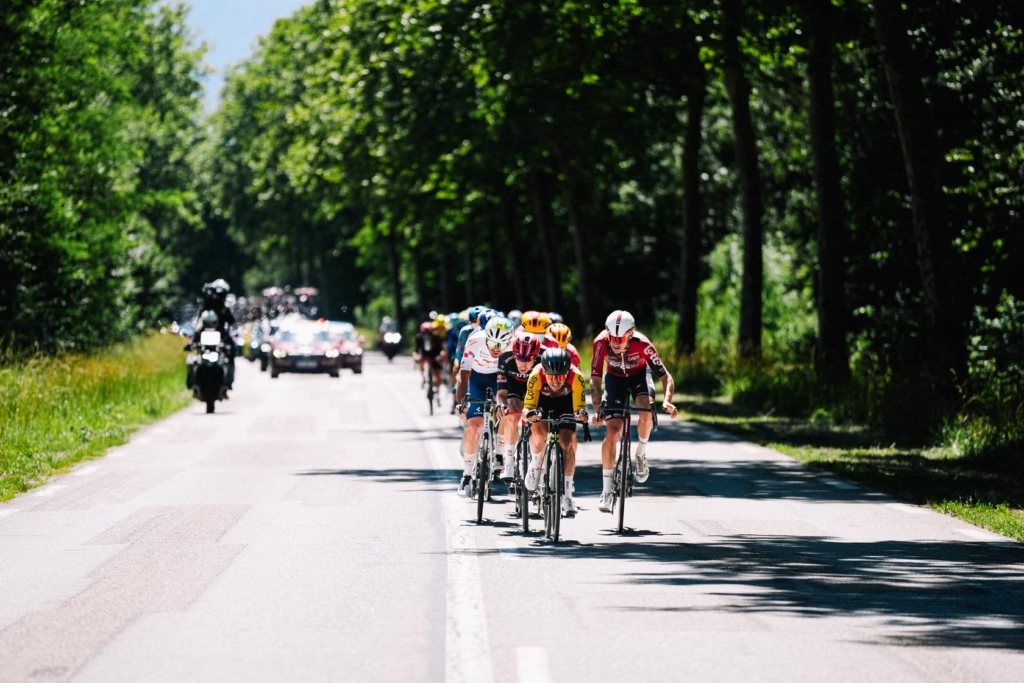 Photo Credit: A.S.O./Gaëtan Flamme
Final climbs reduce the break
The final section began with the Côte d’Héry-sur-Ugine, 11.5 kilometres at 5.1 per cent, followed almost immediately by the final ascent to Crest-Voland, 5.9 kilometres at 7.7 per cent. The break reached that sequence with almost 5 minutes in hand, but the size of the group made the racing difficult to control.
Uno-X Mobility and Red Bull-Bora-Hansgrohe were the first teams to impose order. As the climb began to bite, domestiques who had worked through the valley started dropping away. Armirail, the second-best-placed GC rider in the break behind Tuckwell, also began to lose contact.
Red Bull then increased the pressure through Van Gils, unhappy with the pace being set by Uno-X and keen to reduce the group further. Behind, Lidl-Trek came to the front of the peloton through Lennard Kämna, with Juan Ayuso and Mattias Skjelmose still looking to limit losses and keep themselves in the GC conversation.
The front group had been cut down to the strongest climbers by the approach to the final ascent. Among those still present were Tuckwell, Van Gils, Johannessen, Torres, Georg Steinhauser, Christian Rodríguez, Simone Velasco, Pablo Castrillo, García Pierna, Yannis Voisard, Jordan Jegat, Matteo Vercher, Braz Afonso, Guillaume Martin and Michael Gogl.
Van Gils, Tuckwell and Johannessen decide the stage
Steinhauser attacked from the break on the final climb, trying to repeat the kind of move that brought him Giro success earlier in his career. Red Bull were quick to respond, and Van Gils and Johannessen surged across to him with around 5 kilometres remaining.
The front then shattered. Torres joined the decisive group, while Tuckwell continued climbing strongly, knowing the yellow jersey was moving towards him if he could avoid a collapse. By 2 kilometres to go, the front of the race had been reduced to Van Gils, Tuckwell, Johannessen and Torres.
That situation heavily favoured Red Bull-Bora-Hansgrohe. Van Gils gave them a stage-winning option, while Tuckwell was riding for yellow. Johannessen was strong enough to threaten the stage, and Torres had been impressive in staying with the move, but Red Bull had two cards in the final kilometre.
Torres was the first to drop from the leading quartet. That left Van Gils, Tuckwell and Johannessen as the strongest riders on the climb. Van Gils had enough punch left after the long day in the break and finished it off for the stage, while Tuckwell’s ride delivered the race lead.
Seixas attacks from the favourites’ group
Behind the stage fight, Decathlon finally launched Seixas on the final climb. Baudin had already been dropped early on the ascent, confirming that his time in yellow was over. Once Seixas attacked, the damage was immediate.
Only Del Toro and Jorgenson were able to follow at first. Ayuso and Skjelmose could not match the acceleration, but they worked together to limit their losses. Jorgenson then also dropped under the continued pressure, leaving Seixas and Del Toro at the front of the GC favourites’ race.
There was a visible moment of frustration from Seixas as he flicked his elbow several times, trying to get Del Toro to contribute. The UAE Team Emirates-XRG rider eventually came through, but the dynamic underlined how much Seixas had invested in the attack. Decathlon had spent much of the day chasing, and the Frenchman still had the legs to make the biggest move from the main GC group.
The attack did not bring the stage back, but it did change the order among the contenders. Baudin was gone from yellow, Jorgenson lost ground after initially following, and the Lidl-Trek pair of Ayuso and Skjelmose had to ride defensively. With two more summit finishes still to come, Seixas showed that he remains one of the strongest climbers in the race despite the tactical problems of the opening week.
Tuckwell takes control before the final mountain weekend
Stage 6 was the day the Tour Auvergne – Rhône-Alpes changed character completely. The first five stages had been shaped by breakaways, a team time trial and one sprint, but the mountain phase began with a breakaway so large and so dangerous that it became the main race.
Red Bull-Bora-Hansgrohe were the clear winners tactically. They placed the right riders in the move, helped drive it through the valley, used Van Gils as a pressure point on the climbs, and then came away with both the stage win and yellow through Tuckwell. For a rider who announced himself with second overall at the Giro Next Gen, this was a major WorldTour statement.
Baudin’s race lead had always looked vulnerable once the real mountains arrived, but the way it disappeared said plenty about how hard the stage had been raced from the start. EF Education-EasyPost had held the jersey through breakaway days, a team time trial and the sprint stage, but they could not control a 60-rider move containing multiple GC threats.
The GC contenders behind now have a new target. Tuckwell has yellow, Van Gils has the stage, and Seixas has momentum from the favourites’ group, but the race is far from settled. Stage 7 to the Grand Colombier and stage 8 to Plateau de Solaison still offer enough climbing to overturn the classification again.
Tour Auvergne – Rhône-Alpes 2026 stage 6 result
| Position | Rider | Team | Time/gap |
|---|---|---|---|
| 1 | Maxim Van Gils | Red Bull-BORA-hansgrohe | 4:06:34 |
| 2 | Tobias Halland Johannessen | Uno-X Mobility | same time |
| 3 | Luke Tuckwell | Red Bull-BORA-hansgrohe | +0:06 |
| 4 | Pablo Torres | UAE Team Emirates-XRG | +0:13 |
| 5 | Raúl García Pierna | Movistar Team | +0:33 |
| 6 | Yannis Voisard | Tudor Pro Cycling Team | +0:33 |
| 7 | Jordan Jegat | TotalEnergies | +0:33 |
| 8 | Cristián Rodríguez | XDS Astana Team | +0:33 |
| 9 | Clément Braz Afonso | Groupama-FDJ United | +0:33 |
| 10 | Lennart Jasch | Tudor Pro Cycling Team | +0:33 |
Main photo credit: Getty