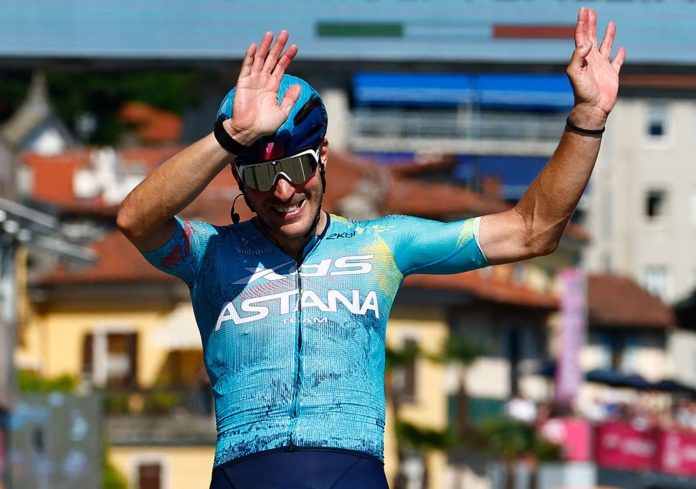
Alberto Bettiol delivered a perfectly timed breakaway victory on stage 13 of the Giro d’Italia 2026, attacking on the final climb of Ungiasca before holding his advantage all the way to Verbania. The XDS Astana rider caught and passed Andreas Leknessund near the summit, then descended with enough composure to stay clear on the flat run to the line.
Leknessund held on for second after making the first serious move on the climb, while Jasper Stuyven sprinted to third from a small chasing group behind. The peloton came in much later, with no meaningful general classification action and all the main contenders finishing together.
The 189-kilometre stage from Alessandria to Verbania always looked like a day for the breakaway if the right group formed. Once 15 riders went clear and Bahrain Victorious settled into tempo behind for Afonso Eulálio, the stage win was quickly pushed out of reach of the peloton. From there, the race became a long tactical contest between the escapees, with the final climbs of Bieno and Ungiasca deciding who had the legs and timing to finish it off.
Fifteen-rider breakaway takes control
The stage began with immediate attacks after the official start, with Jonathan Milan among the early riders trying to get clear. There were several attempts before a seven-rider group began to form, including Andreas Leknessund, Larry Warbasse, Michael Valgren, Johan Jacobs, Mark Donovan and Diego Pablo Sevilla.
More riders tried to bridge across, with Filippo Ganna especially active on a stage that passed close to his home roads. Afonso Eulálio briefly needed attention after a flat tyre and bike change, but the pink jersey returned safely to the peloton as the breakaway battle continued ahead.
The eventual front group settled at 15 riders: Jasper Stuyven, Alberto Bettiol, Mikkel Bjerg, Michael Valgren, Andreas Leknessund, Markus Hoelgaard, Toon Aerts, Larry Warbasse, Johan Jacobs, Axel Huens, Josh Kench, Francesco Busatto, Mark Donovan, Mirco Maestri and Diego Pablo Sevilla.
It was a strong and varied move. Stuyven brought the quickest finish, Bettiol and Valgren carried an obvious Classics pedigree, Bjerg offered a powerful engine, while Leknessund had already shown strong breakaway form earlier in the race. Groupama-FDJ also had numbers, with Jacobs, Huens and Kench giving them several tactical options.
Bahrain allow the gap to grow
NSN initially chased after missing the move, but once that effort stopped, the gap began to expand rapidly. Bahrain Victorious then took over at the front of the peloton, riding steadily rather than trying to close the break down.
With Kench the highest-placed rider in the move at more than 20 minutes down on general classification, there was no immediate pressure on the GC teams to chase. The advantage passed 5 minutes with 130 kilometres remaining, reached 7 minutes with 120 kilometres to go, and continued to grow through the long middle section of the stage.
By the final 100 kilometres, the break’s lead had reached 9 minutes. It later pushed beyond 10 minutes, making it clear that the stage winner would come from the front group. Behind, Eulálio enjoyed one of his calmer days in the maglia rosa, protected by Bahrain while the breakaway riders began to think about how to beat each other.
There were teams who might have regretted missing the move. Lidl-Trek had no rider in the front group despite a finale that could have suited Giulio Ciccone, while Movistar, so active on stage 12, were also absent from the decisive break.
Sevilla takes points before the final climbs
The long run towards Verbania gave the breakaway time to organise, but the tension was always building towards the final pair of climbs. Sevilla led the group through the intermediate sprint, then again moved to the fore on the first classified climb, Bieno.
Bieno, at 2.4 kilometres and averaging 5.7 per cent, did not create major splits. Groupama-FDJ rode near the front, with Jacobs setting tempo and Bettiol moving into position behind him. Sevilla took the KOM points at the top, but the break largely remained intact.
The absence of attacks on Bieno meant the final climb, Ungiasca, would carry the full weight of the stage. At 4.7 kilometres and averaging around 7 per cent, it was both longer and steeper, with gradients sharp enough to break up the group before the descent and flat run into Verbania.
Leknessund attacks before Bettiol counters
Jacobs led the break onto Ungiasca before Huens took over, setting a hard pace to support his Groupama-FDJ teammate Kench. That work quickly began to stretch the group. Bjerg and Warbasse were among the riders dropped as the stronger climbers moved forward.
Kench then took over himself, reducing the front of the race to a smaller selection. Bettiol, Leknessund and Valgren were able to follow, while Donovan chased just behind and Stuyven, Aerts, Sevilla and Busatto slipped into another group further back.
The first decisive attack came from Leknessund. The Norwegian used a steep section to open a gap, briefly looking as though he had found the move that might win the stage. Bettiol, however, stayed within reach. With around 1 kilometre left to climb, the Italian began to close, and inside the final 500 metres he was almost back on terms.
Then came the winning move. Bettiol caught Leknessund, immediately surged past him and went over the summit of Ungiasca alone. It was a sharp, confident acceleration at exactly the point where hesitation behind would be most costly.
Bettiol descends to victory
Once over the top, Bettiol committed fully to the descent. Leknessund chased alone behind, with Valgren and Kench further back, but the Italian quickly turned a few seconds into a more meaningful advantage.
There was one nervous moment when Bettiol nearly lost his balance over a speed bump, but he stayed upright and continued to extend his lead. With 10 kilometres remaining, he still had around 20 seconds. By the time the road flattened out inside the final 5 kilometres, the gap had grown further.
Leknessund could not bring him back, and the chasers behind were also running out of road. Bettiol entered the final kilometre with the stage under control and crossed the line alone in Verbania, taking the ninth professional victory of his career and adding a second Giro stage win to his palmarès after his previous success in 2021.
Leknessund finished second after another strong breakaway ride, while Stuyven won the sprint for third from the group behind, ahead of Valgren, Donovan and Kench. Bjerg took seventh, followed by Busatto, Hoelgaard and Sevilla.
Eulálio stays in pink after quiet GC day
The peloton reached the finish well after the stage had already been decided. There was no action among the main general classification riders, with the contenders finishing together on the same time.
For Eulálio, it was a straightforward day in the maglia rosa after the early bike change. Bahrain Victorious kept the race under control, avoided unnecessary risk, and allowed a non-threatening breakaway to contest the stage.
For Bettiol, stage 13 was a reminder of how dangerous he can be when a race opens up into a tactical battle between strong one-day riders. He did not wait for a sprint, did not hesitate when Leknessund made the first move, and then used the summit of Ungiasca as the launchpad for a victory built on timing, nerve and descending control.
Giro d’Italia 2026 stage 13 result
| Position | Rider | Team | Time/gap |
|---|---|---|---|
| 1 | Alberto Bettiol | XDS Astana Team | 3:51:33 |
| 2 | Andreas Leknessund | Uno-X Mobility | +0:26 |
| 3 | Jasper Stuyven | Soudal Quick-Step | +0:44 |
| 4 | Michael Valgren | EF Education-EasyPost | +0:44 |
| 5 | Mark Donovan | Pinarello-Q36.5 Pro Cycling Team | +0:44 |
| 6 | Joshua Kench | Groupama-FDJ United | +0:44 |
| 7 | Mikkel Bjerg | UAE Team Emirates XRG | +1:33 |
| 8 | Francesco Busatto | Alpecin-Premier Tech | +1:35 |
| 9 | Markus Hoelgaard | Uno-X Mobility | +1:35 |
| 10 | Diego Pablo Sevilla | Team Polti VisitMalta | +1:35 |
Main photo credit: Getty