
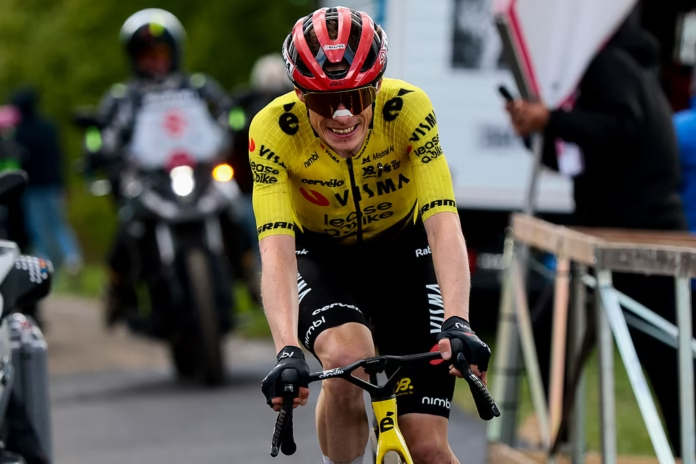
Jonas Vingegaard won stage 7 of the 2026 Giro d’Italia, riding clear on the slopes of Blockhaus to take the first summit finish of this year’s race and stamp his authority on the general classification battle. The Team Visma | Lease a Bike rider made his move with just over 5km to go, first breaking Giulio Pellizzari and then holding off Felix Gall to the line after 244km of racing.
Gall finished 15 seconds behind after a strong ride of his own, while Pellizzari, Jai Hindley and Ben O’Connor came in at 1:05. Giulio Ciccone led home Derek Gee-West and Thymen Arensman at 1:45, while pink jersey Afonso Eulálio lost 2:50 on the climb, the same time as Egan Bernal.
It was the longest stage of the race so far and the first real mountain finish. After six days of sprints, crashes, weather and breakaways, the Giro finally reached the point where the climbers had nowhere to hide. On Blockhaus, the race changed shape.
Milan goes up the road as the break forms early
The stage began in unusual fashion, with Jonathan Milan immediately on the move as soon as the flag dropped after the short neutralised section in Formia. His intentions were obvious enough. The intermediate sprint came early enough in the day for him to target more points before the real climbing began later.
He was joined by Diego Sevilla, Jardi Christiaan van der Lee, Tim Naberman and Nickolas Zukowsky, and the five quickly formed the day’s breakaway. None of them posed any overall threat, with Zukowsky the best placed but already more than 22 minutes down on GC, so Bahrain Victorious were content to let the move go and settle into their role as race leaders behind.
The break built an advantage of more than five minutes as the peloton rolled through the flat first half of the stage. The roads were largely dry early on, helped by a tailwind, and although there were showers in the hills and some wet roads later in the day, the opening 100km passed at a solid tempo rather than at full racing intensity.
That did not mean it was easy. The average speed remained high, the riders were still carrying fatigue from the previous stages, and everyone knew the last 70km would decide everything.
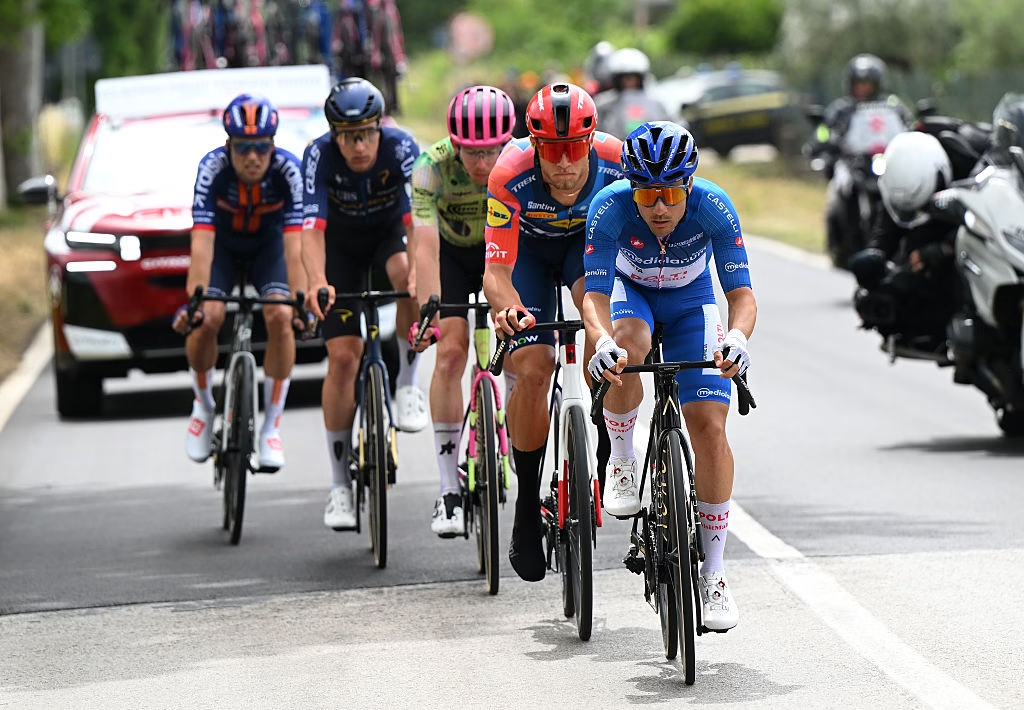 Photo Credit: Getty
Milan gets his points and the break starts to shrink
Milan’s day out front had a clear target. When the intermediate sprint arrived, he delivered. He won it to take 12 points and claw a little ground back in the points competition. After that, the logic of his move was complete. He was still doing turns for a while, but once the road began to rise more steadily he eventually slipped back to the peloton and ended his long day in the break.
Up front, the remaining four kept working, with Sevilla particularly committed to the mountains classification. He took more KOM points at Roccaraso to strengthen his grip on the maglia azzurra, while behind Bahrain kept control of the gap and Visma contributed just enough to keep the day stable before the final showdown.
The break’s lead gradually came down as the terrain became more demanding. By the time the riders approached the final uncategorised rise before the descent towards Blockhaus, the stage had fully entered its decisive phase. Bahrain were on the front to protect Eulálio’s pink jersey, Team Visma | Lease a Bike moved up to keep Vingegaard safe, and Netcompany INEOS and Red Bull-BORA-hansgrohe also began organising for the climb.
From there, the race was on.
The final run-in sharpens everything
The roads on the southern side were wet, but conditions improved as the race dropped over the hill and approached the foot of Blockhaus from the Roccamorice side. The sun came out briefly, the roads dried, and the bunch grew increasingly tense with around 30km to go.
Nickolas Zukowsky attacked his remaining breakaway companions to take the Red Bull kilometre and the six bonus seconds, but by then the stage win was already drifting away from the escape. Jardi Christiaan van der Lee pressed on alone for a while, Zukowsky held on near him, but behind them the peloton was now down to around 40 riders and travelling at the sort of speed that made it obvious the break would not survive.
Red Bull took control just before the final climb, clearly intent on making Blockhaus hard from the bottom. Pellizzari sat tucked behind Giovanni Aleotti, with Hindley close by. Vingegaard had Sepp Kuss and Davide Piganzoli with him, but Visma were also aware that Red Bull were trying to isolate their leader before the decisive move.
The break was swallowed as the climb began properly. Van der Lee and Zukowsky were caught first, then dropped as Team Visma | Lease a Bike and Red Bull turned the GC fight loose.
Red Bull light the fuse, Visma take over
The opening part of Blockhaus was enough to thin the field fast. Red Bull set a hard pace and immediately began putting riders into difficulty. Enric Mas was one of the first major names to crack, while Egan Bernal also began losing ground as the climb bit deeper. Derek Gee-West drifted back too, leaving Ciccone increasingly isolated.
The wind played an important role in the opening kilometres. On the exposed upper slopes before the trees, positioning mattered more than usual, and Visma responded by bringing Piganzoli and Kuss to the front. Rather than waiting passively, they lined the group out and made the climb even harder.
Piganzoli’s work was especially effective. His pace hurt almost everyone behind him. Mas was gone, Bernal slipped away, and even within the front group riders were hanging on rather than riding with any freedom. By the time the riders entered the more sheltered section in the trees with 6km to go, the number of real contenders had fallen sharply.
That was the moment the race finally became a duel of leaders.
Vingegaard attacks and Blockhaus breaks the race
As Eulálio finally began to lose contact, Vingegaard attacked.
It was not a wild acceleration from a distance. It was a sharp, controlled move on the steepest part of the climb, the sort of attack designed to test whether anyone had the legs to match him. Giulio Pellizzari was the only rider able to go with him immediately. Felix Gall tried too and managed to limit the damage, but everyone else was cast aside.
For a moment Pellizzari looked equal to the task. He stayed on Vingegaard’s wheel as the Dane pushed again, and the two riders briefly gave the impression that the stage might be decided between them alone. But Vingegaard did not stop testing him. Another acceleration on a steeper section finally did the damage.
Pellizzari cracked. Gall came through him next, riding his own tempo and keeping the gap to Vingegaard at around 20 seconds for much of the final kilometres. Behind them, O’Connor and Hindley also came back to Pellizzari, with the rest of the GC field now scattered all over the mountain.
That was the first true shake-up of this Giro. There were no more sprint bonuses, no more technical run-ins deciding time differences. On Blockhaus, it was simply about who could climb.
-
 Photo Credit: A.S.O./Gaëtan Flamme
Vingegaard holds on to the summit
Once he had dropped Pellizzari, Vingegaard rode with complete authority. Gall never disappeared entirely and in fact showed enough late strength to confirm that he will be a serious GC rider in this race, but he could not quite close the final gap.
The final kilometre flattened very slightly before pitching up again in the last few hundred metres, with the riders emerging from the trees and back into the wind. Vingegaard still had enough to hold his advantage. He crossed the line alone and immediately celebrated with Piganzoli once he reached the finish area.
Gall finished second at 15 seconds, a ride that may prove almost as important as the stage win itself in shaping the rest of his Giro. Pellizzari came in at 1:05 alongside Hindley and O’Connor after fading in the second half of the climb.
Ciccone was next among the leading GC riders, finishing at 1:45 with Gee-West and Arensman. Eulálio, after spending two days in pink, reached the line 2:50 down, while Bernal lost the same time on a difficult first summit finish.
The first mountain finish changes the race
Blockhaus has a habit of making itself felt in the Giro, and this edition was no different. The stage was long, the climb was hard, and the riders reached it with enough fatigue already in their legs for the gaps to become meaningful.
Vingegaard won because he was the strongest rider on the climb. Gall confirmed his level. Pellizzari showed ambition and quality, even if he faded late. Ciccone limited his losses better than some others, but the first mountain test exposed the difference between trying to defend and trying to win. Eulálio’s time in pink also came under heavy pressure, even if he fought through to limit the damage as best he could.
More than anything, stage 7 finally gave the Giro its first clear GC hierarchy. There will be more mountains to come and more chances for the race to shift again, but on Blockhaus the strongest climber of the day was unmistakable.
That rider was Vingegaard.
Giro d’Italia 2026 stage 7 result
| Position | Rider | Team | Time/gap |
|---|---|---|---|
| 1 | Jonas Vingegaard | Team Visma | Lease a Bike | 6:09:15 |
| 2 | Felix Gall | Decathlon CMA CGM | +0:13 |
| 3 | Jai Hindley | Red Bull-BORA-hansgrohe | +1:02 |
| 4 | Giulio Pellizzari | Red Bull-BORA-hansgrohe | +1:05 |
| 5 | Ben O’Connor | Team Jayco AlUla | +1:05 |
| 6 | Mathys Rondel | Tudor Pro Cycling Team | +1:29 |
| 7 | Giulio Ciccone | Lidl-Trek | +1:40 |
| 8 | Derek Gee | Lidl-Trek | +1:42 |
| 9 | Michael Storer | Tudor Pro Cycling Team | +1:44 |
| 10 | Thymen Arensman | Netcompany INEOS | +1:44 |
Main photo credit: Getty

