
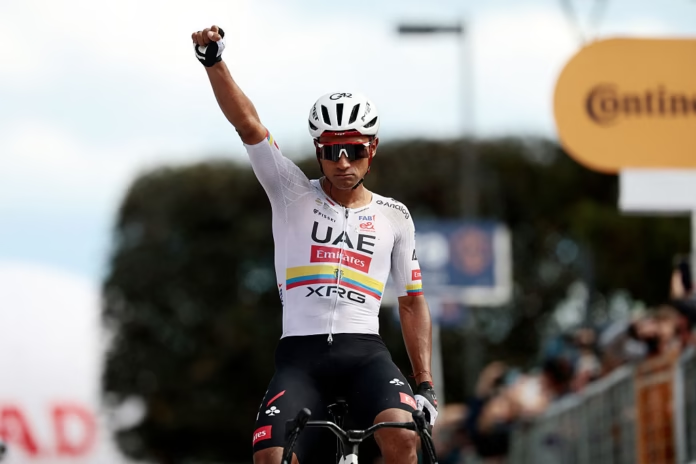
Jhonatan Narváez won stage 8 of the 2026 Giro d’Italia after attacking clear on the steep final climbs into Fermo, giving UAE Team Emirates-XRG another stage victory in a race they have attacked with real intent despite earlier setbacks. Andreas Leknessund finished second at more than 30 seconds, with Martin Tjøtta taking third after proving strongest from the chase behind.
The final kilometres also brought a small but important GC split. Jai Hindley attacked late, with Jonas Vingegaard immediately on his wheel, and the pair were later awarded a two-second gap over the next GC riders. Afonso Eulálio safely retained the maglia rosa after another composed day near the front, but the stage itself belonged to the breakaway and, ultimately, to Narváez.
A furious fight for the break sets the tone
The stage from Chieti to Fermo was only 156km, but it was hard from the start. The profile was full of short climbs and awkward terrain, exactly the kind of route that encourages repeated attacks, and the opening half of the day unfolded in that fashion.
The racing began immediately. Alberto Bettiol was among the first to force the issue, and he was soon joined by Filippo Ganna in one of the more eye-catching early moves. That pairing briefly gave the race some shape, but the peloton never fully accepted it. Riders kept counter-attacking, chasing and bridging, and the opening phase became a rolling battle to establish the right breakaway.
Several more moves came and went. Cavagna tried. A larger group of 13 formed and was pulled back. Andreas Leknessund attacked and then eased when it became clear he would not stay away alone. Ganna and Bettiol held out for a while, but even they could not make their effort stick.
It took more than 50km before the stage finally settled into something more stable. By then, the repeated accelerations had already done plenty of damage to the legs across the bunch.
Narváez, Bjerg and Leknessund make the decisive move
The race finally found its shape when Mikkel Bjerg attacked again and was joined by his UAE team-mate Jhonatan Narváez, with Andreas Leknessund also making it across. This was the move that mattered.
It was not immediately obvious that the trio would survive. Another large chase group formed behind at different moments, and the peloton itself was still splitting and reforming. But what the leading three had in their favour was clarity. They worked well together, they understood the terrain ahead, and behind them the pursuit never found enough cohesion to become truly threatening.
Leknessund took the intermediate sprint uncontested, while the race behind remained untidy. Jan Christen and Christian Scaroni were among the riders trying to animate the chase, while Javier Romo later launched a solo move in an effort to rescue the stage from behind. None of it changed the central picture. Narváez, Bjerg and Leknessund had the strongest position in the race, and as the kilometres ticked down they began to look increasingly likely winners.
By 30km to go they had stretched their advantage over Romo and the fragmented chase, while the peloton, led steadily by Bahrain Victorious, had clearly accepted that the stage win would come from the move.
The GC teams stay controlled, but the race is still live
Although the stage was heading to the breakaway, the peloton never entirely relaxed. Team Visma | Lease a Bike repeatedly moved to the front on descents and exposed sections to keep Vingegaard safe, while Bahrain were content to ride a measured tempo in defence of Eulálio’s pink jersey.
There were still moments of tension. Giulio Ciccone tried a move on one short rise, only for Eulálio to shut it down personally. There was also an earlier split that briefly left Vingegaard in a second group before Visma restored order. Later, as the climbs approached, the bunch stretched again and riders such as Hindley, Gall and O’Connor made sure they stayed in the right places.
The important detail was that the GC teams never committed to a full chase for the stage. Instead, they rode for control and positioning, fully aware that even if the break stayed away, the final walls could still create small but meaningful differences among the contenders.
That proved to be exactly what happened.
Narváez attacks on Capodarco
The decisive move for the stage came on the Capodarco climb. Narváez had looked the sharpest finisher of the leading trio for some time, and once the gradient rose properly he made his move.
He attacked with around 10km to go, just as the leaders approached the penultimate climb. Bjerg was the first to lose contact, leaving Narváez and Leknessund alone at the front. The Norwegian tried to respond and, for a moment, kept the gap within range, but once Narváez kicked again on the steepest section, the elastic began to stretch.
By the top of Capodarco, Narváez had a clear advantage and, more importantly, momentum. Leknessund was still fighting, but he was already losing ground rather than holding it steady. The steep ramps on the final climb into Fermo then suited Narváez perfectly. He managed his effort cleanly, grew the gap again on the hardest gradients and entered the final kilometre with enough of an advantage to begin celebrating before the line.
It was a strong, intelligent finish. He had used Bjerg well while UAE still had numerical superiority over Leknessund, then finished the job with authority once the road turned savage.
Leknessund and Tjøtta round out the podium
Leknessund never gave up, but once Narváez had broken him on Capodarco the stage was effectively gone. He still held on for second at more than 30 seconds, a reward for one of the strongest rides of the day.
Behind him, Martin Tjøtta took third after proving strongest from the broken-up chase. That left Uno-X Mobility with two riders on the podium, a strong return from a stage that demanded both aggression and resilience.
Romo had tried to shake things up from the chase, and riders such as Garofoli, Cepeda, Milesi and Kulset also helped animate the pursuit at different moments, but none of them could undo the advantage the leading trio had built earlier.
-
 Photo Credit: A.S.O./Gaëtan Flamme
Hindley attacks late as Vingegaard follows
While Narváez was sealing the stage, the final ramps into Fermo also produced the day’s main GC action.
Back in the maglia rosa group, Sepp Kuss was controlling the pace for Visma when the gradient bit once more. Eulálio then launched a late move of his own, briefly testing the group behind him, but the more significant acceleration came from Hindley. The Australian attacked late, with Vingegaard immediately on his wheel.
The pair crossed the line together, just ahead of the next riders, and after a short wait the gap was given as two seconds. It was not a dramatic reordering of the overall standings, but it was enough to underline that the first summit finish had not settled everything and that the punchy terrain of Fermo could still expose small differences among the best riders.
Eulálio, for his part, stayed in the front GC group and came through another potentially awkward test in pink. That mattered just as much for Bahrain as the time gap itself. This was a stage that could have become dangerous for the jersey, but he managed it well.
A stage for the attackers, won by the strongest finisher
This was one of those Giro stages where the fight to get into the break almost felt as hard as the finale itself. The opening hour was frantic, the middle phase never fully relaxed, and the final climbs rewarded the riders who still had punch and composure left in their legs.
Narváez had both. He made the right move, had the right team-mate beside him, and then attacked at the perfect moment. It gave UAE Team Emirates-XRG another stage win in a Giro where they have repeatedly found ways to stay aggressive despite crashes and losses elsewhere in the squad.
For the GC riders, it was a quieter day than Blockhaus, but not a neutral one. The two-second split for Hindley and Vingegaard was small, yet on a route like this, small gaps can still matter later in the race.
Giro d’Italia 2026 stage 8 result
| Position | Rider | Team | Time/gap |
|---|---|---|---|
| 1 | Jhonatan Narváez | UAE Team Emirates XRG | 3:27:26 |
| 2 | Andreas Leknessund | Uno-X Mobility | +0:32 |
| 3 | Martin Tjøtta | Uno-X Mobility | +0:42 |
| 4 | Guillermo Silva | XDS Astana Team | +0:44 |
| 5 | Lorenzo Milesi | Movistar Team | +0:44 |
| 6 | Christian Scaroni | XDS Astana Team | +0:48 |
| 7 | Corbin Strong | NSN Cycling Team | +0:55 |
| 8 | Juan Pedro López | Movistar Team | +0:55 |
| 9 | Wout Poels | Unibet Rose Rockets | +0:58 |
| 10 | Markel Beloki | EF Education-EasyPost | +1:00 |
Main photo credit: Getty

