

The Giro d’Italia Women 2026 will be remembered as one of the race’s great late reversals. Demi Vollering did not simply win the Giro. She took it away from Anna van der Breggen on the final day, after a race that had seemed to tilt towards the former world and Olympic champion after the Nevegal uphill time trial.
That is what gives this edition its historical weight. The Giro has always been more than a preparation race, more than a secondary Grand Tour and more than a smaller sibling to the Tour de France Femmes. For decades, it was the most important stage race in women’s cycling, the place where climbing depth, recovery, team strength and race craft were tested more consistently than anywhere else. The 2026 edition added another chapter to that history because it did what the best Giri have often done: it refused to settle early.
It also began with controversy. Lorena Wiebes crossed the line first on stage 1, only to be disqualified after her bike was found to be underweight. Elisa Balsamo was promoted to the stage win and the maglia rosa, giving the race an immediate talking point that went beyond sprint speed alone. That decision did not define the whole Giro, but it did shape the opening narrative and added another unusual entry to the race’s long history of drama, scrutiny and sudden reversals.
Vollering’s win sits in a long line of Giro victories shaped by resilience rather than simple dominance. Fabiana Luperini once made the race her private territory through repeated mountain authority. Nicole Cooke gave Britain one of its major women’s stage-race landmarks. Mara Abbott turned high mountains into a specialist craft. Marianne Vos proved that a complete rider could bend the race across different terrain. Anna van der Breggen and Annemiek van Vleuten later turned the Giro into a central part of their Grand Tour legacies.
The 2026 edition belongs in that conversation because it was not won by control. It was won by escalation.
For the stage-by-stage picture, our Giro d’Italia Women 2026 final classification recap covers how the race was overturned in Saluzzo, while the Giro d’Italia Women 2026 full route guide explains how the route built towards a final weekend that kept the overall result alive.
Why the Giro has always mattered in women’s cycling
Long before the modern Tour de France Femmes returned, the Giro was the race that gave women’s cycling its most consistent Grand Tour platform. It carried different names, different sponsors and different levels of stability, but its sporting role was clear. It was the stage race that asked the biggest questions.
That matters when placing 2026 in context. The Giro’s importance was never only about its route or its duration. It was about status. Winning the Giro meant proving yourself across days, terrain, recovery cycles and pressure. It was not enough to climb well once. A rider had to survive repeated stress, manage teammates, respond to attacks and keep making decisions when the race became tired and unstable.
The race has also been a bridge between eras. It connects the dominance of riders such as Luperini to the wider international age of Cooke, Abbott and Vos, then on to the Van der Breggen and Van Vleuten years, when the Giro became one of the key reference points for the strongest stage racers in the sport.
The modern calendar now has more depth, and the Tour de France Femmes has brought a new level of mainstream visibility. But the Giro still carries an older authority. It is the race that sustained women’s Grand Tour racing when other structures were absent or inconsistent.
Wiebes’ disqualification gave the race an immediate historical marker
Before Vollering’s final-stage comeback, before Van der Breggen’s Nevegal time trial, and before the Finestre was shortened for safety reasons, the 2026 Giro had already entered unusual territory. Wiebes appeared to have opened the race with exactly the kind of sprint victory expected from one of the fastest riders in the world. Instead, the result changed after the finish when she was disqualified for an underweight bike.
That matters in historical terms because Grand Tours are rarely shaped only by legs. They are also shaped by rules, equipment checks, commissaire decisions, weather calls and moments that alter the story away from the road. Wiebes’ disqualification was one of those moments. It turned a standard sprint victory into an immediate controversy and shifted the first maglia rosa to Balsamo.
For Balsamo, the promotion could have been a strange footnote. Instead, she used it as the start of a dominant points-classification campaign. That is what gives the incident balance. The opening result was unusual, but Balsamo’s wider Giro was not an accident. She went on to prove herself repeatedly in the sprints, build a huge ciclamino jersey lead and become one of the defining riders of the race.
For Wiebes, it was a harsh reminder that sprint supremacy means little if the technical side fails. In the long memory of the 2026 Giro, her stage 1 disqualification will sit as the race’s first shock, separate from the GC battle but still part of why this edition felt unstable from the start.
Vollering’s victory joins the Giro’s great late-race turns
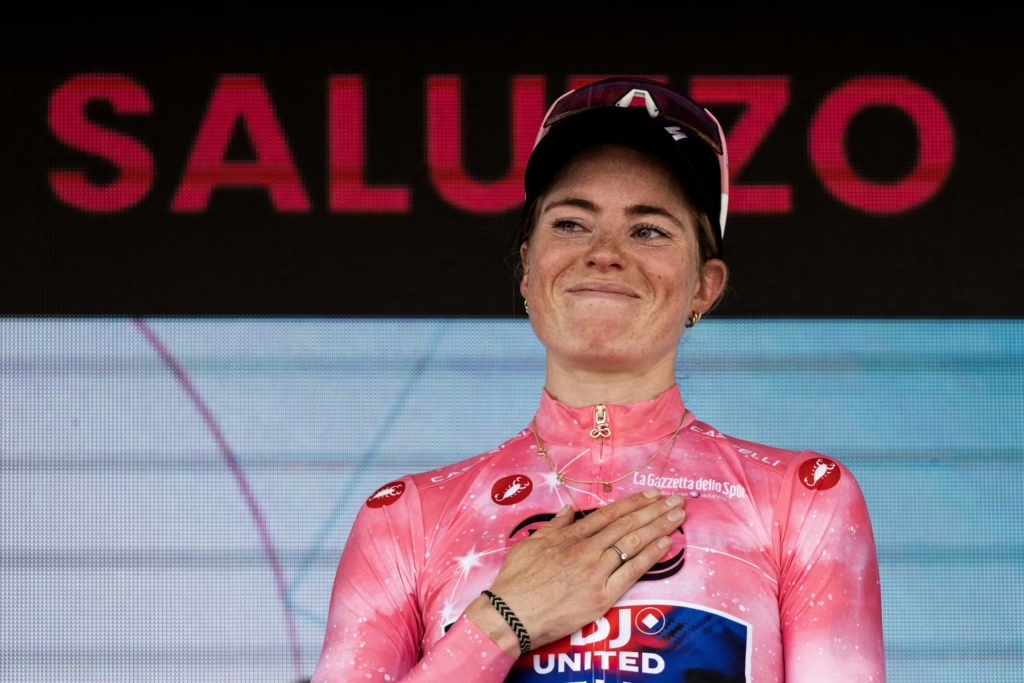
The defining fact of 2026 is simple: Vollering started the final stage 49 seconds behind Van der Breggen and finished the day as Giro winner. That kind of reversal gives the race immediate historical identity.
Some stage races are remembered for the rider who dominated from the first decisive climb. Others are remembered for the day they turned. The 2026 Giro belongs to the second category. Van der Breggen had seized control on Nevegal, defended through the mountains and still looked well placed after Vollering’s victory on the shortened Colle delle Finestre stage. Yet the final hilly loop around Saluzzo changed everything.
That makes Vollering’s win different from a straightforward climbing coronation. She had to live with the deficit, keep applying pressure and believe that one more opportunity still existed. The final-day move was not just a stage-winning attack. It was the culmination of a race-long refusal to accept the time trial as the defining moment.
Historically, those victories tend to linger. They are easier to retell because they have tension built into them. The leader looked safe. The challenger still had one road left. The race turned when the obvious story had nearly been written.
Van der Breggen adds a different kind of historical layer
Anna van der Breggen’s role in this Giro is just as important to its historical feel. She did not win overall, but she shaped the race. Her Nevegal time trial was the performance that forced everyone else into a chase, and her presence in pink gave the Giro a storyline that connected past and present.
Van der Breggen is not simply another contender. She is already part of Giro history, a rider whose previous stage-race authority helped define an era. Seeing her back in control of the maglia rosa changed the emotional tone of the race. It created the possibility of a remarkable return victory, one that would have sat alongside her earlier achievements and deepened one of the most significant careers in modern women’s cycling.
That is why the final-day loss matters so much. It was not only a tactical defeat. It was a shift in generational pressure. Van der Breggen proved she could still produce elite performances and still hold a Grand Tour lead deep into the race. Vollering, Niedermaier and the younger challengers proved that the peloton around her no longer gives that control much room to breathe.
In historical context, Van der Breggen’s third place is not a footnote. It is part of the drama. The Giro was compelling because the rider being overturned was so significant.
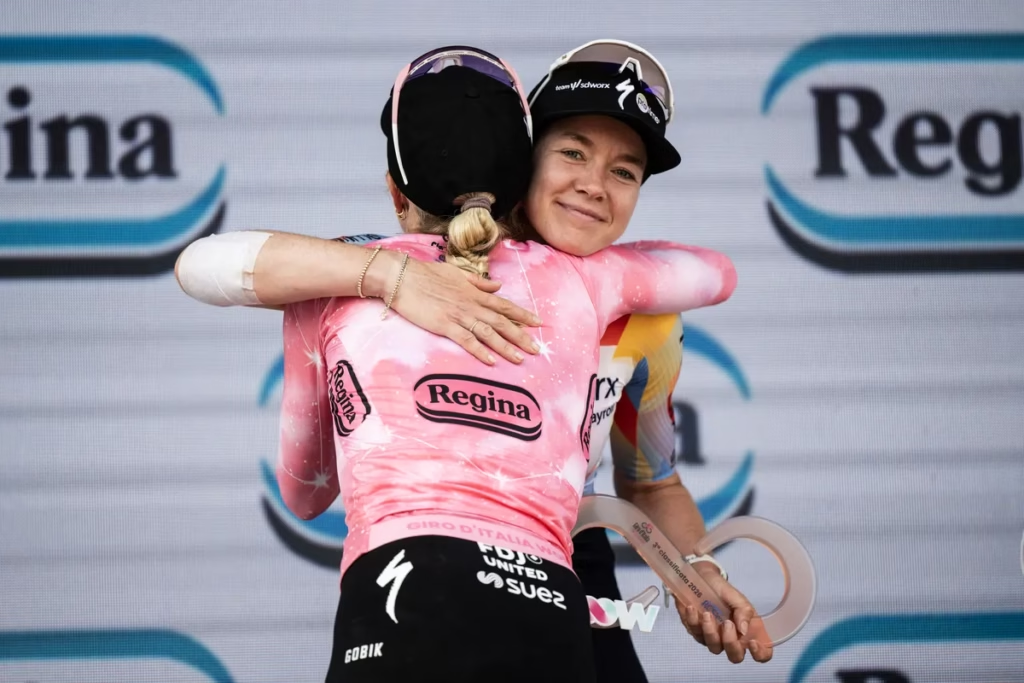 Photo Credit: Getty
Vollering, Van der Breggen and the post-Van Vleuten stage-race era
Women’s stage racing has been searching for its next settled hierarchy since Annemiek van Vleuten’s retirement. Vollering has often looked like the natural rider to inherit that space, but the 2026 Giro added texture to that idea.
This was not a race where one rider simply filled a vacancy. Van der Breggen returned as a genuine force. Niedermaier pushed the race from below. Holmgren emerged as a real young rider threat. Longo Borghini remained dangerous in the tactical stages. Balsamo dominated the sprint side of the race. The result was not a single-rider procession, but a more layered version of the post-Van Vleuten landscape.
That matters historically because the Giro has often revealed the structure of women’s stage racing. When Luperini dominated, the race confirmed her mountain superiority. When Vos won, it reflected her completeness. When Van der Breggen and Van Vleuten controlled editions, it reinforced their Grand Tour authority. In 2026, the Giro showed that the current era may be less settled, but potentially more interesting.
Vollering is now the central reference point, but she is not alone. She had to fight through resistance from a returning great, an emerging German climber, a Canadian young rider breakthrough and an Italian champion who still had enough to win the final stage. That gives the race a more competitive historical texture.
Niedermaier’s second place feels like a future marker
Antonia Niedermaier’s second place could become one of the results people look back on differently in a few years. At the time, it was a superb podium. In historical context, it may prove to be a marker of when she moved from promising climber to Grand Tour contender.
The important thing is how she got there. Niedermaier was not gifted second place by attrition alone. She was active in the decisive phase of stage 9, helping to destabilise the race and forcing Van der Breggen into a defensive struggle that became increasingly difficult to manage. That aggression placed her close to the virtual lead at points on the road and turned the final day into far more than a duel between Vollering and Van der Breggen.
The Giro has often elevated climbers in this way. A rider arrives as a talent, survives the first mountain tests, then suddenly becomes central to the overall race. Niedermaier’s performance belongs in that tradition. It did not quite deliver victory, but it changed her status.
For Canyon SRAM zondacrypto, it also gave the team a Grand Tour result with real depth. Niedermaier leaves the race not as a rider who finished second because others failed, but as one who helped make the race hard enough for the final classification to change.
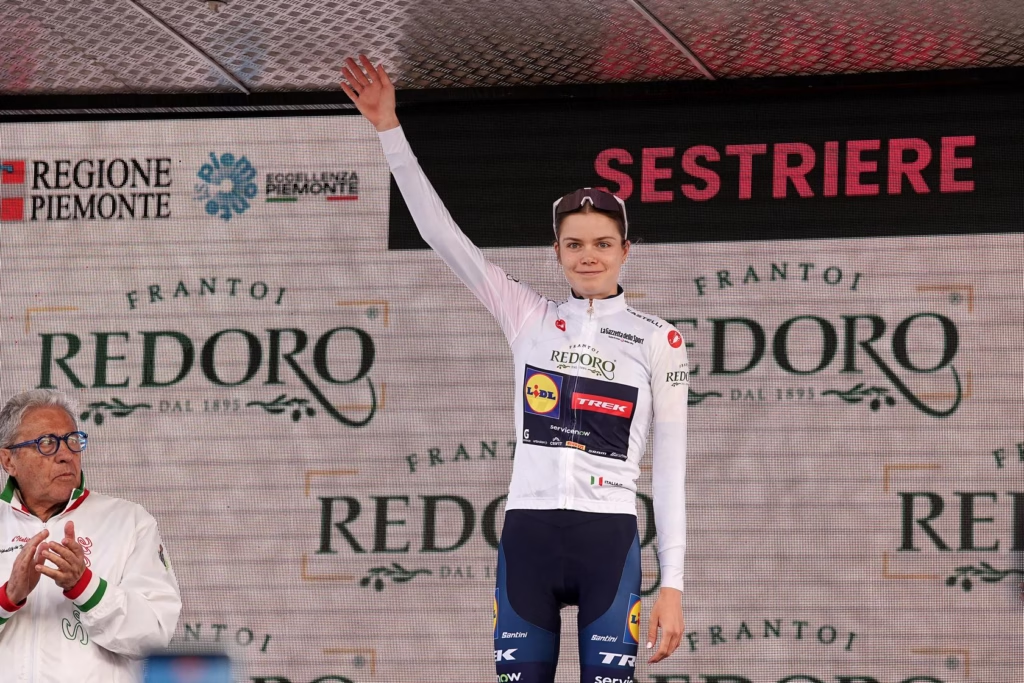 Photo Credit: RCS
Holmgren’s white jersey belongs to the Giro’s development tradition
The Giro has always been a race where younger riders can announce themselves, sometimes before the wider public is fully ready for them. Isabella Holmgren’s 2026 performance fits that pattern.
Winning the young rider classification was already a major result, but her race went beyond the white jersey. She finished seventh overall and was second on the shortened Finestre stage, matching the best climbers on the hardest day of the race. That gave her Giro a historical significance beyond the youth standings. It suggested a rider capable of being part of future GC battles rather than simply collecting a secondary classification.
That is an important distinction. A young rider jersey can sometimes be won by consistency, survival or the absence of stronger rivals. Holmgren’s win was different. It came with visible climbing strength on the race’s defining mountain stage.
In a race with so much history, that kind of emergence matters. The Giro is not only a place where established champions confirm their status. It is also where the next layer of contenders becomes visible.
Balsamo’s sprint dominance gives the race balance
The historical memory of the Giro often leans towards climbers, and understandably so. The race’s greatest images usually come from mountains, time trials and GC collapses. But the 2026 edition also deserves to be remembered for Elisa Balsamo’s sprint dominance.
Balsamo’s race began unusually, with the stage 1 victory coming after Wiebes’ disqualification. That opening result will always carry an asterisk in the story of the stage itself, because Wiebes had been first across the line. But Balsamo’s race did not depend on that one decision. What followed was a full points-jersey campaign built on repeated sprint strength and consistency.
She kept winning, kept scoring and built a points classification lead that was never seriously threatened by the final weekend. In that sense, the disqualification gave her the first opportunity, but her legs gave the race its sprint hierarchy.
That matters because the best editions of the Giro are not only GC stories. They contain different races within the race. Balsamo gave the opening stages a clear identity before the climbers took over. Lidl-Trek then carried that success across other parts of the race through Holmgren’s white jersey, Niamh Fisher-Black’s fifth overall and the team classification.
In historical context, Balsamo’s 2026 Giro reinforces her place among the most dependable fast finishers of her generation. Not every sprinter can carry a points jersey through a race that later becomes mountainous and unstable. Balsamo did it by doing enough damage early, then keeping the classification under control.
Longo Borghini keeps the Italian thread alive
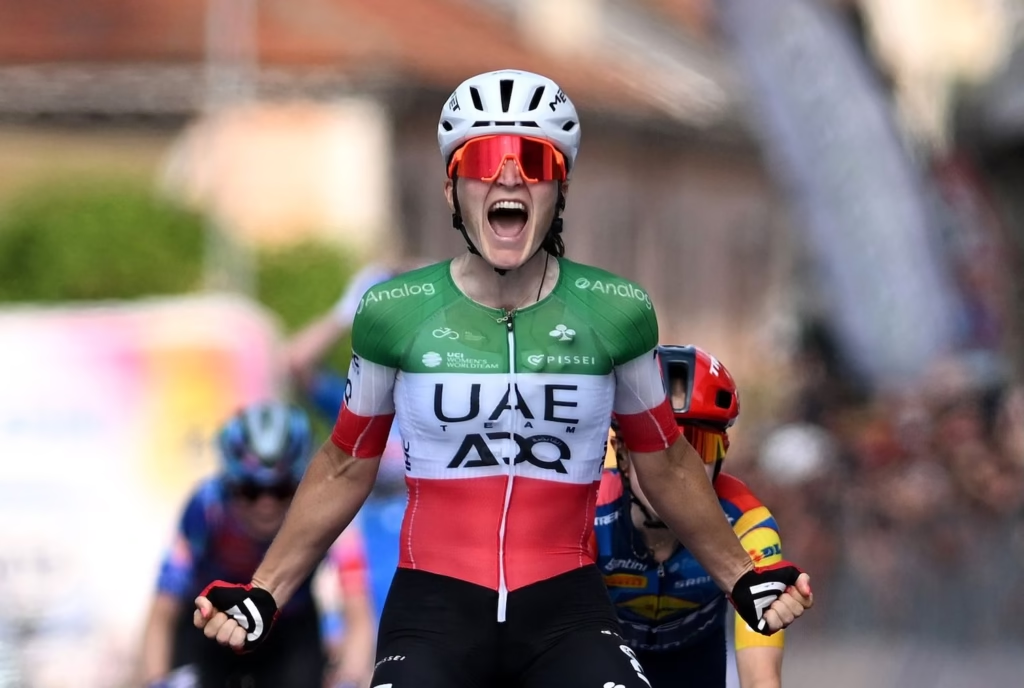
Elisa Longo Borghini’s final-stage victory gave the 2026 Giro an important Italian note. She did not win the overall, and her race was not as consistent as she would have wanted, but winning in Saluzzo on the day the whole race turned was still historically resonant.
The Giro has always carried extra meaning for Italian riders. It is not just another WorldTour stage race. It is the home Grand Tour, the race with domestic memory, domestic expectation and domestic pressure. Longo Borghini has carried that weight for much of her career, and her stage 9 win ensured that the final image of the race was not only Vollering taking pink, but also an Italian champion winning on home roads.
That combination matters. The GC story belonged to Vollering, but the stage belonged to Longo Borghini. In years to come, the final day will be remembered for the classification reversal, but her victory is part of the same moment. She was strong enough to win from the elite group on the day that reshaped the Giro.
It was a reminder that historical significance does not only sit with the overall winner. Sometimes it sits with the rider who gives the decisive day its finish-line image.
The shortened Finestre stage changes how the race will be remembered
Stage 8 was supposed to be the queen stage to Sestriere, via the Colle delle Finestre. Instead, safety concerns over ice on the descent led to the stage being shortened and the finish moved to the Finestre. That decision will remain part of how the 2026 Giro is discussed.
It did not neutralise the race. The Finestre still produced a fierce fight between Vollering, Van der Breggen, Niedermaier and Holmgren. Vollering won, cut the gap, took control of the mountains classification on countback and set up the final day. But the altered finish also meant the stage did not become the full two-part mountain test it had originally promised.
That may have helped preserve the uncertainty for Saluzzo. If the race had continued to Sestriere as planned, the time gaps might have been different. Van der Breggen might have defended the same way, or Vollering might have done more damage. We cannot know. What we can say is that the shortened Finestre stage became a hinge rather than the final verdict.
Historically, that makes the 2026 edition more complex. It was shaped by the route, by rider strength and by a safety decision that changed the final weekend’s rhythm. The Giro has often carried that kind of unpredictability. Weather, road conditions and mountain logistics have always been part of stage-race history.
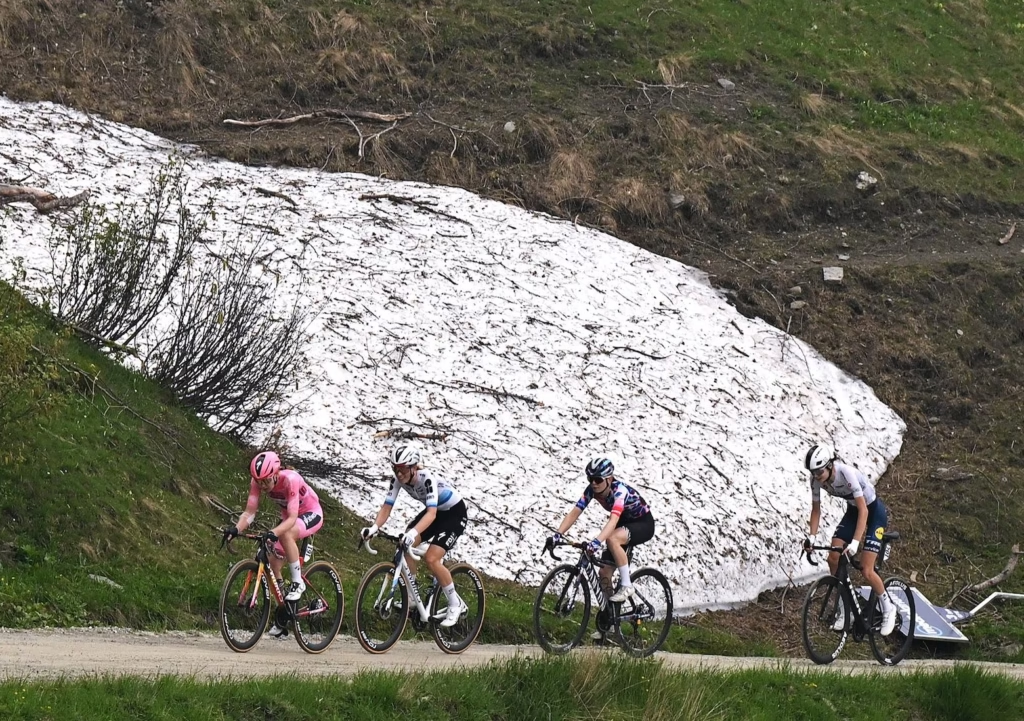 Photo Credit: Getty
The 2026 Giro strengthened the case for final-day difficulty
One of the clearest historical lessons from 2026 is that final stages matter when they are allowed to matter. Saluzzo was not the hardest stage on paper. It was not a summit finish. It did not have the mythic identity of the Finestre. But it changed the Giro because it had enough climbing, enough distance after the final climb and enough tactical uncertainty to punish defensive racing.
That is valuable for women’s race design. The sport does not always need to copy men’s Grand Tour templates or rely only on summit finishes. A final hilly stage can be decisive if it creates pressure in the right places. Montoso, Colletta di Paesana and Colletta di Brondello did not decide the race by profile alone. They decided it because the GC situation made teams use them.
The historical comparison is less about one famous climb and more about stage architecture. The Giro 2026 showed that a race can remain alive if the final day gives riders enough tools. Vollering used those tools. Niedermaier used them. Van der Breggen was exposed by them.
That is the kind of design choice that should influence future editions.
-
 Photo Credit: Getty


Where 2026 sits among modern Giro editions
The 2026 Giro does not sit as a simple domination story. It sits as a turning-point edition. That places it differently from races where one rider imposed herself early and controlled the rest.
Its closest historical value is as a race of reversal and transition. Vollering confirmed herself as the leading Grand Tour rider of the moment. Van der Breggen proved that her comeback was not symbolic. Niedermaier and Holmgren announced the next layer of contenders. Balsamo controlled the sprint narrative after a controversial opening day. Longo Borghini preserved the Italian stage-winning thread on the final day.
That combination gives the race a wide historical footprint. It was not only about who won. It was about how the current generation is arranging itself around the next set of major targets.
The Giro has often been strongest when it reveals more than one thing at once. The 2026 edition did exactly that.
What Giro d’Italia Women 2026 will be remembered for
The 2026 Giro will be remembered first for Vollering’s final-day comeback. That is the headline and the lasting image: a rider starting the last stage 49 seconds behind, attacking when the race still allowed one more chance, and taking pink when Van der Breggen’s control finally broke.
It will also be remembered for Van der Breggen’s near-miss. Her time trial on Nevegal gave the race its middle structure, and her collapse from first to third on the final stage gave the ending its shock.
Wiebes’ stage 1 disqualification will remain part of the race’s opening chapter, a reminder that Grand Tours can turn on technical checks as well as attacks. Balsamo’s response to that moment gave the sprint side of the Giro its own weight, because she turned an unexpected promotion into a dominant points-jersey campaign.
Niedermaier’s second place will grow in importance if she continues on the same trajectory. Holmgren’s white jersey may look like the start of a much bigger GC career. Longo Borghini’s Saluzzo win will remain the home-stage flourish on the decisive day.
Most of all, the 2026 Giro will be remembered as a race that honoured the event’s history. The Giro has always been at its best when it asks riders to keep racing deep into the final week. This edition did that. It gave the maglia rosa a strong leader, then made that leader defend until the last climb that mattered. It gave the challenger just enough road to turn ambition into victory.
That is why the 2026 edition belongs in the Giro’s wider historical story. It did not merely crown the strongest rider. It forced the strongest rider to prove it at the very end.

