

The 2026 Tour de France Femmes comes down to 99.2 kilometres around Nice, four ascents of the Col d’Èze and only eight seconds between Demi Vollering and Kasia Niewiadoma-Phinney.
Vollering starts the final stage in yellow after turning Stage 8 into an unexpected GC attack rather than the sprint many had anticipated. She attacked late above Nice, won alone and overturned the 15-second deficit she had carried out of Mont Ventoux.
The full story of that attack is covered in our Tour de France Femmes 2026 Stage 8 race report.
Niewiadoma-Phinney now trails by only eight seconds. Marlen Reusser remains third at 1:12, while Elisa Longo Borghini is fourth at 3:05.
There is no ceremonial final day here. The 2026 Tour de France Femmes route was designed to leave one final trap around Nice, and the race arrives there with yellow still completely open.
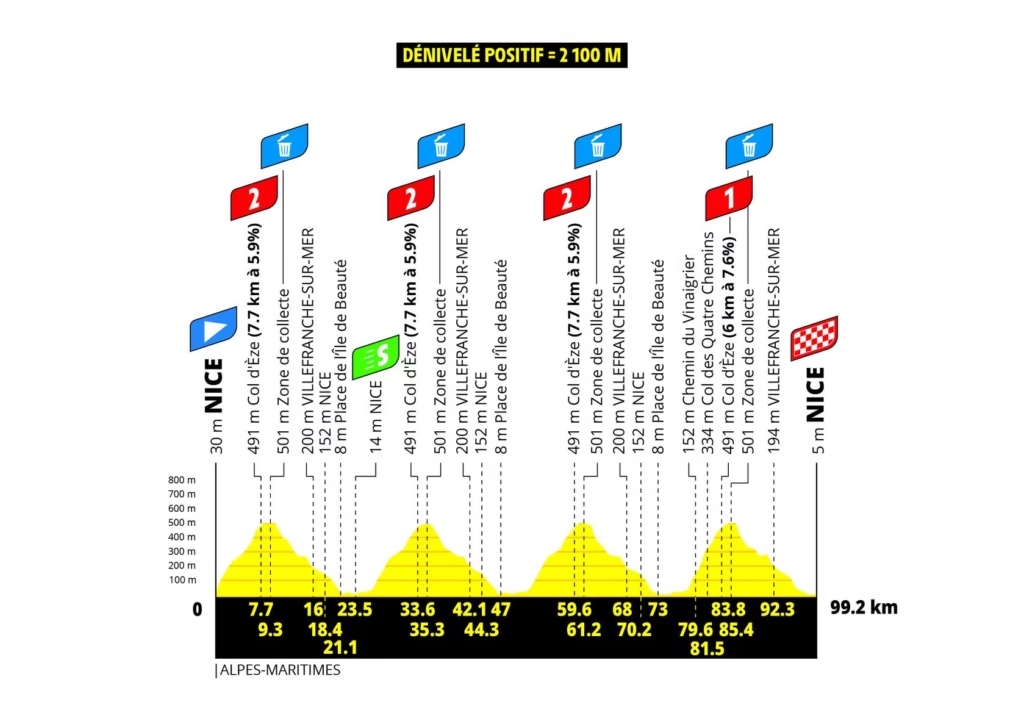 Photo Credit: Getty
Tour de France Femmes Stage 9 route
| Stage detail | Information |
|---|---|
| Date | Sunday 9 August 2026 |
| Start | Nice |
| Finish | Nice |
| Distance | 99.2km |
| Stage type | Mountain |
| Elevation gain | 2,100 metres |
| Neutralised start | 16:05 CEST / 15:05 BST |
| Expected finish | 18:51-19:10 CEST / 17:51-18:10 BST |
| Col d’Èze ascents | Four |
| Final Col d’Èze summit | 15.4km from finish |
| Final climb | 6km at 7.6%, Category 1 |
The stage is built around repeated laps from Nice towards the Col d’Èze before descending back towards the coast.
The first three climbs follow the same basic route: 7.7 kilometres at 5.9%, each classified as Category 2.
The fourth lap changes.
Instead of simply repeating the previous ascent, the riders take the harder approach through the Chemin du Vinaigrier and Col des Quatre Chemins before joining the upper part of the Col d’Èze. That creates a final classified climb of 6 kilometres at 7.6%, including a much steeper section before the summit.
The complete spectator and route picture is covered in our Tour de France Femmes 2026 Nice finish guide.
The first Col d’Èze comes almost immediately
There is virtually no gentle opening to Stage 9.
The first summit of the Col d’Èze comes after only 7.7 kilometres.
That matters because this is only a 99.2km stage. Nobody needs to preserve a full team for another four hours of racing.
Canyon SRAM can begin testing FDJ United-Suez almost immediately.
FDJ can begin controlling almost immediately.
Movistar and UAE Team L’IMAD also have reasons to make the race difficult because both need to improve their positions rather than simply protect them.
The first ascent is unlikely to decide yellow, but it may reveal very quickly how aggressive the final day is going to be.
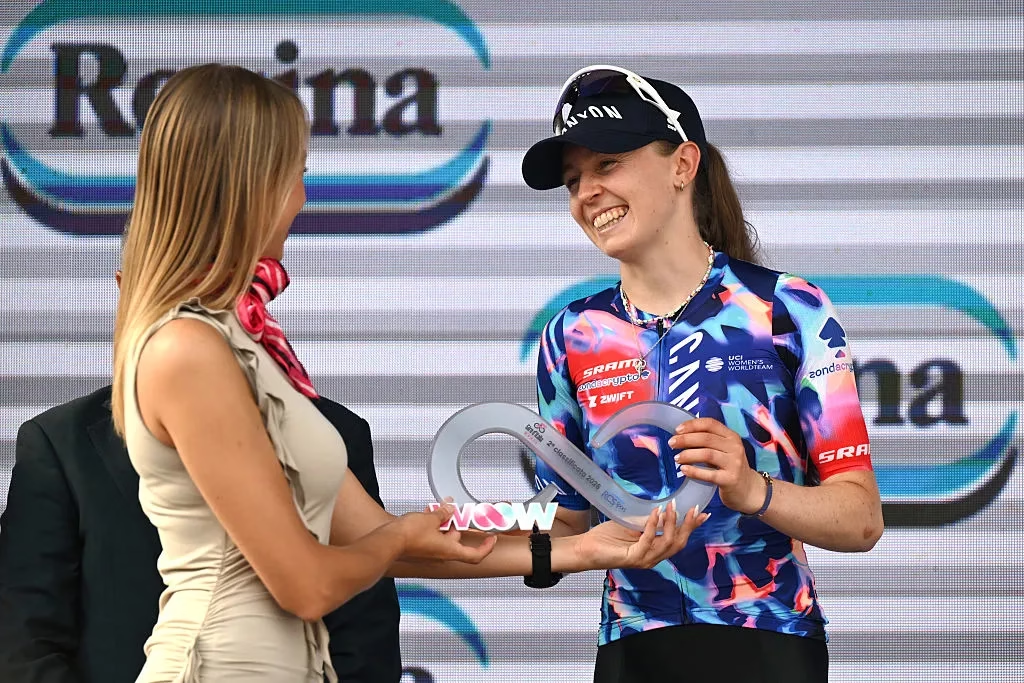
The second ascent is where Canyon SRAM can start using Niedermaier
The second Col d’Èze leaves 65.6 kilometres to race.
That is still too far for Niewiadoma-Phinney to make one obvious all-or-nothing move, but it is ideal terrain for Canyon SRAM to begin forcing tactical decisions.
Antonia Niedermaier gives them the obvious second card.
If Niedermaier attacks, FDJ have to decide how much freedom to give her.
She is not close enough to yellow to trigger immediate panic, but she remains highly placed overall and is strong enough to become a useful satellite rider later.
That matters because the worst possible race for Niewiadoma-Phinney is a controlled one.
If FDJ arrive at the final climb with several teammates around Vollering, the eight-second deficit becomes much harder to recover.
Canyon SRAM need to start removing that support before the last lap.
The third Col d’Èze should reveal the final strategy
The third summit comes with 39.6 kilometres remaining.
By then, the race should have been climbing and descending repeatedly for more than an hour.
This is likely to be the point where the final structure becomes obvious.
If Vollering still has several FDJ United-Suez riders, Canyon SRAM will know they need to make a serious move.
If Vollering is isolated, Niewiadoma-Phinney can start attacking rather than waiting.
Reusser also becomes more relevant here.
At 1:12, she is too far behind to simply wait for a sprint or one short final attack. Movistar need to create a race where Vollering and Niewiadoma-Phinney are forced to react to something other than each other.
Reusser’s sustained power makes her dangerous if she gets clear on one of the earlier laps and begins turning the stage into something closer to an extended time trial.
That scenario would immediately complicate the eight-second duel.
The final Col d’Èze is harder than the first three
The fourth ascent is the decisive one.
After the repeated earlier laps, the riders take the harder Chemin du Vinaigrier approach before climbing towards the Col des Quatre Chemins and rejoining the Col d’Èze.
The classified section measures 6km at 7.6% and is Category 1.
The summit comes with only 15.4 kilometres remaining.
That makes it the final clean opportunity to win the Tour.
Niewiadoma-Phinney does not need a minute.
She needs seconds.
But unlike on Mont Ventoux, there is a descent after the climb. Any gap created at the summit still has to be protected all the way back into Nice.
That makes the presence of teammates or another motivated rider potentially decisive.
 Photo Credit: Getty
Eight seconds means bonuses alone are not enough
The normal finish bonuses remain:
- 10 seconds for first
- 6 seconds for second
- 4 seconds for third
That arithmetic matters.
If Niewiadoma-Phinney wins the stage and Vollering finishes second on the same time, she gains only four seconds.
She would still lose the Tour.
If Niewiadoma-Phinney wins and Vollering finishes third on the same time, the six-second swing is still not enough.
So Niewiadoma-Phinney needs a physical gap unless Vollering finishes outside the bonus positions.
That gives the final stage a very clear tactical shape.
A sprint between the two does not solve Canyon SRAM’s problem.
They need separation.
Vollering can race much more simply than she could on Ventoux
This is one of the biggest changes from Stage 7.
On Mont Ventoux, Vollering was still trying to take yellow from Reusser while Niewiadoma-Phinney attacked ahead. The tactical conflict between chasing one rival and dropping another created the hesitation explored in our analysis of why Vollering waited so long to attack on Mont Ventoux.
Sunday is much simpler.
Vollering has yellow.
If Niewiadoma-Phinney attacks, she follows.
She does not need to create a gap.
She does not need to prove she is the strongest climber.
She does not need to win the stage.
She needs to keep Niewiadoma-Phinney within eight seconds.
That clarity is a major advantage.
Her wider route to reclaiming the Tour was already central to our Demi Vollering Tour de France Femmes 2026 profile.
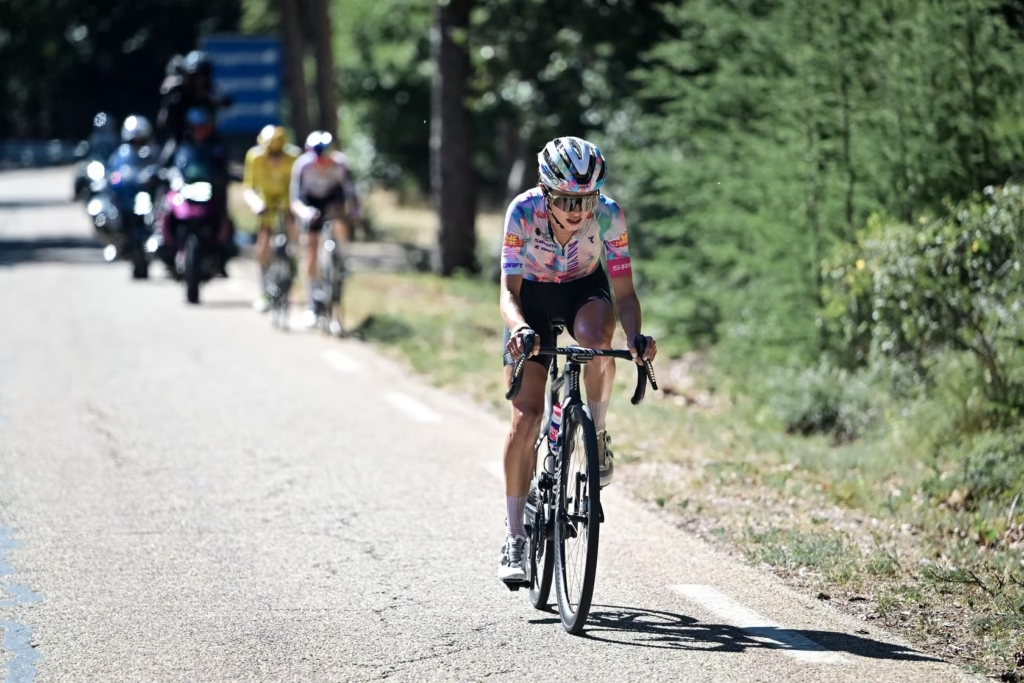 Photo Credit: A.S.O./Billy Ceusters
Niewiadoma-Phinney has to make the race messy
The challenge for Niewiadoma-Phinney is the exact opposite.
She cannot simply wait behind Vollering until the final kilometre.
Eight seconds is too much to recover through bonus seconds alone.
Canyon SRAM therefore need complexity.
Attack with Niedermaier.
Force FDJ United-Suez to chase.
Make Reusser relevant.
Allow Longo Borghini to increase the pressure.
Attack Vollering before the final climb if the opportunity appears.
Then attack again if necessary.
Niewiadoma-Phinney has already shown once this week that she is at her best when she refuses to wait for the obvious moment. Her Ventoux victory came because she attacked while Vollering and Reusser were still watching one another.
That instinct may be even more important now.
Her strengths on a route built around tactical disruption were one of the key themes of our Kasia Niewiadoma-Phinney Tour de France Femmes 2026 profile.
Stage 8 changed the psychological balance again
Twenty-four hours earlier, Niewiadoma-Phinney had yellow and Vollering was chasing.
Now those roles have reversed.
Stage 8 looked like a possible sprint day but turned into another decisive GC stage when FDJ United-Suez increased the pace late and Vollering attacked after the Côte de la Ginestière.
Niewiadoma-Phinney and Longo Borghini initially tried to stay with her, but Vollering created separation and committed fully on the roads back towards Nice.
She won the stage by 17 seconds and took enough time, combined with bonuses, to move eight seconds ahead overall.
That result underlined the warning already present before Stage 8: the 15-second advantage Niewiadoma-Phinney carried off Ventoux was never enough to defend passively.
Our analysis of whether Niewiadoma-Phinney could win the 2026 Tour identified exactly that problem.
Now she has to solve it from behind.
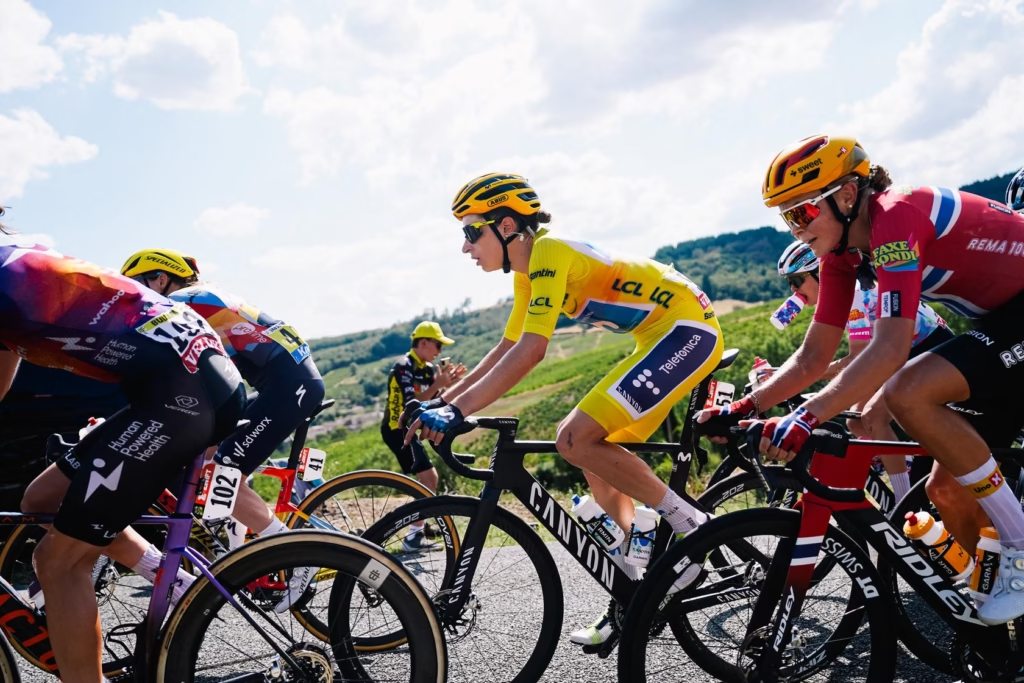 Photo Credit: A.S.O./Gaëtan Flamme
Reusser needs a long-range attack
Reusser begins the final stage 1:12 behind Vollering.
That keeps her in the Tour, but only if Movistar are willing to take risks.
Waiting for the last kilometre makes little sense.
Reusser is less explosive than Vollering and Niewiadoma-Phinney but stronger than almost anyone in the race once she can settle into a sustained effort.
A move from distance therefore suits her much better.
If she attacks on the second or third Col d’Èze, neither Vollering nor Niewiadoma-Phinney will immediately want to take sole responsibility for the chase.
That creates the possibility of the same tactical hesitation that transformed Ventoux.
Reusser needs the race to become complicated.
A simple final-climb contest almost certainly leaves her third.
Longo Borghini can attack Reusser’s podium
Longo Borghini starts fourth at 3:05.
Yellow is probably too far away.
Reusser’s third place is a more realistic target.
The gap between them is 1:53.
That still requires a major move, but the repeated climbs give UAE Team L’IMAD enough opportunities to attack rather than simply wait.
Longo Borghini also has Paula Blasi and Dominika Włodarczyk highly placed overall.
That depth gives UAE several riders capable of increasing the pressure before the final lap.
The more aggressive UAE race, the less control FDJ United-Suez can impose for Vollering.
Niedermaier has white, but yellow has to come first
Niedermaier remains in control of the young rider classification.
That creates a secondary objective for Canyon SRAM, but there should be little doubt about the hierarchy on Sunday.
If using Niedermaier aggressively risks white but increases Niewiadoma-Phinney’s chance of winning the Tour, Canyon SRAM should take that risk.
Yellow matters more.
Niedermaier can be sent ahead on one of the earlier Col d’Èze ascents.
She can force FDJ to work.
She can wait for Niewiadoma-Phinney if the yellow jersey contender later attacks across.
Or she can continue riding for her own position if the race develops differently.
That versatility is one of Canyon SRAM’s biggest tactical advantages.
Puck Pieterse can finish the polka-dot job
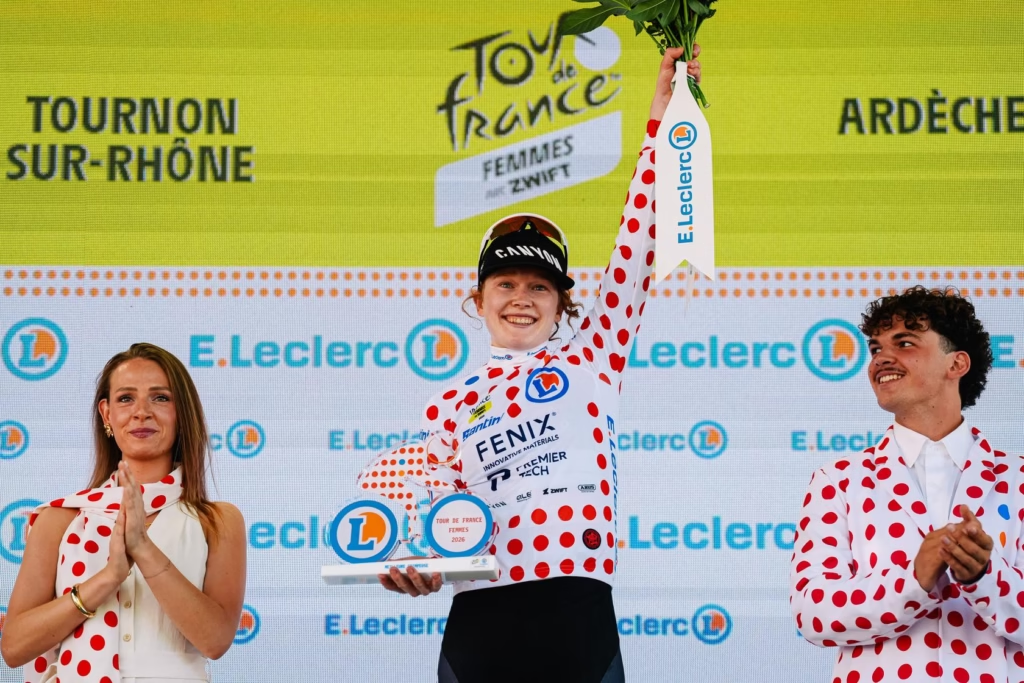
Pieterse has already built a commanding lead in the mountains classification.
Stage 9 provides another large block of points through the four Col d’Èze ascents.
The first three Category 2 climbs each offer points to the first four riders, while the final Category 1 ascent provides the biggest remaining haul.
Pieterse’s best strategy may be to enter an early move and collect enough on the first two or three ascents to remove any remaining mathematical uncertainty.
The full competition and scoring system are covered in our Tour de France Femmes polka-dot jersey guide.
Can a breakaway win Stage 9?
It is possible, but the GC situation works against it.
A short mountain stage normally provides an excellent opportunity for strong climbers who have lost time overall.
The problem is that almost every major team has a reason to race.
Canyon SRAM need to attack Vollering.
FDJ United-Suez need control.
Movistar need an aggressive race if Reusser wants to move up.
UAE Team L’IMAD need to attack Reusser’s podium.
That leaves very few teams interested in allowing a large harmless break to disappear.
An early move can still survive deep into the stage, particularly if it contains riders who can later be used tactically by their leaders.
But the eventual stage winner is more likely to emerge from the GC battle or a late attack launched from it.
The descent could decide the Tour
The last Col d’Èze summit comes 15.4 kilometres from the finish.
That means the Tour is not necessarily decided at the top.
If Niewiadoma-Phinney gains ten seconds on the climb, Vollering still has a descent and the run back into Nice to close the gap.
If Vollering crests with her, Canyon SRAM’s opportunities become much smaller.
That makes descending ability, cooperation and tactical support crucial.
A lone Niewiadoma-Phinney may struggle to maintain a small gap against an organised chase.
Niewiadoma-Phinney with Niedermaier or another motivated rider is a very different problem.
The final stage is therefore not just about who climbs fastest.
It is about who arrives over the last summit in the most useful tactical situation.
What does Vollering need to do?
Follow Niewiadoma-Phinney.
That is the simplest version.
Use FDJ United-Suez to control Niedermaier and other dangerous moves.
Avoid doing unnecessary work for Reusser or Longo Borghini.
Stay close whenever Niewiadoma-Phinney attacks.
Reach the final summit within eight seconds.
If Vollering does that, she should win the Tour.
There will be a temptation to attack and try to finish the race emphatically.
She does not need to.
Stage 9 is one of the rare occasions where Vollering’s biggest tactical challenge may be resisting the urge to demonstrate that she is stronger.
-
 Photo Credit: Getty

What does Niewiadoma-Phinney need to do?
Everything Vollering does not.
Create uncertainty.
Force FDJ United-Suez to chase before the final lap.
Use Niedermaier.
Make Reusser and Longo Borghini part of the race.
Attack before Vollering wants her to.
Then attack again on the final Col d’Èze.
A late sprint will not be enough.
Eight seconds is small, but it still requires a real gap.
Niewiadoma-Phinney needs Stage 9 to become a bike race rather than a controlled hill climb.
That is exactly the kind of situation in which she has been most dangerous throughout her career.
How Stage 9 is likely to unfold
The pace should be high from almost the first kilometre.
The first Col d’Èze arrives too quickly for a conventional quiet opening.
A break may form on the climb or descent, but Canyon SRAM should begin testing FDJ well before halfway.
Niedermaier is the obvious rider to send forward.
Movistar and UAE Team L’IMAD also have every reason to contribute to an aggressive race because both need to change the current podium order.
The third Col d’Èze, with 39.6 kilometres remaining, should be where the main GC group becomes seriously reduced.
The final lap then brings the harder Vinaigrier approach and Category 1 final ascent.
That is the last clean chance to win the Tour.
Niewiadoma-Phinney needs more than bonus seconds.
Vollering only needs to stay close.
Reusser needs something much bigger.
After eight stages, a time trial, Mont Ventoux and two yellow-jersey changes in two days, the Tour de France Femmes comes down to one short final circuit around Nice.
Eight seconds.
Four climbs.
And one final opportunity to decide who wins the 2026 Tour.

