

The Giro d’Italia Women 2026 reaches its queen stage on Saturday, 6th June, with 105km from Rivoli to Sestriere and the race’s most important climbing test. After the hilly trap to Salice Terme, stage 8 sends the peloton towards the Colle delle Finestre before the road continues up to the summit finish at Sestriere.
This is the stage that has been circled since the route was announced. The Finestre is not just another climb. It is long, steep, partly unpaved and mentally draining, with the summit sitting above 2,100 metres. From there, the race still has to reach Sestriere, where the finish comes at more than 2,000 metres altitude.
That makes stage 8 the clearest remaining opportunity for the GC riders to reshape the Giro. Anna van der Breggen has controlled the maglia rosa since the Nevegal uphill time trial, but Demi Vollering is still close enough to force the race open. Antonia Niedermaier, Isabella Holmgren, Marlen Reusser, Elisa Longo Borghini and Niamh Fisher-Black all have reasons to treat this as the day where waiting is no longer an option.
For wider race context, our Giro d’Italia Women 2026 full route guide explains how this stage sits within the nine-day route, while our Giro d’Italia Women 2026 stage 7 preview covers the awkward hilly stage that leads into the queen stage.
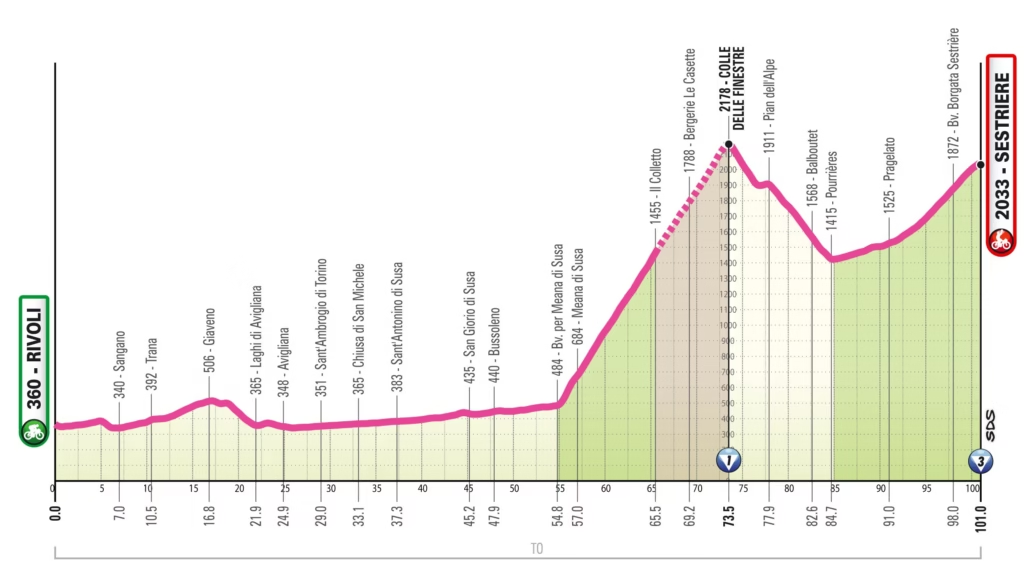
What is the route for Giro d’Italia Women 2026 stage 8?
Stage 8 starts in Rivoli and finishes in Sestriere after 105km. On distance alone, it looks short, but that is misleading. The stage carries around 2,800 metres of elevation gain, with most of the climbing packed into the second half of the day.
The early kilometres should give teams time to position, place riders in the breakaway and prepare for the decisive sequence. The real race begins when the road turns towards the Colle delle Finestre. From that point, the Giro becomes much harder to control.
The Finestre is the key climb of the day. It is steep, exposed in places and famous for its gravel upper section. Once the riders reach the summit, the stage is still not finished. The road continues towards Sestriere, meaning that a rider who cracks on the Finestre could keep losing time all the way to the line.
This is why stage 8 is so dangerous. It is not a single climb with a descent and a chance to regroup afterwards. It is a two-part mountain test: first the Finestre, then the long continuation towards Sestriere. A rider can lose the Giro here very quickly.
Why the Colle delle Finestre is so important
The Colle delle Finestre gives stage 8 its identity. It is one of the most evocative climbs in Italian cycling because it combines length, gradient, altitude and surface in a way that makes rhythm hard to protect. The partial gravel section matters because it adds more than simple spectacle. It changes traction, line choice, positioning and confidence.
The climb is also the Cima Alfonsina Strada of this Giro, the highest point of the race. That gives it another layer of meaning in a women’s edition, with the award named after the Italian pioneer who rode the men’s Giro d’Italia in 1924.
On a climb like this, teams can disappear quickly. A leader who starts the Finestre with two or three teammates may be isolated long before the summit. Riders who rely on steady pacing can be disrupted by surface changes. Riders who are uncomfortable on gravel may spend energy fighting the bike as much as the gradient.
The climb also arrives late enough in the Giro for fatigue to be decisive. By stage 8, the peloton has already raced through sprint days, a hilly stage to Buja, the Nevegal uphill time trial, the Dolomite stage to Santo Stefano di Cadore, a flat sprint day and the hilly stage to Salice Terme. The Finestre is hard on fresh legs. At this point in the race, it becomes a proper examination.
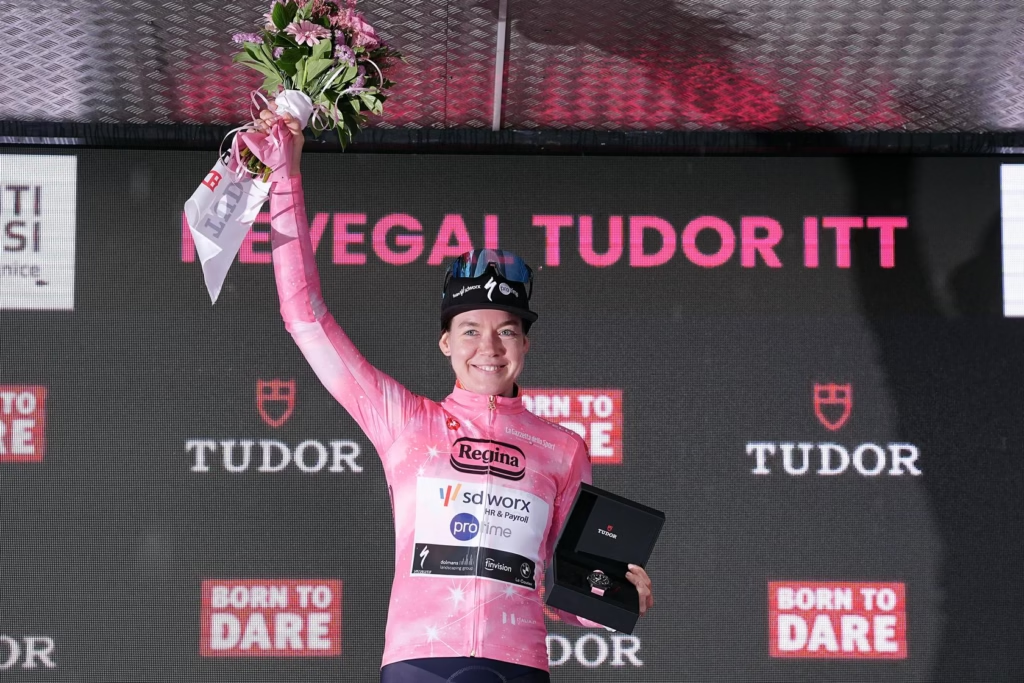 Photo Credit: RCS
The maglia rosa battle reaches its biggest test
Anna van der Breggen starts this part of the race as the rider everyone has to dislodge. Her Nevegal time trial gave her control, and she defended well on the Dolomite stage to Santo Stefano di Cadore, where Vollering won but could not break the race leader.
Stage 8 is different. The Finestre is severe enough to create real gaps, and the continuation to Sestriere means a small weakness can become a major time loss. Van der Breggen does not need to attack, but she cannot simply ride defensively if Vollering or another contender goes early. She will need to judge whether to follow, pace, use teammates or force others to chase.
For Team SD Worx-Protime, the challenge is energy management. They have the race lead, but they cannot burn through support too early. If Van der Breggen reaches the hardest part of the Finestre isolated, Vollering, Niedermaier, Longo Borghini or Holmgren may see an opportunity to test her.
Can Demi Vollering still take pink?
Vollering’s route to the maglia rosa is clear: she has to make stage 8 hard enough to expose Van der Breggen. A small acceleration near the finish may not be enough. She needs the Finestre to become a full GC test, not just a controlled tempo climb.
That suits her racing instincts. Vollering has already shown in this Giro that she can turn selective terrain into a stage win. The question is whether she can turn pressure into time. If she attacks on the Finestre and Van der Breggen follows immediately, the gain may be limited. If she can force a sustained gap before the road towards Sestriere, the race could change quickly.
The stage also gives FDJ United-Suez a tactical role. They cannot leave everything to the final kilometre. If they want to isolate Van der Breggen, they need to make the earlier parts of the climb uncomfortable, keep the pace high over the gravel and prevent the maglia rosa group from settling.
Antonia Niedermaier’s podium chance
Antonia Niedermaier has been one of the strongest climbers in the race, and stage 8 looks like the kind of terrain where she can confirm that status. The Finestre rewards riders who can climb at sustained intensity, handle awkward rhythm changes and keep producing power when the surface becomes less predictable.
Her podium position gives her two possible approaches. She can ride defensively, follow Van der Breggen and Vollering, and try to protect third overall. Or she can treat the stage as an opportunity to move higher. The second option carries more risk, but the route is hard enough to reward courage.
Niedermaier is especially dangerous if the two biggest names mark each other too closely. A well-timed move from a podium contender can become more difficult to control when the road is steep and teammates are gone.
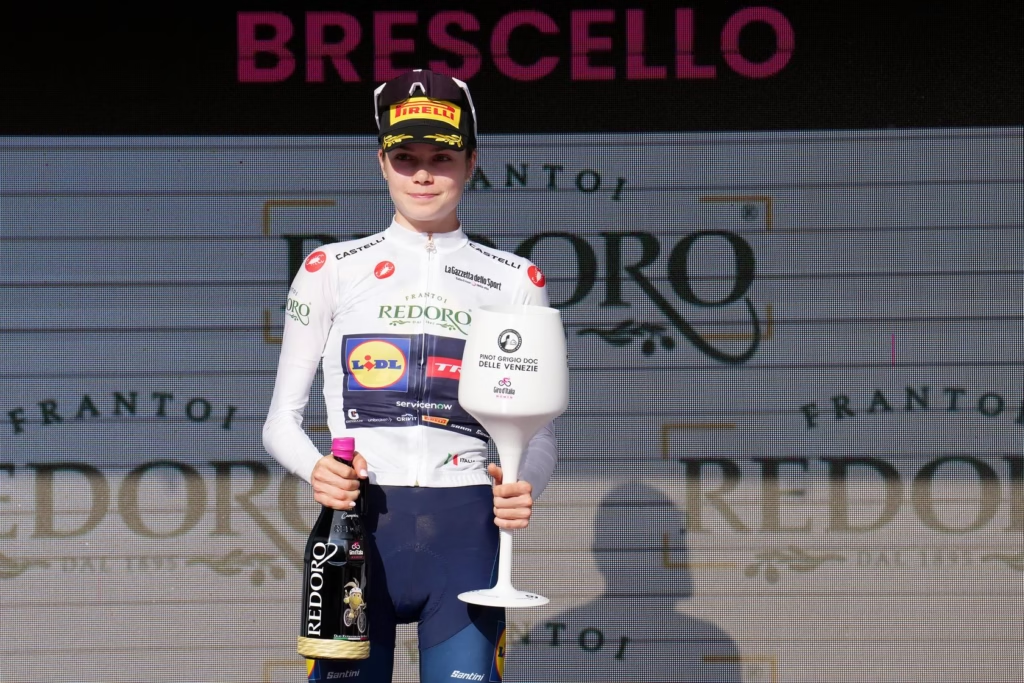 Photo Credit: RCS
Isabella Holmgren faces her biggest test
Isabella Holmgren has already turned this Giro into a breakthrough race. She leads the young rider classification and sits high enough overall that she is no longer only defending white. Stage 8 will show how far she can go in the full GC battle.
The Finestre should suit her in several ways. Holmgren has the climbing ability, off-road background and technical confidence to handle a climb that is not purely about smooth tarmac watts. The gravel section is not a novelty for a rider with her skill set. It could even be an advantage if others become cautious or tense.
The bigger question is endurance at this point in the race. Stage 8 is short, but the accumulated fatigue is real. If Holmgren can stay with the best over the Finestre and into Sestriere, she could reinforce the white jersey and strengthen her overall position. If she has a bad day, the time gaps could be large enough to change both competitions.
What can Elisa Longo Borghini do?
Elisa Longo Borghini has not had the race control she would have wanted, but stage 8 gives her the kind of terrain where she can still change the story. The Finestre is a climb that rewards toughness, race craft and commitment, all qualities that sit firmly in her range.
Longo Borghini’s best chance may be to race before the obvious final selection. If she waits until the front group is down to Van der Breggen, Vollering and Niedermaier, it may be harder to gain meaningful time. If she attacks earlier, or uses UAE Team ADQ to make the race messy before the steepest sections, she can force others into decisions.
She is also one of the riders least likely to be intimidated by the stage. The combination of gravel, altitude, hard gradients and tactical uncertainty suits a rider who has made a career from thriving when races stop being tidy.
Marlen Reusser and the limits of climbing control
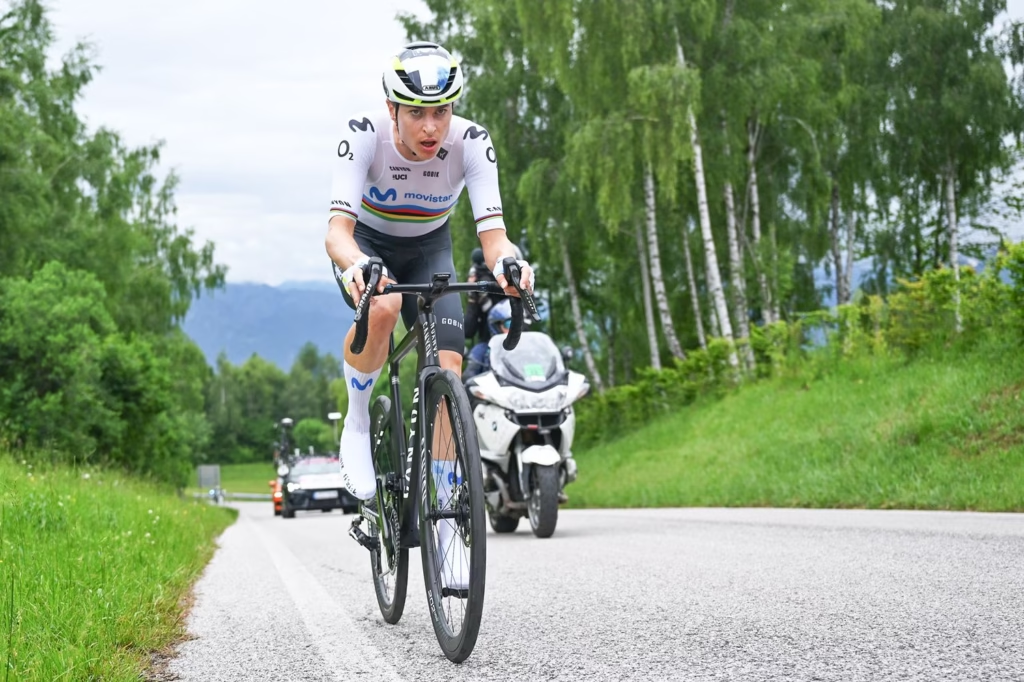
Marlen Reusser remains high on GC, but stage 8 is a difficult assignment. She has the engine to limit losses and the time trial strength to ride at a high steady pace, but the Finestre is not a climb where rhythm is always easy to protect.
The gravel section, changes in gradient and repeated accelerations from the pure climbers could make the stage uncomfortable. Reusser’s best route is likely to be pacing rather than responding to every move. If she can avoid panic when the race splits, she may still defend a strong overall position.
Movistar will also need to judge support carefully. Reusser cannot afford to be exposed too early if the climbers begin attacking before the summit. The stage is short enough for explosive racing, but long enough uphill that pacing discipline can still save time.
Niamh Fisher-Black and the Lidl-Trek balance
Niamh Fisher-Black gives Lidl-Trek another important card on stage 8, especially with Holmgren high on GC and Balsamo focused on the points classification. The team’s Giro has already been successful because of Balsamo’s stage wins, but the Finestre offers a very different target.
Fisher-Black can be dangerous if she is allowed to move before the main favourites fully commit. She climbs well, can handle hard gradients and may benefit if Lidl-Trek use their numbers intelligently. With Holmgren defending white and sitting high overall, the team may have to balance aggression with protection.
That balance matters. If Fisher-Black attacks, other teams have to decide whether she is a stage threat, a GC threat or a move that can be allowed to go. If Holmgren is still comfortable behind, Lidl-Trek could put pressure on multiple fronts.
Could a breakaway survive to Sestriere?
A breakaway win is possible, but stage 8 is a difficult day for attackers to judge. The stage is short, the GC stakes are huge, and the Finestre is likely to bring the favourites into the race properly. That reduces the chances of a lightly controlled break going all the way.
The break’s best hope is to include strong climbers who are far enough down on GC to be allowed space. If the maglia rosa group hesitates before the Finestre, the break could reach the climb with a useful advantage. From there, it becomes a question of survival.
The problem is that the final part of the stage is so hard. A breakaway rider needs to climb at a very high level to hold off the GC favourites once the race ignites. If Vollering, Van der Breggen or Niedermaier attack seriously on the Finestre, most of the day’s early move may be swept up.
A stage win from the GC group looks more likely than a breakaway victory, but if a strong climber gets enough room, the structure of the stage does leave a path.
Where will stage 8 be won?
The stage will probably be won on the Finestre, even if the finish line is in Sestriere. The decisive selection should happen on the steep and gravel sections of the climb, where teams thin out and leaders are forced to ride for themselves.
The road after the summit is just as important. A rider who goes over the top with 20 or 30 seconds cannot ease up and assume the race is won. The continuation to Sestriere gives chasers time to organise, but it also gives a strong solo rider or small group room to build the advantage if the riders behind hesitate.
The final climb to Sestriere may not be as savage as the Finestre, but it comes after the damage has already been done. That is where gaps can stretch. A rider who is only just hanging on over the summit may lose far more on the final rise.


What comes next after stage 8?
Stage 9 around Saluzzo gives the Giro one final difficult day, but stage 8 is the obvious GC centrepiece. After Sestriere, there will still be road left to race, but the biggest mountain opportunity will have passed.
That makes stage 8 crucial for every GC contender. Van der Breggen can put one hand on the overall victory if she controls the Finestre and finishes with her lead intact. Vollering needs to take time before the race runs out of mountain road. Niedermaier, Holmgren, Reusser, Longo Borghini and Fisher-Black all need to decide whether they are defending positions or trying to climb higher.
By the end of Sestriere, the Giro should have a much clearer shape. The final stage may still matter, but this is the day most likely to define the podium.
Giro d’Italia Women 2026 stage 8 prediction
Stage 8 should be the decisive climbing day of the Giro d’Italia Women 2026. The Colle delle Finestre is hard enough to break the GC group, and the continued rise to Sestriere means the damage can continue all the way to the finish.
Vollering has to attack, and that makes her the natural pick for the stage. Van der Breggen has the control and experience to defend pink, but Vollering’s best chance of winning the Giro is to turn this stage into a sustained fight rather than a final-kilometre contest. Niedermaier and Holmgren could both be close if the selection comes down to pure climbing, while Longo Borghini is dangerous if the race becomes messy before the Finestre.
Prediction: Demi Vollering to win stage 8 in Sestriere, with Anna van der Breggen limiting the damage well enough to keep the maglia rosa.

