
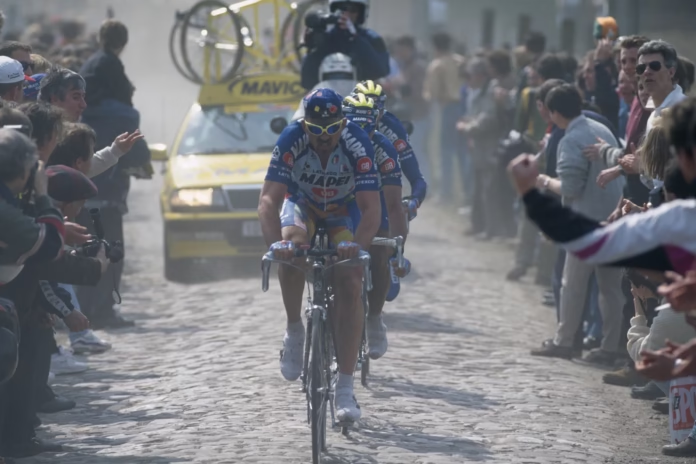
Mapei did not merely win races. It changed the way the biggest one-day races looked, felt and were discussed. In the 1990s and early 2000s, it built such depth, such tactical control and such a relentless presence in the spring Classics that entire races often seemed to bend around its riders. There were strong teams before Mapei and strong teams after it, but very few have made elite one-day racing feel so thoroughly occupied.
That is why the team’s history matters so much. Mapei was not just successful. It represented a particular model of power in cycling, wealthy, organised, internationally ambitious and able to recruit the exact rider profiles needed to dominate the cobbles and hard one-day races. If Boels-Dolmans later came to symbolise the rise of the women’s superteam, Mapei did something similar on the men’s side much earlier, turning the spring into a sequence of races where survival was not enough. Rivals had to survive Mapei too.
For readers placing this within the wider spring picture, this sits naturally alongside A brief history of Paris-Roubaix, A brief history of the Men’s Tour of Flanders and the broader men’s cycling history, races, riders and teams hub. Mapei’s story is woven through all of them.
How Mapei began
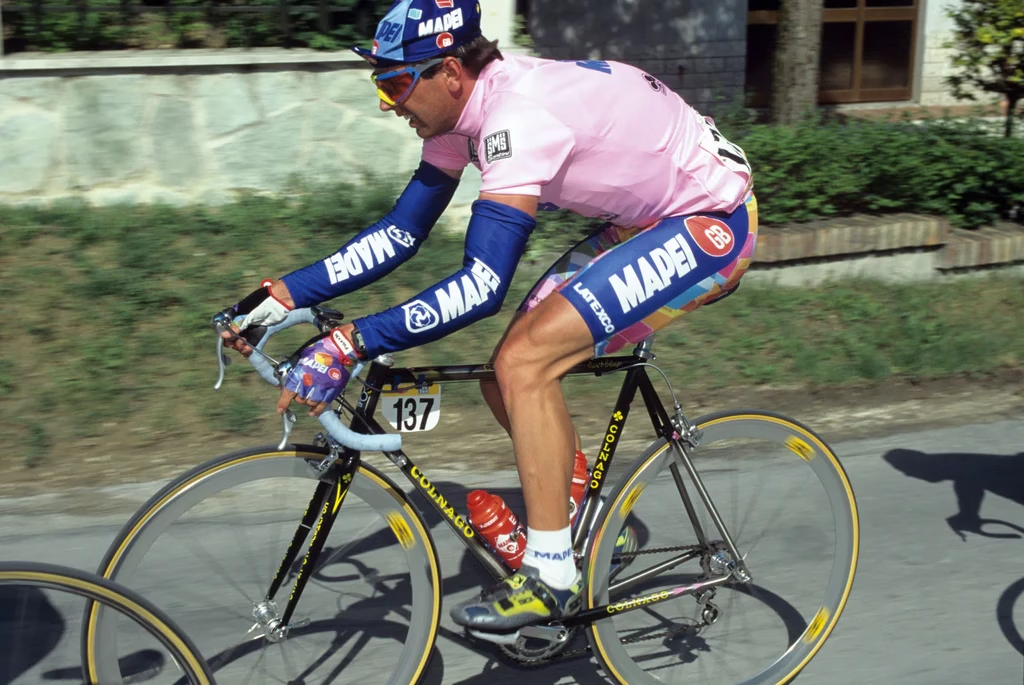
The team’s roots sit in the early 1990s, when the Italian construction chemicals company Mapei became increasingly serious about professional cycling sponsorship. The team emerged into full prominence in 1993, initially through the Mapei-CLAS structure, before later evolving through name changes including Mapei-GB and Mapei-Quick-Step.
The sponsor mattered because Mapei did not approach cycling like a short-term branding exercise. It funded the team at a level that allowed it to think bigger than most rivals. That meant stronger recruitment, deeper support structures and the ability to build a roster not simply around one leader, but around a whole race philosophy.
That philosophy was clearest in the Classics. Mapei understood that the spring one-day races reward not only the best rider, but the strongest collection of riders. The cobbles are too unpredictable, the weather too important and the tactical demands too changeable for one card alone to guarantee control. Mapei built itself to solve that problem.
Why the Classics became Mapei territory
The easiest way to describe Mapei’s approach is that it treated the cobbled Classics like a campaign rather than a set of isolated events. Other teams came with one leader and a few helpers. Mapei often arrived with multiple riders who could plausibly win.
That changes everything in races like Paris-Roubaix and the Tour of Flanders. It means one rider can attack while another waits. It means a dangerous move can be allowed to go because a team-mate is in it. It means rivals are constantly forced to chase the wrong rider, close the wrong gap or commit too early.
That is why Mapei became so oppressive in the spring. The team did not only win because it had strong individuals. It won because it repeatedly created races where its numbers mattered late, after everyone else had already started losing team-mates to crashes, splits and fatigue.
This is the key to understanding the team’s legacy. Mapei turned the decisive phase of the biggest one-day races into its preferred terrain. It made the final selection feel like an arena it had already arranged.
The 1996 and 1998 Paris-Roubaix podium sweeps
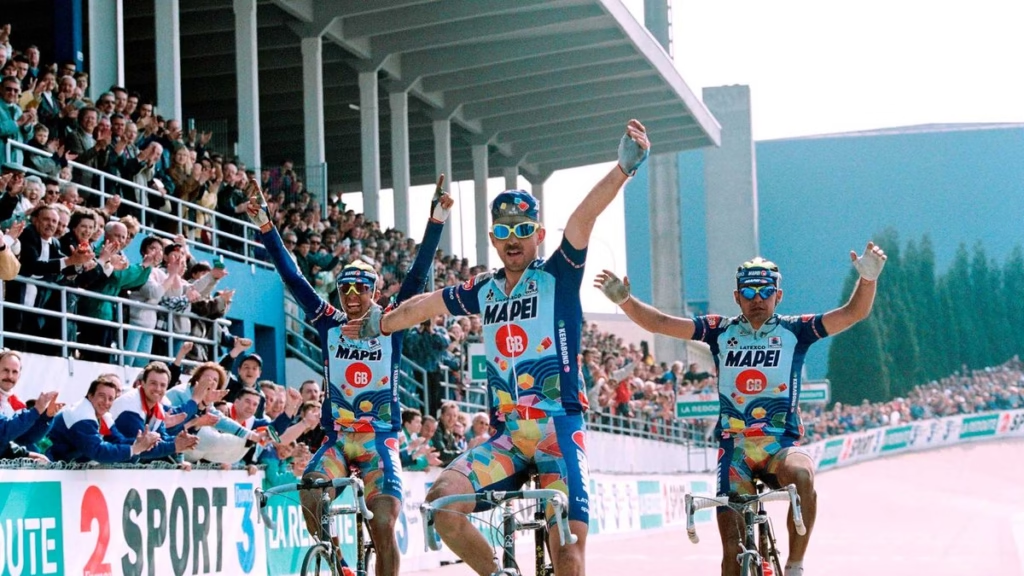
If one image defines Mapei, it is Paris-Roubaix 1996. That was the day the team turned its strength into something close to mythology. Johan Museeuw, Gianluca Bortolami and Andrea Tafi rode clear together and approached the Roubaix velodrome alone, creating one of the most famous finishes of the era. Museeuw took the win, with Bortolami second and Tafi third, completing an all-Mapei podium.
That finish became infamous because it was so overtly symbolic. Mapei had not merely won Paris-Roubaix. It had turned one of the hardest races in the world into a team presentation. The three riders arriving together in the velodrome gave the team an image of total control that has followed it ever since. Some saw it as brilliance. Others saw it as arrogance. Either way, nobody forgot it.
A full podium lockout in Roubaix is the kind of result that shifts a team from strong to era-defining. It told the peloton that Mapei were not just participants in the cobbled spring. They were its organising force. More importantly, it showed how hard the team was to race against once numbers still mattered deep into the finale.
It also established the rider types that would define the team’s best years. Museeuw, Bortolami and Tafi were not identical riders, but they all fitted the broader Mapei mould – powerful, tactically intelligent, resilient on cobbles and dangerous after long, hard races. That range mattered. Mapei were not dependent on one template. They could win through control, late attacks or smaller-group strength. That made them even harder to race against.
The importance of 1996 becomes even clearer when set beside 1998. Two years later, Mapei repeated the feat with another full Paris-Roubaix podium, this time through Franco Ballerini, Andrea Tafi and Wilfried Peeters. That sweep is often remembered a little less vividly because it did not produce the same theatrical image of three riders rolling into the velodrome together. Ballerini won solo, with Tafi and Peeters following behind, so the symbolism was less dramatic even if the dominance was just as real.
That distinction matters. The 1996 sweep became iconic because of how it looked. The 1998 sweep mattered because it proved the first one was not a one-off. Taken together, the two results showed that Mapei’s control of the cobbled Classics was not just memorable, but repeatable. That is what turned a great team into the defining Classics superteam of its era.
Johan Museeuw as the team’s defining champion
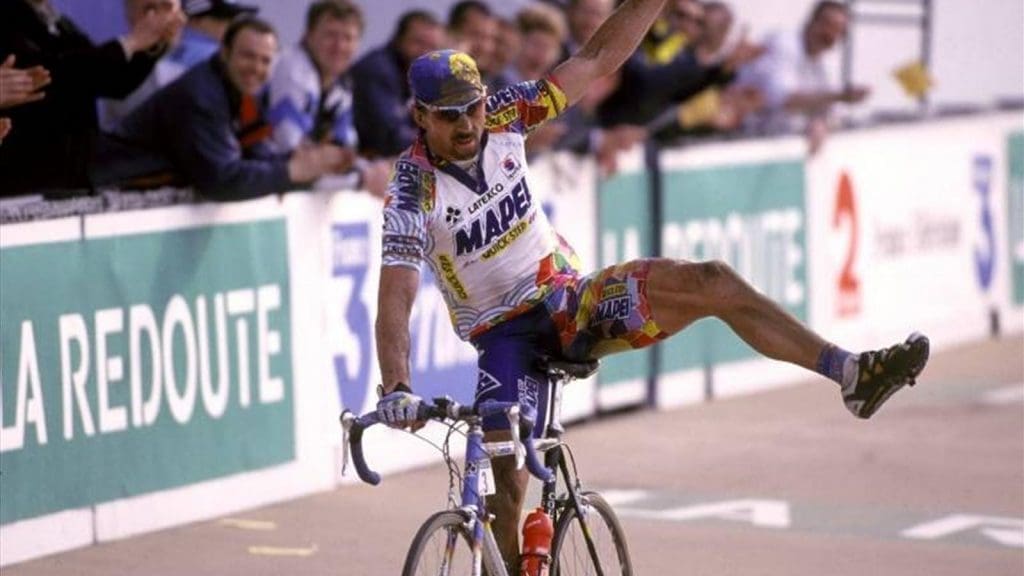
No rider is more central to Mapei’s identity than Johan Museeuw. He had already been an elite Classics rider before the team reached full power, but Mapei gave him the platform to become something larger, the symbolic king of the cobbles in an era when those races were becoming increasingly strategic and team-driven.
Museeuw won the Tour of Flanders three times across his career and Paris-Roubaix three times as well, with several of those greatest performances coming in Mapei colours. He was the rider who best embodied the team’s strengths, patient but aggressive, tactically sharp, physically imposing and utterly suited to the rough logic of northern one-day racing.
That matters because great teams still need one rider who seems to carry their identity. For Mapei, that was Museeuw. Others won major races too, but Museeuw gave the project its emotional centre. He also sits naturally within the wider ProCyclingUK spring archive alongside Eddy Merckx as one of the men who helped define how the biggest Classics are remembered.
Andrea Tafi, Franco Ballerini and a team of specialists
One reason Mapei’s story still feels so rich is that it was never just about one rider. Andrea Tafi was a defining figure in his own right, one of the hardest and most reliable cobbled specialists of the era. Franco Ballerini, though his biggest wins came slightly earlier in the team’s cycle, also mattered hugely to the identity of the squad, particularly in Paris-Roubaix, where his smoothness and resilience became almost a template for the race.
Then there were riders like Gianluca Bortolami, Wilfried Peeters, Michele Bartoli and later Paolo Bettini, each of whom added a slightly different angle to the team’s dominance. Some broadened it beyond the cobbles and into the Ardennes. Some reinforced the team’s grip on the northern races. All helped make Mapei deeper than any rival wanted to face.
That depth is what made the team feel like a private battlefield operator. Mapei did not enter the Classics hoping for one good card. It entered expecting to own the terrain.
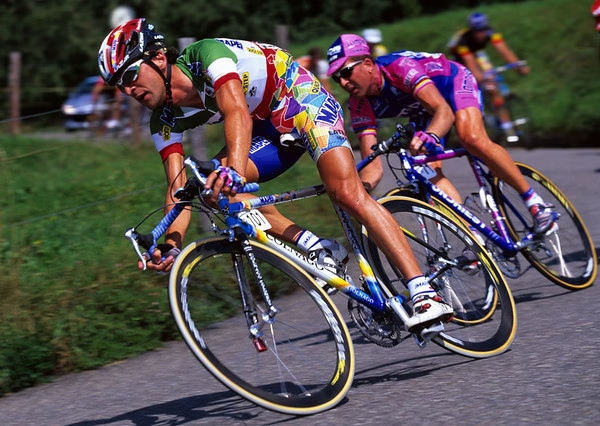
Michele Bartoli and the wider one-day reach
Although Mapei is most strongly remembered for the cobbles, it was not confined to them. Michele Bartoli brought a different type of authority, especially in the Ardennes and hilly one-day races. His victories in Liège-Bastogne-Liège and other major one-day events showed that Mapei could extend beyond flat power and cobbled technique into more varied terrain.
That widened the team’s influence. It meant Mapei were not simply the best cobbled team. They were one of the defining one-day teams full stop.
This broader reach matters because it stops the team history becoming too narrow. Yes, the image of Mapei is built in Roubaix and Flanders mud and dust. But its power stretched across the one-day calendar, and that made the whole team feel bigger than one seasonal niche.
The tactical lesson every rival had to learn
The real impact of Mapei was tactical. It changed what rivals thought a winning team should look like in one-day racing.
Before Mapei, a team could still hope to centre everything around one leader and a more traditional support structure. Mapei made that look inadequate. It showed that in the hardest Classics, the best route to sustained dominance was not just having the best rider, but having the best three or four riders in the final hour.
That has become such a familiar principle now that it is easy to miss how starkly Mapei demonstrated it. The team made numerical superiority in elite one-day racing feel both normal and devastating.
It also changed how viewers watched the sport. Fans started looking not only for who was strongest, but for who still had teammates. In that sense, Mapei helped modernise the tactical language of the Classics.
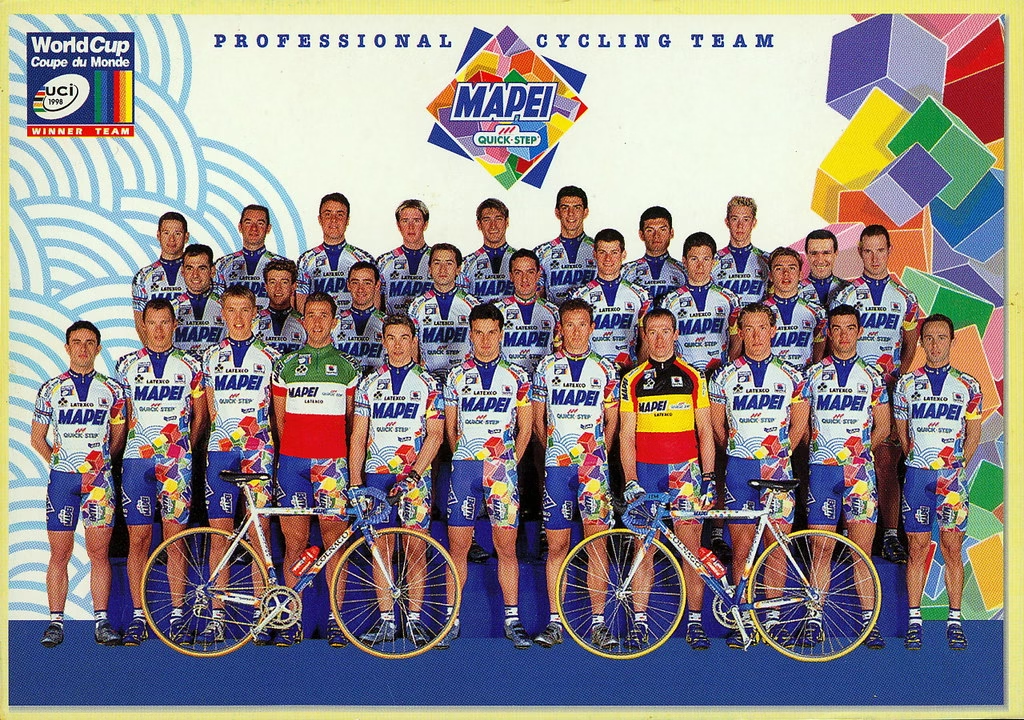
The team was powerful, but not universally loved
A team as dominant as Mapei was never going to be universally admired. For some, it represented excellence and professionalism at the highest level. For others, it represented excess, control and the flattening of spontaneity in races that had once felt wilder.
That tension is part of the history too. Mapei were not sentimental underdogs. They were a machine, and they rode like one. When they won, especially in the most visible and collective way, they could leave behind admiration, resentment or both at once.
That is often what the great superteams do. They force the sport to react to them emotionally as well as competitively.
Why the team mattered beyond results
Mapei also matters because it arrived at a moment when cycling was becoming more international, more commercial and more structured. The team reflected that shift. It used money intelligently, recruited across borders and built a roster that looked more like a multinational sporting project than a purely national squad.
That model feels familiar now. In the 1990s, it still carried some novelty and force. Mapei helped show what cycling teams could become when they were built with long-term strategy rather than short-term instinct.
That does not erase the sport’s wider complications in that era, nor does it place Mapei outside them. But in terms of racing structure, professionalism and one-day tactical depth, the team pushed the sport forward.
-
 Photo Credit: Canyon SRAM (supplied media release)
 -
 Photo Credit: Park Tool

Why Mapei still stands apart
The simplest way to describe Mapei is that it made the Classics feel occupied. Many teams have been strong in the spring. Few have made races look so consistently like their own territory.
That is why the team still carries such historical weight. It did not just produce winners. It created an atmosphere. When Mapei lined up for Paris-Roubaix or the Tour of Flanders, the race felt as though it would have to pass through them before it could belong to anyone else.
That is a rare kind of power in cycling. It is even rarer to sustain it across multiple seasons and multiple riders. Mapei did both.
The legacy of a private battlefield
Mapei’s legacy is not only in victories, although there were plenty of those. It is in the feeling the team created around the biggest one-day races, that the decisive phase was no longer merely a contest between individuals, but a battleground already populated by one team’s riders.
It turned Paris-Roubaix and the Tour of Flanders into races where rivals were not just attacking for victory. They were trying to break occupation.
That is why Mapei remains one of the defining teams in men’s cycling history. Not because it won more stylishly than everyone else, and not because it was more loved than everyone else, but because it understood before most how to make the Classics feel like territory.
And for a while, they were.

