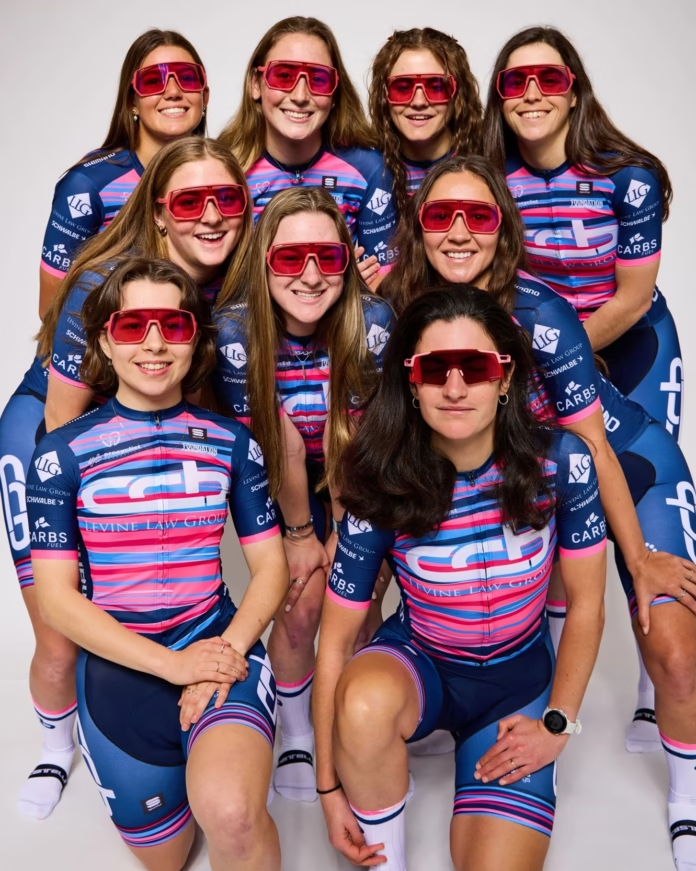
The clearest signal of CCB’s intent for 2026 is not a single race target, but the combination of new funding, new leadership, and a calendar built around international development. The Boston-based outfit has confirmed its 2026 roster under a new name, CCB Kenetik p/b Levine Law Group, with Kenetik joining as a co-title sponsor on a three-year term and Megan Guarnier returning to the sport as a mentor and race director.
For a team that positions itself as a U23 development pathway, Guarnier’s arrival is designed to turn ambition into structure. It is a move aimed less at short-term results and more at giving riders a clearer route from the domestic scene to European racing, and ultimately to professional contracts.
A leadership appointment built around lived experience
CCB has been explicit about why it wanted a third director. Co-director Lauren LeClaire, who continues for a fifth season alongside Tim Mitchell, has framed Guarnier’s addition as a mentorship appointment as much as a sporting one.
“We really wanted to add a third director and somebody who had that top-level experience from a mentorship standpoint,” LeClaire said. “The addition of Megan is exciting. She can talk with the under-23 athletes about finding their way on a pathway to Europe. She’s done it.”
In the context of women’s development racing, that pathway is often the hardest part to build. Talent is common, opportunity is not. Teams can create race days, but bridging the gap between promising riders and professional readiness requires knowledge of Europe’s demands, and the ability to translate those demands into repeatable habits.
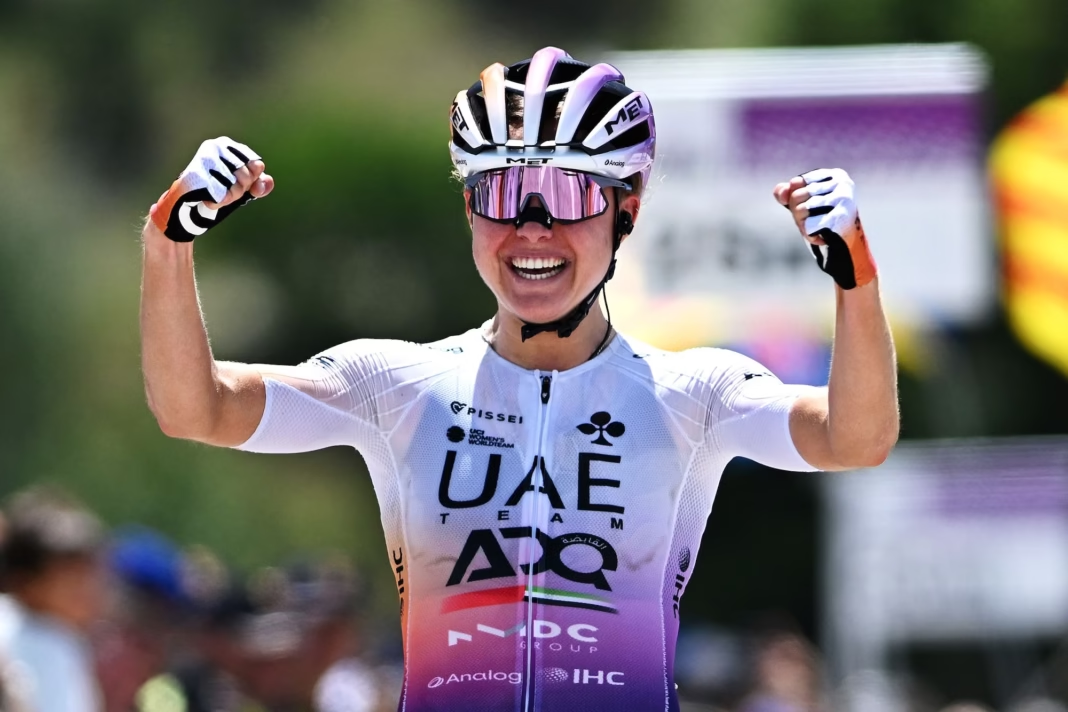
CCB has described Megan Guarnier as one of the most impactful additions in team history, leaning on her background as the winner of the inaugural UCI Women’s WorldTour overall title, a three-time US national champion, and a rider with a Grand Tour palmarès that still carries weight. LeClaire called her “a transformational leader in American cycling”, adding: “It’s impossible to overstate the value of what she brings to our program.”
Kenetik’s three-year deal adds stability, and a clearer identity
The other pillar of the announcement is sponsorship. Kenetik comes in as a co-title partner alongside Levine Law Group, with a three-year term beginning in 2026. The team’s name changes accordingly, and the message from both sides is about stability and shared priorities rather than a transactional branding exercise.
“Each season, our mission remains the same: prepare our athletes for the next level – professionally, academically, and personally,” LeClaire said. “For 2026, the addition of a partner like Kenetik and the leadership of Megan Guarnier elevates every aspect of our program. We are committed to helping our athletes grow through opportunity, challenge, and meaningful mentorship.”
Kenetik, which positions itself in sports performance nutrition, framed the partnership in similar terms. Brandon Dyksterhouse, its Vice President of Performance Nutrition & Sports Market Development, described the attraction as CCB’s “blend of performance, education, and long-term athlete development”, and emphasised alignment around “opportunity, grit, and purpose-driven performance”.
That matters because development programmes live and die on continuity. A three-year commitment does not guarantee success, but it does make it easier to plan a European block properly, invest in staff, and build the kind of season shape that makes a World Championships selection run realistic rather than hopeful.
An expanded calendar, and Montreal as the season’s long horizon
Both the team’s official release and LeClaire’s comments point to 2026 being one of CCB’s most internationally ambitious seasons. The race plan described has two distinct anchors:
- A heavier European summer block, centred on development tours, stage racing, Belgian kermesses and targeted UCI one-day races
- A major US block in early autumn, designed to prepare riders for World Championships selection and performance, ahead of the 2026 Road World Championships in Montreal
LeClaire has also outlined how the US programme begins, with the team set to start racing domestically at the Redlands Bicycle Classic in April before expanding into Europe in summer, then targeting a North American UCI run in the fall.
“We’re excited there’s so many North American UCI events to focus on this year,” she said. “Having Tour de Bloom separate from Collegiate Road Nationals allows us to bring a full team to nationals. In the fall, with Philly, Maryland and Gatineau, it is an amazing build for our riders who are hopefully making a run for U23 Worlds.”
The team also noted that its gravel programme will be limited in 2026, allowing a tighter focus on road development and international competition. That is a strategic choice. Gravel has offered opportunity and visibility, but it can also dilute a development pathway if the core mission is to prepare riders for road contracts and U23 championship selection.
A roster anchored by Gunsalus and shaped around under-23 progression
The 2026 squad blends returning names with targeted additions, and it continues to centre around riders who can carry performance while still serving the programme’s development aims.
Lizzy Gunsalus returns as the headline competitive reference point after winning the US elite women’s cyclo-cross national title and holding the Pan-American title. She gives the roster an immediate level marker: a rider who can win at the top domestic level, but who is still part of the CCB pathway rather than moving straight out of it.
The team also retains Katherine Sarkisov, whose recent trajectory fits the programme’s European intent. After spending 2023 and 2024 with Cynisca Cycling, she delivered some of her strongest results in 2025, including 14th in the U23 road race at the World Championships in Kigali. It is the kind of performance that makes Montreal a tangible target rather than an abstract goal.
2026 roster
Returning riders
- Lizzy Gunsalus
- Katherine Rusch
- Ella Grier
- Ella Brenneman
- Sabrina Hayes
- Jorja Bond
- Katherine Sarkisov
New for 2026
- Bridget Ciambotti
- Lyllie Sonnemann
- Alyssa Sarkisov
- Lily Edwards
A long history, and a modern purpose
CCB’s announcement also leans into the programme’s history, describing itself as the longest continually running elite/pro cycling team in the United States, with roots tracing back to a cycling club founded in Basingstoke, England in 1960, and a USA-based racing programme established in 1976. The team’s pink and blue colours have become part of its identity, tied to a stated mission that blends performance with education.
That education piece remains non-negotiable in CCB’s own framing. The programme describes its women’s U23 development team as a group of riders who are enrolled in, or have completed, post-secondary education, with racing positioned as part of a wider pathway rather than the endpoint.
What Guarnier’s return is really about
Guarnier’s move into team leadership reads as an attempt to turn CCB’s promise into a clearer mechanism. Development teams often talk about “pathways”, but few can offer the combination of European experience, staff continuity, and calendar ambition required to make that pathway repeatable.
With a new co-title sponsor providing stability and an expanded international plan aimed towards Montreal, CCB is trying to do something specific in 2026: build riders who can handle Europe, earn selection, and step into the professional peloton with fewer unknowns.
Guarnier’s presence will not guarantee that. But it should make the conversations inside the team sharper, the preparation more realistic, and the standards harder to ignore.
-
 Photo Credit: quentinphotographiebe
 -
 Photo Credit: Getty