
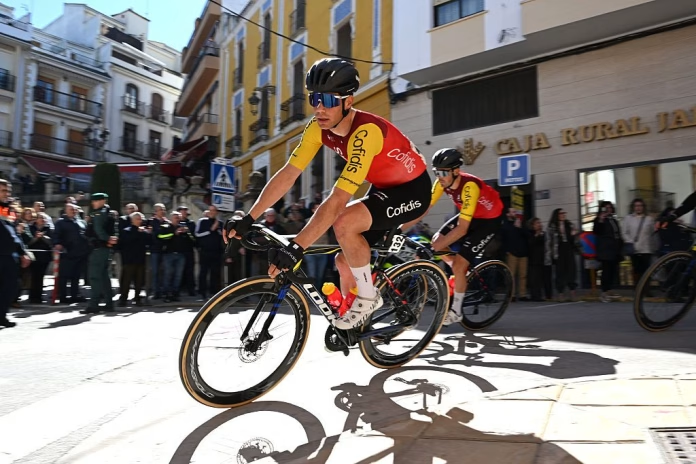
Milan Fretin won stage five of the 2026 Tour of Guangxi for Cofidis, with Matteo Moschetti and Erlend Jordbrekk Blikra completing a same-time podium. The official result placed the first ten riders on 3:44:18, making the outcome a tightly compressed finish after a stage shaped by repeated breakaway moves and a late change in the chase.
The race was not defined by one early attack holding a clear advantage from start to finish. Florian Vermeersch’s move helped trigger the opening break, but the composition changed several times before a four-rider counterattack became the main escape. The peloton then accelerated with 96 kilometres remaining, reducing the gap while also dropping riders at the rear.
By the final 30 kilometres, however, the chase had not completed the job. UAE Team Emirates-XRG had been pulling through the peloton, but with 26 kilometres left the gap to the break was increasing rather than falling. Other teams took over the pursuit late, and Fretin eventually emerged as the winner from a finish in which Moschetti, Blikra and the rest of the leading group were all given the same time.
How it unfolded
The opening phase was unsettled almost immediately. Vermeersch attacked with 167 kilometres remaining, and a small gap formed behind the move. Four riders were briefly reported clear before that reduced to two, showing that the first escape had not yet settled into a stable breakaway.
The early sequence ended with Brady Gilmore, Artem Shmidt and Niklas Behrens caught by the peloton at 153 kilometres to go. A three-rider move then formed, but the race continued to change at the front. Jasha Sütterlin attacked at 136 kilometres, and Patrick Gamper followed with a counterattack involving Baptiste Veistroffer, Davide Formolo and Brandon Smith Rivera.
That counterattack gave the breakaway its clearest structure of the first half of the stage. Gamper, Veistroffer, Formolo and Rivera were named in the four-rider move, while Sütterlin’s earlier attack formed part of the same broader attempt to escape the peloton. The race had moved from isolated probing to a defined group trying to build a lasting advantage.
The break establishes its phase
The escape reached the KOM sprint with 124 kilometres remaining, on a 6.6-kilometre climb averaging 4.9 per cent. Veistroffer was later recorded as the winner of the KOM sprint with 114 kilometres to go, and again at the next listed KOM sprint with 93 kilometres remaining.
Those intermediate contests gave the breakaway a continuing presence in the race, but they did not settle the final result. The group was still clear at 96 kilometres to go, when the gap began to decrease. The shift mattered because the peloton was no longer simply allowing the break to continue at its established pace.
At the same point, the peloton accelerated and riders began to drop from the rear. The evidence points to a change in the race’s shape rather than a single named selection: the breakaway was losing some of its advantage, while the main field was becoming more selective under the increased pace.
Acceleration changes the chase
The acceleration produced further attacking activity. An EF Education-EasyPost rider moved clear at 95 kilometres to go, followed almost immediately by a named attack from Max Walker. The chase was therefore not a straightforward mass pursuit, with the peloton simultaneously trying to reduce the gap to the break and accommodate fresh moves from within the group.
Veistroffer was again listed as the winner of the KOM sprint at 93 kilometres, but six kilometres later the gap between the breakaway and its chasers was decreasing. That progression suggests that the main escape was under pressure, although the move was not yet caught.
The breakaway remained in front through the next major phase of the stage. At 45 kilometres remaining, Veistroffer was again recorded at a KOM sprint, while the decisive question had shifted from whether the break could establish itself to whether the peloton could bring it back before the intermediate sprint.
That question was still open with 30 kilometres left. Julius Johansen was pulling in the peloton for UAE Team Emirates-XRG, providing a named reference for the organised pursuit. The effort did not immediately produce a catch, and the race reached its most uncertain point as the intermediate sprint approached.
The chase loses its certainty
With 28 kilometres remaining, the intermediate sprint was four kilometres away. Two kilometres later, the situation changed sharply: UAE had given up on bringing the break back before the sprint, and the gap was increasing. The move therefore survived a point at which the peloton had been expected to make its strongest attempt to close it.
That did not mean the peloton stopped racing. Soudal Quick-Step was reported pulling with 13 kilometres left, followed by Su Haoyu of XDS Astana Team at 10 kilometres. The pursuit had passed between several teams, but the timing of the renewed work showed that the break had not been neutralised by the earlier UAE effort.
The late chase was also spread across several teams rather than controlled by one named rider. Cofidis was pulling with 3.2 kilometres remaining, while Tijmen Graat and Louis Barré were both listed at the front for Team Visma-Lease a Bike inside the final three kilometres.
Those pulls kept the peloton moving towards the finish, but the packet does not record a catch. Instead, the official result places Fretin first and gives the first ten riders the same finishing time. The safest reading is that the stage finished with a tightly grouped outcome after the breakaway and the peloton had remained closely connected in the closing phase.
The final kilometres become crowded
The final sequence involved a succession of teams at the front. Arthur Kluckers of Tudor Pro Cycling Team was pulling with 1.5 kilometres left, and Daan Hoole of Decathlon CMA CGM Team was doing the same at 700 metres. The leading organisation changed repeatedly, leaving the approach to the finish as a collective effort rather than one continuous lead-out described around a single rider.
There was a crash with 500 metres remaining involving Paul Magnier and Frits Biesterbos. A second event also named Magnier, but the packet does not establish that the incident altered the result or caused any rider’s final position. It occurred in the closing stretch, but the official classification remains the authority for the finishing order.
Fretin was then recorded as the winner at 100 metres to go. Moschetti finished second and Blikra third, with all three awarded the same time. Joshua Giddings, Jordi Meeus, Max Kanter, Sam Welsford, Arvid De Kleijn, Cees Bol and Oded Kogut also occupied the same-time group through tenth place.
Fretin’s victory came from a finish where the official gaps did not separate the leading riders. The decisive difference was therefore position rather than elapsed time: Fretin was ranked first in 3:44:18, while Moschetti and Blikra were assigned the same time in second and third.
The race’s earlier development explains why the winning margin never became a time gap. The breakaway repeatedly formed, changed and came under pressure, but remained part of the race deep into the route. The peloton accelerated at 96 kilometres and reduced the gap, yet the chase later lost ground before recovering through work from several teams.
That sequence left the finale open to a broad group. UAE’s attempt to close the break before the intermediate sprint did not succeed, while Soudal Quick-Step, XDS Astana, Cofidis, Visma-Lease a Bike, Tudor and Decathlon CMA CGM all appeared in the late pursuit. No single late move is recorded as creating separation between the eventual top ten.
Fretin consequently converted a complex stage into the result that mattered most, taking the win ahead of Moschetti and Blikra on the same official time. The closeness continued through the remainder of the top ten, with Giddings fourth and Meeus fifth before Kanter, Welsford, De Kleijn, Bol and Kogut completed the listed leading group.
Tour of Guangxi Stage 5 2026 Result
| Pos. | Rider | Team / nation | Time / gap |
|---|---|---|---|
| 1 | Milan Fretin | Cofidis (PRT) | 3:44:18 |
| 2 | Matteo Moschetti | Pinarello Q36.5 Pro Cycling Team (PRT) | Same time |
| 3 | Erlend Jordbrekk Blikra | Uno-X Mobility | Same time |
| 4 | Joshua Giddings | Lotto Intermarché (WT) | Same time |
| 5 | Jordi Meeus | Red Bull – BORA – hansgrohe (WT) | Same time |
| 6 | Max Kanter | XDS Astana Team (WT) | Same time |
| 7 | Sam Welsford | Netcompany INEOS (WT) | Same time |
| 8 | Arvid de Kleijn | Tudor Pro Cycling Team (PRT) | Same time |
| 9 | Cees Bol | Decathlon CMA CGM Team (WT) | Same time |
| 10 | Oded Kogut | NSN Cycling Team (WT) | Same time |

